[Key interpretation] ETH sent out strong earthquake signal, and the number of active addresses soared

Huobi ResearchPublished on 2022-07-27Last updated on 2022-07-28

Abstract

After the ETH callback, the rebound speed was faster, and the data supported the short-term changes in prices.

1. BTC volume stagflation

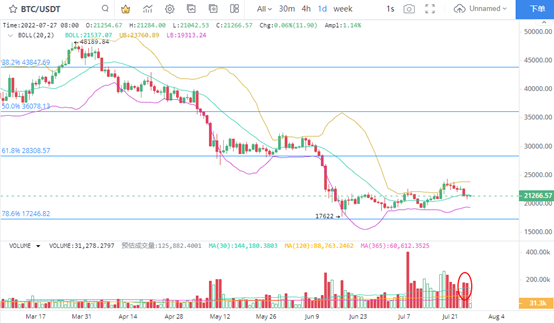
In the daily K-line of BTC, with the continuation of the adjustment, the BTC price operates below the medium rail of brin line, and the trading volume remains stable. This shows that the long and short has not yet reached the showdown stage, and the large-scale operation shows that the trading heat remains at a short-term high.

Judging from the direction of trading, from March to July 2022, when the trading volume rebounded, investors changed hands at a low level relatively fully, which has a lot to do with the decline of BTC price. As the peak value of BTC intra day trading volume is not at a new high, the longer the adjustment time, the greater the possibility of cooling the low trading heat. BTC investors have completed many transactions in more than half a year, and $17600 has become a strong support point for BTC. Low absorption can still refer to US $1.76 to buy BTC.
2. The number of BTC giant whale addresses shows signs of decreasing

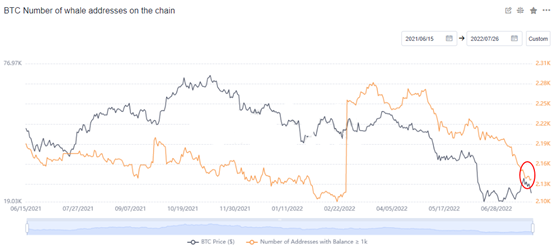
The number of giant whale addresses in BTC has not reached a new low, but the downward trend is very obvious. As of July 26, the number of BTC giant whales was 2138, a decrease of 144 from the peak of 2282 in the year. In terms of quantity, the number of 114 megawhale addresses disappears, and the corresponding number of BTCs is 114000. The number of giant whale addresses not only shows a downward trend, but also in a state of accelerated reduction, indicating that the possibility of capital flight increases. Although the BTC point has not reached a new low since June 18, it does not rule out the possibility of retreating to a short-term low during the period of price shocks.
3. The number of unconfirmed transactions of BTC is low

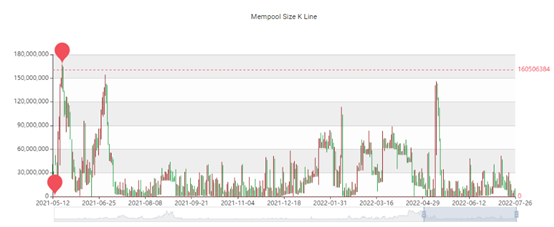
The low number of unconfirmed transactions of BTC indicates that the current trading heat is not high. Most of them are investors with small capital volume who buy and sell BTC, so the transaction speed is relatively fast. Since the number of unconfirmed transactions fell from the peak on May 12, there has never been a significant rebound in the near future. The small number of unconfirmed transactions indicates that investors buy and sell BTC relatively smoothly. The data from the number of active addresses also showed that although BTC remained active in the daily trading volume, the number of active addresses did not continue to increase significantly, indicating that BTC price rebound is not a real price reversal signal.

On the news side, the market generally expects the Federal Reserve to raise interest rates by 75 basis points on July 28, pushing the benchmark interest rate back to 2.5%. Therefore, in judging the direction of BTC change, the possibility of price signs callback is greater.
4. Eth continued technical rebound

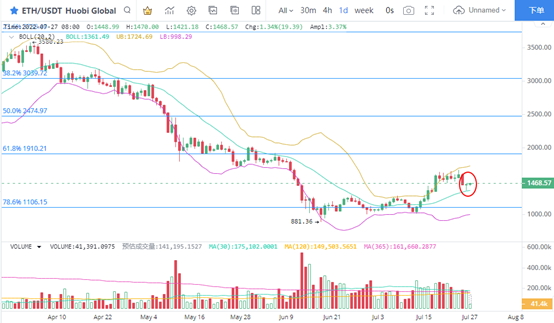
In the daily K line of eth, the price continued the performance of technical rebound, and the starting point of the rebound began from the $1349 corresponding to the brin line. In terms of trading volume, the intraday trading volume of eth has shrunk to the vicinity of the equivalent line, and there is no chance of further contraction in the short term. Therefore, the rebound trend continued, raising the price strength. The abnormal data on the chain also indicates the possible change expectation of eth.
5. The number of eth daily active addresses soared

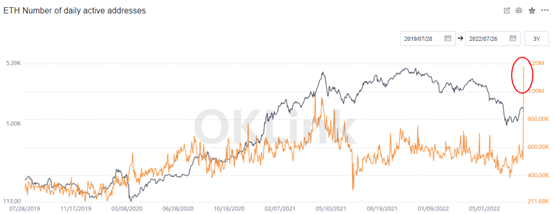
The number of daily active addresses of eth soared significantly, reaching a peak of 1.178 million on July 26, which means that the trading heat shows signs of rapid warming. The soaring number of active addresses may be an important signal of disk change. At least from the middle of 2021, the number of eth daily active addresses has not exceeded the maximum 979000. At present, the number of active addresses has rebounded. If the data is accurate, ETH will have more opportunities to rise in this price change.

Related Reads

Ethereum 2026 Q1 Review: On-Chain Activity Hits Record Highs, Tokenized Assets Lead the Industry

Ethereum Q1 2026 Review: Record On-Chain Activity, Tokenized Assets Lead the Industry. Despite a price correction impacting USD-denominated metrics, Ethereum's on-chain usage hit all-time highs in Q1 2026. Monthly active addresses surged 85.9% year-over-year to 13.2 million, while L1 transactions and throughput also set new records. This growth occurred alongside a significant 47.9% quarterly drop in L1 transaction fees, demonstrating the impact of network scaling via upgrades like the Blob Parameter Fork. The ecosystem maintained its dominance in decentralized finance (DeFi), holding 71% of the total value locked among top chains and 79.2% of active borrowing. Ethereum solidified its position as the primary platform for tokenized real-world assets (RWAs), with a total market cap of $203.4B. It holds leading shares in stablecoins (61.8%), tokenized funds (73%), and tokenized commodities (84%) across major chains. Key developments included the ERC-8004 standard for AI agents and heightened institutional engagement at forums. Major financial institutions like BlackRock, JPMorgan, and a European banking consortium announced new tokenized products on Ethereum throughout the period. The report draws parallels to the early internet, suggesting Ethereum is sacrificing short-term fee revenue for long-term network expansion and adoption. Its strategy focuses on becoming a neutral, open settlement layer for global finance, with scaling roadmaps aiming for tens of thousands of TPS by 2029.

marsbit35m ago

Ethereum 2026 Q1 Review: On-Chain Activity Hits Record Highs, Tokenized Assets Lead the Industry

marsbit35m ago

Matrixdock Featured Again in SBMA’s 《Crucible》: Discussing How Tokenisation Enhances Efficiency in the Precious Metals Market

Matrixdock's research article, titled "Why Tokenisation Matters for the Bullion Industry and How Carrying Costs Fit In," has been featured again in the SBMA's industry publication *Crucible*. Authored by Matrixdock lead Eva Meng, the piece examines how tokenisation enhances the efficiency and utility of the precious metals market. The article argues that tokenisation builds upon the accessibility improvements brought by gold ETFs, not by redefining gold's value but by enabling it to function within digital finance. It extends gold's role beyond a portfolio holding, potentially facilitating instant settlement, digital collateral, and operation in 24/7 markets. A key focus is transparently handling the unavoidable carrying costs (storage, insurance) of physical assets like gold and silver. Matrixdock introduces the Fungible Reserve Standard (FRS) framework, based on an "Economic Purity Principle," which aims to reflect these real-world economic costs clearly within the token mechanism, rather than bundling them opaquely. The platform's practical applications are highlighted, including its gold token XAUm and its silver token XAGm, the first built on the FRS framework. As the tokenised gold market surpassed $6 billion in February 2026, the industry's focus is shifting from initial proofs of reserves to broader concerns of market efficiency and capital utilization. Tokenisation is positioning gold and other precious metals to become active components within the evolving digital financial system.

marsbit1h ago

Matrixdock Featured Again in SBMA’s 《Crucible》: Discussing How Tokenisation Enhances Efficiency in the Precious Metals Market

marsbit1h ago

Trading

Spot
Futures
活动图片