From ETH’s Merge to ‘surge, verge, purge, splurge’- Making sense of it all

AmbcryptoPublished on 2022-07-23Last updated on 2022-07-23

Abstract

The annual Ethereum community Conference (ETHCC) took place on 21 July in Paris. Ethereum [ETH] co-founder Vitalik Buterin addressed the audience at this conference and spoke about the long-term potential of the network.

The annual Ethereum community Conference (ETHCC) took place on 21 July in Paris. Ethereum [ETH] co-founder Vitalik Buterin addressed the audience at this conference and spoke about the long-term potential of the network.

The developer-focused conference saw Buterin speak of the upcoming “Merge,” which will see Ethereum’s transition from proof-of-work (PoW) to proof-of-stake (PoS).

Moreover, while describing the long- and short-term effects of the Merge, Buterin stated: “After the merge, you will be able to design an Ethereum client that does not even know the proof-of-work phase has happened.”

He also went on to state that, “At the end of this road map, Ethereum will be a much more scalable system. By the end, Ethereum will be able to process 100,000 transactions per second.”

According to him, post Merge, the protocol will be “55% complete” in terms of the overall evolution of the Ethereum network. Therefore, developers have a lot of work ahead of them.

Change is the only constant

The intended “deep changes” are being made to make Ethereum a more potent and reliable network, according to Buterin. He informed the audience that following the integration, Ethereum will go through additional upgrades that he refers to as the “surge,” “verge,” “purge,” and “splurge.”

The surge refers to the addition of Ethereum sharding, a scaling solution that, according to the Ethereum Foundation will make layer-2 blockchains even more affordable.

It will also reduce the cost of rollups or bundled transactions, and make it simpler for users to run nodes that protect the Ethereum network. Buterin added that the Ethereum network will handle transactions more quickly after the surge is over.

The Verge will introduce “stateless clients” and “Verkle trees,” a kind of mathematical proof. Users won’t need to keep a lot of data on their computers to function as network validators because of these technological advancements.

Validators in a proof-of-stake network authenticate and verify transactions using locked-up or “staked” ETH.

To streamline storage and lessen network traffic, the Purge will help eliminate old data. Following the previous upgrades, there will be a Splurge that will consist of several smaller upgrades and fine-tuning to ensure seamless network operations.

Vitalik further claimed that accomplishing these decentralized goals is difficult because of the network’s complexity and how quickly it is evolving. But, he asserted, these network upgrades have long been anticipated by all parties.

Notably, the price of ETH increased by about 33% this week. The altcoin also crossed the $1,600 mark to trade at $1,628 at press time.


Related Reads

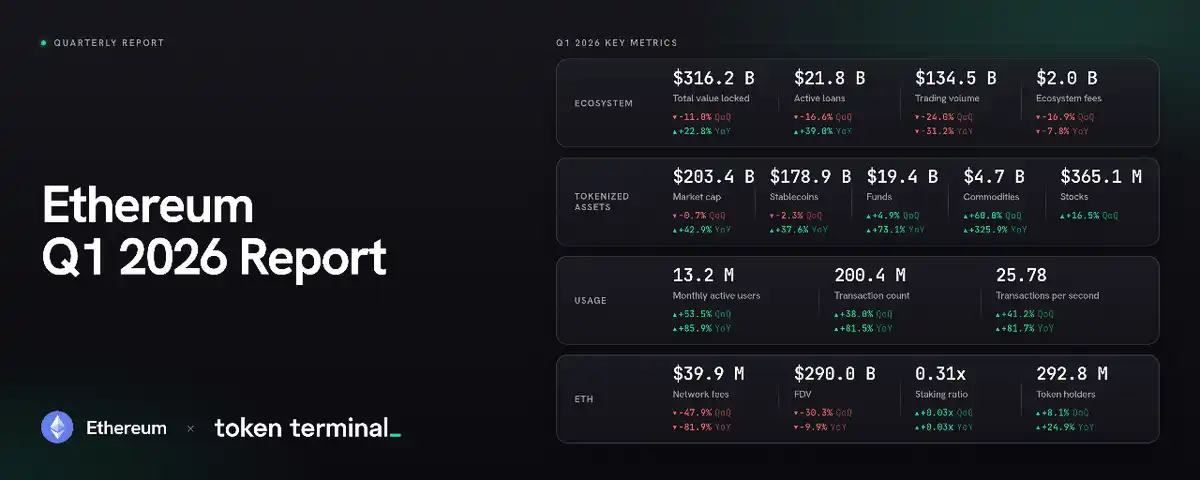
Ethereum Q1 2026 Review: On-chain Activity Hits New Highs, Tokenized Assets Lead the Industry

Ethereum Q1 2026 Review: Chain Activity Hits Record High, Tokenized Assets Lead the Industry In Q1 2026, the Ethereum ecosystem displayed a dual narrative: record-high on-chain activity coincided with declining USD-denominated metrics. User adoption surged, with monthly active addresses reaching 13.2 million (up 53.5% QoQ) and layer-1 transactions hitting 200.4 million (up 38% QoQ). However, the total value locked (TVL) decreased 11% to $316.2B, and protocol revenue fell 16.9% to $2.0B, largely due to a broader crypto market downturn. Tokenized assets emerged as a key strength. Their total market cap reached $203.4B, with significant growth in tokenized funds (+73.1% YoY) and commodities (+325.9% YoY). Ethereum dominated cross-chain comparisons, holding over 61% of stablecoin value and 84% of tokenized commodities value among top chains. A major development was the impact of network scaling. The "Blob" upgrade significantly increased data capacity, causing average transaction fees on layer-1 to plummet 47.9% QoQ despite higher usage. This demonstrates the "Jevons Paradox" in action: cheaper block space stimulates demand. The report highlights Ethereum's established position as the primary settlement layer for institutional tokenization, evidenced by new fund launches from giants like BlackRock and JPMorgan in May. Analysts draw parallels between Ethereum's current stage and the internet in the mid-1990s, suggesting its open, neutral network is poised to become the foundational infrastructure for global finance, outcompeting closed, private alternatives.

Foresight News4m ago

Ethereum Q1 2026 Review: On-chain Activity Hits New Highs, Tokenized Assets Lead the Industry

Foresight News4m ago

Gate Research Institute: ETF Outflows Suppress Risk Appetite, Two-Way System Navigates Weak Market

Gate Institute Research Report: May 2026 Crypto Market Review & Strategy Analysis In May 2026, the crypto market shifted from an early-month rally to a mid-month correction, concluding with low-volatility consolidation. BTC, ETH, and SOL peaked in early May before declining. The primary market dynamic was a divergence between weakening spot ETF inflows and persistently high leverage-driven perpetual trading volume. A dual-direction moving average cluster breakout strategy outperformed, returning +2.11% for an equally-weighted BTC/ETH/SOL portfolio. This contrasted with a -6.09% return for buy-and-hold and -3.65% for a long-only version of the strategy. Profits were primarily generated from short positions on ETH and SOL during the mid-to-late May downtrend, demonstrating the month's suitability for two-way trend trading. Market structure evolved in three phases: an initial surge (May 1-6), a failure and reversal (starting May 7), and low-volatility compression (May 22 onward). While stablecoin supply remained stable, significant outflows from mainstream BTC and ETH ETFs created selling pressure. Concurrently, high correlation with the S&P 500 (~0.6) and stronger performance from AI equities like Nvidia highlighted crypto's position as a high-beta risk asset within a broader risk-budget framework, lacking independent momentum. The successful strategy employed a 4-hour chart system using a cluster of six moving averages (EMA6,12,24 & SMA6,12,24). A breakout signal was triggered after the cluster width compressed below 2.2%. Trades were managed with a 2.5% fixed stop-loss, a 3:1 Risk/Reward (7.5%) take-profit, and an EMA12-based exit rule to control losses from false breakouts. The strategy's low win rate but high payoff from a few large trend moves was effective in May's conditions. The report concludes that for June, a disciplined, bidirectional approach remains superior to subjective directional bets. The framework should adapt signal weighting based on BTC's position relative to key EMAs, ETF flow trends, and the relative strength of the Nasdaq, prioritizing risk management and trend preservation.

marsbit34m ago

Gate Research Institute: ETF Outflows Suppress Risk Appetite, Two-Way System Navigates Weak Market

marsbit34m ago

Anthropic CEO's Latest Interview: On Technological Explosion, Safety Red Lines, and the Civilization Contract

Interview with Anthropic CEO Dario Amodei covers the intense pressures and ethical dilemmas of leading AI development. He describes the experience as "exponential growth," feeling constant acceleration akin to relativistic time dilation. The discussion delves into his departure from OpenAI, rooted in a fundamental loss of trust and divergent values rather than mere technical disagreements. Amodei emphasizes Anthropic's enterprise-focused business model, arguing it aligns better with safety and responsible deployment than consumer-facing, ad-driven models. He addresses critical issues like AI's impact on employment, advocating for proactive macroeconomic policies and a shift towards "doing more with the same resources" to avoid widespread job displacement. On safety and governance, he details Anthropic's cautious approach, including delaying the release of the powerful "Mythos" model due to its advanced cyber capabilities. He stresses the need for "human-in-the-loop" principles in military applications, setting red lines against autonomous weapons and mass surveillance. Amodei calls for industry collaboration among trustworthy actors to establish standards and advocates for a balanced regulatory framework with checks and balances, such as Anthropic's Long-term Benefit Trust, rather than corporate or government monopoly over the technology. He expresses geopolitical concerns, particularly regarding China, and a belief that AI should bolster liberal democracies. While acknowledging a non-zero risk of civilizational catastrophe from advanced AI, he asserts Anthropic's actions are aimed at significantly reducing that probability. The interview concludes with Amodei arguing that trust must be earned through concrete actions, like sacrificing commercial gain for safety, to distinguish Anthropic in a Silicon Valley landscape he criticizes for eroded public trust.

marsbit37m ago

Anthropic CEO's Latest Interview: On Technological Explosion, Safety Red Lines, and the Civilization Contract

marsbit37m ago

Trading

Spot
Futures
活动图片