马斯克称比特币为「基本」且「基于物理学」的货币

深潮Published on 2025-12-01Last updated on 2025-12-02

马斯克称比特币是一种与能源挂钩的“基于物理的货币”,并暗示人工智能和机器人技术的进步最终可能会使货币过时。

撰文:Micah Zimmerman

编译:AididiaoJP,Foresight News

特斯拉和 SpaceX 的首席执行官埃隆·马斯克再次引发了关于比特币的讨论,将其描述为一种基于能源的、「基于物理学的基本货币」。

在与尼基尔·卡马斯最近的一次播客对话中,马斯克强调,比特币的价值与现实世界的能源消耗紧密相连,这凸显了数字资产与传统法定货币之间的不同。

「能源才是真正的货币,」马斯克说。「这就是为什么我说比特币是基于能源的。能源无法通过立法获得。你不能仅仅通过一项法律,就突然拥有大量能源。」

这位特斯拉创始人提请人们注意生产和利用能源的难度,并将其与比特币的「工作量证明」系统联系起来,该系统需要消耗大量的计算能力和电力来维护网络安全。

他还提到了卡尔达肖夫指数,即一种衡量文明能源消耗水平的方法,将其作为理解社会进步的一个视角。他认为,通过一个文明产生和管理能源的能力来评估其发展水平,这与比特币的设计原则不谋而合,即价值是由稀缺性和计算投入所支撑的。

展望更远的未来,马斯克提出,人工智能和机器人技术的进步可能会让货币变得不再必要。

「在一个任何人都能拥有任何东西的未来,我认为你就不再需要货币来作为劳动力分配的数据库了,」他说道,并引用了伊恩·M·班克斯笔下描绘后稀缺时代的《文明》系列小说,将其视为一种蓝图:在那个社会中,超级智能机器可以在没有货币体系的情况下管理资源。
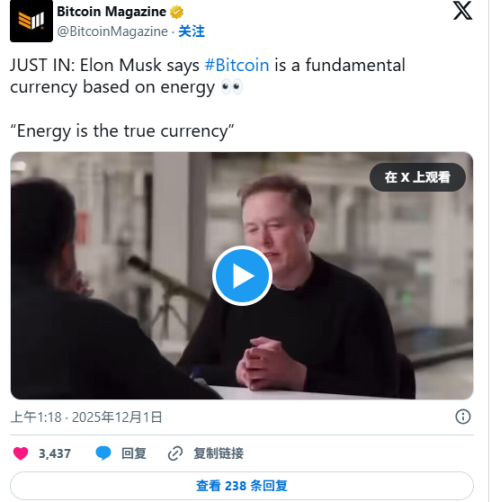
马斯克:你无法「印刷」能源

马斯克还强调了比特币的独特属性。与政府可以随意印制的法定货币不同,比特币的「工作量证明」系统将其创造过程与能源和计算能力绑定,这赋予了其内在的稀缺性,并使其相对独立于政治影响。

「政府可以印钱,但他们无法印刷能源,」马斯克说。

尽管马斯克设想了一个能源可能成为更根本价值尺度的未来,但他承认,传统货币在当今世界仍占据主导地位。

国家货币依然主导着商业、工资和储蓄,而像比特币这样的加密货币,目前主要作为替代性资产存在,而非日常交易的替代品。

马斯克的这番言论,再次提醒人们比特币背后的哲学基础,它与物理学和能源息息相关,而非依赖于政策和政府控制。

今日早些时候,比特币价格在周一早盘大跌 8%,至 84,000 美元中段水平,延续了持续两个月的跌势,自 10 月创下历史高点以来,其价值已缩水超过 30%。

此次下跌发生在上周比特币价格短暂回升至 92,500 美元上方之后,此前在 11 月,其价格曾跌至 81,000 美元附近的低点。

Related Reads

From Theft to Re-entry: How Was $292 Million "Laundered"?

A sophisticated crypto laundering operation was executed following the $292 million hack of Kelp DAO on April 18. The attack, attributed to the North Korean Lazarus group, began with anonymous infrastructure preparation using Tornado Cash to fund wallets untraceably. The hacker exploited a vulnerability in Kelp’s cross-chain bridge, stealing 116,500 rsETH. To avoid crashing the market, the attacker used Aave and Compound as laundering tools—depositing the stolen rsETH as collateral to borrow $190 million in clean, liquid ETH. This move triggered a bank run on Aave, causing an $8 billion drop in TVL. After consolidating funds, the attacker fragmented them across hundreds of wallets to evade detection. A major breakpoint was THORChain, where over $460 million in volume—30 times its usual activity—was processed in 24 hours, converting ETH into Bitcoin. This shift to Bitcoin’s UTXO model exponentially increased tracing complexity by shattering funds into countless untraceable fragments. The final destination was Tron-based USDT, the primary channel for illicit crypto flows. From there, funds were cashed out via OTC brokers in China and Southeast Asia, using unlicensed underground banks and UnionPay networks outside Western sanctions scope. Ultimately, the laundered money supports North Korea’s weapons programs, which rely heavily on crypto hacking for foreign currency. The incident underscores structural challenges in DeFi: its openness, composability, and lack of central control make such laundering not just possible, but inherently difficult to prevent.

marsbit2h ago

From Theft to Re-entry: How Was $292 Million "Laundered"?

marsbit2h ago

Google and Amazon Simultaneously Invest Heavily in a Competitor: The Most Absurd Business Logic of the AI Era Is Becoming Reality

In a span of four days, Amazon announced an additional $25 billion investment, and Google pledged up to $40 billion—both direct competitors pouring over $65 billion into the same AI startup, Anthropic. Rather than a typical venture capital move, this signals the latest escalation in the cloud wars. The core of the deal is not equity but compute pre-orders: Anthropic must spend the majority of these funds on AWS and Google Cloud services and chips, effectively locking in massive future compute consumption. This reflects a shift in cloud market dynamics—enterprises now choose cloud providers based on which hosts the best AI models, not just price or stability. With OpenAI deeply tied to Microsoft, Anthropic’s Claude has become the only viable strategic asset for Google and Amazon to remain competitive. Anthropic’s annualized revenue has surged to $30 billion, and it is expanding into verticals like biotech, positioning itself as a cross-industry AI infrastructure layer. However, this funding comes with constraints: Anthropic’s independence is challenged as it balances two rival investors, its safety-first narrative faces pressure from regulatory scrutiny, and its path to IPO introduces new financial pressures. Globally, this accelerates a "tri-polar" closed-loop structure in AI infrastructure, with Microsoft-OpenAI, Google-Anthropic, and Amazon-Anthropic forming exclusive model-cloud alliances. In contrast, China’s landscape differs—investments like Alibaba and Tencent backing open-source model firm DeepSeek reflect a more decoupled approach, though closed-source models from major cloud providers still dominate. The $65 billion bet is ultimately about securing a seat at the table in an AI-defined future—where missing the model layer means losing the cloud war.

marsbit8h ago

Google and Amazon Simultaneously Invest Heavily in a Competitor: The Most Absurd Business Logic of the AI Era Is Becoming Reality

marsbit8h ago

Trading

Spot
Futures

Hot Articles

What is $BITCOIN

DIGITAL GOLD ($BITCOIN): A Comprehensive Analysis Introduction to DIGITAL GOLD ($BITCOIN) DIGITAL GOLD ($BITCOIN) is a blockchain-based project operating on the Solana network, which aims to combine the characteristics of traditional precious metals with the innovation of decentralized technologies. While it shares a name with Bitcoin, often referred to as “digital gold” due to its perception as a store of value, DIGITAL GOLD is a separate token designed to create a unique ecosystem within the Web3 landscape. Its goal is to position itself as a viable alternative digital asset, although specifics regarding its applications and functionalities are still developing. What is DIGITAL GOLD ($BITCOIN)? DIGITAL GOLD ($BITCOIN) is a cryptocurrency token explicitly designed for use on the Solana blockchain. In contrast to Bitcoin, which provides a widely recognized value storage role, this token appears to focus on broader applications and characteristics. Notable aspects include: Blockchain Infrastructure: The token is built on the Solana blockchain, known for its capacity to handle high-speed and low-cost transactions. Supply Dynamics: DIGITAL GOLD has a maximum supply capped at 100 quadrillion tokens (100P $BITCOIN), although details regarding its circulating supply are currently undisclosed. Utility: While precise functionalities are not explicitly outlined, there are indications that the token could be utilized for various applications, potentially involving decentralized applications (dApps) or asset tokenization strategies. Who is the Creator of DIGITAL GOLD ($BITCOIN)? At present, the identity of the creators and development team behind DIGITAL GOLD ($BITCOIN) remains unknown. This situation is typical among many innovative projects within the blockchain space, particularly those aligning with decentralized finance and meme coin phenomena. While such anonymity may foster a community-driven culture, it intensifies concerns about governance and accountability. Who are the Investors of DIGITAL GOLD ($BITCOIN)? The available information indicates that DIGITAL GOLD ($BITCOIN) does not have any known institutional backers or prominent venture capital investments. The project seems to operate on a peer-to-peer model focused on community support and adoption rather than traditional funding routes. Its activity and liquidity are primarily situated on decentralized exchanges (DEXs), such as PumpSwap, rather than established centralized trading platforms, further highlighting its grassroots approach. How DIGITAL GOLD ($BITCOIN) Works The operational mechanics of DIGITAL GOLD ($BITCOIN) can be elaborated on based on its blockchain design and network attributes: Consensus Mechanism: By leveraging Solana’s unique proof-of-history (PoH) combined with a proof-of-stake (PoS) model, the project ensures efficient transaction validation contributing to the network's high performance. Tokenomics: While specific deflationary mechanisms have not been extensively detailed, the vast maximum token supply implies that it may cater to microtransactions or niche use cases that are still to be defined. Interoperability: There exists the potential for integration with Solana’s broader ecosystem, including various decentralized finance (DeFi) platforms. However, the details regarding specific integrations remain unspecified. Timeline of Key Events Here is a timeline that highlights significant milestones concerning DIGITAL GOLD ($BITCOIN): 2023: The initial deployment of the token occurs on the Solana blockchain, marked by its contract address. 2024: DIGITAL GOLD gains visibility as it becomes available for trading on decentralized exchanges like PumpSwap, allowing users to trade it against SOL. 2025: The project witnesses sporadic trading activity and potential interest in community-led engagements, although no noteworthy partnerships or technical advancements have been documented as of yet. Critical Analysis Strengths Scalability: The underlying Solana infrastructure supports high transaction volumes, which could enhance the utility of $BITCOIN in various transaction scenarios. Accessibility: The potential low trading price per token could attract retail investors, facilitating wider participation due to fractional ownership opportunities. Risks Lack of Transparency: The absence of publicly known backers, developers, or an audit process may yield skepticism regarding the project's sustainability and trustworthiness. Market Volatility: The trading activity is heavily reliant on speculative behavior, which can result in significant price volatility and uncertainty for investors. Conclusion DIGITAL GOLD ($BITCOIN) emerges as an intriguing yet ambiguous project within the rapidly evolving Solana ecosystem. While it attempts to leverage the “digital gold” narrative, its departure from Bitcoin's established role as a store of value underscores the need for a clearer differentiation of its intended utility and governance structure. Future acceptance and adoption will likely depend on addressing the current opacity and defining its operational and economic strategies more explicitly. Note: This report encompasses synthesised information available as of October 2023, and developments may have transpired beyond the research period.

363 Total ViewsPublished 2025.05.13Updated 2025.05.13

What is $BITCOIN

Discussions

Welcome to the HTX Community. Here, you can stay informed about the latest platform developments and gain access to professional market insights. Users' opinions on the price of BTC (BTC) are presented below.

活动图片