Quantum Threat Could Split Bitcoin—Analyst Warns Politics, Not Tech, Is The Real Danger

bitcoinistPublished on 2025-11-25Last updated on 2025-11-25

Abstract

According to on-chain analyst James Check, Bitcoin may face a political crisis as much as a technical one if powerful...

Trusted Editorial content, reviewed by leading industry experts and seasoned editors. Ad Disclosure

According to on-chain analyst James Check, Bitcoin may face a political crisis as much as a technical one if powerful quantum computers arrive.

He warns that the hard part will not be the math but getting the Bitcoin community to agree on how to protect coins that have not moved for years.

Dormant Supply At Risk

Reports have disclosed that roughly 32.4% of all Bitcoin has not moved in the past five years, and nearly 17% has stayed still for more than a decade.

That stockpile includes addresses that expose public keys, which are the main target if quantum attacks become practical.

Some analysts estimate roughly 6–7 million BTC sit in these vulnerable formats. Those holdings are already being watched by security experts.
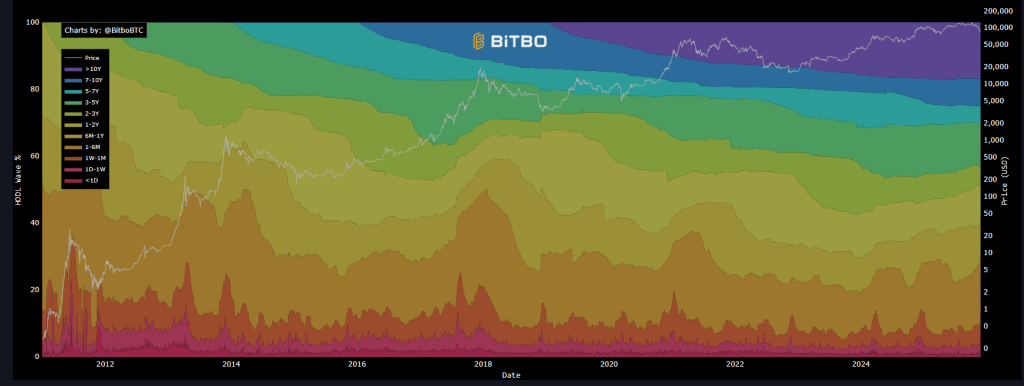
HODL Waves chart for Bitcoin, based on BitBo data.

Bitcoin Uses Elliptic Curve Signatures

Bitcoin’s current protection relies on ECDSA and Schnorr signatures. According to researchers and standards bodies, those schemes can be broken by Shor’s algorithm if a large enough quantum computer appears.

The US National Institute of Standards and Technology has approved several quantum-resistant signature schemes, and Bitcoin Improvement Proposal 360 references post-quantum options. Adoption, however, requires wide agreement across the network.

Technical Timelines And Estimates

Today’s quantum devices have about 1,000 physical qubits. Some researchers now say a specialized machine with roughly 126,000 physical qubits could break elliptic curve signatures.

Others put the bar at around 2,300 logical qubits. These gaps matter because physical and logical qubits are not the same; heavy error correction is required to turn the former into the latter.

BTCUSD trading at $87,017 on the 24-hour chart: TradingView

Estimates place a workable attack window in the late 2020s or early 2030s, though timelines vary. Some scientists say a serious threat is unlikely for at least two to four decades, arguing the machines are unreliable and not close to practical use.

Institutional Steps And Wary Firms

Reports say some actors are already changing how they handle Bitcoin. El Salvador reportedly split its 6,284 BTC reserve across 14 addresses to lower risk.

Major firms have listed quantum concerns in filings, and stablecoin operators have raised warnings about long-inactive wallets.

Politics Could Decide The Outcome

James Check argues the main danger is governance. He believes there is “no chance” the community will agree to freeze or forcibly migrate coins that owners do not move themselves.

That political reality, he says, could leave millions of coins exposed even if technical fixes exist. Some developers and industry figures urge faster action; others believe the switch can wait until post-quantum standards are ready.

The debate splits experts: some push for early migration plans, while others say the threat is distant and manageable. Based on reports and the numbers above, the picture is clear: the risk is real, the dates are uncertain, and the biggest obstacle may be human agreement rather than hardware.

Featured image from PostQuantum.com, chart from TradingView

Editorial Process for bitcoinist is centered on delivering thoroughly researched, accurate, and unbiased content. We uphold strict sourcing standards, and each page undergoes diligent review by our team of top technology experts and seasoned editors. This process ensures the integrity, relevance, and value of our content for our readers.

Christian, a journalist and editor with leadership roles in Philippine and Canadian media, is fueled by his love for writing and cryptocurrency. Off-screen, he's a cook and cinephile who's constantly intrigued by the size of the universe.

Related Reads

Trading

Spot
Futures

Hot Articles

What is $BITCOIN

DIGITAL GOLD ($BITCOIN): A Comprehensive Analysis Introduction to DIGITAL GOLD ($BITCOIN) DIGITAL GOLD ($BITCOIN) is a blockchain-based project operating on the Solana network, which aims to combine the characteristics of traditional precious metals with the innovation of decentralized technologies. While it shares a name with Bitcoin, often referred to as “digital gold” due to its perception as a store of value, DIGITAL GOLD is a separate token designed to create a unique ecosystem within the Web3 landscape. Its goal is to position itself as a viable alternative digital asset, although specifics regarding its applications and functionalities are still developing. What is DIGITAL GOLD ($BITCOIN)? DIGITAL GOLD ($BITCOIN) is a cryptocurrency token explicitly designed for use on the Solana blockchain. In contrast to Bitcoin, which provides a widely recognized value storage role, this token appears to focus on broader applications and characteristics. Notable aspects include: Blockchain Infrastructure: The token is built on the Solana blockchain, known for its capacity to handle high-speed and low-cost transactions. Supply Dynamics: DIGITAL GOLD has a maximum supply capped at 100 quadrillion tokens (100P $BITCOIN), although details regarding its circulating supply are currently undisclosed. Utility: While precise functionalities are not explicitly outlined, there are indications that the token could be utilized for various applications, potentially involving decentralized applications (dApps) or asset tokenization strategies. Who is the Creator of DIGITAL GOLD ($BITCOIN)? At present, the identity of the creators and development team behind DIGITAL GOLD ($BITCOIN) remains unknown. This situation is typical among many innovative projects within the blockchain space, particularly those aligning with decentralized finance and meme coin phenomena. While such anonymity may foster a community-driven culture, it intensifies concerns about governance and accountability. Who are the Investors of DIGITAL GOLD ($BITCOIN)? The available information indicates that DIGITAL GOLD ($BITCOIN) does not have any known institutional backers or prominent venture capital investments. The project seems to operate on a peer-to-peer model focused on community support and adoption rather than traditional funding routes. Its activity and liquidity are primarily situated on decentralized exchanges (DEXs), such as PumpSwap, rather than established centralized trading platforms, further highlighting its grassroots approach. How DIGITAL GOLD ($BITCOIN) Works The operational mechanics of DIGITAL GOLD ($BITCOIN) can be elaborated on based on its blockchain design and network attributes: Consensus Mechanism: By leveraging Solana’s unique proof-of-history (PoH) combined with a proof-of-stake (PoS) model, the project ensures efficient transaction validation contributing to the network's high performance. Tokenomics: While specific deflationary mechanisms have not been extensively detailed, the vast maximum token supply implies that it may cater to microtransactions or niche use cases that are still to be defined. Interoperability: There exists the potential for integration with Solana’s broader ecosystem, including various decentralized finance (DeFi) platforms. However, the details regarding specific integrations remain unspecified. Timeline of Key Events Here is a timeline that highlights significant milestones concerning DIGITAL GOLD ($BITCOIN): 2023: The initial deployment of the token occurs on the Solana blockchain, marked by its contract address. 2024: DIGITAL GOLD gains visibility as it becomes available for trading on decentralized exchanges like PumpSwap, allowing users to trade it against SOL. 2025: The project witnesses sporadic trading activity and potential interest in community-led engagements, although no noteworthy partnerships or technical advancements have been documented as of yet. Critical Analysis Strengths Scalability: The underlying Solana infrastructure supports high transaction volumes, which could enhance the utility of $BITCOIN in various transaction scenarios. Accessibility: The potential low trading price per token could attract retail investors, facilitating wider participation due to fractional ownership opportunities. Risks Lack of Transparency: The absence of publicly known backers, developers, or an audit process may yield skepticism regarding the project's sustainability and trustworthiness. Market Volatility: The trading activity is heavily reliant on speculative behavior, which can result in significant price volatility and uncertainty for investors. Conclusion DIGITAL GOLD ($BITCOIN) emerges as an intriguing yet ambiguous project within the rapidly evolving Solana ecosystem. While it attempts to leverage the “digital gold” narrative, its departure from Bitcoin's established role as a store of value underscores the need for a clearer differentiation of its intended utility and governance structure. Future acceptance and adoption will likely depend on addressing the current opacity and defining its operational and economic strategies more explicitly. Note: This report encompasses synthesised information available as of October 2023, and developments may have transpired beyond the research period.

363 Total ViewsPublished 2025.05.13Updated 2025.05.13

What is $BITCOIN

Discussions

Welcome to the HTX Community. Here, you can stay informed about the latest platform developments and gain access to professional market insights. Users' opinions on the price of BTC (BTC) are presented below.

活动图片