Ключевые факторы роста биткоина в октябре теперь заставляют его цену падать

cryptonews.ruPublished on 2025-11-21Last updated on 2025-11-24

По данным NYDIG, ключевыми факторами роста биткоина до пика в октябре стали те, которые теперь заставляют его цену падать до многомесячных минимумов, при этом развороты в криптоказначействе и отток средств из криптофондов указывают на «реальный отток капитала», а не исключительно на негативные настроения.

Руководитель исследований NYDIG Грег Чиполаро заявил в своей заметке в пятницу, что приток средств в биржевые инвестиционные фонды (ETF) и спрос на казначейские цифровые активы (DAT) сыграли ключевую роль в росте биткоина во время последнего цикла.

Однако Чиполаро заявил, что крупная ликвидация, которая произошла в начале октября, привела к обратному притоку средств в ETF, падению премий по казначейским облигациям и сокращению предложения стейблкоинов, что является сигналом об уходе ликвидности из системы и «классическим признаком» того, что цикл «теряет импульс».

«Исторически сложилось так, что как только эта петля нарушается, рынок, как правило, следует предсказуемой последовательности. Ликвидность сокращается, кредитное плечо пытается реформироваться, но с трудом набирает обороты, а ранее благоприятные заявления перестают воплощаться в реальные потоки. Мы наблюдали это в каждом крупном цикле. История меняется, но механика остается неизменной. Рефлексивный цикл толкает рынок вверх, а его разворот подготавливает почву для следующей фазы цикла», — заявил Чиполаро.

Доминирование биткоина растет

Спотовые биткоин-ETF, которые, по словам Чиполаро, стали выдающейся историей успеха этого цикла, превратились из надежного двигателя притока «в существенный встречный ветер», но на биткоин по-прежнему влияет более широкий набор факторов, таких как глобальные изменения ликвидности, заголовки макроэкономической информации, стресс в структуре рынка и поведенческая динамика.

«Доминирование биткоина, как правило, резко возрастает во время циклических спадов, поскольку спекулятивные активы ликвидируются более агрессивно, а капитал консолидируется в самом устоявшемся и ликвидном активе экосистемы. Мы уже неоднократно наблюдали эту динамику, и видим ее снова», — сказал Чиполаро.
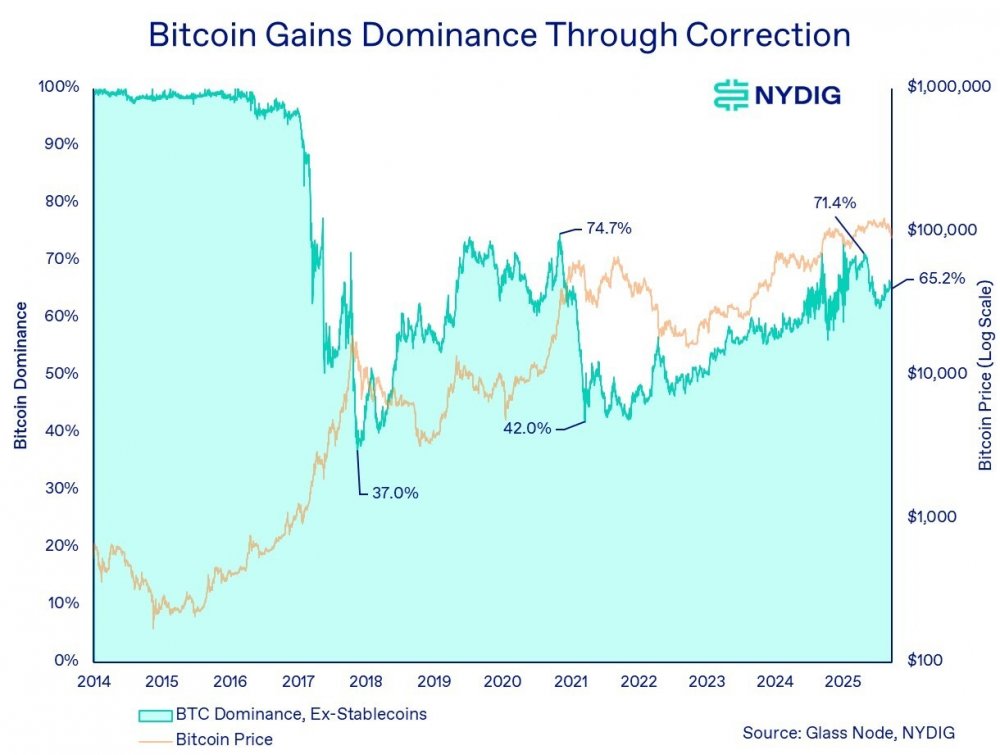
Доминирование биткоина имеет тенденцию к росту во время спадов, поскольку капитал возвращается в самый надежный и ликвидный актив. Источник: NYDIG.

По данным криптоплатформы CoinMarketCap, в начале ноября доминирование биткоина вновь превысило 60% и с тех пор по состоянию на понедельник стабилизировалось на уровне около 58%.

Падение DAT и стейблкоинов

DAT и стейблкоины также были значительным источником структурного спроса на биткоин. Однако, по словам Чиполаро, премии DAT (цена акций, торгуемых относительно чистой стоимости активов) повсеместно сократились, а предложение стейблкоинов впервые за несколько месяцев сократилось, поскольку инвесторы, по всей видимости, изымают ликвидность из экосистемы.

Чиполаро заявил, что даже если падение рынка усилится, сектору DAT предстоит пройти долгий путь, прежде чем реальный стресс станет проблемой.

«Важно отметить, что, хотя эти перемены знаменуют собой явный переход от некогда сильного двигателя спроса к потенциальному встречному ветру, ни один DAT пока не продемонстрировал признаков финансовых проблем. Кредитное плечо остается умеренным, процентные обязательства управляемы, и многие структуры DAT позволяют эмитентам приостанавливать выплаты дивидендов или купонов при необходимости».

Долгосрочная траектория биткоина остается неизменной

Несмотря на недавний откат, Чиполаро полагает, что «вековая история биткоина остается неизменной», поскольку он продолжает набирать институциональную поддержку, суверенный интерес медленно растет, а его роль как нейтрального, программируемого денежного актива по-прежнему весьма существенна.

«За последние несколько недель ничего не изменило эту долгосрочную траекторию. Но цикличность, движимая потоками, рычагами и рефлексивным поведением, теперь заявляет о себе гораздо сильнее, — сказал он.— Инвесторам следует надеяться на лучшее, но готовиться к худшему. Если судить по прошлым циклам, путь вперед, вероятно, будет неровным, эмоционально тяжелым и отмеченным внезапными потрясениями».


Related Reads

No Sales Team, $20 Million in Revenue: How Did AI Employee Viktor Win Over 30,000 Companies?

The AI employee Viktor, developed by a team with DeepMind background, has achieved $20 million in annual revenue without a traditional sales team, serving over 30,000 companies. Its core innovation lies in positioning itself as a "Tier 3 AI Coworker" capable of "end-to-end execution and delivery of results," moving beyond the "draft and wait for human completion" model of typical AI assistants. Users can simply mention Viktor in Slack or Microsoft Teams using natural language commands, and it autonomously performs tasks like pulling sales data from a CRM, generating reports, or even cross-tool operations like creating board meeting PPTs by aggregating data from six different sources. Key to its growth is a pure Product-Led Growth (PLG) model, eliminating complex implementation cycles and per-seat licensing. Instead, it charges based on task credits or consumption, lowering the trial barrier with a $100 free credit offer and no credit card required. This enabled viral, bottom-up adoption within organizations. Viktor's interaction paradigm removes the barrier of prompt engineering, allowing non-technical employees to delegate complex workflows seamlessly. It also features proactive, automated task execution (e.g., overnight bookkeeping, scheduled reports) based on triggers, effectively embedding AI as an automated "process layer" within business operations. However, its expansion into Microsoft Teams—a platform with 320 million users—highlights challenges. Large enterprises require stringent IT compliance, security reviews (e.g., SOC 2), and governance, potentially hindering the frictionless, user-driven adoption that succeeded in Slack. Additionally, the "black box" nature of its autonomous decision-making raises concerns about operational risks, data integrity, and the need for robust audit logs and permission controls. Balancing efficiency gains with security and trust remains a critical hurdle for Viktor and similar AI agents aiming to become core enterprise infrastructure.

marsbit54m ago

No Sales Team, $20 Million in Revenue: How Did AI Employee Viktor Win Over 30,000 Companies?

marsbit54m ago

Manus Buyback Plan Emerges: Chinese Investors Plan to Repurchase Equity with $2 Billion, Path to Hong Kong IPO Becomes Clearer

According to a report by The Information, early Chinese investors of Manus, including Tencent, Sequoia Capital China, and ZhenFund, are planning to repurchase the company from Meta for $2 billion—the same price Meta paid in its acquisition last December. This move is a direct response to the Chinese government's prohibition of the foreign acquisition in April. As part of the repurchase plan, Manus is considering establishing a Sino-foreign joint venture within China. This structure is seen as a way to ensure regulatory compliance for its Chinese investors and to pave the way for a future IPO in Hong Kong. Notably, U.S. investor Benchmark will not participate in the buyback, which will concentrate ownership even more among Chinese capital. Since its acquisition by Meta, Manus's business has grown rapidly, with its annualized revenue run rate reportedly increasing four-to-fivefold to $400-$500 million in roughly six months. This strong growth underpins the investors' willingness to repurchase at the original price. Financially, the forced unwinding of the deal may benefit the early investors, allowing them to regain equity at a cost far below the company's current implied valuation, with the added prospect of an independent future listing. However, specific terms of the repurchase, including funding proportions and the joint venture's equity structure, are still under negotiation. This "repurchase-joint venture-Hong Kong IPO" approach could serve as a reference model for other Chinese AI startups navigating cross-border M&A regulations.

marsbit1h ago

Manus Buyback Plan Emerges: Chinese Investors Plan to Repurchase Equity with $2 Billion, Path to Hong Kong IPO Becomes Clearer

marsbit1h ago

STRC Loses Peg by 11%, Can Strategy's Perpetual Motion Machine Keep Running?

The article discusses the significant and concerning depegging of MicroStrategy's (MSTR) preferred stock, STRC. Designed to trade near its $100 target par value, STRC has recently fallen sharply, reaching a low of $83.26 and closing at $88.59, representing an over 11% discount. STRC is a core component of MicroStrategy's financial strategy. As a perpetual preferred stock, it allows the company to raise capital through an "at-the-market" (ATM) issuance program without diluting common shareholders (MSTR). This capital is primarily used to purchase Bitcoin, creating a "capital flywheel": issuing STRC → raising cash → buying BTC → increasing net assets → supporting STRC's value. The flywheel's operation depends on STRC maintaining its $100 price. To enforce this, MicroStrategy employs a dynamic dividend mechanism, recently raising the rate to 11.5% and increasing payout frequency. However, this has failed to halt the depegging, indicating market concerns extend beyond yield. Analysts cite two main reasons. First, technical factors like forced liquidations from leveraged arbitrage trades may have exacerbated the sell-off. Second, and more fundamentally, is waning confidence in MicroStrategy's financial resilience. A JPMorgan report highlighted the company's limited cash relative to its ~$1.7 billion annual dividend obligation, raising liquidity concerns. While MicroStrategy counters that its massive Bitcoin holdings provide decades of coverage, this argument relies on the potential need to sell BTC—a departure from its long-standing "never sell" narrative. The company's recent sale of a small amount of Bitcoin for "testing," despite being framed as minor, has intensified these fears. The persistent depegging threatens to cripple MicroStrategy's primary funding channel. If STRC remains discounted, the company's ability to fund further Bitcoin purchases weakens. Should cash reserves dwindle while financing is constrained, the market may increasingly price in the risk of MicroStrategy becoming a forced seller of Bitcoin to meet obligations. This shift from a major marginal buyer to a potential seller could pose significant downside risk to the broader Bitcoin market.

链捕手1h ago

STRC Loses Peg by 11%, Can Strategy's Perpetual Motion Machine Keep Running?

链捕手1h ago

Trading

Spot
Futures
活动图片