Bitcoin Quantum Threat: Top Expert Predicts Breakthrough Before Next US Election

bitcoinistPublished on 2025-11-19Last updated on 2025-11-19

Abstract

One of the world’s most respected quantum computing researchers has sharply pulled forward the perceived timeline for a cryptographically relevant...

Trusted Editorial content, reviewed by leading industry experts and seasoned editors. Ad Disclosure

One of the world’s most respected quantum computing researchers has sharply pulled forward the perceived timeline for a cryptographically relevant quantum computer – and Bitcoin is suddenly in the crosshairs of the debate.

In a new post on his Shtetl-Optimized blog, theoretical computer scientist Scott Aaronson writes that, given the “current staggering rate of hardware progress,” he now thinks “it’s a live possibility that we’ll have a fault-tolerant quantum computer running Shor’s algorithm before the next US presidential election.” He frames the post as an attempt to process “too much happening” in quantum computing, citing a string of advances across hardware and verifiable quantum advantage experiments, and concludes: “Evidence continues to pile up that we are not living in the universe of Gil Kalai and the other quantum computing skeptics.”#

What This Means For Bitcoin

For Bitcoin, the key words are “fault-tolerant” and “Shor’s algorithm.” Bitcoin’s ECDSA signatures over the secp256k1 elliptic curve derive their security from the hardness of the discrete logarithm problem. A sufficiently large, error-corrected quantum computer running Shor’s algorithm can, in principle, solve both integer factorization and discrete logs in polynomial time – directly undermining the assumptions behind today’s public-key cryptography.

The market reaction crystallized on X. Castle Island Ventures partner Nic Carter highlighted Aaronson’s line about a pre-election Shor-capable device and stressed that the messenger matters: “this guy is one of the most notable quantum academics/researchers/educators and is known as major quantum SKEPTIC / realist.” He added that Aaronson is “specifically known for not selling out to quantum vaporware companies,” arguing that “people don’t understand the significance of HIM saying this” and remarking, “A lot changed this year.”

Crypto voices quickly connected the dots to Bitcoin and other crypto assets. “I am honestly worried for bitcoin. This is an opportunity for Ethereum,” wrote one commentator, while StarkWare co-founder Eli Ben-Sasson replied, “I’m honestly worried for both.” The message: no major chain that relies on classical public-key cryptography is immune to a sufficiently mature quantum adversary.

Others urged the industry not to jump from “live possibility” to imminent catastrophe. Haseeb Qureshi argued it is “important not to scaremonger here about quantum timelines,” drawing a line between demonstrating Shor’s algorithm and breaking real-world 256-bit elliptic-curve keys. Running Shor to factor a moderately sized number would already be a landmark, but, he noted, scaling to numbers with “hundreds of digits” would require a “huge degree of scaling and engineering.”

To anchor expectations, Qureshi pointed to prediction platform Metaculus, where forecasters currently place the first RSA challenge number being factored by Shor’s algorithm around the mid-2030s, with a wide distribution around that date. Notably, that median has moved dramatically in just a few years; in 2022, community expectations were centered a couple of decades later. Progress, in other words, is running ahead of earlier forecasts, but still not on the scale of “next cycle, everything breaks.”

“Important to take seriously. But not imminent by any means. All blockchains will need to adapt to post-quantum cryptography. An orderly transition probably needs at least 4 years, which means we have the next few years to decide on a viable upgrade path,” Qureshi concluded.

Developers Need To Get Serious Now

Alex Pruden, CEO of Project Eleven, an applied lab of builders & technologists at the intersection of quantum computing and cryptography formed in 2024, countered: “We don’t need to panic, but we need to get serious. I wish people would stop referencing Metaculus. It’s just a random survey platform without any mechanism to filter people w/ authority from randos on the internet.”

While Pruden acknowledged that it is “notoriously difficult to predict how the development of a quantum computer will play out,” he warned that technologies like quantum computing or AI “often happen not in a linear way, but as a series of breakthroughs.” He added: “Even if it’s only a 1% chance in the next five years, given that it breaks **the fundamental security guarantee which secures assets onchain**, why shouldn’t this be the top priority for every blockchain? Whenever it does happen, it will be the only thing that matters.”

For Bitcoin specifically, the risk is unevenly distributed. Pay-to-public-key (P2PK) outputs and any address that has already revealed its public key on-chain are inherently more exposed in a post-quantum world than single-use pay-to-public-key-hash (P2PKH) outputs that never reuse addresses. Long-dormant early coins and heavily reused addresses would be natural targets once a quantum attacker can derive private keys from known public keys at scale.

The harder problem is governance and timing. Aaronson’s “live possibility before the next US presidential election” does not mean a Bitcoin-breaking machine exists or is guaranteed on that schedule. It does, however, narrow the psychological distance between quantum timelines and Bitcoin’s upgrade horizon. Experts like Charles Edwards already argue that an “orderly transition” to post-quantum or hybrid signatures would require multiple years of planning and coordination across nodes, miners, wallets and exchanges, and should be completed before—not after—ECDSA is practically breakable.

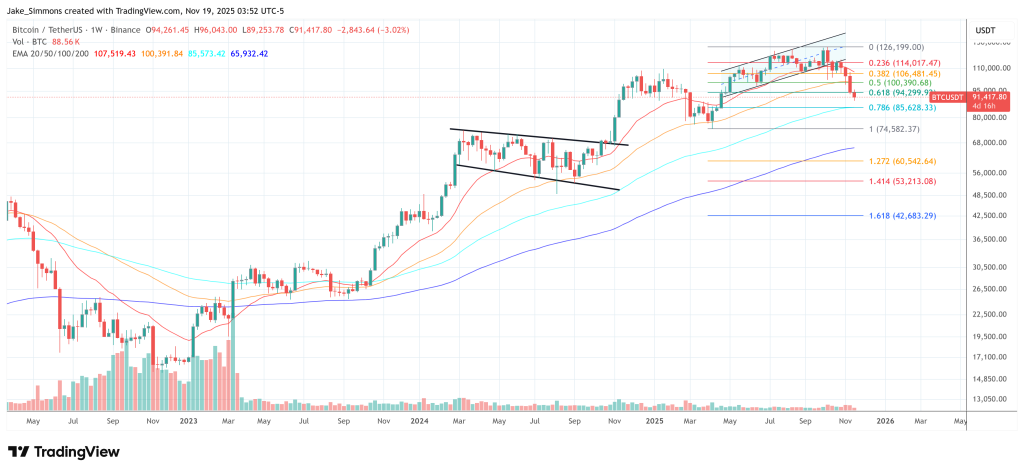
At press time, BTC traded at $91,417.
Bitcoin price
Bitcoin remains below the 0.618 Fib, 1-week chart | Source: BTCUSDT on TradingView.com
Featured image created with DALL.E, chart from TradingView.com
Editorial Process for bitcoinist is centered on delivering thoroughly researched, accurate, and unbiased content. We uphold strict sourcing standards, and each page undergoes diligent review by our team of top technology experts and seasoned editors. This process ensures the integrity, relevance, and value of our content for our readers.

Jake Simmons has been a Bitcoin enthusiast since 2016. Ever since he heard about Bitcoin, he has been studying the topic every day and trying to share his knowledge with others. His goal is to contribute to Bitcoin's financial revolution, which will replace the fiat money system. Besides BTC and crypto, Jake studied Business Informatics at a university. After graduation in 2017, he has been working in the blockchain and crypto sector. You can follow Jake on Twitter at @realJakeSimmons.

Related Reads

How the $900 Billion Anthropic Was Built?

Anthropic, the AI startup behind Claude, is reportedly in early talks to raise at least $30 billion in new funding, targeting a valuation exceeding $900 billion. This would propel it past OpenAI's recent $852 billion valuation. The funding round is expected to close by late May 2026. The company's valuation surge is driven by extraordinary revenue growth, reportedly reaching an annualized $30 billion by March 2026 from $1 billion in December 2024. However, OpenAI questions this figure, suggesting a net revenue closer to $22 billion after cloud platform fees. Despite high revenue, Anthropic's gross margin is reportedly around 40%, and it is not yet profitable, with breakeven projected for 2028. A significant portion of the new capital would fund massive, pre-committed computing infrastructure with partners like Amazon, Google, and Microsoft. This highlights a new AI financing model where high valuations fuel compute spending, which in turn requires even higher future valuations to sustain. Notably, many early-stage investors are reportedly sitting out this round. Bankers privately estimate a potential IPO valuation between $400-500 billion, creating a rare scenario where the final private funding round valuation ($900B+) could far exceed the expected public market debut. Anthropic is targeting an IPO between October 2026 and the first half of 2027. Its public listing is poised to be a critical test for the entire AI sector's valuation logic, potentially validating or challenging the high-stakes "valuation-compute-valuation" cycle that has defined private market investments.

链捕手20m ago

How the $900 Billion Anthropic Was Built?

链捕手20m ago

UBS Enters the Fray, 20 Swiss Banks Now Offer Crypto Trading, Covering 2.5 Million Accounts

Global wealth management giant UBS has entered the cryptocurrency market, offering Bitcoin and Ethereum trading to select private banking clients in Switzerland as of January 2026. This move is part of a broader trend in Switzerland, where approximately 20 banks now provide crypto services, collectively covering over 2.5 million accounts. Client data from Zurich Cantonal Bank (ZKB) challenges the stereotype of crypto being solely for the young, revealing that the average buyer is aged 30-50 and predominantly male. Notably, over 40% of these clients previously held no investment portfolio, indicating crypto is activating dormant capital. The business case is proving substantial. For several Swiss banks, crypto-related activities already contribute a significant and disproportionate share of profits, with unit economics often outperforming traditional banking services. This institutional adoption in Switzerland reflects a global trend, with a recent survey showing 73% of institutional investors planning to increase crypto allocations in 2026. Switzerland's early regulatory clarity through its DLT Act and established custody infrastructure have provided a foundation for this growth. However, upcoming challenges include the implementation of the OECD's Crypto Asset Reporting Framework (CARF) in 2027 and ongoing reforms by Swiss regulator FINMA. The final shape of these regulations will be crucial in determining whether Switzerland can maintain its leading position in the global banking crypto sector.

marsbit22m ago

UBS Enters the Fray, 20 Swiss Banks Now Offer Crypto Trading, Covering 2.5 Million Accounts

marsbit22m ago

Circle Releases Arc Network Whitepaper: Can the New Economic Mechanism Drive It to Become the "Clearing Coordination Layer" for Institutional-Grade Stablecoin Payments?

Circle has released the whitepaper for its Arc Network, detailing plans for a new economic coordination layer using the proposed ARC token. Arc is a Layer 1 blockchain designed for enterprise-level stablecoin payments, featuring USDC as its native gas token, a high-performance consensus mechanism for instant transaction finality, and optional enterprise privacy features. Currently operating on a Proof-of-Authority (PoA) model, the network plans a future transition to a Proof-of-Stake (PoS) system. The ARC token is intended to serve as the network's native coordination asset, facilitating governance, enabling staking rewards, and managing fee mechanisms. User fees paid in stablecoins would be converted to ARC, with portions distributed as rewards and burned. The governance model will blend token-based voting with institutional oversight, especially for high-sensitivity matters like security and compliance. While positioning Arc as a potential settlement layer for institutional stablecoin payments, the whitepaper acknowledges challenges. These include the network's current centralization, the unfinished and potentially volatile ARC token economics, and the evolving global regulatory landscape for stablecoins. The development signals a broader industry trend where Web3 infrastructure competition is shifting from pure performance to factors like liquidity, compliance, and institutional-grade stability.

marsbit58m ago

Circle Releases Arc Network Whitepaper: Can the New Economic Mechanism Drive It to Become the "Clearing Coordination Layer" for Institutional-Grade Stablecoin Payments?

marsbit58m ago

18-Year-Old Hacker's Boastful Discord Display Leads to Uncovering of $19 Million Theft Case

An 18-year-old hacker from the U.S., Dritan Kapllani Jr., has been exposed by on-chain investigator ZachXBT for his alleged involvement in multiple cryptocurrency social engineering attacks, with total funds stolen estimated at $19 million. The case gained attention after Dritan inadvertently revealed his involvement during a Discord voice call in April 2026, where he screen-shared his Exodus wallet containing approximately $3.68 million to show off his wealth during a "Band 4 Band" argument. Tracing this wallet address led investigators to uncover its connection to a major theft from March 14, 2026, where 185 Bitcoin (worth around $13 million at the time) was stolen. Approximately $5.3 million from that heist was funneled into Dritan’s wallet. Further analysis linked the same wallet to over $5.85 million from other social engineering attacks dating back to 2025. While Dritan has not yet been formally charged, he is identified as "Co-Conspirator 1" in recently unsealed court documents related to the 185 Bitcoin theft case. Another individual, Meme coin KOL yelotree, is also implicated for allegedly assisting with money laundering through a car rental business. Dritan, who had been living a lavish lifestyle and was previously seen as untouchable within hacking circles, turned 18 recently, making him legally accountable. His previous "immunity" has ended as law enforcement closes in.

Odaily星球日报2h ago

18-Year-Old Hacker's Boastful Discord Display Leads to Uncovering of $19 Million Theft Case

Odaily星球日报2h ago

Trading

Spot
Futures

Hot Articles

What is $BITCOIN

DIGITAL GOLD ($BITCOIN): A Comprehensive Analysis Introduction to DIGITAL GOLD ($BITCOIN) DIGITAL GOLD ($BITCOIN) is a blockchain-based project operating on the Solana network, which aims to combine the characteristics of traditional precious metals with the innovation of decentralized technologies. While it shares a name with Bitcoin, often referred to as “digital gold” due to its perception as a store of value, DIGITAL GOLD is a separate token designed to create a unique ecosystem within the Web3 landscape. Its goal is to position itself as a viable alternative digital asset, although specifics regarding its applications and functionalities are still developing. What is DIGITAL GOLD ($BITCOIN)? DIGITAL GOLD ($BITCOIN) is a cryptocurrency token explicitly designed for use on the Solana blockchain. In contrast to Bitcoin, which provides a widely recognized value storage role, this token appears to focus on broader applications and characteristics. Notable aspects include: Blockchain Infrastructure: The token is built on the Solana blockchain, known for its capacity to handle high-speed and low-cost transactions. Supply Dynamics: DIGITAL GOLD has a maximum supply capped at 100 quadrillion tokens (100P $BITCOIN), although details regarding its circulating supply are currently undisclosed. Utility: While precise functionalities are not explicitly outlined, there are indications that the token could be utilized for various applications, potentially involving decentralized applications (dApps) or asset tokenization strategies. Who is the Creator of DIGITAL GOLD ($BITCOIN)? At present, the identity of the creators and development team behind DIGITAL GOLD ($BITCOIN) remains unknown. This situation is typical among many innovative projects within the blockchain space, particularly those aligning with decentralized finance and meme coin phenomena. While such anonymity may foster a community-driven culture, it intensifies concerns about governance and accountability. Who are the Investors of DIGITAL GOLD ($BITCOIN)? The available information indicates that DIGITAL GOLD ($BITCOIN) does not have any known institutional backers or prominent venture capital investments. The project seems to operate on a peer-to-peer model focused on community support and adoption rather than traditional funding routes. Its activity and liquidity are primarily situated on decentralized exchanges (DEXs), such as PumpSwap, rather than established centralized trading platforms, further highlighting its grassroots approach. How DIGITAL GOLD ($BITCOIN) Works The operational mechanics of DIGITAL GOLD ($BITCOIN) can be elaborated on based on its blockchain design and network attributes: Consensus Mechanism: By leveraging Solana’s unique proof-of-history (PoH) combined with a proof-of-stake (PoS) model, the project ensures efficient transaction validation contributing to the network's high performance. Tokenomics: While specific deflationary mechanisms have not been extensively detailed, the vast maximum token supply implies that it may cater to microtransactions or niche use cases that are still to be defined. Interoperability: There exists the potential for integration with Solana’s broader ecosystem, including various decentralized finance (DeFi) platforms. However, the details regarding specific integrations remain unspecified. Timeline of Key Events Here is a timeline that highlights significant milestones concerning DIGITAL GOLD ($BITCOIN): 2023: The initial deployment of the token occurs on the Solana blockchain, marked by its contract address. 2024: DIGITAL GOLD gains visibility as it becomes available for trading on decentralized exchanges like PumpSwap, allowing users to trade it against SOL. 2025: The project witnesses sporadic trading activity and potential interest in community-led engagements, although no noteworthy partnerships or technical advancements have been documented as of yet. Critical Analysis Strengths Scalability: The underlying Solana infrastructure supports high transaction volumes, which could enhance the utility of $BITCOIN in various transaction scenarios. Accessibility: The potential low trading price per token could attract retail investors, facilitating wider participation due to fractional ownership opportunities. Risks Lack of Transparency: The absence of publicly known backers, developers, or an audit process may yield skepticism regarding the project's sustainability and trustworthiness. Market Volatility: The trading activity is heavily reliant on speculative behavior, which can result in significant price volatility and uncertainty for investors. Conclusion DIGITAL GOLD ($BITCOIN) emerges as an intriguing yet ambiguous project within the rapidly evolving Solana ecosystem. While it attempts to leverage the “digital gold” narrative, its departure from Bitcoin's established role as a store of value underscores the need for a clearer differentiation of its intended utility and governance structure. Future acceptance and adoption will likely depend on addressing the current opacity and defining its operational and economic strategies more explicitly. Note: This report encompasses synthesised information available as of October 2023, and developments may have transpired beyond the research period.

363 Total ViewsPublished 2025.05.13Updated 2025.05.13

What is $BITCOIN

Discussions

Welcome to the HTX Community. Here, you can stay informed about the latest platform developments and gain access to professional market insights. Users' opinions on the price of BTC (BTC) are presented below.

活动图片