Bitcoin Hyper Ignites Market as First SVM Layer-2, Presale Blasts Past $27.8M

bitcoinistPublished on 2025-11-18Last updated on 2025-11-18

Abstract

Quick Facts: ➡️ Bitcoin has had a rough month after reaching an ATH of $126K in early October. In the...

Trusted Editorial content, reviewed by leading industry experts and seasoned editors. Ad Disclosure

Quick Facts:

  • ➡️ Bitcoin has had a rough month after reaching an ATH of $126K in early October. In the past 24 hours, it sank below $90K.
  • ➡️ Despite its struggles, Bitcoin remains the most valuable cryptocurrency. While its transaction speeds are notoriously slow and expensive, Layer-2 projects have cropped up to solve this.
  • ➡️ Bitcoin Hyper is the first Bitcoin Layer-2 to integrate the Solana Virtual Machine for high-speed transactions.
  • ➡️ Its presale has shown massive momentum, raising over $27.8M and attracting significant whale investment.

It’s been a tough several months for Bitcoin ($BTC). Just last month, it reached an ATH of $126K, leading many traders to believe that it would continue to go up from there.

And yet the market shared a collective sigh as Bitcoin dropped below $90K in the last 24 hours, a level that would’ve been close to unthinkable in October.

Despite that, Bitcoin remains the most valuable cryptocurrency in the market. Because of this, it’s also easy to overlook the fact that it isn’t perfect at all.

Bitcoin’s core limitations are well-known: slow transactions, high fees, and a lack of smart contract functionality. While its security is unmatched, its utility has been constrained, pushing developers and decentralized applications to other, more flexible blockchains.

This has created a massive opportunity for solutions that can expand Bitcoin’s capabilities without compromising its foundational strength. The race to build effective Bitcoin Layer-2 networks is heating up, and this is where Bitcoin Hyper ($HYPER) comes in.

Bitcoin Hyper Unlocks DeFi on Bitcoin with Solana-Like Speed Transactions

Bitcoin Hyper is positioning itself as the first-ever Bitcoin Layer-2 solution that integrates the Solana Virtual Machine (SVM). This innovative approach aims to solve Bitcoin’s scalability problem by bringing the high-speed, low-cost transaction processing of the Solana ecosystem directly to Bitcoin.

By creating a modular blockchain that uses Bitcoin for settlement and a real-time SVM layer for execution, it promises to deliver performance that could even surpass Solana itself.

Bitcoin Hyper Layer-2.

Unlike the Ethereum Virtual Machine (EVM), the SVM is renowned for its parallel transaction processing capabilities. This allows it to handle thousands of transactions per second at a fraction of the cost of other networks.

This architecture is designed to finally enable a robust ecosystem of DeFi, NFTs, and complex dApps on Bitcoin, backed by its unparalleled security and liquidity. The market has responded with overwhelming enthusiasm, signaling strong belief in the project’s vision.

📖 Read our detailed Bitcoin Hyper review for a full lowdown on the project.

By building a Layer-2 on top of Bitcoin that uses this engine, Bitcoin Hyper effectively bypasses Bitcoin’s native limitations. It creates an execution environment where developers can build sophisticated applications in Rust, a language known for safety and performance.

This opens the door for a wave of new use cases previously impossible on Bitcoin. Imagine high-frequency trading, decentralized exchanges, lending protocols, and NFT marketplaces operating with the speed of Solana but settling on the trust-minimized Bitcoin blockchain.

The platform provides a Canonical Bridge for seamless $BTC transfers, ensuring liquidity can flow easily between the layers. This combination of speed, low fees, and security is what makes the Bitcoin Hyper proposition so powerful.

$HYPER Presale Surges Past $27M as Whales Take Notice

When the L2 launches, its native $HYPER tokens will power it. While you can use it to pay for transaction fees, holding it will also give you governance rights and access to exclusive features.

Right now, you buy get these tokens via the official Bitcoin Hyper presale website. The market’s response to the project has been nothing short of explosive. The project’s presale has soared, raising an impressive $27.8M, with the $HYPER token currently priced at just $0.013295.
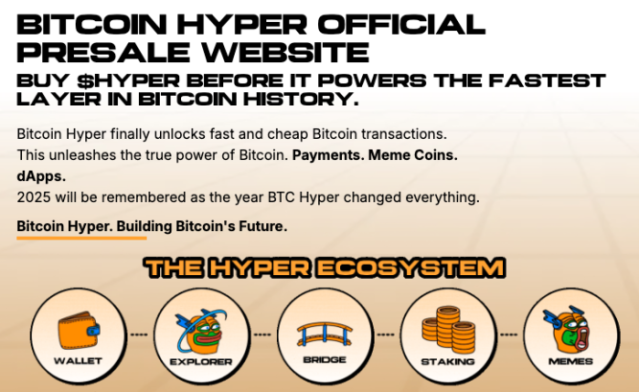
A snippet of the Bitcoin Hyper presale page.

💰 It’s easy to get your share of $HYPER tokens. Check out our guide to buying Bitcoin Hyper for more details.

This powerful momentum indicates strong investor confidence in its mission to scale Bitcoin. Adding to the bullish sentiment, on-chain data shows significant interest from major players. A recent whale buy just north of $500K worth of tokens is the strongest proof yet of the attention it is getting.

This smart money movement suggests that high-net-worth investors are recognizing the project’s long-term potential. The Bitcoin Hyper price is expected to climb as the presale progresses, rewarding early participants.

Beyond the initial offering, the project incentivizes long-term holding through a robust staking program. You can stake your tokens immediately and enjoy 41% APY, although this can still change as more holders lock their tokens in the staking pool.

With just a day before the next price increase, now’s the time to get your hands on tokens at a discounted price.

🚀 Ready to jump in? Join the Bitcoin Hyper presale today.

Disclaimer: This article is for informational purposes only and does not constitute financial advice.

Authored by Bogdan Patru, Bitcoinist – https://bitcoinist.com/bitcoin-hyper-presale-surges-above-27m

Editorial Process for bitcoinist is centered on delivering thoroughly researched, accurate, and unbiased content. We uphold strict sourcing standards, and each page undergoes diligent review by our team of top technology experts and seasoned editors. This process ensures the integrity, relevance, and value of our content for our readers.

As a crypto writer, Bogdan’s responsibilities are split between researching and writing articles and entertaining the team with his humor bordering on the politically incorrect, an aspiring Bill Burr, if you will. Thanks to his 12+ years of writing experience in just as many fields, including tech, cybersecurity, modelling, fitness, crypto, and other topics-that-shall-not-be-named, he's become a genuine asset to the team. While his position as a senior writer at PrivacyAffairs thought him valuable lessons about the power of self-management, his entire writing career was and is an exercise in self-improvement. Now, he's ready to sink his teeth into crypto and teach people how to take control of their own money on the blockchain. With fiat as an eternally devaluing currency, Bitcoin and altcoins seem like the best-fitting alternative for Bogdan. Bogdan’s biggest professional accomplishment, aside from securing a position as a main writer for Bitcoinist, was his 5-year run as a writing manager at Blackwood Productions, where he coordinated a team of four writers. During that time, he learned the value of teamwork and that of creating a working environment that breeds efficiency, positivity, and friendship.

Related Reads

From Gas Limit to 'Keyed Nonces', How to Understand the Next Step in Ethereum Scalability?

Ethereum’s scalability efforts are shifting toward a user-centric approach—focusing not only on higher TPS, but on translating technical upgrades into lower costs, smoother operations, and better wallet experiences. Two recent developments highlight this direction: - **Raising the Gas Limit to 200 million**: Following the Fusaka upgrade that increased it to 60 million, a consensus has formed around a potential future increase to 200 million. This would boost Ethereum’s execution capacity, but it is planned alongside other upgrades—such as ePBS, Block-Level Access Lists (BAL), and EIP-8037—to manage state growth and keep node operation viable for average participants. - **Keyed Nonces (EIP-8250)**: This proposal aims to improve how transactions are queued. Instead of a single linear nonce per account, it introduces multiple independent nonce domains. This prevents different types of transactions—such as private payments, session keys, or batch operations—from blocking each other. Vitalik Buterin views this as a foundational step toward better privacy support and more flexible state scalability. Together, these upgrades are part of a broader move to push complexity from wallets, DApps, and relays back into the protocol layer. For everyday users, this means future Ethereum interactions could become less congested, more intuitive, and safer—especially as core improvements in account abstraction, cross-L2 interoperability, and node decentralization continue to progress. Ultimately, Ethereum is evolving to handle not just more transactions, but more varied and complex on-chain use cases while preserving its decentralized foundation.

marsbit21m ago

From Gas Limit to 'Keyed Nonces', How to Understand the Next Step in Ethereum Scalability?

marsbit21m ago

Leaving OpenAI, How Much Has Their Net Worth Increased?

Former OpenAI employees have collectively accrued near-trillion dollar valuations through ventures and investments, charting AI's future. The article highlights two main paths: founding high-value companies like Anthropic and Perplexity, or applying insider insights as investors. Leopold Aschenbrenner exemplifies the investor path. After being fired from OpenAI, he leveraged firsthand knowledge of AI's massive energy demands to make hugely successful public market bets on nuclear and fuel cell companies, practicing "cross-industry cognitive arbitrage." Other alumni, like the Zero Shot VC fund founders, use their technical foresight for early-stage investing. Their key advantage lies not just in picking winners, but in knowing which technical approaches are likely dead ends—a "veto list" derived from internal OpenAI experience. Angel investing within the network, as seen with Mira Murati and Sam Altman, operates on deep, pre-existing understanding of a founder's capabilities, reducing due diligence to near zero. This creates an ecosystem bound by a shared belief in AGI's imminent arrival, differing from networks like the "PayPal Mafia" which were built on shared past struggles. The shift of these builders to investors signals a profound conviction: their situational awareness of the AI landscape is now so clear that deploying capital based on that judgment is more efficient than building themselves. They are allocating bets on the future they helped shape from the inside.

marsbit32m ago

Leaving OpenAI, How Much Has Their Net Worth Increased?

marsbit32m ago

Countdown to the AI Bull Market? Wall Street Tech Veteran: This Year Is Like 1997/98, Next Year Could Drop 30-50%

"AI Bull Market Countdown? Wall Street Veteran: This Year Feels Like 1997/98, Next Year Could Drop 30-50%" In an interview, veteran tech analyst Dan Niles draws parallels between the current AI boom and the 1997-98 period of the internet boom, suggesting the bull run isn't over yet. The core new driver is identified as "Agentic AI," which performs multi-step tasks and consumes vastly more computing power than conversational AI. This shift is expected to boost demand for cloud infrastructure and benefit CPU makers like Intel and AMD, potentially pressuring GPU leader Nvidia. However, Niles warns of significant short-term overbought conditions in semiconductors. His central warning is for a potential major market correction of 30-50% starting in early 2027. Drivers include a slowdown from high growth comparables, the outsized capital demands of companies like OpenAI, and a wave of massive tech IPOs sucking liquidity from the market. A J.P. Morgan survey of 56 global investors aligns with this view, finding that 54% expect a >30% U.S. stock correction by 2027. Among mega-cap tech, Niles favors Google due to its full-stack AI capabilities and cash flow, expresses concern about Meta's user growth, and sees potential for Apple's AI Siri and foldable iPhone. Niles advises investors to be nimble, hold significant cash, and closely monitor the conflicting signals from equities, oil prices, and bond yields, which he believes cannot all be correct simultaneously.

marsbit1h ago

Countdown to the AI Bull Market? Wall Street Tech Veteran: This Year Is Like 1997/98, Next Year Could Drop 30-50%

marsbit1h ago

Trading

Spot
Futures

Hot Articles

What is $BITCOIN

DIGITAL GOLD ($BITCOIN): A Comprehensive Analysis Introduction to DIGITAL GOLD ($BITCOIN) DIGITAL GOLD ($BITCOIN) is a blockchain-based project operating on the Solana network, which aims to combine the characteristics of traditional precious metals with the innovation of decentralized technologies. While it shares a name with Bitcoin, often referred to as “digital gold” due to its perception as a store of value, DIGITAL GOLD is a separate token designed to create a unique ecosystem within the Web3 landscape. Its goal is to position itself as a viable alternative digital asset, although specifics regarding its applications and functionalities are still developing. What is DIGITAL GOLD ($BITCOIN)? DIGITAL GOLD ($BITCOIN) is a cryptocurrency token explicitly designed for use on the Solana blockchain. In contrast to Bitcoin, which provides a widely recognized value storage role, this token appears to focus on broader applications and characteristics. Notable aspects include: Blockchain Infrastructure: The token is built on the Solana blockchain, known for its capacity to handle high-speed and low-cost transactions. Supply Dynamics: DIGITAL GOLD has a maximum supply capped at 100 quadrillion tokens (100P $BITCOIN), although details regarding its circulating supply are currently undisclosed. Utility: While precise functionalities are not explicitly outlined, there are indications that the token could be utilized for various applications, potentially involving decentralized applications (dApps) or asset tokenization strategies. Who is the Creator of DIGITAL GOLD ($BITCOIN)? At present, the identity of the creators and development team behind DIGITAL GOLD ($BITCOIN) remains unknown. This situation is typical among many innovative projects within the blockchain space, particularly those aligning with decentralized finance and meme coin phenomena. While such anonymity may foster a community-driven culture, it intensifies concerns about governance and accountability. Who are the Investors of DIGITAL GOLD ($BITCOIN)? The available information indicates that DIGITAL GOLD ($BITCOIN) does not have any known institutional backers or prominent venture capital investments. The project seems to operate on a peer-to-peer model focused on community support and adoption rather than traditional funding routes. Its activity and liquidity are primarily situated on decentralized exchanges (DEXs), such as PumpSwap, rather than established centralized trading platforms, further highlighting its grassroots approach. How DIGITAL GOLD ($BITCOIN) Works The operational mechanics of DIGITAL GOLD ($BITCOIN) can be elaborated on based on its blockchain design and network attributes: Consensus Mechanism: By leveraging Solana’s unique proof-of-history (PoH) combined with a proof-of-stake (PoS) model, the project ensures efficient transaction validation contributing to the network's high performance. Tokenomics: While specific deflationary mechanisms have not been extensively detailed, the vast maximum token supply implies that it may cater to microtransactions or niche use cases that are still to be defined. Interoperability: There exists the potential for integration with Solana’s broader ecosystem, including various decentralized finance (DeFi) platforms. However, the details regarding specific integrations remain unspecified. Timeline of Key Events Here is a timeline that highlights significant milestones concerning DIGITAL GOLD ($BITCOIN): 2023: The initial deployment of the token occurs on the Solana blockchain, marked by its contract address. 2024: DIGITAL GOLD gains visibility as it becomes available for trading on decentralized exchanges like PumpSwap, allowing users to trade it against SOL. 2025: The project witnesses sporadic trading activity and potential interest in community-led engagements, although no noteworthy partnerships or technical advancements have been documented as of yet. Critical Analysis Strengths Scalability: The underlying Solana infrastructure supports high transaction volumes, which could enhance the utility of $BITCOIN in various transaction scenarios. Accessibility: The potential low trading price per token could attract retail investors, facilitating wider participation due to fractional ownership opportunities. Risks Lack of Transparency: The absence of publicly known backers, developers, or an audit process may yield skepticism regarding the project's sustainability and trustworthiness. Market Volatility: The trading activity is heavily reliant on speculative behavior, which can result in significant price volatility and uncertainty for investors. Conclusion DIGITAL GOLD ($BITCOIN) emerges as an intriguing yet ambiguous project within the rapidly evolving Solana ecosystem. While it attempts to leverage the “digital gold” narrative, its departure from Bitcoin's established role as a store of value underscores the need for a clearer differentiation of its intended utility and governance structure. Future acceptance and adoption will likely depend on addressing the current opacity and defining its operational and economic strategies more explicitly. Note: This report encompasses synthesised information available as of October 2023, and developments may have transpired beyond the research period.

363 Total ViewsPublished 2025.05.13Updated 2025.05.13

What is $BITCOIN

Discussions

Welcome to the HTX Community. Here, you can stay informed about the latest platform developments and gain access to professional market insights. Users' opinions on the price of BTC (BTC) are presented below.

活动图片