Hyperliquid 的未来:HIP-3 与 HyperStone

深潮Published on 2025-11-12Last updated on 2025-11-13

Hyperliquid 的未来在 HIP-3,HIP-3 的根基在 HyperStone。

撰文:岳小鱼

Hyperliquid 的未来在 HIP-3,HIP-3 的根基在 HyperStone。

1️⃣ Hyperliquid 不只是在做一个链上合约交易所,而是正在构建一个生态,这件事天花板才足够高。

现在 RWA 热潮正汹涌,美债上链、美股上链,万物皆可上链。

但是这些市场 Hyperliquid 一家做不来,也吃不下,所以肯定要借助生态的力量。

2025 年 10 月 13 日,HIP-3 主网上线,实现了永续合约上市的完全去中心化。

从那天起,Hyperliquid 不再是审批制的交易所,而变成了任何人只要质押 100 万 HYPE,就能自己开市的开放平台。

简单说,Hyperliquid 将上币权开放给了社区。

2️⃣ 此时,当大家都想把各类资产都放到链上时,遇到的一个核心问题是什么呢?

其实是价格。

不同于 Hyperliquid 原生市场,是依赖验证者共识定价,HIP-3 市场完全依赖外部预言机提供价格数据。

这对数据准确性和实时性提出了极高要求。

因此预言机是最为关键的基础设施。

3️⃣ 这就一定要关注这个赛道的核心玩家:RedStone。

RedStone 早在 HyperEVM 启动之初就占据了 99.5% 的预言机市场主导地位,并担任 Hyperliquid 原生稳定币 USDH 的官方价格馈送提供商。

基于此,RedStone 又开发了 HyperStone,将其模块化预言机架构优化为 HIP-3 专用解决方案。

这是首个专为 HIP-3 设计的预言机。

HyperStone 可以帮助构建者从加密货币到代币化股票(比如 TSLA)、真实世界资产(RWA)甚至经济指标等,几乎任何资产上推出永续合约。

比如你想做一个 Tesla 股票永续合约,HyperStone 每 3 毫秒就告诉你一次:Tesla 现在美股多少钱。

可以说,没有 HyperStone,HIP-3 就是一座空城。

4️⃣ Hyperliquid 的护城河在哪里?

不是交易量,不是手续费,而是能建市场的人,和喂价的精度与速度。

Hyperliquid 正在从中心化团队驱动转向去中心化的交易网络。

而这个网络的每一次心跳,都来自 HyperStone 的 3 毫秒脉冲。

这就是为什么说 Hyperliquid 的未来在 HIP-3,HIP-3 的根基在 HyperStone。
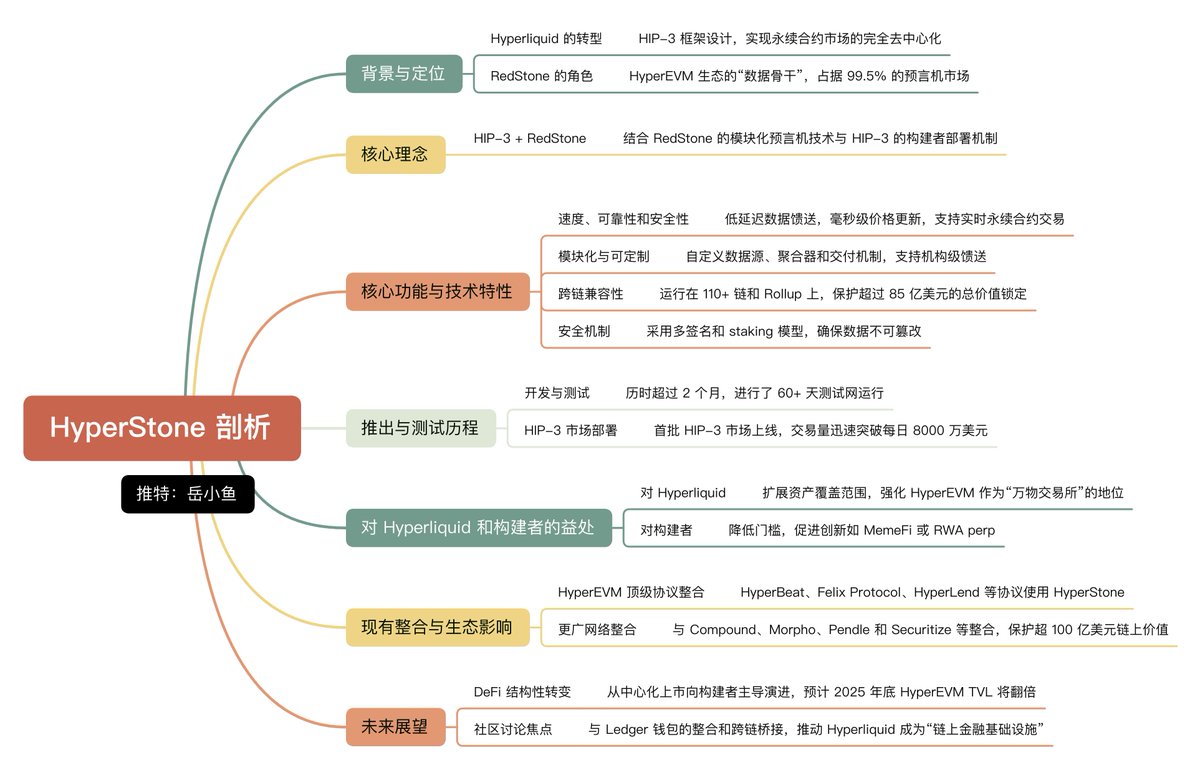
具体的 @redstone_defi 项目剖析可以看下思维导图 ⬆️

Related Reads

Claude Accused of Becoming Dumber by the Entire Internet, Anthropic Steps In to Reveal: It’s Not the Model That’s Tricking You

When users complained that Claude was "getting dumber," the root cause wasn't the AI model itself. In an official blog post, Anthropic clarified the critical difference between two key settings in Claude Code: Model and Effort. Model refers to the core "brain"—the fixed, trained weights of a specific AI (like Sonnet, Opus, or Fable). Changing the Model addresses *capability* ("can it do this?"), but its knowledge is static post-training. Effort, however, controls the AI's *approach and thoroughness* for a specific task. A higher Effort level instructs Claude to read more files, run tests, perform verification, and complete multi-step reasoning before responding, significantly increasing its "work output" for that job. Conversely, low Effort leads to quicker, less thorough replies. This distinction explains the March 2024 uproar where users experienced a sudden drop in Claude's performance. The cause was not a model change but Anthropic quietly lowering the *default* Effort setting from "high" to "medium" to reduce latency, which was later reverted. The key insight is that a smaller, capable model (like Sonnet) on high Effort can often outperform a larger, more powerful model (like Opus) on low Effort for many tasks. The article provides a practical troubleshooting framework: if Claude makes an error, first check the context and instructions. If it seems to skip necessary steps or validations, increase Effort. If it diligently attempts the task but fails conceptually or makes consistent factual errors despite good context, then consider switching to a more capable Model. The takeaway is a shift in focus: effective AI programming is less about always choosing the "strongest" model and more about intelligently *orchestrating* models and effort levels—acting like a project manager to assign the right "brain" with the right level of diligence for each job, optimizing both results and cost.

marsbit1h ago

Claude Accused of Becoming Dumber by the Entire Internet, Anthropic Steps In to Reveal: It’s Not the Model That’s Tricking You

marsbit1h ago

Will the Ethereum Foundation Evolve into a 'Mascot'? Diversified Organizations Are Fragmenting Its Functions

The Ethereum Foundation (EF) is undergoing significant internal turmoil and functional erosion. Following its largest-ever layoff of 54 staff (20% of its workforce) and a major organizational restructuring announced in June, its Protocol Support Team has been officially dissolved. This comes alongside the high-profile resignation of key figures like co-executive director Xiaowei Wang, bringing senior departures this year to at least eight. Criticism of EF's rigid structure, opaque decision-making, and perceived lack of a clear value narrative for ETH has intensified within the community. The layoffs have catalyzed the emergence of independent, non-profit organizations like Ethlabs and Ethereum Institutional, founded by former EF researchers and members. These entities are now taking on core functions such as protocol research/development and institutional adoption, effectively fragmenting the EF's traditional leadership role. Concurrently, EF's security team is adapting to technological change, deploying specialized AI agents to audit Ethereum's codebase, which successfully discovered a critical vulnerability (CVE-2026-34219). While EF states AI complements rather than replaces researchers, it signals a potential future shift in its operational model. Faced with these challenges—internal restructuring, talent drain, the rise of competing organizations, and AI integration—the Ethereum Foundation appears to be stepping back from a central commanding role. Analysts and community observers speculate it may increasingly transition towards a symbolic "ecosystem mascot" function, while decentralized initiatives drive Ethereum's future growth and institutional adoption.

marsbit1h ago

Will the Ethereum Foundation Evolve into a 'Mascot'? Diversified Organizations Are Fragmenting Its Functions

marsbit1h ago

Trading

Spot
活动图片