First US Bank Opens Crypto Trading: SoFi’s Move Puts Best Wallet Token in Play

bitcoinistPublished on 2025-11-12Last updated on 2025-11-12

Abstract

Quick Facts: ➡️ SoFi became the first nationally chartered U.S. bank to offer in-app crypto trading, signaling a policy-driven thaw...

Trusted Editorial content, reviewed by leading industry experts and seasoned editors. Ad Disclosure

Quick Facts:

  • ➡️ SoFi became the first nationally chartered U.S. bank to offer in-app crypto trading, signaling a policy-driven thaw in bank crypto.
  • ➡️ Wider bank distribution typically deepens liquidity and lowers frictions, funneling new users toward non-custodial wallets where utility lives.
  • ➡️ Best Wallet positions $BEST as a utility token for reduced fees, presale access, and staking inside a mobile-first, MPC-secured app.
  • ➡️ The Best Wallet Token presale has raised over $16.9M to date, positioning it as one of the hottest presales of 2025.

SoFi Bank just did what every US lender has tiptoed around for years: it lit up in-app crypto trading for retail customers.

The rollout makes SoFi the first and only nationally chartered, FDIC-insured bank to let its customers buy, sell, and hold digital assets like Bitcoin ($BTC) and Ethereum ($ETH) on the same app they already use for checking, savings, and investing.

According to SoFi’s CEO, the launch is staged, with support for ‘dozens’ of assets coming online. That’s the exact kind of SKU breadth that pushes crypto from niche app to default banking tab.

The bank’s move is certain to bridge the gap between TradFi accounts and on-chain assets.

It matters for traders because every new on-ramp tends to compress spreads, deepen liquidity, and normalize allocation behavior. It also matters for the next wave of retail users, who won’t need to bridge funds through multiple apps to get exposure.
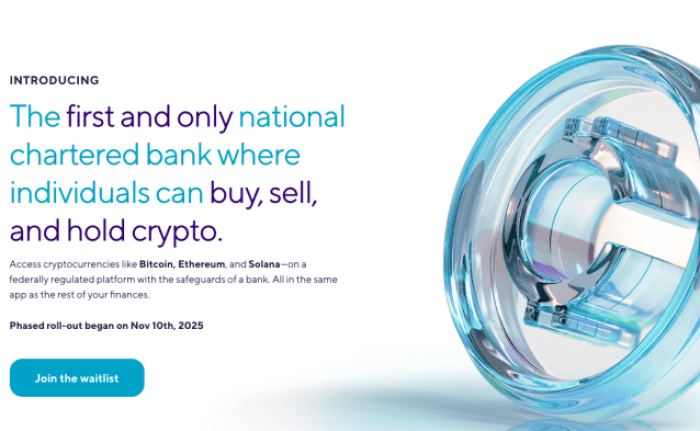
SoFi Bank's crypto landing page.

We believe the move is a product of clearer US bank guidance this year, which unlocked internal greenlights at institutions that were previously wary of digital-asset ambiguity.

✅ Said simply: if compliance had the brakes on in 2023, policy clarity just shifted the gearbox. With a national bank now setting the pace, expect copycats. Also, expect the user funnel to get wider, faster.

SoFi also aims to bring crypto access to its 12.6M-plus customer base over the coming weeks. It’s a firehose of distribution that typically re-prices convenience premiums across the stack.

For wallets, that’s an opportunity. If banks are turning into crypto on-ramps, non-custodial wallets become the place where people actually use tokens, stake, swap, and chase new opportunities.

Which is why this environment keeps steering attention toward Best Wallet Token ($BEST).

Best Wallet: A Bank-Age Wallet Built for On-Chain Action

Best Wallet is a non-custodial, multi-chain wallet (Best Wallet with a launchpad-style ‘Upcoming Tokens’ portal and an integrated DEX aggregator.

This ecosystem (alongside its official token, Best Wallet Token) is designed to cut the steps between buying crypto and doing something with it.
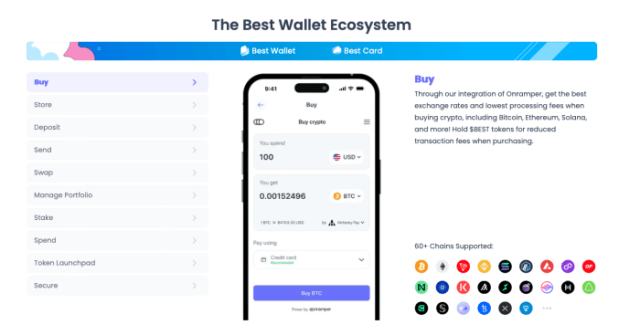
The Best Wallet Ecosystem featured on the Best Wallet Token presale page.

This all happens inside a mobile-first app using MPC security and Fireblocks infrastructure. That means if you’re a new user arriving from banking apps, you won’t wrestle with seed phrases or chain roulette on day one.

Utility shows up in the workflow. Fiat on-ramp via partners, cross-chain swaps via an auto-router that hunts better rates, portfolio views across multiple hot wallets, and forthcoming features like a Best Card for spending.

For traders watching risk rotations: non-custodial rails can become a beneficiary when custodial venues get busy.

Bank-integrated buying lowers friction; wallets that compress the jump to staking, swapping, and presales can capture more of the post-buy value chain. That’s the demand-side logic behind $BEST’s utility design.

Check out $BEST’s presale here.

Best Wallet Token ($BEST) — Presale With App-Native Distribution And High Staking APY

To get more out of the Best Wallet app, it helps to get its native Best Wallet Token ($BEST) via its ongoing presale. As a token holder, you’ll enjoy exclusive perks like low transaction fees, governance rights, and early access to the best crypto presales via the Token Launchpad.

💡 Want to learn more about the project? Be sure to check out ‘What is Best Wallet Token?’

Each $BEST token is priced at $0.025935, which can also be staked at 77% APY. Its attractive price has allowed the presale to raise over $16.9M at press time. There are regular price increases, with a new one coming up in 16 days, which encourages buyers to lock in their tokens early.

Best Wallet Token presale widget.

💰 Find out how you can buy $BEST tokens in our Best Wallet Token buying guide.

HODLing can be an enticing option for long-term investors, given Best Wallet something to look forward do a few years down the line.

According to our Best Wallet Token price prediction, $BEST has the potential to reach between $0.24 and $0.62 by the end of 2026, a considerable potential jump from its current price.

The macro tie-in is clear: SoFi’s bank-grade entry normalizes crypto exposure for mainstream users. Once they buy, they’ll want to stake, farm, and discover new launches, which are activities that don’t live inside a checking account.

Best Wallet Token ($BEST) aims to be the connective tissue there, monetizing utility rather than mere custody. If you’ve been scanning for best altcoins, this is a more functional, wallet-native narrative with optional upside from app adoption.

Join the $BEST presale now.

Disclaimer: This article is educational and not financial advice. Crypto assets are volatile; do your own research and assess personal risk tolerance before investing.

Authored by Bogdan Patru, Bitcoinist: https://bitcoinist.com/first-us-bank-launch-crypto-trading-best-wallet-token-soars

Editorial Process for bitcoinist is centered on delivering thoroughly researched, accurate, and unbiased content. We uphold strict sourcing standards, and each page undergoes diligent review by our team of top technology experts and seasoned editors. This process ensures the integrity, relevance, and value of our content for our readers.

As a crypto writer, Bogdan’s responsibilities are split between researching and writing articles and entertaining the team with his humor bordering on the politically incorrect, an aspiring Bill Burr, if you will. Thanks to his 12+ years of writing experience in just as many fields, including tech, cybersecurity, modelling, fitness, crypto, and other topics-that-shall-not-be-named, he's become a genuine asset to the team. While his position as a senior writer at PrivacyAffairs thought him valuable lessons about the power of self-management, his entire writing career was and is an exercise in self-improvement. Now, he's ready to sink his teeth into crypto and teach people how to take control of their own money on the blockchain. With fiat as an eternally devaluing currency, Bitcoin and altcoins seem like the best-fitting alternative for Bogdan. Bogdan’s biggest professional accomplishment, aside from securing a position as a main writer for Bitcoinist, was his 5-year run as a writing manager at Blackwood Productions, where he coordinated a team of four writers. During that time, he learned the value of teamwork and that of creating a working environment that breeds efficiency, positivity, and friendship.

Related Reads

Learn Codex with the "Morning Briefing": Six Replicable Levels of Use

This article introduces a "Morning Briefing" as a simple, progressive framework for learning to effectively use Codex (an AI assistant), moving from basic information gathering to a more sophisticated, autonomous work partner. It outlines six actionable levels: **Level 1: Basic Information Query.** Start by simply asking Codex to check your Slack, Gmail, and Calendar to summarize what needs your attention today. **Level 2: Personalization with an Agents File.** Create a persistent file containing your default preferences for the briefing's format and content, so it's consistently useful. **Level 3: Automation.** Set the briefing to run automatically every weekday morning, creating a reliable starting point for your day. **Level 4: Project-Specific Briefings.** Instead of one overwhelming summary, create separate, dedicated threads for different projects (e.g., a launch, recruitment), each with its own focused briefing. **Level 5: Drafting Follow-Up Actions.** Elevate the briefing from a summary to an action starter by having it draft replies, prepare meeting notes, or highlight stalled decisions—ready for your review. **Level 6: Building a Memory System (Vault).** Integrate a knowledge vault (a structured file system) where important recurring information (project statuses, key people, decisions) is stored and updated. The briefing consults this vault to provide richer context and learns over time. The approach's strength is its incremental nature. Each level teaches a core Codex capability (connectors, personalization, automation, project context, assisted work, persistent memory) within a familiar, practical workflow, avoiding overwhelming theoretical concepts. It transforms a simple daily check-in into a personalized, evolving work operating system.

marsbit37m ago

Learn Codex with the "Morning Briefing": Six Replicable Levels of Use

marsbit37m ago

Can Alibaba Cloud Rewrite Itself?

Over the past five months, Alibaba Cloud's MaaS (Model as a Service) revenue has surged 15x, marking a strategic overhaul where the company is shifting its 17-year-old system designed for "humans using cloud" to a new paradigm centered on "Agents consuming Tokens." At its recent summit, Alibaba Cloud announced a full-stack upgrade encompassing "chip-cloud-model-inference," all optimized for AI Agents. Key launches include the new AI product portal "QianWen Cloud," hyper-node servers powered by the in-house AI chip Zhenwu M890, and the latest flagship model, Qwen3.7-Max. Senior VP Liu Weiguang described this as building "China's largest AI factory," where chips are raw materials, the cloud is the workshop, models are machines, and the inference platform is the assembly line, with Tokens as the final product. The company is now emphasizing its chip strategy, unveiling the Zhenwu M890 and a two-year roadmap for future chips. With over 560,000 chips deployed across 400+ clients, Alibaba Cloud aims to control the marginal cost per Token, mirroring Google's integration of TPU and Gemini for optimal cost-performance. The cloud infrastructure itself is being rewritten. Traditional cloud interfaces are being transformed into standardized, Agent-callable Skills. A new scheduling logic focuses on "task scheduling" over "resource scheduling" to handle the unpredictable, elastic workloads of Agents. Liu noted that AI applications now automatically provision cloud resources, with one customer's daily automated provisioning equaling two weeks of manual work. For models, the focus has shifted from conversational prowess to execution capability. Qwen3.7-Max demonstrated this by autonomously writing and optimizing a production-grade AI compute kernel for the new Zhenwu M890 chip over 35 hours, achieving a 10x performance improvement. The underlying Bailian platform was upgraded for efficiency, and it maintains an open ecosystem, hosting third-party models. This restructuring extends beyond technology to sales, organization, and metrics. Alibaba Cloud has established dedicated MaaS sales teams, separated from traditional IaaS, with new KPIs focusing on high-quality Tokens that solve real problems, the number of core business systems integrated with models, and the efficiency of Agent task completion. The underlying bet is clear: AI represents an opportunity orders of magnitude larger than before. Despite the uncertainty, Alibaba Cloud is aggressively rebuilding its entire system, betting on an AI-driven future where Tokens could become its largest product line.

marsbit1h ago

Can Alibaba Cloud Rewrite Itself?

marsbit1h ago

Trading

Spot
Futures

Hot Articles

What is $BANK

Bank AI: A Revolutionary Step in the Future of Banking Introduction In an era marked by rapid advancements in technology, Bank AI stands at the intersection of artificial intelligence (AI) and banking services. This innovative project seeks to redefine the financial landscape, enhancing operational efficiency, security measures, and customer experiences through the power of AI. As we embark on this exploration of Bank AI, we will delve into what the project entails, its operational dynamics, its historical context, and significant milestones. What is Bank AI? At its core, Bank AI represents a transformative initiative aimed at integrating artificial intelligence into various banking operations. This project harnesses the capabilities of AI to automate processes, improve risk management protocols, and enhance customer interaction through personalised services. The primary objectives of Bank AI include: Automation of Banking Functions: By leveraging AI technologies, Bank AI aims to automate routine tasks, reducing the burden on human resources and enhancing efficiency. Enhanced Risk Management: The project utilises AI algorithms to predict and identify risks, thereby fortifying security measures against fraud and other threats. Personalisation of Banking Services: Bank AI focuses on offering tailored financial products and services by analysing customer data and behaviours. Improving Customer Experience: The implementation of AI-driven solutions, such as chatbots and virtual assistants, aims to provide users with more human-like interactions, revolutionising the way customers engage with banks. With these goals, Bank AI positions itself as a crucial player in rendering banking more efficient, secure, and user-centric. Who is the Creator of Bank AI? Details regarding the creator of Bank AI remain unknown. As such, no specific individual or organisation has been identified in the available information. The anonymity surrounding the project's inception raises questions but does not detract from its ambitious vision and objectives. Who are the Investors of Bank AI? Similar to the project's creator, specific information regarding the investors or supporting organisations of Bank AI has not been disclosed. Without this information, it is challenging to outline the financial backing and institutional support that might be propelling the project forward. Nevertheless, the importance of having a robust investment foundation is pivotal for sustaining development in such an innovative field. How Does Bank AI Work? Bank AI operates on several innovative fronts, focusing on unique factors that differentiate it from traditional banking frameworks. Below are key operational features: Automation: By applying machine learning algorithms, Bank AI automates various manual processes within banks. This results in reduced operational costs and allows human workers to redirect their efforts towards more strategic activities. Advanced Risk Management: The integration of AI into risk management practices equips banks with tools to accurately predict potential threats such as fraud, ensuring that customer information and assets remain secure. Tailored Financial Recommendations: Through continuous learning from customer interactions, the AI systems develop a nuanced understanding of user needs, enabling them to offer tailored advice on financial decisions. Enhanced Customer Interactions: Utilizing chatbots and virtual assistants powered by AI, Bank AI enables a more engaging customer experience, allowing users to have their queries resolved quickly, thus reducing wait times and improving satisfaction levels. Together, these operational features position Bank AI as a pioneer in the banking sector, establishing new benchmarks for service delivery and operational excellence. Timeline of Bank AI Understanding the trajectory of Bank AI requires a look at its historical context. Below is a timeline highlighting important milestones and developments: Early 2010s: The conceptualisation of AI integration into banking services began to gain attention as banking institutions recognised the potential benefits. 2018: A marked increase in the implementation of AI technologies occurred when banks started using AI tools like chatbots for basic customer service and risk management systems for improved security handling. 2023: The sophistication of AI continued to advance, with generative AI being introduced for more complex tasks such as document processing and real-time investment analysis. This year marked a significant leap in the capabilities afforded to banks by AI technology. 2024-Current Status: As of this year, Bank AI is on an upward trajectory, with ongoing research and developments poised to further enhance capabilities in banking operations. Continued exploration of AI applications hints at exciting developments yet to come. Key Points About Bank AI Integration of AI in Banking: Bank AI focuses on adopting artificial intelligence to streamline banking processes and improve user experiences. Automation and Risk Management Focus: The project strongly emphasises these areas, aiming to shift the burden of routine tasks while enhancing security frameworks through predictive analytics. Personalised Banking Solutions: By harnessing customer data, Bank AI enables tailored banking services that cater to individual user needs. Commitment to Development: Bank AI remains committed to ongoing research and development efforts, ensuring its adaptability and ongoing relevance as technology continues to evolve. Conclusion In summary, Bank AI exemplifies a crucial step forward in the banking industry, leveraging artificial intelligence to reshape operational paradigms, enhance security, and promote customer satisfaction. Despite gaps in information surrounding the creator and investors, the clear objectives and functional mechanisms of Bank AI provide a strong foundation for its ongoing evolution. As AI technology continues to advance and merge with the banking sector, Bank AI is well-positioned to significantly impact the future of financial services, enhancing the way we understand and interact with banking.

152 Total ViewsPublished 2024.04.06Updated 2024.12.03

What is $BANK

Discussions

Welcome to the HTX Community. Here, you can stay informed about the latest platform developments and gain access to professional market insights. Users' opinions on the price of BANK (BANK) are presented below.

活动图片