Visa Opens The Floodgates — Stablecoin Payments To Span 4 Blockchains

bitcoinistPublished on 2025-10-29Last updated on 2025-10-30

Abstract

Visa announced support for four new stablecoins across four blockchains, moving deeper into crypto payments. According to the credit card...

Trusted Editorial content, reviewed by leading industry experts and seasoned editors. Ad Disclosure

Visa announced support for four new stablecoins across four blockchains, moving deeper into crypto payments. According to the credit card firm’s Q4 2025 earnings call, card spending tied to stablecoins has surged fourfold year-over-year. That kind of growth, company executives say, points to rising use of tokenized money on established payment rails.

Stablecoin Settlement Hits A $2.5 Billion Run Rate

Based on reports from the earnings call, Visa’s stablecoin settlement platform now handles conversions between two currencies and more than 25 fiat currencies, with monthly volumes running at an annualized $2.5 billion.

“We are adding support for four stablecoins running on four unique blockchains, representing two currencies that we can accept and convert to over 25 traditional fiat currencies,” Visa CEO Ryan McInerney told investors on the company’s Q4 and year-end earnings call, Tuesday.

Since 2020, the company reports total crypto and stablecoin flows have topped $140 billion. Of that, over $100 billion was linked to direct card purchases of digital assets, while about $35 billion came from spending on digital assets through the card company’s credentials. Those figures suggest stablecoins are no longer an experiment inside the company.

Banks Can Mint And Burn Tokens On Visa’s Platform

The company is also opening up tooling for banks. The firm has enabled banks to mint and burn their own stablecoins on its Tokenized Asset Platform. Tests of pre-funding options for Visa Direct have been launched.

Reports say these features aim to give remitters, banks, and companies quicker and more flexible liquidity options. Payment delays, price swings and high costs in some corridors are named reasons for the trials, with a focus on areas where traditional fiat rails are slow or expensive.

Stablecoin Partners And Network Support

The company named stablecoin partners including Paxos and cited support for USDG and PYUSD on blockchains such as Stellar, Avalanche, Ethereum, and Solana.

More than 130 stablecoin-linked Visa card programs now exist across 40 countries. Those programs combine blockchain rails with the firm’s network, allowing wallets and cards to interact with tokenized balances in ways that were uncommon a few years ago.


Consulting, Tokenization And Fraud Tools

Reports indicate Visa’s consulting arm is working with clients on stablecoin setups, folding these services into a broader Visa-as-a-Service offering.

The company is also pushing tokenization for payments and using AI to improve fraud checks. Visa says over 16 billion tokens now power parts of the e-commerce transaction system, and those layers are being applied to protect both traditional and crypto-linked payments.

Analysts and industry watchers say the move targets remittances, B2B transfers and instant payouts for gig workers. By offering pre-funded rails and local stablecoin issuance, Visa aims to cut cost and time for cross-border transfers.

Featured image from Gemini, chart from TradingView

Editorial Process for bitcoinist is centered on delivering thoroughly researched, accurate, and unbiased content. We uphold strict sourcing standards, and each page undergoes diligent review by our team of top technology experts and seasoned editors. This process ensures the integrity, relevance, and value of our content for our readers.

Christian, a journalist and editor with leadership roles in Philippine and Canadian media, is fueled by his love for writing and cryptocurrency. Off-screen, he's a cook and cinephile who's constantly intrigued by the size of the universe.

Related Reads

Bank of Russia: 12 Largest Banks to Connect Digital Ruble from September 1, 2026

The Central Bank of Russia (CBR) announced that all 12 of the country's systemically important banks will be ready to offer clients digital ruble accounts and transactions starting September 1, 2026. According to Alla Bakina, director of the CBR's national payment system department, these banks cover over 80% of the domestic payment market. The digital ruble is described as a new form of the existing currency, functioning as a cashless payment method but held directly in a user's wallet on the CBR platform. Nine other banks designated as significant payment market participants are also expected to provide access, with most aiming to complete integration by autumn 2026. Starting from the September launch date, major retail chains with annual revenue exceeding 120 million rubles will be required to accept digital ruble payments, though adoption for citizens remains voluntary. The rollout follows a delayed pilot phase, with mass implementation postponed from 2025. The CBR's model currently offers basic account functionality without interest accrual, unlike China's digital yuan, which began paying interest in early 2026. The announcement positions Russia among dozens of countries testing Central Bank Digital Currencies (CBDCs), though the digital ruble's potential role in cross-border settlements, particularly within BRICS, remains an open question for its future international relevance.

cryptonews.ru5m ago

Bank of Russia: 12 Largest Banks to Connect Digital Ruble from September 1, 2026

cryptonews.ru5m ago

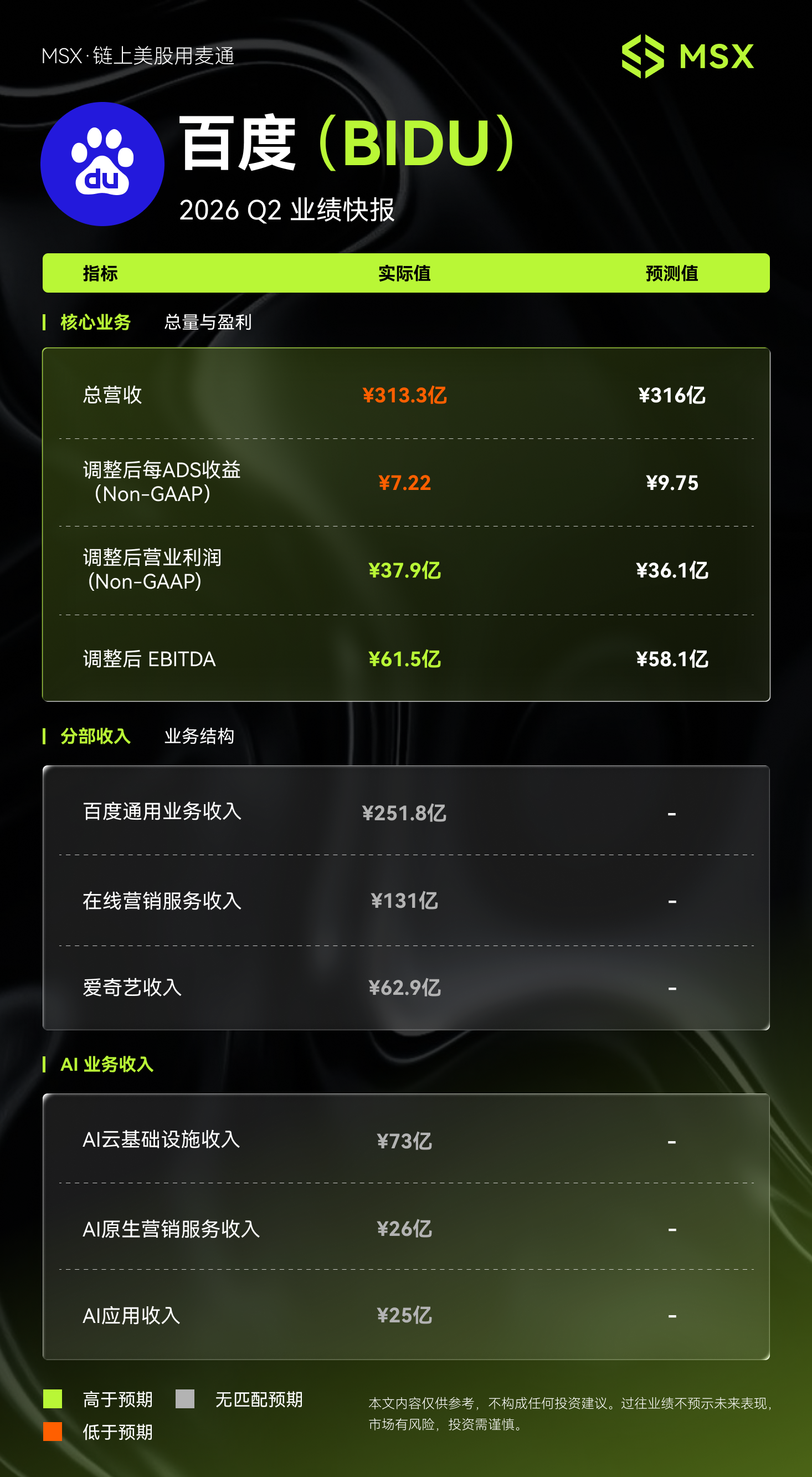
MSX US Stock Daily Observation: Baidu 2026 Q2 Earnings: AI Revenue Accounts for Half of Core Business for Two Consecutive Quarters, 283% GPU Cloud Growth Boosts Business Transformation

**MSX Daily US Stock Observation: Baidu 2026 Q2 Earnings Report** Baidu's Q2 2026 earnings present a clear picture of a company in transition. Total revenue declined slightly to RMB 313.25 billion, missing market expectations. This was driven by a continued double-digit contraction (-19%) in its core online marketing (advertising) business. The key highlight is the structural shift within the company's operations. AI-related revenue reached RMB 125 billion, accounting for approximately half of Baidu's core business income for the second consecutive quarter. Within AI, growth is heavily skewed towards infrastructure: AI cloud infrastructure revenue grew 50% year-over-year to RMB 73 billion, with GPU cloud revenue surging 283%. In contrast, AI application and AI-native marketing services revenue grew only 3% and remained flat, respectively, indicating slower commercialization on the application side. Profitability metrics were mixed. While adjusted operating profit and EBITDA exceeded expectations, demonstrating cost control, adjusted earnings per ADS of RMB 7.22 fell short by about 26%. This gap is largely attributed to depreciation and amortization costs linked to significant AI infrastructure investments, which continue to pressure bottom-line profit realization. The company holds a substantial cash position of RMB 2831 billion, providing runway for continued investment. The critical challenge ahead is translating the explosive growth in AI infrastructure (like GPU cloud) into stronger monetization from AI applications to bridge the gap between operational profit and per-share earnings.

Odaily星球日报10m ago

MSX US Stock Daily Observation: Baidu 2026 Q2 Earnings: AI Revenue Accounts for Half of Core Business for Two Consecutive Quarters, 283% GPU Cloud Growth Boosts Business Transformation

Odaily星球日报10m ago

Trading

Spot
活动图片