Fed cuts rates by 25 bps, ends QT by December — Crypto eyes dovish turn

ambcryptoPublished on 2025-10-29Last updated on 2025-10-29

Key Takeaways 

What did the Federal Reserve announce?

The Fed cut interest rates by 25 basis points to a target range of 3.75%–4.00%, marking its first reduction since 2023.

How could this affect crypto markets?

Lower rates and the end of QT could boost liquidity, which has historically been a tailwind for risk assets like Bitcoin.


The U.S. Federal Reserve cut interest rates by 25 basis points on Wednesday, setting a new target range of 3.75% to 4.00%. It’s the first rate reduction since 2023 and signals a clear pivot toward monetary easing.

In the same announcement, the Fed confirmed it will end quantitative tightening (QT) by 1 December, effectively halting its long-running balance sheet reduction program. 

This move marks a sharp shift from the central bank’s prior focus on curbing inflation through tighter liquidity.

According to the FOMC statement, policymakers acted in response to slowing inflation, softening labor conditions, and rising downside risks to employment. 

While officials noted that inflation remains above the 2% target, they stated that the “balance of risks” has now shifted in favor of supporting growth rather than restraining demand.

Markets react cautiously

The rate cut immediately drew attention from crypto traders, who often view Fed policy as a key driver of liquidity across digital assets. 

Bitcoin [BTC] held steady above $110,500 after the announcement, while Ethereum [ETH] hovered around $4,000. 

Market participants are now watching Fed Chair Jerome Powell’s press conference for further clues about whether this is the start of a longer easing cycle.

The Crypto Fear and Greed Index dropped to 39 (“Fear”), reflecting a more cautious market mood compared to last week’s neutral reading. 

Crypto market sentimentCrypto market sentiment

Source: CoinMarketCap

This suggests that investors remain wary despite the policy shift, waiting for stronger confirmation of a sustained dovish approach.

Powell tempers expectations for further cuts

During his post-meeting press conference, Fed Chair Jerome Powell stressed that Wednesday’s 25 bps rate cut is “not a preset course” toward continued easing. He said the move reflects a balanced approach as risks to employment rise and inflation stays “somewhat elevated.”

Powell also confirmed that the Fed will end quantitative tightening by 1 December after signs of tightening liquidity in money markets. 

Repo rates have climbed relative to policy benchmarks — a signal the Fed has drained enough reserves.

The remarks suggest the Fed aims to stabilize liquidity, not launch a full easing cycle, leaving traders cautious but optimistic about a dovish shift ahead.

Why it matters

A lower interest rate environment and the end of QT could inject fresh liquidity into global markets. 

Historically, such conditions have supported risk assets like Bitcoin, which tend to perform well when capital becomes cheaper and more abundant. 

A potential revival in ETF inflows and stablecoin demand is expected, as investors rebalance portfolios around a softer Fed stance.

However, the Fed’s reference to “elevated uncertainty” signals that volatility may persist. If Powell emphasizes caution during his remarks, markets could swing sharply before stabilizing.

For now, traders appear to be positioning for a gradual return to liquidity-driven growth—one that could reignite risk appetite across crypto if the Fed confirms this dovish shift in tone.


Share

Related Reads

Bank of Russia: 12 Largest Banks to Connect Digital Ruble from September 1, 2026

The Central Bank of Russia (CBR) announced that all 12 of the country's systemically important banks will be ready to offer clients digital ruble accounts and transactions starting September 1, 2026. According to Alla Bakina, director of the CBR's national payment system department, these banks cover over 80% of the domestic payment market. The digital ruble is described as a new form of the existing currency, functioning as a cashless payment method but held directly in a user's wallet on the CBR platform. Nine other banks designated as significant payment market participants are also expected to provide access, with most aiming to complete integration by autumn 2026. Starting from the September launch date, major retail chains with annual revenue exceeding 120 million rubles will be required to accept digital ruble payments, though adoption for citizens remains voluntary. The rollout follows a delayed pilot phase, with mass implementation postponed from 2025. The CBR's model currently offers basic account functionality without interest accrual, unlike China's digital yuan, which began paying interest in early 2026. The announcement positions Russia among dozens of countries testing Central Bank Digital Currencies (CBDCs), though the digital ruble's potential role in cross-border settlements, particularly within BRICS, remains an open question for its future international relevance.

cryptonews.ru5m ago

Bank of Russia: 12 Largest Banks to Connect Digital Ruble from September 1, 2026

cryptonews.ru5m ago

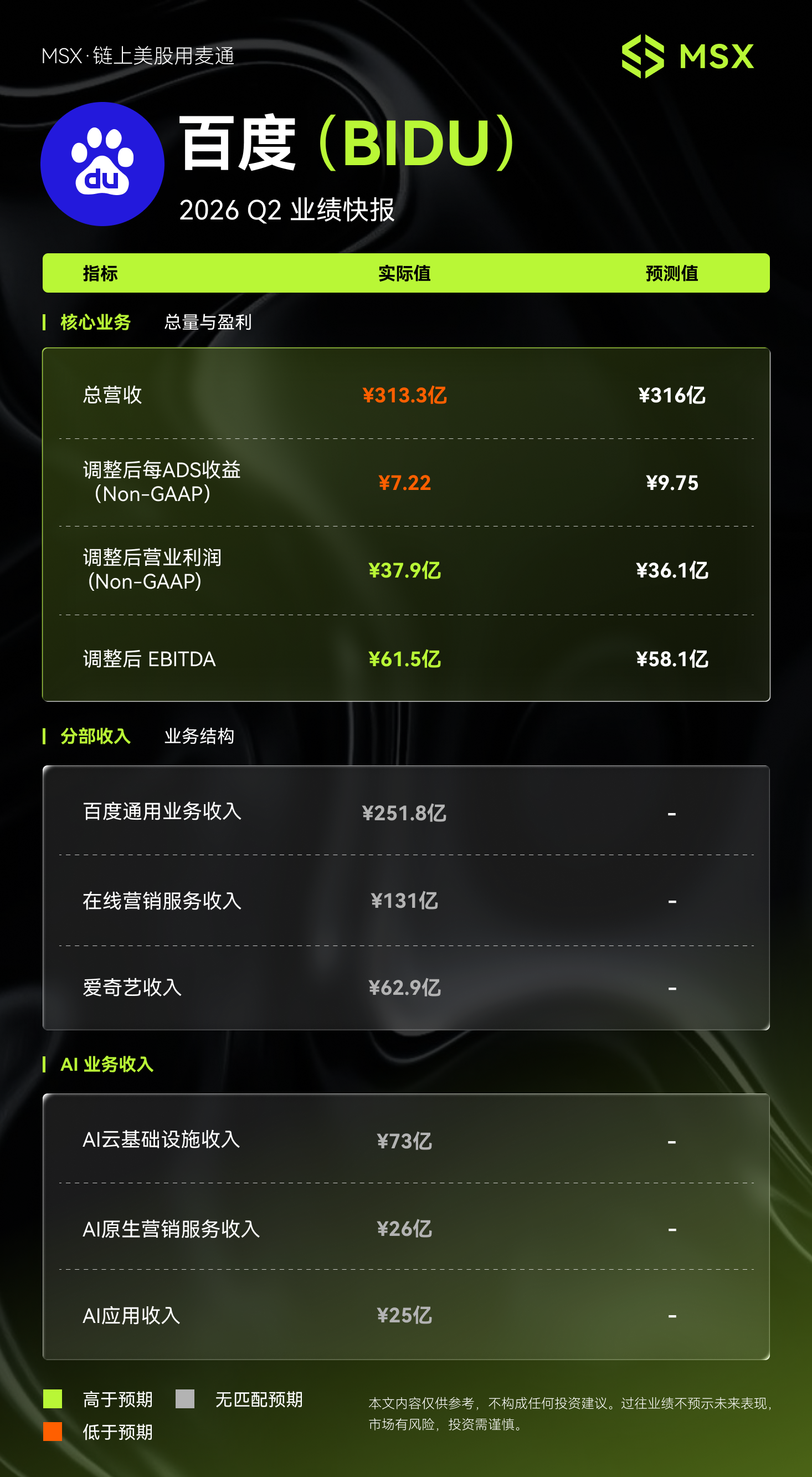
MSX US Stock Daily Observation: Baidu 2026 Q2 Earnings: AI Revenue Accounts for Half of Core Business for Two Consecutive Quarters, 283% GPU Cloud Growth Boosts Business Transformation

**MSX Daily US Stock Observation: Baidu 2026 Q2 Earnings Report** Baidu's Q2 2026 earnings present a clear picture of a company in transition. Total revenue declined slightly to RMB 313.25 billion, missing market expectations. This was driven by a continued double-digit contraction (-19%) in its core online marketing (advertising) business. The key highlight is the structural shift within the company's operations. AI-related revenue reached RMB 125 billion, accounting for approximately half of Baidu's core business income for the second consecutive quarter. Within AI, growth is heavily skewed towards infrastructure: AI cloud infrastructure revenue grew 50% year-over-year to RMB 73 billion, with GPU cloud revenue surging 283%. In contrast, AI application and AI-native marketing services revenue grew only 3% and remained flat, respectively, indicating slower commercialization on the application side. Profitability metrics were mixed. While adjusted operating profit and EBITDA exceeded expectations, demonstrating cost control, adjusted earnings per ADS of RMB 7.22 fell short by about 26%. This gap is largely attributed to depreciation and amortization costs linked to significant AI infrastructure investments, which continue to pressure bottom-line profit realization. The company holds a substantial cash position of RMB 2831 billion, providing runway for continued investment. The critical challenge ahead is translating the explosive growth in AI infrastructure (like GPU cloud) into stronger monetization from AI applications to bridge the gap between operational profit and per-share earnings.

Odaily星球日报10m ago

MSX US Stock Daily Observation: Baidu 2026 Q2 Earnings: AI Revenue Accounts for Half of Core Business for Two Consecutive Quarters, 283% GPU Cloud Growth Boosts Business Transformation

Odaily星球日报10m ago

Trading

Spot
活动图片