В Конгрессе США обострились споры о регулировании DeFi и крипторынка

cryptonews.ruPublished on 2025-04-23Last updated on 2025-10-24

Обсуждение законопроекта о структуре рынка криптовалют между руководителями отрасли и американскими законодателями достигло пика в среду на напряженном заседании. Поводом стала утечка предложения демократов о введении разрешительных требований для сектора децентрализованных финансов.

Сенаторы-демократы обвинили руководителей отрасли в том, что они действуют как продолжение Республиканской партии. По словам журналистки Элинор Терретт, ссылающейся на источники на заседании, просочившееся предложение демократов о введении правил «Знай своего клиента» и борьбе с отмыванием денег в сфере DeFi вызвало общественный резонанс.

Сообщается, что законодатели предупредили представителей отрасли, что продолжающееся общественное недовольство законопроектом или отдельными его положениями замедлит процесс принятия нормативных актов.
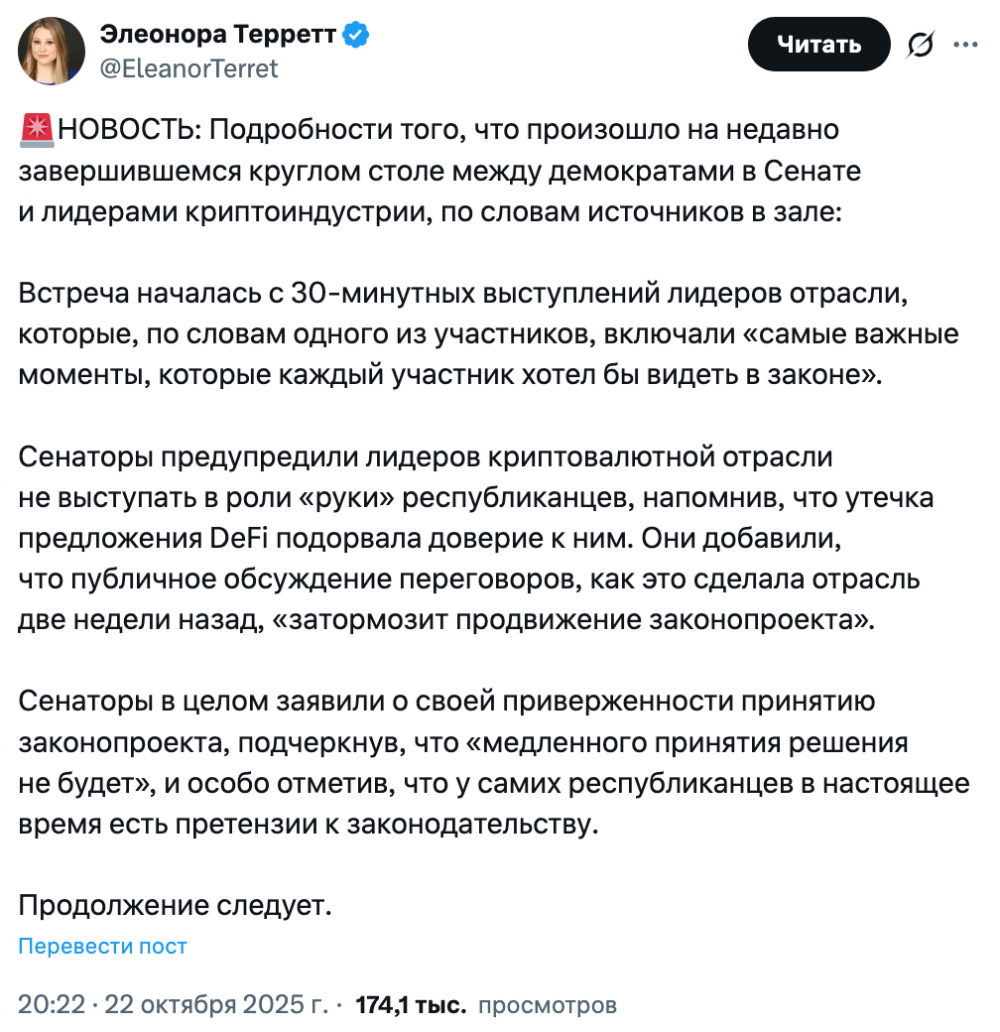

Источник: Элеонора Терретт.

Бо Хайнс, бывший директор Рабочей группы президента США по цифровым активам, раскритиковал реакцию демократов. Он заявил, что сенатор-демократ расстроен тем, что криптосообщество смогло рассмотреть политические предложения, которые он хочет превратить в закон. По его словам, это напоминает сатиру.

Напряженная встреча проходит на фоне четвертой недели приостановки работы правительства США. Это тормозит процесс принятия законопроекта о структуре рынка криптовалют и обеспечение ясности в регулировании отрасли.

Законопроект о структуре рынка криптовалют продвигается вперед, несмотря на приостановку работы правительства

Конгрессмен от Висконсина Брайан Стейл заявил, что законопроект о структуре рынка криптовалют, известный как Закон CLARITY, все еще находится на пути к подписанию к 2026 году, несмотря на продолжающуюся приостановку работы правительства.

«Я надеюсь, что, когда мы оправимся от приостановки работы правительства, у нас будет возможность быстро взяться за дело и добиться быстрого продвижения в Сенате», — заявил Стейл в интервью CNBC 8 октября.

Экономический советник Белого дома Кевин Хассетт также заявил CNBC в понедельник, что приостановка работы правительства, вероятно, завершится на этой неделе, если республиканцам удастся получить необходимые голоса.

«Умеренные демократы продвинутся вперед и обеспечат нам открытое правительство, и тогда мы сможем обсуждать любые политические решения, которые они захотят, в обычном порядке», — сказал Хассетт.


Related Reads

Why Does 'AGI Godfather' Ben Goertzel Believe the Future of AI Relies on Blockchain?

Ben Goertzel, known as the "AGI Godfather," argues that the future of Artificial General Intelligence (AGI) must be built on blockchain to prevent its control by a few corporations or venture capital firms. He believes the core AGI code should be free and open-source, but that this alone is insufficient without a decentralized infrastructure to run it affordably. His blockchain project, SingularityNET, and the broader Artificial Superintelligence Alliance aim to create a user-owned, decentralized network for hosting and deploying AGI, contrasting with the closed models of companies like OpenAI and Anthropic. Goertzel criticizes the shift of other labs from open to closed development. He argues that while a closed path is simpler, an open, decentralized model—akin to Linux and the internet—is both possible and ultimately better for humanity. He envisions an "Agent economy" where individuals orchestrate teams of AI agents to perform tasks, including transactions, on an open network rather than corporate clouds. While his current model relies on cryptocurrency, plans include offering paid AI services to businesses with the decentralized blockchain as the backend. Goertzel predicts human-level AGI could arrive by 2029 and warns that a gap in understanding and access to AGI could drastically worsen inequality. The first test of his decentralized approach will be the upcoming release of the Agent Omega Claw.

Foresight News9m ago

Why Does 'AGI Godfather' Ben Goertzel Believe the Future of AI Relies on Blockchain?

Foresight News9m ago

A Company Once on the Brink of Bankruptcy Just Surpassed Bitcoin in Market Cap

On June 22nd, driven by rising stock prices, SK Hynix’s market capitalization reached $1.35 trillion, surpassing Bitcoin's total market cap of approximately $1.29 trillion. This temporarily made it South Korea's highest-valued company. The core driver of this surge is HBM (High Bandwidth Memory), for which SK Hynix is the primary supplier to NVIDIA, holding over 60% market share. AI's demand for high memory bandwidth has translated into immense profitability, with SK Hynix reporting a 72% operating profit margin in Q1. The company's success follows a 13-year bet on HBM technology, beginning in 2009. It nearly failed after the 2001 dot-com bubble, was acquired by SK Group in 2012, and was subsequently recapitalized to continue its long-term HBM development. The article contrasts this with the Crypto AI narrative. Capital currently favors AI infrastructure players like SK Hynix due to "real orders, physical barriers, and quantifiable profit margins." In comparison, Crypto AI projects, promising decentralized compute and data markets, remain largely conceptual with limited tangible progress. Examples include Bittensor, whose core mechanisms are still under development, and Bitcoin miners transitioning to AI, who face significant funding gaps and execution challenges. The piece cites analysis suggesting the AI sector has absorbed nearly all new market liquidity since 2022, leaving little for crypto. It concludes that the current AI infrastructure红利 is captured by entities with proven technical barriers and supply capabilities, while crypto networks still need to define their concrete role in the value chain.

链捕手49m ago

A Company Once on the Brink of Bankruptcy Just Surpassed Bitcoin in Market Cap

链捕手49m ago

Bittensor Moves Towards Ultimate Decentralization: The Critical 18 Months for the TAO Ecosystem is Here?

Bittensor, a decentralized AI protocol, is accelerating its transition to full decentralization over the next 18 months, as outlined in a recent post by co-founder Const. The project currently operates in a "semi-decentralized" state: ownership and network participation are open and permissionless, with TAO distribution based on competitive contribution. However, protocol upgrades and governance have remained under core team control to enable rapid iteration in the fast-evolving AI sector. This strategic shift comes as the ecosystem matures, boasting 128 subnets and a large community. Const argues that continued centralization now poses risks, including single points of failure and regulatory scrutiny. The upcoming decentralization roadmap includes optimizing validator competition, opening liquidity pools, introducing governance rights for Alpha holders, and refining economic models. The move could fundamentally reshape TAO's value proposition, adding governance premiums to its existing valuation based on AI narrative and scarcity. It also signals a potential maturation of the AI crypto sector, where competition may shift from hype to sustainable protocol design and real economic activity. Bittensor positions itself not just as another AI token, but as foundational infrastructure aiming to decentralize intelligence production—analogous to Bitcoin's role in decentralizing money—with the goal of creating a resilient "Millennium Intelligence Federation."

marsbit1h ago

Bittensor Moves Towards Ultimate Decentralization: The Critical 18 Months for the TAO Ecosystem is Here?

marsbit1h ago

Trading

Spot
Futures
活动图片