加密市场震荡蓄势:美政与降息预期交织 BTC筑底、ETH与SOL领衔主线

金色财经Published on 2025-10-23Last updated on 2025-10-23

现在加密市场处于震荡期,耐心等他洗完——

目前多头需要做的事情就是等!

一、等美国政府恢复运行

二、等中美关税事件落地

目前10月降息概率较高,利率宽松是一个基础利好,只要美国政府恢复运行,流动性释放自然会让市场更加活跃。

市场终究是要上去的。

  市场动态   数据解读  

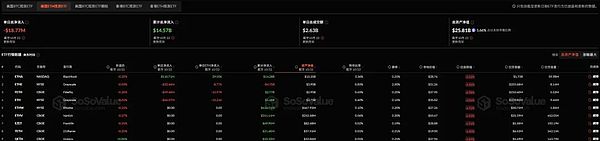
一、以太坊现货ETF昨日净流出1877万美元,仅贝莱德ETHA录得净流入:
图片

美东时间10月22日,以太坊现货ETF总净流出达1877.29万美元。截至目前,以太坊现货ETF总资产净值为258.15亿美元,占以太坊总市值约5.66%,历史累计净流入达145.74亿美元。

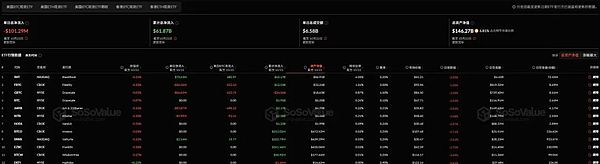
二、比特币现货ETF昨日净流出1.01亿美元,贝莱德IBIT逆势流入7363万美元:
图片

美东时间10月22日,比特币现货ETF总净流出1.01亿美元。截至目前,比特币现货ETF总资产净值为1462.70亿美元,占比特币总市值约6.81%,历史累计净流入达618.74亿美元。

技术面:BTC/ETH 寻底筑局,关键点位定方向

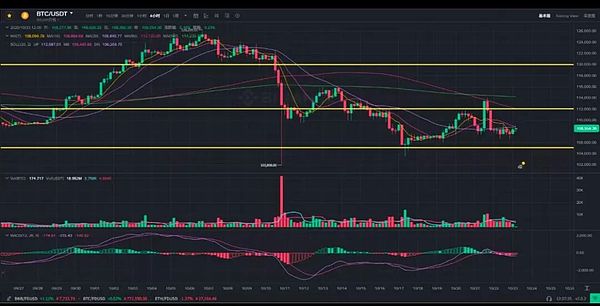
(1)BTC:W 底形态初现,110K 成止跌关键

趋势与量能特征:比特币当前处于中期上升趋势中的阶段式回调,核心任务是回踩确认支撑,周线级上升通道尚未被破坏。前两日市场放量但未现大幅下跌,表明低位已有承接资金介入;不过反弹阶段成交量萎缩,显示多头尚未形成共识性动能,暂未进入强势反攻阶段。
640?wx_fmt=jpeg&from=appmsg

形态与指标指引:走势已浮现 “W 底雏形”,颈线压力锚定 110K 关口,若后续能放量突破该位置,可视为阶段性止跌信号,行情有望开启反弹。MACD 指标虽仍在 0 轴下方运行,但曲线趋于平缓,柱状图负值持续缩短,空头动能正逐步衰减,多空力量对比缓慢向多头倾斜。

日内操作锚点:下方重点关注 106.3K-107.3K 支撑区间,可依托该区间布局短多;上方需留意 109.3K-110.3K 压力带,突破需量能配合方可确认强度,短期 1-3 天大概率在 107K-110K 区间震荡测试方向。

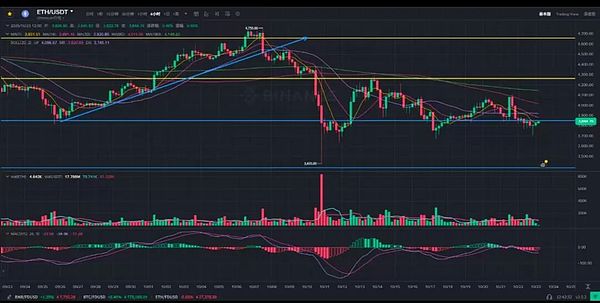
(2)ETH:收敛三角收尾,3700 点守生命线

趋势与形态结构:以太坊同样处于中期上升趋势的阶段性回调,周线大周期仍维持多头格局,但短线陷入弱势整理。日线短期均线(MA7/14)形成死叉向下,对价格构成压制;中期均线(MA30/60)开始拐头进入整理区,仅长期均线(MA180/365)保持上升,3400 点成为中期生命防守线。当前日线处于收敛三角形态收尾阶段,横向震荡空间不断收窄,方向抉择窗口临近。
640?wx_fmt=jpeg&from=appmsg

量能与指标信号:近期 K 线以连续小阴小阳为主,反弹动能明显减弱,反映市场恐慌情绪仍较浓烈;成交量呈现 “放量小跌、缩量反弹” 特征,交易活跃度偏低,多空观望氛围浓厚。MACD 指标在 0 轴下方趋于平缓,柱状图负值缩小,底背离信号初露端倪,若比特币率先放量突破,以太坊或同步开启反弹。

日内走势预判:重点关注两个关键点位 —— 若放量突破 4000 点,可确认反弹启动;若放量跌破 3700 点,则大概率下探 3400 点附近支撑。日内操作上,下方支撑聚焦 3750-3800 区间,上方压力关注 3880-3930 区间。

山寨币:分化加剧,ETH/SOL 生态成布局主线

昨日受主流币震荡调整影响,山寨币市场情绪再度谨慎,恐慌指数回落至 30 以下,整个板块尚未真正突破困局,不少代币仍随大盘波动。尽管 ZEC 表现亮眼,30 天内涨幅达五倍左右,但多数山寨币仍处于调整或观望阶段。

在大盘缺乏强劲上攻动力的背景下,资金开始布局低位山寨币,尤其聚焦有真实应用场景和技术创新的项目。市场分化愈发明显:部分开发活跃、根基扎实的山寨币在回调中展现出较强韧性,而多数山寨币仍未摆脱 “危机余震” 的影响。

未来,只有具备生态生命力(兼具技术与生态)的项目,如 ETH、SOL 生态相关代币,才能经受住市场考验,实现突破。

  • 以太坊的生态生命力,体现在其作为 Web3 结算层、安全层与信任层的核心地位 —— 拥有全球规模最大、最活跃的开发者社区,承载着最高的 TVL,更是 DeFi 与 NFT 的发源地。后续诸如 Restaking、LSD 等创新叙事,都将围绕以太坊的安全性与质押展开。

  • SOL 的生态生命力,源于其极低的交易成本与极快的处理速度,在牛市回调后展现出强劲韧性。其用户体验领先,尤其适配高频交易及面向消费者的应用(如 DePin、NFT、Meme Coin)。此外,香港批准首只 SOL 现货 ETF,将其列为机构认可的第三大底层资产,为生态引入了合规资金。

未来围绕 ETH 与 SOL 两大生态主线布局,将是把握山寨币市场机遇的首要步骤。

Related Reads

Understanding CPO (Co-Packaged Optics) in One Article: Why Nvidia Is Willing to Spend $3.2 Billion on a Fiber?

NVIDIA and Corning announced a multi-year strategic partnership on May 6, 2026, with NVIDIA committing up to $3.2 billion to support Corning's U.S. expansion. This investment will triple Corning's manufacturing plants and significantly boost its optical fiber and communications production capacity. The core driver behind this massive investment is the fundamental shift from copper to optical interconnect technology within AI data centers. As GPU clusters scale, copper wires face critical limitations: severe signal attenuation over distance, high energy consumption for signal integrity, and excessive heat generation. Optical fiber, transmitting light instead of electrical signals, solves these issues with minimal loss, near-light speed, and lower power needs. The article outlines a three-stage evolution of data center interconnect: 1. **Traditional Copper Interconnects:** The mainstream solution of the 2010s, now being phased out due to scaling bottlenecks. 2. **Pluggable Optical Modules:** The current mainstream, where modules convert electrical signals to light externally. This process still introduces energy loss and latency. 3. **CPO (Co-Packaged Optics):** The next-generation technology where the optical engine is integrated directly with the GPU chip package. This drastically reduces the electrical signal travel distance to mere millimeters, slashing power consumption and latency while boosting data density. NVIDIA CEO Jensen Huang has identified CPO as an essential core technology for AI infrastructure. NVIDIA's investment signifies a strategic shift from being a buyer to actively controlling its supply chain for critical components. With demand for specialized optical fiber far outstripping supply—evidenced by soaring prices—securing long-term manufacturing capacity has become a competitive necessity. While Corning's expansion may pressure some suppliers, a projected global fiber supply gap of 5-15% over the next few years creates a significant opportunity window, particularly for Chinese manufacturers competitive in optical preforms, chips, and modules. Ultimately, NVIDIA's move is not about chasing a trend but an engineering imperative. The transition to light-based interconnects like CPO is driven by the physical limits of copper, marking a definitive step in the ongoing AI computing revolution.

marsbit23m ago

Understanding CPO (Co-Packaged Optics) in One Article: Why Nvidia Is Willing to Spend $3.2 Billion on a Fiber?

marsbit23m ago

KOL's Perspective: Why Is SOL Set to Rise from This Point?

**Summary: Why SOL is Positioned for Growth at This Level** The article argues that SOL is poised for an upward move from its current price point, citing several key factors. Primarily, SOL has just broken out of a 4-month consolidation phase. This breakout signals a return of risk appetite to the broader crypto market, as SOL is seen as a key indicator of overall crypto health. The token's ownership has reportedly shifted from short-term traders and tourists to long-term accumulators, leading to low volume. Any meaningful increase in trading activity could thus trigger significant upward momentum. Fundamental strengths include strong institutional adoption, integration with DeFi and RWAs (Real-World Assets), and the potential benefits from the Clarity Act. Despite its high volatility—having dropped 70% from its all-time high but still up 12x from its bear market low—SOL is highlighted as one of the few tokens from the last cycle to reach new highs. It boasts a robust ecosystem of applications, users, and protocols. Future catalysts include the expected influx of AI developers following the Miami Accelerate conference, which focused on AI on Solana. Furthermore, Solana is positioned as the premier chain for memecoin activity, a trend expected to continue and drive network usage and fees. The article concludes that recent price action reflects a healthy transfer to long-term holders, setting the stage for growth.

marsbit1h ago

KOL's Perspective: Why Is SOL Set to Rise from This Point?

marsbit1h ago

Those Pre-Bitcoin PoW Protocols Have Recently Been Reimplemented

This article details a recent surge in replicating pre-Bitcoin Proof-of-Work (PoW) protocols, specifically focusing on Hal Finney's 2004 RPOW (Reusable Proofs of Work). Within five days in May 2026, multiple independent builders in the Bitcoin/cypherpunk community launched projects inspired by this early electronic cash proposal. The initiative began with Fred Krueger's `rpow2.com`, a centralized but auditable system that replaced RPOW's original IBM 4758 hardware with Ed25519 signatures. Initially a faithful replica, it later adopted Bitcoin-like features (21M supply cap, difficulty adjustment) and a controversial 5.24% founder allocation. This sparked rapid forks, including `rpow4.com` which incorporated full Bitcoin parameters, a prediction market (`rpowmarket.com`), and a DEX (`rpow2swap.com`). Concurrently, Mike In Space created a prototype of Wei Dai's 1998 b-money proposal (`b-money.replit.app`), pushing the historical exploration even further back. The article contrasts these centralized, server-dependent experiments with Bitcoin's core innovation of decentralized, trustless consensus. It also highlights a parallel development: the `HASH` project on Ethereum, which uses smart contract hooks to enable a purely fair-launch, browser-mineable PoW token with 0% allocations to team or VCs. The collective activity is framed as a meme-driven, educational exploration of cypherpunk history rather than a serious financial movement, with all projects heavily disclaiming any investment value.

marsbit1h ago

Those Pre-Bitcoin PoW Protocols Have Recently Been Reimplemented

marsbit1h ago

South Korean Exchanges 'Battle' Regulators, Challenging the Boundaries of Enforcement and Legislation

South Korea's cryptocurrency industry is engaged in a rare, direct confrontation with regulators. The Financial Intelligence Unit (FIU), the primary anti-money laundering (AML) watchdog, has recently imposed heavy penalties on major exchanges like Upbit and Bithumb for alleged violations involving unregistered overseas VASPs and AML procedures. However, exchanges are now actively challenging these actions in court and through industry associations. In a significant shift, the Seoul Administrative Court ruled in favor of Upbit's operator, Dunamu, overturning part of an FIU-ordered business suspension. The court found the FIU's penalty criteria and justification insufficiently clear. Similarly, the court suspended the enforcement of a six-month business suspension against Bithumb pending a final ruling, citing potential irreversible harm to the exchange. Beyond legal battles, the industry is contesting proposed legislative amendments. The Digital Asset eXchange Alliance (DAXA) strongly opposes a draft rule that would mandate Suspicious Transaction Reports (STRs) for all crypto transfers over 10 million KRW (~$6,800). DAXA argues this "poison pill" clause violates legal principles and would overwhelm the STR system, increasing reports from 63,000 to an estimated 5.45 million annually for major exchanges, thereby crippling effective AML monitoring. This conflict highlights a structural tension in South Korea's crypto governance: comprehensive digital asset laws are still developing, while regulators rely heavily on AML enforcement. The industry's move from passive compliance to active legal and legislative challenges signifies a new phase, pressing for clearer rules and more proportionate enforcement. While short-term disputes may intensify, this clash could ultimately lead to a more mature and sustainable regulatory framework for South Korea's vibrant crypto market.

marsbit2h ago

South Korean Exchanges 'Battle' Regulators, Challenging the Boundaries of Enforcement and Legislation

marsbit2h ago

Trading

Spot
Futures

Hot Articles

What is $BITCOIN

DIGITAL GOLD ($BITCOIN): A Comprehensive Analysis Introduction to DIGITAL GOLD ($BITCOIN) DIGITAL GOLD ($BITCOIN) is a blockchain-based project operating on the Solana network, which aims to combine the characteristics of traditional precious metals with the innovation of decentralized technologies. While it shares a name with Bitcoin, often referred to as “digital gold” due to its perception as a store of value, DIGITAL GOLD is a separate token designed to create a unique ecosystem within the Web3 landscape. Its goal is to position itself as a viable alternative digital asset, although specifics regarding its applications and functionalities are still developing. What is DIGITAL GOLD ($BITCOIN)? DIGITAL GOLD ($BITCOIN) is a cryptocurrency token explicitly designed for use on the Solana blockchain. In contrast to Bitcoin, which provides a widely recognized value storage role, this token appears to focus on broader applications and characteristics. Notable aspects include: Blockchain Infrastructure: The token is built on the Solana blockchain, known for its capacity to handle high-speed and low-cost transactions. Supply Dynamics: DIGITAL GOLD has a maximum supply capped at 100 quadrillion tokens (100P $BITCOIN), although details regarding its circulating supply are currently undisclosed. Utility: While precise functionalities are not explicitly outlined, there are indications that the token could be utilized for various applications, potentially involving decentralized applications (dApps) or asset tokenization strategies. Who is the Creator of DIGITAL GOLD ($BITCOIN)? At present, the identity of the creators and development team behind DIGITAL GOLD ($BITCOIN) remains unknown. This situation is typical among many innovative projects within the blockchain space, particularly those aligning with decentralized finance and meme coin phenomena. While such anonymity may foster a community-driven culture, it intensifies concerns about governance and accountability. Who are the Investors of DIGITAL GOLD ($BITCOIN)? The available information indicates that DIGITAL GOLD ($BITCOIN) does not have any known institutional backers or prominent venture capital investments. The project seems to operate on a peer-to-peer model focused on community support and adoption rather than traditional funding routes. Its activity and liquidity are primarily situated on decentralized exchanges (DEXs), such as PumpSwap, rather than established centralized trading platforms, further highlighting its grassroots approach. How DIGITAL GOLD ($BITCOIN) Works The operational mechanics of DIGITAL GOLD ($BITCOIN) can be elaborated on based on its blockchain design and network attributes: Consensus Mechanism: By leveraging Solana’s unique proof-of-history (PoH) combined with a proof-of-stake (PoS) model, the project ensures efficient transaction validation contributing to the network's high performance. Tokenomics: While specific deflationary mechanisms have not been extensively detailed, the vast maximum token supply implies that it may cater to microtransactions or niche use cases that are still to be defined. Interoperability: There exists the potential for integration with Solana’s broader ecosystem, including various decentralized finance (DeFi) platforms. However, the details regarding specific integrations remain unspecified. Timeline of Key Events Here is a timeline that highlights significant milestones concerning DIGITAL GOLD ($BITCOIN): 2023: The initial deployment of the token occurs on the Solana blockchain, marked by its contract address. 2024: DIGITAL GOLD gains visibility as it becomes available for trading on decentralized exchanges like PumpSwap, allowing users to trade it against SOL. 2025: The project witnesses sporadic trading activity and potential interest in community-led engagements, although no noteworthy partnerships or technical advancements have been documented as of yet. Critical Analysis Strengths Scalability: The underlying Solana infrastructure supports high transaction volumes, which could enhance the utility of $BITCOIN in various transaction scenarios. Accessibility: The potential low trading price per token could attract retail investors, facilitating wider participation due to fractional ownership opportunities. Risks Lack of Transparency: The absence of publicly known backers, developers, or an audit process may yield skepticism regarding the project's sustainability and trustworthiness. Market Volatility: The trading activity is heavily reliant on speculative behavior, which can result in significant price volatility and uncertainty for investors. Conclusion DIGITAL GOLD ($BITCOIN) emerges as an intriguing yet ambiguous project within the rapidly evolving Solana ecosystem. While it attempts to leverage the “digital gold” narrative, its departure from Bitcoin's established role as a store of value underscores the need for a clearer differentiation of its intended utility and governance structure. Future acceptance and adoption will likely depend on addressing the current opacity and defining its operational and economic strategies more explicitly. Note: This report encompasses synthesised information available as of October 2023, and developments may have transpired beyond the research period.

363 Total ViewsPublished 2025.05.13Updated 2025.05.13

What is $BITCOIN

Discussions

Welcome to the HTX Community. Here, you can stay informed about the latest platform developments and gain access to professional market insights. Users' opinions on the price of BTC (BTC) are presented below.

活动图片