Tether Mints Another 1B USDT – $7B in Stablecoins Issued Since The Crash

bitcoinistPublished on 2025-10-23Last updated on 2025-10-23

Abstract

Tether has just minted another 1 billion USDT, only hours ago, reigniting debate over stablecoin-driven liquidity flows across the crypto...

Trusted Editorial content, reviewed by leading industry experts and seasoned editors. Ad Disclosure

Tether has just minted another 1 billion USDT, only hours ago, reigniting debate over stablecoin-driven liquidity flows across the crypto market. The mint comes at a crucial time — Bitcoin is struggling to reclaim higher levels after weeks of volatility, while altcoins continue to bleed as if a full-blown bear market were underway.
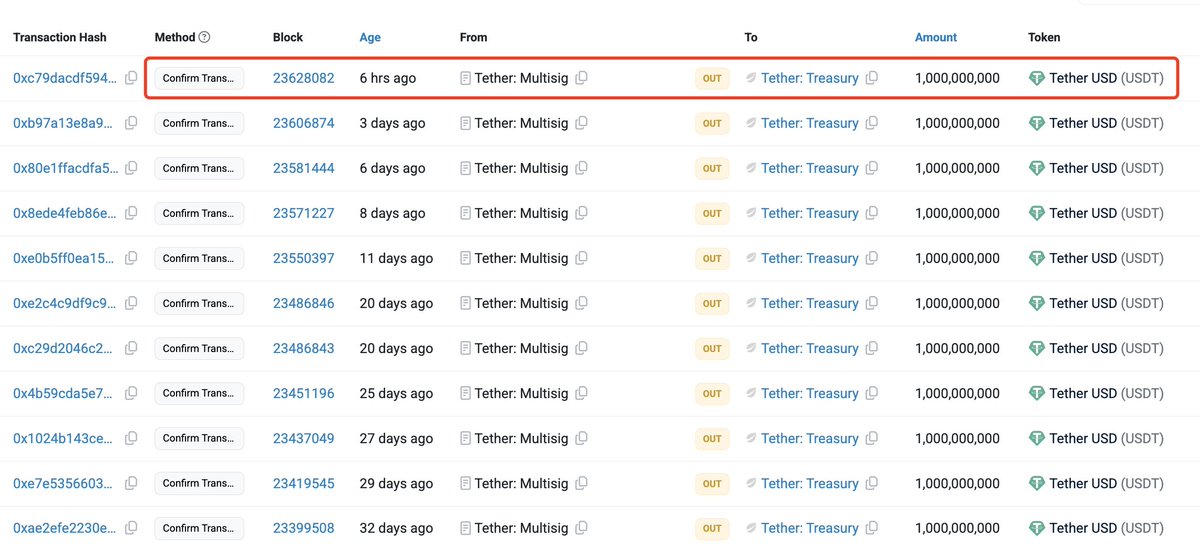
Tether mints $1B USDT | Source: Lookonchain

These mints tend to inject liquidity into exchanges, providing the capital needed for traders and market makers to re-enter positions or stabilize volatile price swings. While not always an immediate bullish catalyst, they frequently precede recoveries in market sentiment and volume.

The latest mint follows a wave of renewed uncertainty across the crypto landscape, with investors closely watching Bitcoin’s $110K level as a make-or-break support zone. Altcoins, meanwhile, are experiencing double-digit declines, raising concerns that risk appetite remains weak.

If history is any indication, this new influx of stablecoin liquidity could be setting the stage for a short-term rebound — or at least a temporary relief rally — as liquidity begins to circulate across major exchanges and derivative markets in the days ahead.

A Liquidity Wave That Could Shake the Market

According to data from Lookonchain, Tether and Circle have collectively minted over $7 billion in stablecoins since the October 10 market crash. This surge in new supply marks one of the most significant liquidity injections since midyear, sparking speculation about its potential impact on Bitcoin and the broader crypto market.

Stablecoin mints on this scale often act as precursors to major price swings. While not a direct form of buying, they indicate that fresh capital is being positioned to enter the market — typically through market makers, institutional desks, or exchanges preparing for renewed trading activity. In this context, the $7 billion influx suggests that liquidity conditions are improving after the sharp drawdown that liquidated billions in long positions earlier this month.

Related Reading: 2,496 Bitcoin Moved After Years Of Inactivity – Long-Term Holders Take Action

However, such rapid capital movement can also heighten volatility. As this liquidity begins to circulate, it can amplify both sides of the market — first triggering relief rallies as buyers re-enter, and then sharp corrections as leveraged positions unwind.

For Bitcoin, the timing is especially critical. With BTC still struggling to hold above $108K–$110K, this new liquidity could determine whether the next move is a bullish breakout or another leg lower. Historically, large stablecoin issuances have preceded upward shifts in Bitcoin’s price, but in a fragile market, they can also fuel speculative whipsaws.

Tether’s USDT Dominance Rebounds As Traders Seek Stability

Tether’s market dominance has risen sharply to around 5.06%, signaling a notable shift in sentiment as investors move capital into stablecoins amid heightened market volatility. The weekly chart shows a strong rebound from the 4.6% level, with USDT dominance now testing resistance near the 100-week moving average. This uptick coincides with the broader crypto market downturn following Bitcoin’s failure to hold key support at $110K and widespread selling across altcoins.
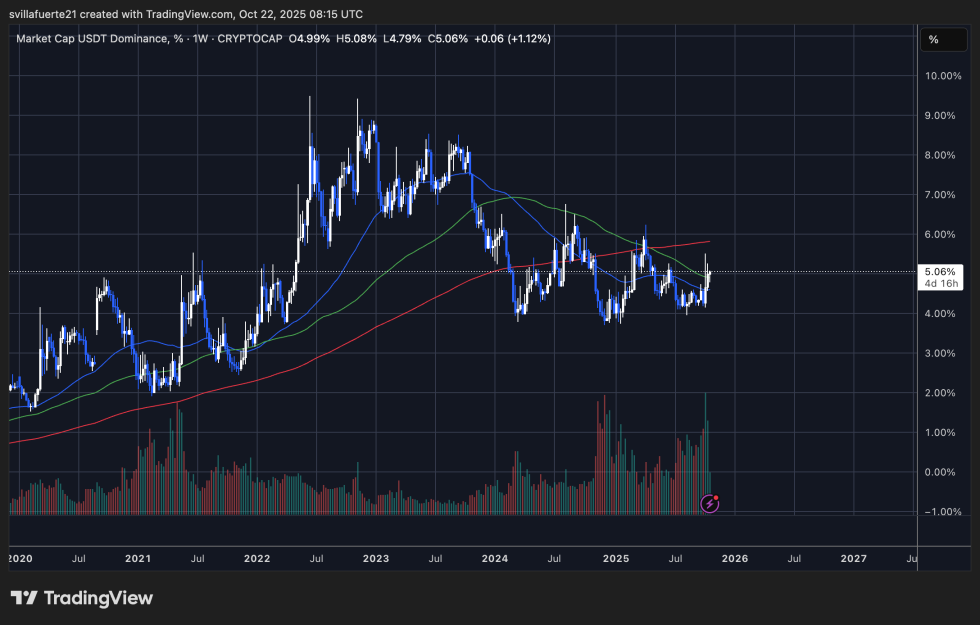
USDT Market Dominance | Source: USDT.C.D chart on TradingView

Historically, rising USDT dominance reflects increased demand for safety — traders exiting volatile assets and parking capital in stablecoins to wait for clearer market direction. This pattern often precedes periods of accumulation, as sidelined liquidity builds up, ready to re-enter once confidence returns.

From a technical standpoint, the structure suggests that a sustained breakout above 5.2% could extend the dominance rally toward 6%, a level last seen during previous market corrections. However, rejection here would imply stabilization and potential capital rotation back into risk assets.

Featured image from ChatGPT, chart from TradingView.com

Editorial Process for bitcoinist is centered on delivering thoroughly researched, accurate, and unbiased content. We uphold strict sourcing standards, and each page undergoes diligent review by our team of top technology experts and seasoned editors. This process ensures the integrity, relevance, and value of our content for our readers.

Sebastian's journey into the world of crypto began four years ago, driven by a fascination with the potential of blockchain technology to revolutionize financial systems. His initial exploration focused on understanding the intricacies of various crypto projects, particularly those focused on building innovative financial solutions. Through countless hours of research and learning, Sebastian developed a deep understanding of the underlying technologies, market dynamics, and potential applications of cryptocurrencies. As his knowledge grew, Sebastian felt compelled to share his insights with others. He began actively contributing to online discussions on platforms like X and LinkedIn, focusing on fintech and crypto-related content. His goal was to expose valuable trends and insights to a wider audience, fostering a deeper understanding of the rapidly evolving crypto landscape. Sebastian's contributions quickly gained recognition, and he became a trusted voice in the online crypto community. To further enhance his expertise, Sebastian pursued a UC Berkeley Fintech: Frameworks, Applications, and Strategies certification. This rigorous program equipped him with valuable skills and knowledge regarding Financial Technology, bridging the gap between traditional finance (TradFi) and decentralized finance (DeFi). The certification deepened his understanding of the broader financial landscape and its intersection with blockchain technology. Sebastian's passion for finance and writing is evident in his work. He enjoys delving into financial research, analyzing market trends, and exploring the latest developments in the crypto space. In his spare time, Sebastian can often be found immersed in charts, studying 10-K forms, or engaging in thought-provoking discussions about the future of finance. Sebastian's journey as a crypto analyst and investor has been marked by a relentless pursuit of knowledge and a dedication to sharing his insights. His ability to navigate the complex world of crypto, combined with his passion for financial research and communication, makes him a valuable asset to the industry. As the crypto landscape continues to evolve, Sebastian remains at the forefront, providing valuable insights and contributing to the growth of this revolutionary technology.

Related Reads

HSBC Research Report Analysis: Behind 12 Million Starlink Users, the Space Economy is Feeding Back to Earth

HSBC Research Report Analysis: The 120 Million Starlink Users and How the Space Economy is Fueling Earth's Industries. The core value of the new space race is returning to Earth, driving industrial upgrades across multiple sectors, according to an HSBC report covering 12 industries. Key developments include: SpaceX’s Starlink has surpassed a critical scale with 10,200 satellites, 12 million broadband users, and 7.4 million direct-to-cell devices. It is evolving from a backup solution to default infrastructure in maritime, aviation, trucking, and remote areas, complementing rather than competing with terrestrial telecom operators. Starship aims to reduce launch costs to $100-$300 per kilogram, a 95%+ reduction from historical averages. This drastic cost compression is reshaping the economics of satellite manufacturing, in-orbit services, and future ventures like asteroid mining. SpaceX’s plans for orbital AI data centers (100 GW by 2040) and the Terafab vertically integrated semiconductor foundry (a joint venture with Tesla and xAI) represent strategic shifts. While orbital data center costs are currently triple those on Earth, they offer a policy-independent backup for power-constrained AI growth. Terafab poses a potential challenge to the traditional fabless-foundry model. The report warns that aggressive capacity expansion by SpaceX and others could lead to a compute surplus by the late 2020s, potentially commoditizing LLMs and pressuring hardware vendors. The space race is most directly reshaping three core industries: 1. **Power/Utilities:** AI data centers are boosting annual U.S. electricity demand growth. Renewable energy and grid infrastructure are clear beneficiaries. 2. **Semiconductors:** Demand is created for "low-Earth orbit optimized" chips, while the vertically integrated Terafab model threatens traditional foundries. 3. **Robotics/Industrial:** Technologies for space mining, lunar construction, and in-orbit servicing are advancing with direct feedback to terrestrial applications in autonomous machinery and navigation. In conclusion, the space economy is already acting as an accelerator for Earth's industries through Starlink's scale, Starship's cost curve, and strategic projects like Terafab, with the most immediate impacts felt in power, semiconductors, and robotics.

marsbit15m ago

HSBC Research Report Analysis: Behind 12 Million Starlink Users, the Space Economy is Feeding Back to Earth

marsbit15m ago

Trading

Spot
活动图片