比特币的“黄金时刻”还未到来:ETF 买盘只是序章

marsbitPublished on 2025-10-21Last updated on 2025-10-22

当前加密市场对比特币存在两大核心疑问:

1. 为何金价表现会远超比特币?

2. 既然 ETF 和企业大量买入,为何比特币价格仍停滞不前?

事实上,若能仔细解答第一个问题,第二个问题的答案也会随之浮现——且这一答案为比特币的未来描绘了一幅极具看涨潜力的图景。

接下来我将具体分析。

疑问一:为何金价表现远超比特币?

目前金价尽管有所回调,但今年以来涨势迅猛,2025 年涨幅已达 57%,正朝着美元计价下的历史第二好年度表现迈进。与此同时,比特币却在 11 万美元关口附近陷入停滞,自 5 月以来价格大致持平。

这让将比特币视为「数字黄金」的投资者感到沮丧,但背后其实有一个简单的解释:差异源于各国央行的行为。

自俄罗斯入侵乌克兰后美国冻结俄罗斯持有的美国国债以来,各国央行便开始大量增持黄金。据 Metals Focus 数据显示,央行的黄金购买量自俄乌战争爆发后近乎翻倍,从每年约 467 吨增至如今的约 1000 吨,这一规模约为黄金 ETP(交易所交易产品)预估购买量的两倍。

比特币则无法享受这一待遇。尽管部分央行在研究比特币,但尚未有央行实际买入。因此,若央行是此次金价上涨的主要推手,那么比特币未能跟随金价走高便合乎逻辑。

这一观点并非新鲜事。无论是摩根士丹利(Morgan Stanley)、摩根大通(JPMorgan),还是穆罕默德·埃尔 - 埃里安(Mohamed El-Erian)等机构与人士,均指出央行购金是金价飙升的关键驱动因素。

疑问二:为何 ETF 与企业大量买入,比特币价格仍停滞不前?

这与第二个疑问有何关联?

答案是:关联极大。

比特币市场最大的谜团在于,尽管 ETF 和企业在大量买入,但其价格为何相对平稳。自 2024 年 1 月比特币 ETF 推出以来,ETF 和企业累计买入 139 万枚比特币,而同期比特币网络的新增供应量还不到这一规模的四分之一。尽管从那时起比特币价格已上涨 135%,表现不俗,但许多人仍在疑惑:难道它不该涨得更高吗?

我也曾有过同样的疑问:究竟是谁在大量抛售比特币?是什么阻碍了它突破 20 万美元关口?

当前的金价上涨给出了答案。

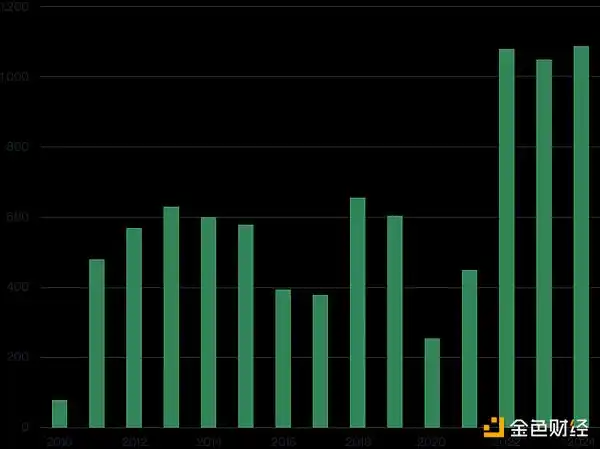
请看下方表格,该表格展示了 2010 年至 2024 年各国央行的年度黄金购买量。2021 年央行购金量为 467 吨,2022 年跃升至 1080 吨,此后一直保持在这一高位(预测显示 2025 年的需求将略低于 2024 年)。

2010-2024 年各国央行黄金购买量(单位:吨):

ETF

来源:世界黄金协会(World Gold Council)


简而言之,尽管央行购金是今年金价上涨的重要催化剂,但这类购买并非始于今年,而是从 2022 年就已开始。

这也为比特币当前的情况提供了答案。

2022 年央行购金量开始大幅增加时,金价的上涨速度较为缓慢:2022 年平均价格为 1800 美元,2023 年升至 1941 美元(仅上涨 8%),2024 年升至 2386 美元(上涨 23%)。直到今年,金价才迎来爆发式上涨,涨幅近 60%,达到约 4200 美元。

也就是说:央行从 2022 年开始购金,而金价在 2025 年才出现 parabolic(抛物线式)上涨。

我认为事情的逻辑很清晰:在任何市场中,都存在一部分对价格敏感的投资者——这类投资者往往会在价格涨跌 10%-15% 时采取行动。2022 年央行开始大量购金、推动金价上涨时,这些投资者会趁着需求上升抛售黄金。但最终,这部分抛售力量会消耗殆尽,随后价格便会大幅上涨。

我怀疑比特币当前正处于类似阶段。

正如前文所述,自 2024 年 ETF 和企业开始大举买入以来,比特币价格已上涨 2.3 倍。在此期间,对价格敏感的持有者会抓住获利机会抛售离场。

但正如金价的例子所显示的,总有一天这些抛售力量会消耗殆尽。只要 ETF 和企业的联合买入态势持续(我认为大概率会持续),比特币就会迎来属于它的「2025 年黄金时刻」。

我的建议是:保持耐心。

不要艳羡金价的暴涨,而应将其视为一种预示——它或许正在向我们展示比特币未来的走向。

Related Reads

Cerebras IPO: A $48.8 Billion Valuation—Is the 'Nvidia Challenger' a Bubble or a New King?

Cerebras Systems, positioning itself as an NVIDIA challenger, is going public with a $48.8 billion valuation despite several underlying paradoxes revealed in its S-1 filing. While 2025 revenue grew 76% to $510M and GAAP net income was $237.8M, this profitability relies heavily on a one-time, non-cash accounting gain. Adjusting for this, the company's non-GAAP net loss actually widened to $75.7M. Furthermore, customer concentration remains extreme: 86% of 2025 revenue came from two Abu Dhabi-based entities, MBZUAI (62%) and G42 (24%). Its landmark deal with OpenAI, valued at over $20 billion, creates a complex, nested relationship where OpenAI is simultaneously a major customer, lender, warrant holder, and strategic partner with exclusivity clauses. Cerebras's technical edge in latency-sensitive AI inference is real, with its wafer-scale chip outperforming competitors in benchmarks. However, this advantage is confined to a specific niche, not the broader AI training market dominated by NVIDIA's CUDA ecosystem. With a 95x price-to-sales ratio, the valuation demands flawless execution of the OpenAI contract and massive future revenue growth. Key long-term risks include intense competition from giants like NVIDIA and AMD, a dual-class share structure granting insiders near-total voting control, and ongoing geopolitical uncertainties regarding export controls. The IPO is a pivotal capital markets event for AI infrastructure. As an investment, it represents a high-risk, high-reward bet on the "inference-first" narrative and Cerebras's ability to dominate its specialized segment, underpinned by a valuation that highlights the current fervor in the sector.

marsbit22m ago

Cerebras IPO: A $48.8 Billion Valuation—Is the 'Nvidia Challenger' a Bubble or a New King?

marsbit22m ago

What Happens to Ethereum Developer Tools After the Grants Run Out?

On February 27th, the Ethereum Foundation (EF) announced Project Odin, a structured sustainability support program designed for a select group of strategic, previously grant-funded teams. Unlike a standard grant, Odin offers a long-term advisory mechanism focused on helping these teams establish credible, sustainable paths within a two-year framework, thereby reducing long-term dependence on single funding sources. The program addresses a critical post-grant challenge: how essential public goods, especially major developer tools, can achieve financial sustainability beyond initial funding. While grants from EF and programs like Gitcoin or RetroPGF remain vital for startups and research, they often fall short for mature, widely-used infrastructure. Tools like compilers, languages, and network stacks are deeply embedded but struggle with monetization, trapped between being too foundational to lose and too public to generate natural revenue. Project Odin provides teams with a dedicated Strategic Advisor to guide them through a three-phase process: 1) analyzing current funding and realistic options, 2) validating potential paths with stakeholders, and 3) executing plans, which may include crafting support contracts, service agreements, or other recurring revenue models. The first pilot participant is Vyper, a critical smart contract language for the EVM, highlighting the need for sustainable models for core infrastructure. The initiative reframes the public goods conversation from "who should be funded" to "how do already-proven teams avoid perpetual funding crises?" It encourages ecosystem participants—protocols and projects that depend on these tools—to view sustainable support not just as charity, but as essential risk management for their own operational supply chains.

marsbit51m ago

What Happens to Ethereum Developer Tools After the Grants Run Out?

marsbit51m ago

MARA Reports Q1 Revenue Below Expectations, Net Loss of $1.3 Billion, Stock Plunges After Hours

Bitcoin mining firm MARA Holdings reported disappointing Q1 2024 results, causing its stock to erase all daily gains and fall 3.44% in after-hours trading. Revenue dropped 18% year-over-year to $174.6 million, missing Wall Street estimates of $192.7 million. The company posted a net loss of $1.3 billion, a significant increase from a $533.4 million loss a year ago, primarily driven by unrealized losses on its holdings of 38,689 Bitcoin, which depreciated in value during the quarter. MARA also sold over 15,100 BTC in late March to repurchase debt at a discount. The broader mining environment remains challenging due to a 35% decline in Bitcoin's price from its all-time high and a nearly 30% increase in mining difficulty over the past year. MARA's market cap ranking among U.S. miners has slipped to seventh. Critically, the company announced a strategic pivot away from Bitcoin mining expansion. It stated it has no plans to purchase new mining equipment and is fully transitioning toward AI data centers. Its strategy involves retrofitting existing mining sites for AI and high-performance computing (HPC) and leveraging its recent $1.5 billion acquisition of Long Ridge Energy & Power, a gas-fired power plant and data center. This infrastructure could eventually support 600 MW of AI compute capacity, allowing MARA to redeploy up to 90% of its non-custodial mining power for AI and IT workloads.

marsbit52m ago

MARA Reports Q1 Revenue Below Expectations, Net Loss of $1.3 Billion, Stock Plunges After Hours

marsbit52m ago

Trading

Spot
Futures

Hot Articles

What is $BITCOIN

DIGITAL GOLD ($BITCOIN): A Comprehensive Analysis Introduction to DIGITAL GOLD ($BITCOIN) DIGITAL GOLD ($BITCOIN) is a blockchain-based project operating on the Solana network, which aims to combine the characteristics of traditional precious metals with the innovation of decentralized technologies. While it shares a name with Bitcoin, often referred to as “digital gold” due to its perception as a store of value, DIGITAL GOLD is a separate token designed to create a unique ecosystem within the Web3 landscape. Its goal is to position itself as a viable alternative digital asset, although specifics regarding its applications and functionalities are still developing. What is DIGITAL GOLD ($BITCOIN)? DIGITAL GOLD ($BITCOIN) is a cryptocurrency token explicitly designed for use on the Solana blockchain. In contrast to Bitcoin, which provides a widely recognized value storage role, this token appears to focus on broader applications and characteristics. Notable aspects include: Blockchain Infrastructure: The token is built on the Solana blockchain, known for its capacity to handle high-speed and low-cost transactions. Supply Dynamics: DIGITAL GOLD has a maximum supply capped at 100 quadrillion tokens (100P $BITCOIN), although details regarding its circulating supply are currently undisclosed. Utility: While precise functionalities are not explicitly outlined, there are indications that the token could be utilized for various applications, potentially involving decentralized applications (dApps) or asset tokenization strategies. Who is the Creator of DIGITAL GOLD ($BITCOIN)? At present, the identity of the creators and development team behind DIGITAL GOLD ($BITCOIN) remains unknown. This situation is typical among many innovative projects within the blockchain space, particularly those aligning with decentralized finance and meme coin phenomena. While such anonymity may foster a community-driven culture, it intensifies concerns about governance and accountability. Who are the Investors of DIGITAL GOLD ($BITCOIN)? The available information indicates that DIGITAL GOLD ($BITCOIN) does not have any known institutional backers or prominent venture capital investments. The project seems to operate on a peer-to-peer model focused on community support and adoption rather than traditional funding routes. Its activity and liquidity are primarily situated on decentralized exchanges (DEXs), such as PumpSwap, rather than established centralized trading platforms, further highlighting its grassroots approach. How DIGITAL GOLD ($BITCOIN) Works The operational mechanics of DIGITAL GOLD ($BITCOIN) can be elaborated on based on its blockchain design and network attributes: Consensus Mechanism: By leveraging Solana’s unique proof-of-history (PoH) combined with a proof-of-stake (PoS) model, the project ensures efficient transaction validation contributing to the network's high performance. Tokenomics: While specific deflationary mechanisms have not been extensively detailed, the vast maximum token supply implies that it may cater to microtransactions or niche use cases that are still to be defined. Interoperability: There exists the potential for integration with Solana’s broader ecosystem, including various decentralized finance (DeFi) platforms. However, the details regarding specific integrations remain unspecified. Timeline of Key Events Here is a timeline that highlights significant milestones concerning DIGITAL GOLD ($BITCOIN): 2023: The initial deployment of the token occurs on the Solana blockchain, marked by its contract address. 2024: DIGITAL GOLD gains visibility as it becomes available for trading on decentralized exchanges like PumpSwap, allowing users to trade it against SOL. 2025: The project witnesses sporadic trading activity and potential interest in community-led engagements, although no noteworthy partnerships or technical advancements have been documented as of yet. Critical Analysis Strengths Scalability: The underlying Solana infrastructure supports high transaction volumes, which could enhance the utility of $BITCOIN in various transaction scenarios. Accessibility: The potential low trading price per token could attract retail investors, facilitating wider participation due to fractional ownership opportunities. Risks Lack of Transparency: The absence of publicly known backers, developers, or an audit process may yield skepticism regarding the project's sustainability and trustworthiness. Market Volatility: The trading activity is heavily reliant on speculative behavior, which can result in significant price volatility and uncertainty for investors. Conclusion DIGITAL GOLD ($BITCOIN) emerges as an intriguing yet ambiguous project within the rapidly evolving Solana ecosystem. While it attempts to leverage the “digital gold” narrative, its departure from Bitcoin's established role as a store of value underscores the need for a clearer differentiation of its intended utility and governance structure. Future acceptance and adoption will likely depend on addressing the current opacity and defining its operational and economic strategies more explicitly. Note: This report encompasses synthesised information available as of October 2023, and developments may have transpired beyond the research period.

363 Total ViewsPublished 2025.05.13Updated 2025.05.13
What is $BITCOIN

Discussions

Welcome to the HTX Community. Here, you can stay informed about the latest platform developments and gain access to professional market insights. Users' opinions on the price of BTC (BTC) are presented below.

活动图片