为什么暴涨的是黄金,而不是比特币?

marsbitPublished on 2025-10-18Last updated on 2025-10-19

为什么只有黄金在上涨?

自 2020 年无限量化宽松和法定货币贬值以来,个人一直关注贵金属,将其作为一种与大盘无关的保值方式。

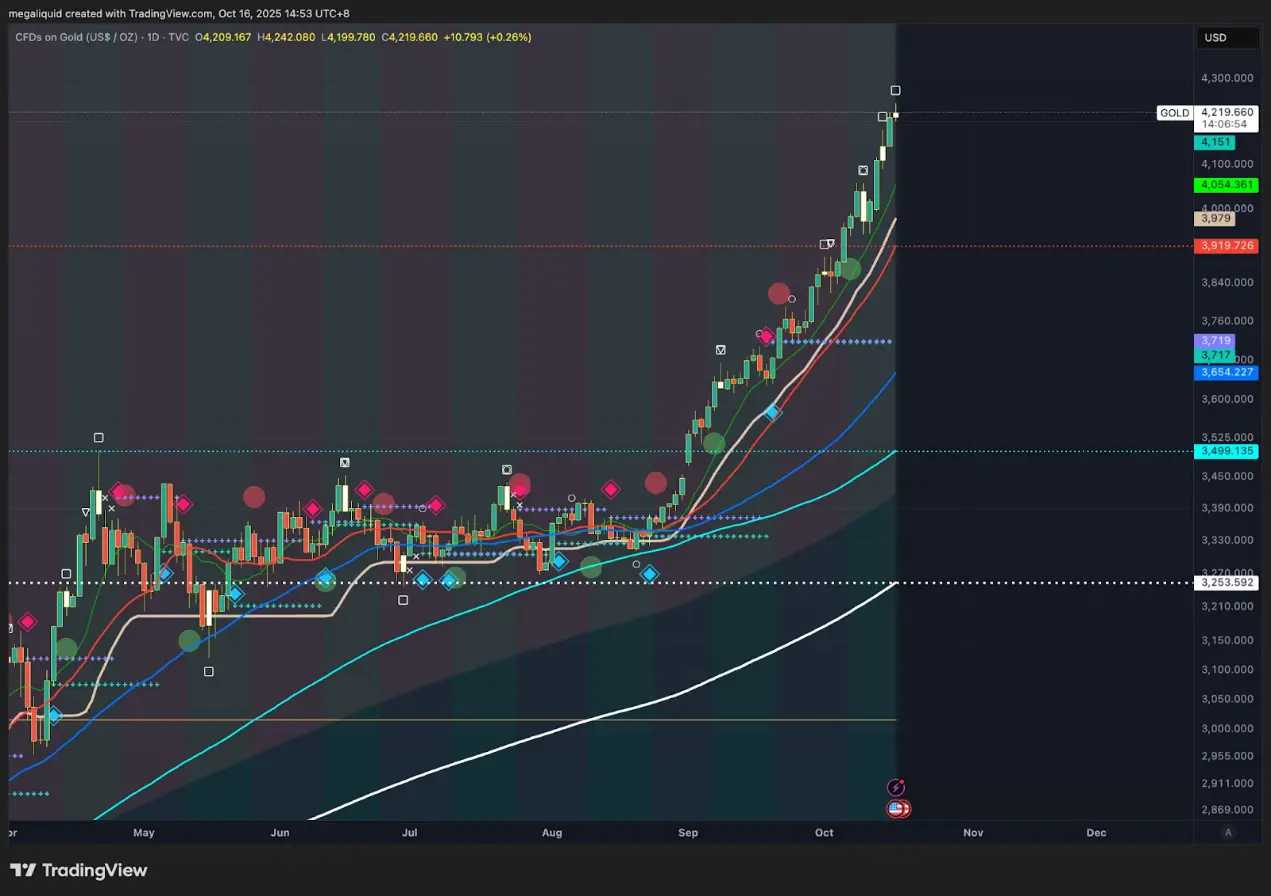
黄金已突破 4300 美元,在不到两个月的时间里上涨了 25%,下面来探讨一下上涨原因。
央行

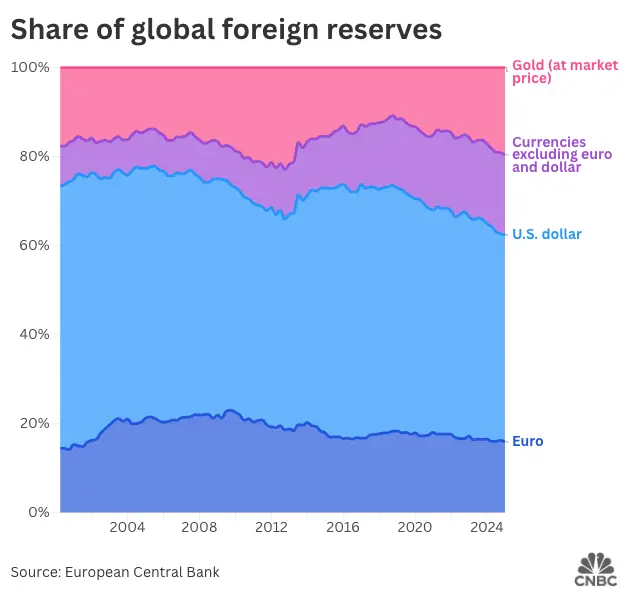
1.去美元化/各国央行竞相购买

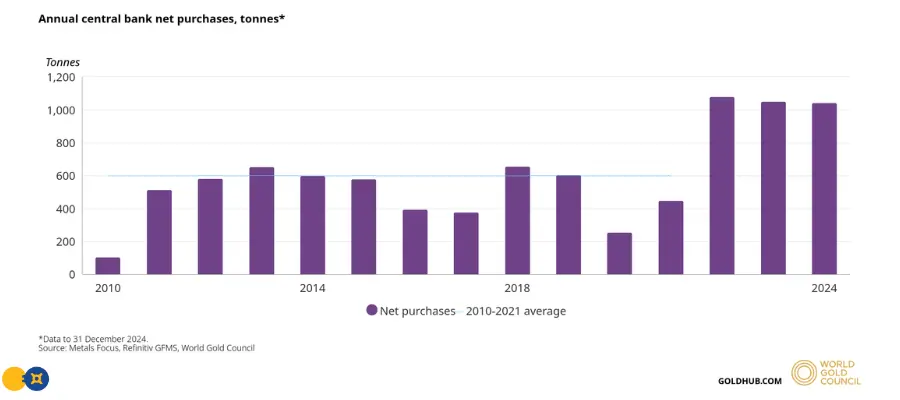
各国央行,尤其是中国政府,一直在疯狂购入黄金,个人认为今年有望连续第四年购入超过 1000 吨黄金,而且调查显示中国政府计划继续购买。
央行

为什么?美国国债预计今年将达到 37.5 万亿美元,仅利息就超过 1 万亿美元(尽管税收收入约为 4 至 5 万亿美元)。处理如此巨额债务只有两种办法:违约或贬值,而美国永远不必违约,因为它们可以印更多的钱,从而贬值债务。

2.稳定币作为债务社会化工具

美国通过货币通胀来贬值其债务,基本上就是印更多的钱,让美元的价值降低,从而使其债务的实际价值缩水。这一点你应该已经知道了,因为这种情况已经持续了几十年。

新的情况是,如果美国将债务转移到像稳定币这样的加密货币中,这可能会很有趣,因为稳定币对全世界来说更容易获得。

稳定币越来越多地由贷款支持。像 USDT 和 USDC 这样的美元挂钩稳定币现在主要由美国国债支持。原本纯粹的 1:1 工具逐渐变成了超过 90% 由美国国债支持。

所以现在,每当其他国家的人持有稳定币时,他们就在间接购买美国债务。这将美国的“通胀税”全球化了。全球对美国稳定币的采用率越高(这一数字将达到数万亿美元),美国就能越多地向世界输出债务,并与世界(而非仅限美国)分担其“损失”。

如果这确实是计划的一部分,那么就回到了之前提到的为什么存在去美元化的需求,以及为什么黄金是一种相当安全的保值替代品。

3.实物挤压

另一个要点是,这次黄金上涨并非仅仅由纸面/衍生品驱动。如果您了解当期权合约的未平仓合约量大于某种代币的流动性时,永续合约市场可能出现的轧空现象,这里的情况与之类似。

2025 年,纽约商品交易所(COMEX)黄金期货的未平仓合约通常有数十万份(每份代表 100 金衡盎司),而注册用于交割的实物黄金总量只是其中的一小部分。

这意味着,在任何特定时间,实物黄金的认购量都远远超过可供交割的数量。这就是为什么黄金的交割时间从几天延长到几周,存在实际的实物需求(类似于现货需求),而且这些需求不太可能是弱手,从而形成了结构性底部。

4.整体不确定性

黄金再次证明了其在不确定性时期作为避险资产的地位。当前的中美竞争、贸易战担忧、美国国内动荡、美联储降息、美国经济靠 AI 基础设施支出支撑、经济不确定性,所有这些都导致全球投资者逃离美元,转而投资黄金。

个人看来,黄金主要在无需避险时下跌,需要满足以下这些条件,但短期内不太可能出现:

  • 高就业率:但当前美国经济前景不佳
  • 风险资产轮动:当前股票并不便宜
  • 政治确定性:美国需要与中国友好相处
  • 利率上升即资金成本上升:目前情况恰恰相反

由于特朗普的言行举止难以预测,这些因素也可能迅速变化(或者至少是外界对其的看法),所以要小心。

这对比特币意味着什么?

比特币今年迄今相对于黄金已下跌超过 25%。尽管比特币与黄金有许多相似之处,但个人仍然认为比特币还不具备成为“数字黄金”的条件,但随着时间的推移,比特币正越来越接近黄金(尽管仍不清楚如何解决量子问题)。

不过,如果您尝试过购买黄金,就会知道实物买卖价差非常高,所以黄金是一种买后持有的资产,这并不有趣。所以散户可能会选择购买比特币而非黄金,但散户的购买力相对于央行来说较低。

如今比特币与美国的政治关联度如此之高,反而会让其他央行不愿通过购买比特币来去美元化。个人认为目前美国矿工约占比特币算力的 38%,美国实体(交易所交易基金、上市公司、信托和政府)控制着大约 15%的比特币总供应量,而且这一比例可能还在继续增长。

所以……个人并不清楚比特币相对于黄金的走势如何,但短期内(直到今年),它将继续对黄金造成压力。

个人正在做什么?

做多比特币:个人认为去美元化对比特币更有利,而非其他山寨币。而且在最近的“1011”暴跌之后,很明显比特币是唯一具有真正订单簿流动性和买盘的资产,而且目前比特币主导地位似乎处于上升趋势。如果看到山寨币表现良好,个人可能会结束这笔交易,但通常是在比特币创下历史新高之后,这应该会提高比特币的主导地位。

做多黄金:基本上就是购买纸黄金、卖出看跌期权或买入看涨期权。不过“不是你的密钥,就不是你的币”(Not your keys, not your coins)这句话在这里也适用,可能只是拿着一张没用的纸,但个人对此还算认可。
央行

结语

鉴于上述结构性变化,黄金仍然是不错的买入选择,但如果出现 20% - 30% 的回调,也不会感到意外,如果短期内出现这种情况,可能是长期买入的好机会,前提是上述不确定性没有消除。

此外,黄金即将触及相对于标普 500 的阻力位,而且市值即将达到 30 万亿美元,这两个因素都可能是局部顶部,建议先观望,不要盲目跟风。

最后,以下是个人看待黄金的另一种方式,个人认为黄金仍有上涨空间:

  • 如果美国经济或世界局势不稳定,黄金价格就会上涨;
  • 如果美国经济或世界局势将变得更加不稳定,黄金价格就会上涨;
  • 如果美国经济或世界局势将变得更加稳定,黄金价格就会下跌。

Related Reads

Smart Money Hoards $40 Billion in Cash, Retail Bets $2.6 Trillion on Calls: The Critical Moment of the US Stock Market's AI Narrative

Title: Smart Money Hoards $40 Billion in Cash, Retail Traders Bet $2.6 Trillion on Call Options: The Tipping Point for the AI Narrative in U.S. Stocks The U.S. stock market is experiencing a striking divergence. While the S&P 500 hits new highs, the financial sector is down 6% year-to-date, underperforming more than during the 2008 and COVID crises. In contrast, a record $2.6 trillion in S&P 500 call options traded in a single day, and the Philadelphia Semiconductor Index RSI is at its highest since 1999. This reflects a clear split: "smart money" is retreating while retail traders chase gains. Key data points highlight this critical juncture in the AI-driven rally: 1. SoftBank had to cut its $10 billion loan target against its OpenAI stake to $6 billion, as lenders questioned the valuation of the private AI giant, signaling primary market skepticism. 2. The explosive $2.6 trillion daily options volume, with 60% being calls, is described by a Goldman Sachs partner as a "semi-irrational chase," drawing parallels to the 1999 tech bubble. 3. The financial sector's severe underperformance relative to the S&P 500 is a classic technical warning signal, indicating potential underlying economic stress. 4. Apollo Global Management, despite strong earnings, is building a $40 billion cash buffer in its insurance business, preparing for what its CEO calls a 30-35% probability of an exogenous shock from geopolitics, inflation, and AI's economic disruption. 5. Consumer behavior mirrors this split: while Whirlpool plunged on a worsening macro outlook for big-ticket items, DoorDash rose on strong demand for small, immediate services. Together, these conflicting signals from primary markets, secondary markets, leading sectors, and top institutions suggest market risk premia have compressed to a precarious level. The current price action may be increasingly reliant on speculative sentiment rather than fundamental support, marking a potential tipping point for the AI investment narrative.

marsbit15m ago

Smart Money Hoards $40 Billion in Cash, Retail Bets $2.6 Trillion on Calls: The Critical Moment of the US Stock Market's AI Narrative

marsbit15m ago

Tiger Research: AI Agents Will Now Need Identity Verification

Tiger Research: AI Agents Now Need "ID Verification" AI agents are increasingly capable of autonomously executing contracts, making payments, and conducting trades. However, a critical issue remains unresolved: how to verify the identity of the agent on the other side of a transaction. This article examines the emerging competition to establish a KYA (Know Your Agent) standard and the current state of regulatory progress. **Core Points:** 1. As AI agents operate independently in A2A (agent-to-agent) scenarios, the focus shifts from KYC (Know Your Customer) to KYA for identity verification. 2. KYA is not universally required; it's essential primarily when independently deployed agents interact with open ecosystems like DEXs, engage in A2A payments, or pay merchants, not within centralized platforms. 3. A standards battle is underway, with four key players approaching KYA from different angles: * **ERC-8004:** A blockchain-native approach, creating agent IDs as NFTs with on-chain registries for identity, reputation, and validation. * **Visa TAP:** Leverages Visa's payment network to issue verified "Agent Intent" credentials, bundling agent identity into its payment rails. * **Trulioo:** Adapts the SSL certificate model to issue dynamic "Digital Agent Passports," verifying both developer (KYB) and user (KYC) credentials. * **Sumsub:** Focuses on real-time risk detection and re-verification of the human behind an agent during suspicious transactions, rather than pre-issuing certificates. 4. Regulatory momentum is building. The EU AI Act, the U.S. NIST, and Singapore's national AI governance framework are prioritizing agent identity management. The rollout of KYA standards is likely to follow a pattern similar to the FATF Travel Rule, becoming a watershed moment for the industry. The market is unlikely to have a single winner. Different approaches will dominate specific niches: ERC-8004 for on-chain autonomous transactions, Visa TAP for payment-bound commerce, Trulioo for regulated finance, and Sumsub for fraud-prone scenarios. The key differentiator will be which players successfully integrate their identity infrastructure earliest as adoption scales.

marsbit59m ago

Tiger Research: AI Agents Will Now Need Identity Verification

marsbit59m ago

Perspective: The current AI supercycle will last 15 years, but most are still buying stocks in the first FOMO stage

This article outlines a 15-year AI supercycle, segmented into four investment stages. It argues that while most investors are still focused on the first stage, smart money is already moving to the third. **Stage 1: The Foundation (2023-2025) - Priced In** The semiconductor layer (e.g., NVIDIA, AMD) is complete. While growth continues, the historic entry opportunity is over as risk/reward has compressed. **Stage 2: The Build-Out (2025-2027) - In Progress** This phase involves building the necessary physical infrastructure: power/utilities (CEG), cooling (VRT), networking (ANET), and nuclear SMRs (OKLO, SMR). Significant upside remains, but obvious names have already moved. **Stage 3: The Asymmetric Bet (2026-2028) - Positioning Window** AI moves into the physical world. Key areas include robotics/autonomy (Tesla Optimus), space/defense/drones (Rocket Lab, LUNR), and critical materials. This stage presents the best asymmetric risk/reward and is where positioning should occur now. **Stage 4: The Endgame (2028+) - Software Dominance** The mega-cap cloud platforms (Microsoft, Alphabet, Amazon, Meta), with their massive capital expenditure, will build the AI software layer and AGI infrastructure, aiming to win the entire cycle. **Core Conclusion:** The cycle is confirmed in Stage 2. Stage 3 (robotics, space, defense, nuclear SMRs) is where capital is currently rotating for maximum opportunity, while the majority of investors are expected to be 12 months behind this shift.

marsbit1h ago

Perspective: The current AI supercycle will last 15 years, but most are still buying stocks in the first FOMO stage

marsbit1h ago

Trading

Spot
Futures

Hot Articles

What is $BITCOIN

DIGITAL GOLD ($BITCOIN): A Comprehensive Analysis Introduction to DIGITAL GOLD ($BITCOIN) DIGITAL GOLD ($BITCOIN) is a blockchain-based project operating on the Solana network, which aims to combine the characteristics of traditional precious metals with the innovation of decentralized technologies. While it shares a name with Bitcoin, often referred to as “digital gold” due to its perception as a store of value, DIGITAL GOLD is a separate token designed to create a unique ecosystem within the Web3 landscape. Its goal is to position itself as a viable alternative digital asset, although specifics regarding its applications and functionalities are still developing. What is DIGITAL GOLD ($BITCOIN)? DIGITAL GOLD ($BITCOIN) is a cryptocurrency token explicitly designed for use on the Solana blockchain. In contrast to Bitcoin, which provides a widely recognized value storage role, this token appears to focus on broader applications and characteristics. Notable aspects include: Blockchain Infrastructure: The token is built on the Solana blockchain, known for its capacity to handle high-speed and low-cost transactions. Supply Dynamics: DIGITAL GOLD has a maximum supply capped at 100 quadrillion tokens (100P $BITCOIN), although details regarding its circulating supply are currently undisclosed. Utility: While precise functionalities are not explicitly outlined, there are indications that the token could be utilized for various applications, potentially involving decentralized applications (dApps) or asset tokenization strategies. Who is the Creator of DIGITAL GOLD ($BITCOIN)? At present, the identity of the creators and development team behind DIGITAL GOLD ($BITCOIN) remains unknown. This situation is typical among many innovative projects within the blockchain space, particularly those aligning with decentralized finance and meme coin phenomena. While such anonymity may foster a community-driven culture, it intensifies concerns about governance and accountability. Who are the Investors of DIGITAL GOLD ($BITCOIN)? The available information indicates that DIGITAL GOLD ($BITCOIN) does not have any known institutional backers or prominent venture capital investments. The project seems to operate on a peer-to-peer model focused on community support and adoption rather than traditional funding routes. Its activity and liquidity are primarily situated on decentralized exchanges (DEXs), such as PumpSwap, rather than established centralized trading platforms, further highlighting its grassroots approach. How DIGITAL GOLD ($BITCOIN) Works The operational mechanics of DIGITAL GOLD ($BITCOIN) can be elaborated on based on its blockchain design and network attributes: Consensus Mechanism: By leveraging Solana’s unique proof-of-history (PoH) combined with a proof-of-stake (PoS) model, the project ensures efficient transaction validation contributing to the network's high performance. Tokenomics: While specific deflationary mechanisms have not been extensively detailed, the vast maximum token supply implies that it may cater to microtransactions or niche use cases that are still to be defined. Interoperability: There exists the potential for integration with Solana’s broader ecosystem, including various decentralized finance (DeFi) platforms. However, the details regarding specific integrations remain unspecified. Timeline of Key Events Here is a timeline that highlights significant milestones concerning DIGITAL GOLD ($BITCOIN): 2023: The initial deployment of the token occurs on the Solana blockchain, marked by its contract address. 2024: DIGITAL GOLD gains visibility as it becomes available for trading on decentralized exchanges like PumpSwap, allowing users to trade it against SOL. 2025: The project witnesses sporadic trading activity and potential interest in community-led engagements, although no noteworthy partnerships or technical advancements have been documented as of yet. Critical Analysis Strengths Scalability: The underlying Solana infrastructure supports high transaction volumes, which could enhance the utility of $BITCOIN in various transaction scenarios. Accessibility: The potential low trading price per token could attract retail investors, facilitating wider participation due to fractional ownership opportunities. Risks Lack of Transparency: The absence of publicly known backers, developers, or an audit process may yield skepticism regarding the project's sustainability and trustworthiness. Market Volatility: The trading activity is heavily reliant on speculative behavior, which can result in significant price volatility and uncertainty for investors. Conclusion DIGITAL GOLD ($BITCOIN) emerges as an intriguing yet ambiguous project within the rapidly evolving Solana ecosystem. While it attempts to leverage the “digital gold” narrative, its departure from Bitcoin's established role as a store of value underscores the need for a clearer differentiation of its intended utility and governance structure. Future acceptance and adoption will likely depend on addressing the current opacity and defining its operational and economic strategies more explicitly. Note: This report encompasses synthesised information available as of October 2023, and developments may have transpired beyond the research period.

363 Total ViewsPublished 2025.05.13Updated 2025.05.13

What is $BITCOIN

Discussions

Welcome to the HTX Community. Here, you can stay informed about the latest platform developments and gain access to professional market insights. Users' opinions on the price of BTC (BTC) are presented below.

活动图片













