Best Presales News Live Today: Latest Updates on Early Crypto Projects with 10x Potential (October 17)

bitcoinistPublished on 2025-10-17Last updated on 2025-10-17

Abstract

Stay Ahead with the Latest Insights of Today's Best Presales News Check out our Live Best Presales Updates for October...

Trusted Editorial content, reviewed by leading industry experts and seasoned editors. Ad Disclosure

Stay Ahead with the Latest Insights of Today’s Best Presales News

Check out our Live Best Presales Updates for October 17, 2025!

Of all the crypto opportunities out there, presales are often the most promising and potentially the most profitable. These early-stage projects raise funds to launch community-driven meme coins, utility-heavy projects, and even degen shitcoins.

What defines crypto presales is the opportunity to join stage zero at the lowest possible price point. It can only go up from there, which it often does.

Pepe Unchained soared 550% post-presale, to name one presale. The potential is there, and if you’re looking for the latest crypto presale updates to get in early, you’ve come to the to right place.

We update this page regularly throughout the day with the latest insights on presales. Keep refreshing to stay ahead of the pack!

Disclaimer: No crypto investment comes without risk. Our content is for informational purposes, not financial advice. We may earn affiliate commissions at no extra cost to you.


Stablecoins Are Now Big Finance, Says Visa as One of the Best Presales, $BEST, Shines

October 17, 2025 • 11:08 UTC

It turns out stablecoins aren’t just for the crypto-minded anymore; they’re becoming a massive part of the global financial system. According to a new report from Visa, stablecoins have powered over $670B in on-chain loans in the last five years alone.

The huge lending market is growing thanks in part to new clarity from the U.S. government with legislation like the GENIUS Act, which is making banks and major firms more confident about jumping into blockchain-based lending.

This digital money is also revolutionizing payments. KPMG points out that stablecoins can cut the time it takes for cross-border payments to just seconds, and slice transaction fees by as much as 99%.

With big players like JPMorgan already moving $2B daily on its private blockchain, the digital dollar is making its mainstream move.

Seeing as stablecoins are making the game easier, your crypto wallet should keep up. Best Wallet and its native Best Wallet Token ($BEST) do exactly that. $BEST offers perks like discounts and exclusive early access to new token launches.

Find out more about $BEST here.


Bitcoin Fear Index Plunges to Yearly Low — Bitwise Sees Opportunity as $HYPER Emerges Among the Best Presales

October 17, 2025 • 10:00 UTC

On October 10th, a violent market crash sent $BTC tumbling to $103,133, only for the coin to rebound to $116,044 by October 13th before cooling off at $108,138 at the time of writing.

The Bitcoin Fear Index dropped to 22 from last week’s 71, its lowest in a year, reflecting the widespread risk aversion among investors.

However, Bitwise interprets this as a contrarian signal, arguing that it’s the ideal phase for accumulation. The historical pattern from April this year supports Bitwise’s theory, as $BTC dipped below $74K only to rally above $100K the following month.
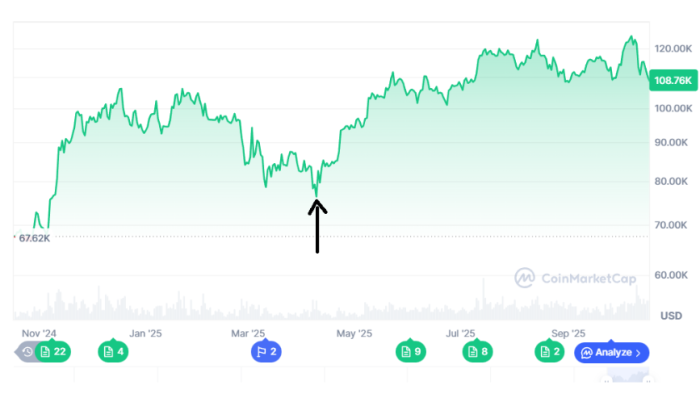
$BTC dipped to $76,273 in April, only to rebound above $100K the following month.

On the other hand, Glassnode data suggest that small holders are accumulating Bitcoin, a sign of rising retail confidence.

Amid high market volatility, promising presale opportunities like Bitcoin Hyper ($HYPER) are gaining strong traction from savvy investors. Bitcoin Hyper is a scalability solution that aims to deliver Solana-level speed, ultra-low fees, near-instant finality, and support for dApps, DeFi, and NFTs.

Discover how to purchase Bitcoin Hyper ($HYPER) in our comprehensive guide.


$1.8B in Bitcoin Profits Hit the Market — Is Bitcoin Hyper ($HYPER) Poised to Shine Among the Best Presales?

October 17, 2025 • 10:00 UTC

$BTC is exhibiting signs of exhaustion, dipping below its key psychological zone of $110K-$112K and is now trading at $108,572, signalling low investor confidence.

On October 15, traders locked in $1.8B in profits during which long-term holders took advantage of 6X gains and small-time holders sidelined with smaller returns. The same day saw $319M in realized losses, suggesting market instability and a sentiment shift among profit-takers and loss-sellers.
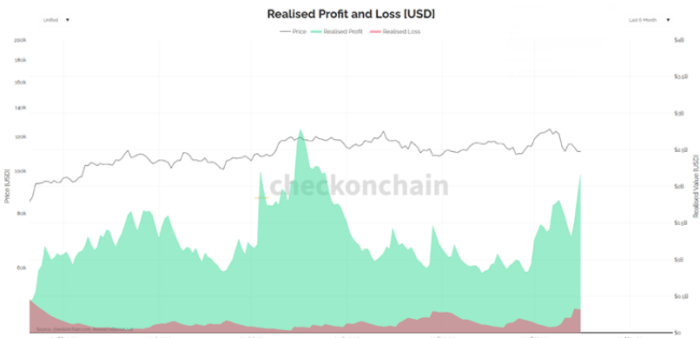
Graph showing Bitcoin’s realized profit (green) and loss (red) from May. 1 to Oct. 16, 2025
Source: Checkonchain

Analysts cite this pattern as healthy derisking – one that resets the market’s overbought conditions before its next leg up.

Checkonchain Data shows Bitcoin stuck between its 128 and 200 DMAs, signalling fading momentum and a potential directional shift ahead.

As $BTC consolidates near $110K, savvy traders are rotating capital into emerging presales like Bitcoin Hyper ($HYPER). A recent whale purchase $28,230 just last week shows that the project’s momentum is heating up.

Take a look at our expert $HYPER price prediction path.


Authored by Ben Wallis, Bitcoinist — https://bitcoinist.com/best-presales-news-live-today-october-17

Editorial Process for bitcoinist is centered on delivering thoroughly researched, accurate, and unbiased content. We uphold strict sourcing standards, and each page undergoes diligent review by our team of top technology experts and seasoned editors. This process ensures the integrity, relevance, and value of our content for our readers.

Ben is a freelance writer specializing in crypto developments (mainly altcoins) and the intricate ways global economics shape the digital asset space. His B.Ed. in Education provides a unique foundation for his writing, enabling him to distill complex crypto concepts and market shifts into clear, digestible insights. This skill is key to helping readers adapt and apply their understanding to the ever-evolving world of crypto investment. Passionate about making crypto accessible, Ben crafts content designed to educate a broad audience, from current market events to the essential foundational knowledge that underpins them. His goal is to empower readers through understanding. When he’s not immersed in crypto analysis and breaking down complex topics, Ben is an avid Pokémon fan and enjoys all things Disney.

Related Reads

In the Era of Agent Users, Where Does Crypto Value Flow?

Title: Who Makes Money from Agents? The rise of AI Agents as potential blockchain users raises a crucial question: if they become the next billion users, who will capture the value? Traditional crypto value capture theories—like "fat protocols" (where value accrues to the base layer) and "fat applications" (where value accrues to user-facing apps)—assume human users who value UX, brand, and convenience. Agents, however, operate differently: they interact via APIs, have no brand loyalty, and can switch services with near-zero cost. This shift could disrupt existing value flows. Applications might become "headless," offering their routing and infrastructure as APIs to Agents. Alternatively, Agents might bypass intermediaries entirely, allowing protocols to regain value capture ("fat protocols" reborn). A more extreme scenario is that Agents, being purely rational and cost-sensitive, could commoditize the entire stack, compressing margins toward marginal cost and turning crypto into a low-margin utility. However, Agents may not just amplify existing activities; they could enable entirely new ones—like continuous, sub-penny portfolio rebalancing, machine-to-machine commerce, and new market types only viable at automated speeds. This expands the economic pie rather than just redistributing it. Ultimately, the key question for builders is: what will make an Agent return to your service instead of a cheaper alternative? The answer may not be UX but factors like liquidity, latency, settlement guarantees, or a yet-unnamed business model. As humans and Agents will coexist as users, value capture may split: "fat apps" for human-facing services, and a new, evolving model for the Agent-dominated layer.

marsbitJust now

In the Era of Agent Users, Where Does Crypto Value Flow?

marsbitJust now

Base MCP, The Next Step for x402

Base has officially launched Base MCP, allowing users to connect their Base Account to AI Agents to perform actions like swaps, transfers, portfolio tracking, and transaction history queries through conversational commands. This move aligns with Base's strategic focus on AI, driven by the broader competition in the emerging Agent-to-Agent payment sector. The evolution of Agent payments has accelerated. In late 2024, the primary method involved insecure browser automation. By 2025, solutions like Coinbase's x402 (providing crypto wallets for Agents), Google's AP2, and Visa's token-based system emerged. x402 has since processed 176 million transactions totaling over $70 million, with a median value between $0.01 and $0.10. Stablecoins, particularly USDC, dominate these settlements due to their negligible transaction costs compared to traditional payment fees, which are prohibitive for micro-payments. Coinbase faces competition from Stripe, which has built a comparable infrastructure for Agent payments with its Tempo blockchain, Privy wallets, Bridge routing (acquired for $1.1B), and the recently launched MPP protocol. Both companies are now competing at the application layer. The core reason AI is central to Base's strategy is to expand the scenarios for Agent payments, ensuring more transactions occur on its network. By securing a dominant position and scale advantage in this nascent field, Coinbase aims to capture the future commercial potential of Agent-driven payments. The launch of Base MCP is thus a strategic step in this larger ambition.

marsbit6m ago

Base MCP, The Next Step for x402

marsbit6m ago

Reframing Ethereum's Valuation: Why the Fee Model is Wrong, and the 'Treasury Logic' is the Future?

"Rethinking Ethereum's Value: The 'Vault Logic' Framework" Traditional valuation models incorrectly treat Ethereum as a company, valuing ETH based on transaction fees ("revenue"). This is flawed. Fees are network friction; a successful network aims to reduce them to zero. Ethereum's average fee has dropped from over $50 in 2021 to around $0.20 today, while transaction volume has tripled. Instead, view Ethereum as a digital vault securing ~$250 billion in on-chain assets (stablecoins, RWAs, L2 bridged funds, wBTC, etc.). Post-merge, Ethereum's security is directly purchased with its own asset: ETH. To attack the network, an attacker must acquire and control staked ETH. Therefore, the vault's security level is intrinsically tied to ETH's market value. Currently, the value of all staked ETH is only ~$72B, protecting ~$250B in assets—a dangerous imbalance. For robust security, the staked ETH securing the network should be valued significantly *higher* than the total value it protects. Applying a conservative security multiplier suggests ETH's fair value should be closer to ~$6,900 (vs. ~$2,070 currently). As on-chain asset value grows into the trillions, ETH's price must rise proportionally to maintain this security budget. Comparisons to free infrastructure like Linux or low-margin utilities like the DTCC are misguided. Their security is provided externally (community, law, banks). Ethereum's security is internal and must be purchased in the open market using ETH. ETH is not the clearinghouse; it is the collateral backing it. The model is not a short-term price predictor but a structural framework. The economic force for ETH appreciation grows monotonically with the adoption of Ethereum for settling value. The narrative that high fees are good is backwards; low fees enable more activity, which increases the value needing protection, thus demanding a more valuable ETH.

marsbit12m ago

Reframing Ethereum's Valuation: Why the Fee Model is Wrong, and the 'Treasury Logic' is the Future?

marsbit12m ago

Justin Sun’s Interview with Hurun Report: A New Order and Certainty for Value Flow in the Era of Transformation

In an interview with *Hurun Report*, Justin Sun, founder of TRON, discussed the evolution of the Web3 industry as it moves from initial exploration to large-scale adoption. He emphasized that the core value of blockchain lies in building an open and inclusive internet of value, enabling anyone globally to transfer and use funds efficiently and at low cost, regardless of location or access to banking. Sun highlighted that projects with lasting impact are those built on genuine demand and real-world usage. He pointed to the stablecoin payment ecosystem as the most mature and scalable application currently, noting that TRON has rapidly become one of the world's largest stablecoin networks. The circulation of USDT on TRON has surpassed $86.3 billion, driven by actual use cases such as cross-border transfers and daily payments, demonstrating strong network effects. Regarding strategy, Sun outlined a methodology combining data-driven iteration, rapid execution, and user-centric focus. He cited the decision to partner with Tether to launch TRC-20 USDT as a key strategic move, based on an assessment of market trends and long-term potential, which has become a significant growth engine for the TRON ecosystem. On globalization, Sun stressed the importance of local compliance and cultural adaptation, noting that success in different markets depends on deep understanding and local partnerships. He also addressed the convergence of AI and blockchain, describing it as a transformative direction where blockchain provides decentralized infrastructure for AI, while AI enhances the intelligence and user experience of blockchain systems. For industry participants and young entrepreneurs, Sun advised continuous learning and adaptability in a fast-changing environment, focusing on building irreplaceable core strengths rather than spreading resources too thinly. Through infrastructure development, global strategy, and technological foresight, TRON aims to advance the practical implementation and evolution of the value internet.

marsbit45m ago

Justin Sun’s Interview with Hurun Report: A New Order and Certainty for Value Flow in the Era of Transformation

marsbit45m ago

Samsung Leverages Technology Cycles, SK Hynix Relies on HBM, What Enabled Micron to Win a Trillion-Dollar Market Cap?

Micron Technology, the Idaho-based memory chip maker, recently saw its market cap surpass $1 trillion, securing its position as one of the top three DRAM manufacturers alongside Samsung and SK Hynix. Its survival and growth story is marked by a unique combination of political maneuvering and hard-won manufacturing efficiency, but also strategic missteps that now challenge its future. Founded in 1978 in Boise without significant government or capital backing, Micron repeatedly turned to Washington for survival during critical junctures. In the 1980s, it filed anti-dumping complaints against Japanese firms, leading to the U.S.-Japan Semiconductor Agreement. Ironically, this created an opening for Samsung, which Micron had earlier licensed its 64K DRAM technology to. In 2002, Micron avoided heavy fines in a price-fixing investigation by acting as a whistleblower against its competitors, cementing its reputation as a "political opportunist." A major strategic error occurred in 2013 with its $2.5 billion acquisition of bankrupt Japanese firm Elpida. This deal burdened Micron with integrating incompatible manufacturing processes just as the industry was pivoting toward HBM (High Bandwidth Memory), a critical technology for AI. SK Hynix had launched its first HBM chip that same year. By the time AI demand exploded with ChatGPT in 2022, SK Hynix commanded about 85% of the HBM3 market, while Micron, playing catch-up, held only around 3%. In 2017, Micron employed similar tactics against a new competitor, Chinese startup Fujian Jinhua, by alleging intellectual property theft, which led to U.S. sanctions effectively crippling the firm. However, this strategy backfired in 2023 when China banned Micron's products from its critical infrastructure, causing its revenue share from China to plummet from 14% in FY2023 to just 7.1% by FY2025. Today, Micron faces a triple squeeze: it lags in the high-margin HBM race, faces pricing pressure in low-end DRAM from Chinese manufacturers like CXMT, and has lost crucial access to the booming Chinese AI server market. Despite its political strategies, Micron's core strength is its exceptional manufacturing cost control, achieved through decades of engineering. Its DRAM chips have a smaller cell area than its rivals, yielding more chips per wafer. This efficiency has been vital for weathering industry downturns. However, this advantage cannot compensate for the decade lost in HBM development. Micron is now racing to ramp up production of its HBM3E, certified by NVIDIA, and develop HBM4. Its future hinges on whether it can close this technological "time debt" through relentless R&D and execution, in a marathon where its competitors, having started earlier, are not slowing down.

marsbit1h ago

Samsung Leverages Technology Cycles, SK Hynix Relies on HBM, What Enabled Micron to Win a Trillion-Dollar Market Cap?

marsbit1h ago

Trading

Spot
Futures
活动图片