Bitcoin Hyper Raises $1M in a Week – Could It Be the Next 1000x Crypto?

bitcoinistPublished on 2025-10-06Last updated on 2025-10-06

Abstract

Bitcoin ($BTC) remains the undisputed king of crypto, but it’s a monarch trapped in slow motion. While it holds a...

Trusted Editorial content, reviewed by leading industry experts and seasoned editors. Ad Disclosure

Bitcoin ($BTC) remains the undisputed king of crypto, but it’s a monarch trapped in slow motion. While it holds a $2.4T+ market cap and dominates global adoption, the network still processes one block every 10 minutes, struggles with high fees, and can’t natively support DeFi, dApps, or real-time payments.

In a world now used to $SOL-level speed and $ETH-level programmability, Bitcoin feels like dial-up in a fiber-optic era. That’s where Bitcoin Hyper ($HYPER) steps in – a new Layer-2 built to supercharge Bitcoin’s capabilities and become the next 1000x crypto.

💰 With $21.7M+ raised – including $1M in whale buys last week alone – $HYPER is positioning itself as the upgrade Bitcoin has been waiting for.

And if $HYPER delivers on its promise, Bitcoin could finally rival $SOL and $ETH – without ever leaving its own chain.

Bitcoin’s Greatness Comes at a Cost

Bitcoin’s reliability is legendary – but it comes with baggage. The network’s Proof-of-Work design, while unmatched in security, limits throughput to around seven transactions per second (TPS). In real time, according to Chainspect, it’s at around 5.6 TPS with an average block time of nine minutes.
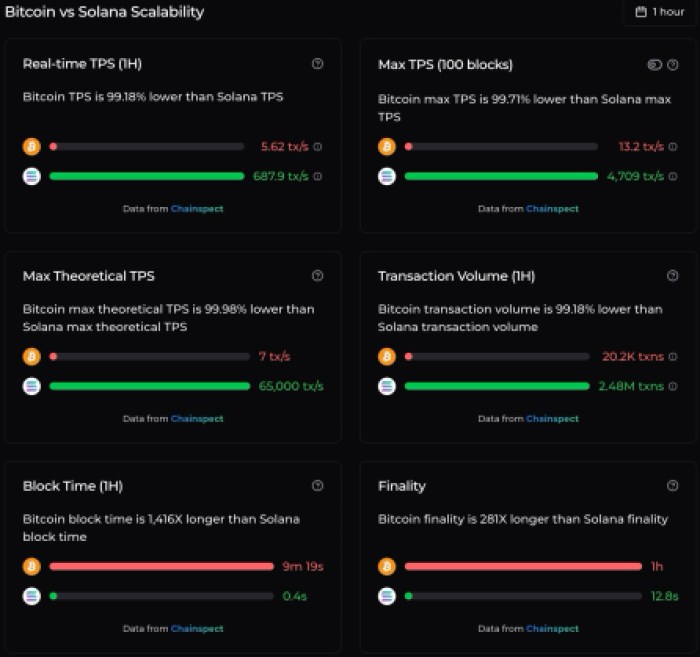
Bitcoin ($BTC) vs Solana ($SOL) scalability comparison.
Source: Chainspect

To put that into context, Solana processes 688 TPS in real-time and can push a max theoretical value of 65K TPS, with a block time of 0.4s. This puts Bitcoin at 99%+ lower than Solana in terms of TPS, and its block time is over 1.4K times longer.

That’s the difference between sending money instantly versus waiting nearly 10 minutes for confirmation.

Bitcoin has tried to evolve. The Taproot upgrade improved privacy and efficiency, and the Lightning Network promised faster payments, but adoption lagged. And during busy bull markets, on-chain transfer fees can skyrocket, pricing out everyday users.

The paradox: Bitcoin is the King of Crypto, yet you can’t build dApps, trade DeFi, or launch meme coins tokens directly on it. It’s a digital giant confined by its own architecture. Scalability isn’t a luxury anymore – it’s the single obstacle preventing Bitcoin from becoming the financial backbone of Web3.

From Store of Value to Full-Fledged Ecosystem

Bitcoin Hyper ($HYPER) plans to rewrite what Bitcoin can be. Built as a Layer-2 solution for Bitcoin, it will integrate the Solana Virtual Machine (SVM) – the same high-performance framework that enables Solana to process millions of transactions per hour. Instead of competing with Bitcoin, Hyper is designed to improve it.

Here’s how it will work, step-by-step:

  1. Bridge in: Send your $BTC to a Hyper smart contract address. The system verifies your deposit by reading Bitcoin blocks.
  2. Mint on the Layer-2: Once verified, the same amount of $BTC is automatically minted on Bitcoin Hyper as wrapped $BTC. No middlemen, just pure trustless bridging.
  3. Transact, stake, or build: On Hyper, you can trade, stake for rewards, or deploy dApps instantly with sub-second finality and near-zero fees, thanks to the SVM.
  4. Secure settlement: Transactions are bundled and validated through zero-knowledge proofs, then anchored back to Bitcoin’s mainnet for security and transparency.
  5. Bridge out anytime: When you’re ready, withdraw your $BTC back to the Layer-1. The process is clean, verifiable, and fully synced with Bitcoin’s original chain.
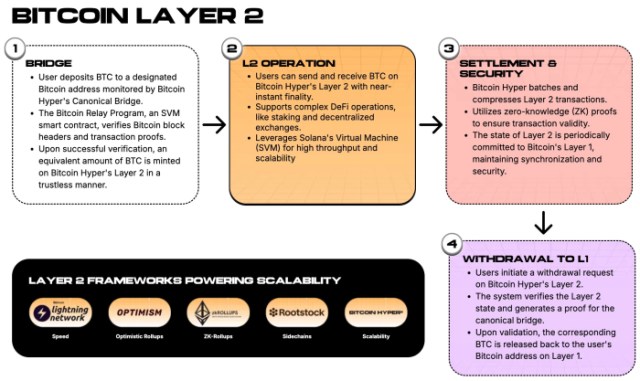
Bitcoin Hyper ($HYPER) Layer-2 framework for powering scalability.

Unlike wrapped tokens or sidechains that rely on third-party custody, Bitcoin Hyper will connect directly to Bitcoin using zero-knowledge verification, combining Bitcoin’s integrity with Solana’s speed.

This will mean instant Bitcoin payments, $BTC-native DeFi, and Solana-compatible dApps, all powered by the world’s oldest blockchain. In simple terms – if $ETH owns DeFi and $SOL owns speed, $BTC will have both.

It’s like giving a vintage Ferrari a modern engine… Same body, but 1000x the performance. More transactions mean more users, more fees and, ultimately, more demand.

$HYPER aims to turn Bitcoin from a static store of value into a living, breathing digital economy with speed and programmability that institutions and retail crave.

Find out more about this exciting new project in our comprehensive Bitcoin Hyper guide.

Whales Are Feeding On The $HYPER Frenzy

Momentum around the Bitcoin Hyper ($HYPER) presale is building fast. The project has already raised $21.7M+, with more than $1M in whale purchases the past week alone, including buys of $196.6K, $145K, and $56.9K.

🐳  These aren’t small-time investors; they’re high-conviction players betting big that Bitcoin Hyper will be the next crypto to explode to 1000x.

Each $HYPER token is currently priced at $0.013065, while staking yields sit at 53% APY, rewarding long-term believers who help secure the network early. We predict $HYPER’s price to potentially reach the $1.50 mark by 2030. That means buying $HYPER at today’s price could see it pump by around 11,380%.

Holding $HYPER will also give you access to a full ecosystem: use yours for gas, staking, governance, and launchpad access. Discover how to buy Bitcoin Hyper in our step-by-step guide.

The Bitcoin Hyper ($HYPER) ecosystem.

Early buyers get the first-in advantage in what is set to become Bitcoin’s execution layer. Bitcoin Hyper will give $BTC the speed of $SOL and the utility of $ETH, meaning it could rewrite Bitcoin’s role in the market entirely.

💰 If early $ETH backers saw 15,000X returns by recognizing potential before the crowd, Bitcoin Hyper might offer Bitcoin’s version of that same opportunity. The whales have noticed, and they’re buying before the next price jump.

Remember, though, presale prices go up in stages, while the APY drops as more holders stake their tokens. And the next price increase is due tomorrow.

The clock is ticking. Join the Bitcoin Hyper presale before the next price increase.

⚠️ Disclaimer: As always, this article is not financial advice. Always do your own research and never invest more than you can afford to lose.

Authored by Aidan Weeks, Bitcoinist – https://bitcoinist.com/bitcoin-hyper-next-1000x-crypto-1m-raise-week

Editorial Process for bitcoinist is centered on delivering thoroughly researched, accurate, and unbiased content. We uphold strict sourcing standards, and each page undergoes diligent review by our team of top technology experts and seasoned editors. This process ensures the integrity, relevance, and value of our content for our readers.

Aidan Weeks, a Master's graduate in Mechanical Engineering, has thrived as a content writer for over four years. Specializing in crypto, tech, engineering, AI, and B2B sectors, Aidan adeptly crafts web copy, blog posts, buying guides, manuals, product pages, and more, making complex concepts accessible and engaging. His transition from academia to full-time writing reflects his passion for bridging technical expertise with clear, informative content. Since joining Bitcoinist, Aidan has written extensively about DeFi, dApps, AI, and meme coins, solidifying his grasp on emerging blockchain technologies. An early adopter, he began investing in Solana in 2020, further deepening his insights into crypto markets and innovation. Today, he combines hands-on experience with a sharp editorial instinct to help readers cut through hype, spot real trends, and make sense of a fast-moving space.

Related Reads

SpaceX, OpenAI, Anthropic: The Three AI Giants Racing for IPO, Which One Is Worth Betting On?

SpaceX, OpenAI, and Anthropic are poised for historic IPOs within weeks, potentially raising a combined $180 billion—a sum exceeding the entire internet bubble's fundraising. The hosts of the Limitless Podcast argue this isn't just individual company financing but an unprecedented capital concentration for AI infrastructure, driven by an insatiable need for compute, data centers, power, and chips. SpaceX's IPO is notable for reportedly changing market index rules to allow faster inclusion, potentially funneling trillions in passive retirement funds into its stock, despite its unproven space-based data center business model. In contrast, Anthropic demonstrates explosive growth, with ARR reportedly hitting $45 billion and approaching profitability, fueled by strong enterprise adoption of products like Claude Code. Google's separate $80 billion raise highlights the immense capital pressure, even for giants. The discussion acknowledges bubble risks but leans optimistic. The hosts contend the massive spending is building essential physical infrastructure for the next technological era. A key bottleneck isn't capital but the real-world limits of chip manufacturing and construction speed. As long as demand for AI compute outstrips supply, this investment cycle represents a foundational build-out rather than a purely financial bubble. All three companies are seen as foundational bets on the future, with Anthropic often cited as the most immediately compelling due to its proven revenue trajectory.

marsbit2h ago

SpaceX, OpenAI, Anthropic: The Three AI Giants Racing for IPO, Which One Is Worth Betting On?

marsbit2h ago

From 'Old Guys' to 'New Favorites': How AI Is Revaluing Old Infrastructure from Dell to Nokia?

From "Vintage Tech" to "New AI Darlings": How AI Revalues Old Infrastructure One year ago, tech giants like Dell, Nokia, Cisco, and Western Data were seen as slow-growth, low-valuation stories, far from the AI spotlight dominated by players like Nvidia. Now, these legacy tech stocks are gaining market attention, sparking debate on whether this is genuine industry revaluation or a temporary narrative. As AI moves from model parameters to real-world data centers, the market is recognizing companies with proven delivery and infrastructure capabilities. This shift marks a change in the AI investment thesis: from pure model and GPU focus to the complex systems engineering required for deployment. Companies like Dell, HPE, and Corning are being revalued not for being "sexy" AI innovators, but for their decades of accumulated expertise in supply chains, enterprise delivery, and infrastructure—assets that have become critical in the AI buildout phase. The revaluation is unfolding across three key infrastructure lines: 1. **Servers & System Integration:** Dell and HPE are emerging as crucial system integrators or "general contractors" for AI data centers, translating GPU orders into complete, deployable server racks integrated with power, cooling, and networking. 2. **Networking & Connectivity:** AI's scale demands robust high-speed connections. Corning (fiber optics), Nokia (AI-RAN, 6G), and Cisco (data center switches) are gaining importance for enabling efficient data transfer within and between AI clusters. 3. **Storage:** Beyond high-speed memory (HBM/DRAM), the AI data explosion is driving demand for high-capacity hard drives (HDDs) from companies like Western Digital and Seagate to handle training data, logs, and cold storage cost-effectively. For this revaluation to be substantive and not just a narrative, three criteria are key: 1) Concrete AI-related order and revenue growth (e.g., Dell's AI server sales), 2) Upward revisions to company financial guidance, and 3) Sustainable improvements in profit quality, not just top-line revenue spikes. In essence, AI's transition to a real construction phase is re-pricing "old assets" against "new demand." The opportunity, however, is selective. Only those legacy firms that are demonstrably integrated into the capital expenditure chains of data center and enterprise AI deployment are likely to experience a true "logic re-rating" rather than just a temporary valuation bounce.

marsbit2h ago

From 'Old Guys' to 'New Favorites': How AI Is Revaluing Old Infrastructure from Dell to Nokia?

marsbit2h ago

The Merger of Codex and ChatGPT Marks the Beginning of a Major Reshuffle in Programming Tools

OpenAI is shifting its strategic focus from ChatGPT to Codex, merging them along with the browser tool Atlas into a unified desktop super-app. This move signals an internal belief that Codex, originally a programming tool, represents the next evolution of AI more than conversational models like ChatGPT. Over the past year, Codex's weekly active users have surged past 5 million. The key distinction is that while ChatGPT answers questions, Codex executes tasks. Enterprises increasingly value this ability to get work done over simply receiving advice. Consequently, Codex is attracting professionals beyond developers, including analysts, bankers, marketers, and product managers. OpenAI's reorganization and increased investment in Codex stem from recognizing that the future of AI competition lies in execution capabilities, not just conversation. The company is launching role-specific plugins (e.g., for data analysis, sales, design) to transform Codex into a broad knowledge work platform that automates and redefines white-collar workflows. Beyond being a tool, Codex reflects OpenAI's ambition to redefine software. New features like "Sites"—which generates interactive websites from documents—and collaborative "Annotations" aim to create a paradigm where the AI understands the goal and handles the tools and steps, functioning more like a digital colleague than traditional software. The ultimate goal is a unified experience where the user cares only about the completed task.

marsbit2h ago

The Merger of Codex and ChatGPT Marks the Beginning of a Major Reshuffle in Programming Tools

marsbit2h ago

Trading

Spot
Futures

Hot Articles

What is $BITCOIN

DIGITAL GOLD ($BITCOIN): A Comprehensive Analysis Introduction to DIGITAL GOLD ($BITCOIN) DIGITAL GOLD ($BITCOIN) is a blockchain-based project operating on the Solana network, which aims to combine the characteristics of traditional precious metals with the innovation of decentralized technologies. While it shares a name with Bitcoin, often referred to as “digital gold” due to its perception as a store of value, DIGITAL GOLD is a separate token designed to create a unique ecosystem within the Web3 landscape. Its goal is to position itself as a viable alternative digital asset, although specifics regarding its applications and functionalities are still developing. What is DIGITAL GOLD ($BITCOIN)? DIGITAL GOLD ($BITCOIN) is a cryptocurrency token explicitly designed for use on the Solana blockchain. In contrast to Bitcoin, which provides a widely recognized value storage role, this token appears to focus on broader applications and characteristics. Notable aspects include: Blockchain Infrastructure: The token is built on the Solana blockchain, known for its capacity to handle high-speed and low-cost transactions. Supply Dynamics: DIGITAL GOLD has a maximum supply capped at 100 quadrillion tokens (100P $BITCOIN), although details regarding its circulating supply are currently undisclosed. Utility: While precise functionalities are not explicitly outlined, there are indications that the token could be utilized for various applications, potentially involving decentralized applications (dApps) or asset tokenization strategies. Who is the Creator of DIGITAL GOLD ($BITCOIN)? At present, the identity of the creators and development team behind DIGITAL GOLD ($BITCOIN) remains unknown. This situation is typical among many innovative projects within the blockchain space, particularly those aligning with decentralized finance and meme coin phenomena. While such anonymity may foster a community-driven culture, it intensifies concerns about governance and accountability. Who are the Investors of DIGITAL GOLD ($BITCOIN)? The available information indicates that DIGITAL GOLD ($BITCOIN) does not have any known institutional backers or prominent venture capital investments. The project seems to operate on a peer-to-peer model focused on community support and adoption rather than traditional funding routes. Its activity and liquidity are primarily situated on decentralized exchanges (DEXs), such as PumpSwap, rather than established centralized trading platforms, further highlighting its grassroots approach. How DIGITAL GOLD ($BITCOIN) Works The operational mechanics of DIGITAL GOLD ($BITCOIN) can be elaborated on based on its blockchain design and network attributes: Consensus Mechanism: By leveraging Solana’s unique proof-of-history (PoH) combined with a proof-of-stake (PoS) model, the project ensures efficient transaction validation contributing to the network's high performance. Tokenomics: While specific deflationary mechanisms have not been extensively detailed, the vast maximum token supply implies that it may cater to microtransactions or niche use cases that are still to be defined. Interoperability: There exists the potential for integration with Solana’s broader ecosystem, including various decentralized finance (DeFi) platforms. However, the details regarding specific integrations remain unspecified. Timeline of Key Events Here is a timeline that highlights significant milestones concerning DIGITAL GOLD ($BITCOIN): 2023: The initial deployment of the token occurs on the Solana blockchain, marked by its contract address. 2024: DIGITAL GOLD gains visibility as it becomes available for trading on decentralized exchanges like PumpSwap, allowing users to trade it against SOL. 2025: The project witnesses sporadic trading activity and potential interest in community-led engagements, although no noteworthy partnerships or technical advancements have been documented as of yet. Critical Analysis Strengths Scalability: The underlying Solana infrastructure supports high transaction volumes, which could enhance the utility of $BITCOIN in various transaction scenarios. Accessibility: The potential low trading price per token could attract retail investors, facilitating wider participation due to fractional ownership opportunities. Risks Lack of Transparency: The absence of publicly known backers, developers, or an audit process may yield skepticism regarding the project's sustainability and trustworthiness. Market Volatility: The trading activity is heavily reliant on speculative behavior, which can result in significant price volatility and uncertainty for investors. Conclusion DIGITAL GOLD ($BITCOIN) emerges as an intriguing yet ambiguous project within the rapidly evolving Solana ecosystem. While it attempts to leverage the “digital gold” narrative, its departure from Bitcoin's established role as a store of value underscores the need for a clearer differentiation of its intended utility and governance structure. Future acceptance and adoption will likely depend on addressing the current opacity and defining its operational and economic strategies more explicitly. Note: This report encompasses synthesised information available as of October 2023, and developments may have transpired beyond the research period.

363 Total ViewsPublished 2025.05.13Updated 2025.05.13

What is $BITCOIN

Discussions

Welcome to the HTX Community. Here, you can stay informed about the latest platform developments and gain access to professional market insights. Users' opinions on the price of BTC (BTC) are presented below.

活动图片














