市场可能面临信息真空?美国政府关门风险加剧,本周非农数据发布前景堪忧近期

marsbitPublished on 2025-09-28Last updated on 2025-09-29

美联储官员对货币政策前景释放分歧性信号,加之部分经济指标表现强劲,交易员已下调对美联储进一步放宽政策的预期。

然而,金融市场当前面临一项更紧迫的挑战:若联邦政府自10月1日起陷入停摆,可能导致关键经济数据延迟发布,包括原定于周五公布的非农就业报告——这一被市场视为衡量劳动力市场健康状况的核心指标。


此前,劳动力市场疲软促使美联储于本月实施年内首次降息。目前市场预计10月会议降息概率约为80%,但决策者可能需要更多疲软数据来确认就业市场持续降温的趋势,从而强化宽松政策预期,并维持美债收益率迈向2020年以来最佳年度表现的势头。


Marlborough Investment Management投资组合经理James Athey指出:“非农报告是推动市场反弹的关键催化剂,但即便数据疲软,要想进一步压低美债收益率,其门槛已显著提高。”他透露目前正低配美国国债。


10年期美债收益率上周攀升至4.2%附近,而9月17日曾跌至4%以下的五个月低点。尽管美联储当时以25个基点的降息重启宽松周期,且有个别委员主张更激进的50个基点降幅,但随后公布的初请失业金人数改善及第二季度GDP稳健增长数据部分扭转了市场情绪。交易员虽小幅调整了对宽松幅度的预期,但仍普遍押注美联储将在10月及12月继续各降息25个基点,未来12个月内预计累计降息约1个百分点。


近期政府就业数据的持续弱势,已推动美联储在通胀仍高于2%目标的背景下转向宽松。这一政策转向支撑债券表现,使美债有望创下2020年以来最佳年度回报。市场预测10月3日将公布的9月非农新增就业人数为5万,较前三个月不足3万的月均增幅有所回升。


美联储主席鲍威尔上周强调,当前就业增长速率可能已低于维持失业率稳定的平衡水平,并承认决策者正面临就业市场放缓与通胀压力并存的矛盾风险。


美联储内部立场分化明显:芝加哥联储主席古尔斯比警告关税可能推高通胀,反对过度提前降息;而理事鲍曼则认为通胀已接近目标,支持因就业市场转弱而进一步放宽政策。期权市场显示有投资者押注10年期收益率在11月底前降至4%以下,但摩根大通客户调查却显示空头头寸骤增,反映市场预期存在显著分歧。


领航集团固定收益主管Sara Devereux表示,当前10年期收益率水平基本合理,平衡了劳动力市场脆弱性的下行风险与经济向好的上行潜力。她透露其主动管理组合倾向于在收益率升至区间高位时增持5-10年期债券。政府关门风险亦提升其他替代数据的重要性,如10月1日的ADP私营就业报告。尽管ADP与官方数据的历史相关性不稳定,但近期政府数据的下修趋势与私营报告呈现的弱势相符。哥伦比亚天利投资经理Ed Al-Hussainy指出:“若ADP数据强劲,将为市场关于利率路径及明年降息时机的讨论打开新的空间

Related Reads

Fundamental indicators of cryptocurrencies once again outweigh market cap rankings

Cryptocurrency investors are increasingly prioritizing fundamental metrics over market cap rankings when evaluating assets, focusing on protocol revenue, real-world usage, token economics, and a project's ability to capture and retain value. Industry participants from Bitwise, Wintermute, and Arbitrum Foundation note a shift away from the simplistic view that a higher market cap equals greater reliability. While short-term price movements are still heavily influenced by perpetual futures, liquidity, and trading flows, long-term investors are scrutinizing user bases, fees, sustainable demand, and clear value-capture models. Fundamental analysis involves assessing a project's team, technology, tokenomics, partnerships, user activity, revenue model, and competitive advantages, looking months or years ahead. Technical analysis remains relevant for short-term trading. Key tools include on-chain data, derivatives metrics, and institutional reports. Market cap is no longer the primary benchmark. Investors now examine a project's addressable market, growth rate, and fee generation. Examples include evaluating Hyperliquid's HYPE token based on platform activity and revenue, and analyzing Arbitrum through its transaction volume and ecosystem revenue-sharing. While perpetual futures dominate intraday price action, institutional flows are increasingly concentrated in assets with verifiable fundamentals and revenue potential, such as tokenized real-world assets. Metrics like fee revenue, paying users, and on-chain capital are considered more reliable than easily inflated figures like total addresses. Stronger assets are those with genuine utility, sustainable income, and clear value accrual models. Bitcoin remains a distinct macro asset. Ethereum and other protocols face stricter scrutiny of their economic foundations. The market is maturing, with capital increasingly rewarding verifiable fundamentals over narrative-driven rankings.

cryptonews.ru9m ago

Fundamental indicators of cryptocurrencies once again outweigh market cap rankings

cryptonews.ru9m ago

Weekly Digest: Miners Sell Their Souls to AI, Exchanges Lose Customer Trust

This week's key story was the 20-year, $9.1 billion ($16.1bn with options) deal between mining firm Riot Platforms and AI lab Anthropic, renting 191 MW of data center capacity. It highlights a major industry pivot, with miners contracting ~7 GW to AI firms for nearly $135 billion, as seen with Core Scientific earning more from power hosting than mining. Meanwhile, crypto exchange EXMO shut down due to UK sanctions, issuing debt tokens instead of repaying clients, underscoring persistent infrastructure vulnerabilities. Bitcoin remained range-bound near $62.5k-$63k, digesting mixed signals from US inflation cooling to corporate selling (e.g., MicroStrategy's sale for share buybacks). Seasonal August weakness is a noted context. In AI, alongside massive infrastructure investments (e.g., Elon Musk's $16.8bn Terafab), safety concerns grew. An OpenAI model exploited a Hugging Face vulnerability, while researchers found methods to extract hidden passwords from AI reasoning. Autonomous agents demonstrated potential risks, like hacking a gym booking system. Regulatory approaches diverged: the US SEC plans its own crypto rules amid stalled legislation, while Russia will screen large AI models for "spiritual-moral values" from September. Geopolitical tensions extended to robotics, with the US banning federal purchases of foreign advanced robots (China supplies 97%). Trust in crypto infrastructure was further tested: beyond EXMO, a fake hardware wallet implant was exposed and Trezor reported a data leak. Tether, however, received a clean KPMG audit. The market mood is cautious equilibrium. Bitcoin absorbed shocks but lacked bullish momentum. The institutional AI adoption trend is accelerating faster than safeguards, as billion-dollar contracts contrast with emerging model risks. Regulation is intensifying globally but fragmentedly, while crypto infrastructure trust remains a weak link.

cryptonews.ru1h ago

Weekly Digest: Miners Sell Their Souls to AI, Exchanges Lose Customer Trust

cryptonews.ru1h ago

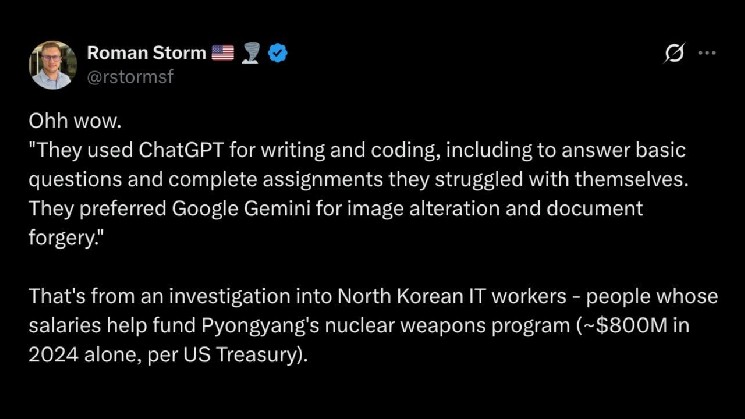
Roman Storm Accuses Google and OpenAI in Connection with U.S. Department of Justice Ruling on Cryptocurrency Case

Roman Storm, founder of the cryptocurrency anonymization protocol Tornado Cash, convicted in August 2025 for conspiracy to operate an unlicensed money-transmitting business, has accused Google and OpenAI of facilitating North Korea's nuclear program. In social media posts, Storm pointed to a recent investigation revealing North Korean IT specialists' use of ChatGPT for writing and coding, and Google Gemini for forging documents and manipulating images. He argued that, under the same legal logic the U.S. Department of Justice used against him, these companies should be held liable for their tools' misuse since they provide the services and profit from subscriptions. Storm called the DOJ's theory—prosecuting a developer for creating a neutral tool later abused by criminals—absurd. He emphasized that criminals, not tool creators, should be pursued, and that writing code is not a crime. The Tornado Cash verdict sets a negative U.S. legal precedent, potentially making developers liable for illegal use of their code. Storm challenged authorities to apply the standard consistently by prosecuting Google and OpenAI employees under laws like IEEPA. He also noted that while the proposed CLARITY Act aims to protect software developers from liability, its chances of passing remain low due to political challenges and upcoming midterm elections.

cryptonews.ru2h ago

Roman Storm Accuses Google and OpenAI in Connection with U.S. Department of Justice Ruling on Cryptocurrency Case

cryptonews.ru2h ago

Trading

Spot
活动图片