SEC, FINRA Probe Firms For Unusual Trading Activity Ahead Of Crypto Treasury Announcements – Report

bitcoinistPublished on 2025-09-27Last updated on 2025-09-27

Abstract

The US Securities and Exchange Commission (SEC) and the Financial Industry Regulatory Authority (FINRA) are reportedly investigating suspicious trading patterns...

Trusted Editorial content, reviewed by leading industry experts and seasoned editors. Ad Disclosure

The US Securities and Exchange Commission (SEC) and the Financial Industry Regulatory Authority (FINRA) are reportedly investigating suspicious trading patterns in the shares of certain companies that have announced crypto treasury strategies.

SEC, FINRA Scrutinize Suspicious Trading Moves

On Thursday, The Wall Street Journal (WSJ) reported that financial regulators have reached out to some of the over 200 companies with Digital Asset Treasury (DAT) strategies after observing unusual trading activity in the days leading up to the announcement of their crypto treasury strategy.

People familiar with the matter told the news media outlet that the SEC and the FINRA have examined unusual trading moves in the shares of multiple unnamed companies that announced that they would adopt a DAT strategy this year.

Reportedly, the regulators have raised concerns in letters and conversations about “unusually high trading volumes and sharp stock-price gains” that preceded the announcement that these companies would make cryptocurrencies their core corporate strategy.

SEC officials have warned these companies about potential violations of Regulation Fair Disclosure, the WSJ sources alleged. As the news media outlet noted, the rule prohibits public companies from “selectively disclosing material, nonpublic information to investors, analysts, and other market participants who might trade on the information.”

According to some lawyers, these types of FINRA letters usually mark the start of serious investigations into insider trading. However, it remains unclear whether the financial regulators are pursuing enforcement actions against any of these companies or investors.

Former SEC enforcement lawyer and now SEC defense attorney David Chase told WSJ that “when those go out, it really stirs the pot. It’s typically the first step in an investigation. Whether it goes full, full length, it’s anybody’s guess.”

The sources noted that, in some cases, the secrecy of the DAT announcements can be compromised, leading to the unusual stock activity ahead of the official statements. Meanwhile, lawyers who have worked on crypto-treasury deals affirmed that information leaks can also harm pricing transactions.

“If the stock price is highly volatile in the days leading up to pricing a transaction, that could actually make it very difficult to agree on a price for the transaction and put it at risk of execution,” Justin Platt, a partner at law firm Goodwin, told WSJ.

Crypto DAT’s Momentum Continues

Over the past few months, the crypto treasury strategy trend, pioneered by Michael Saylor’s Strategy, has gained momentum, with 212 new companies announcing plans to raise hundreds of billions of dollars to launch DAT strategies, the WSJ noted, citing data from crypto advisory firm Architect Partners.

Throughout September, multiple companies have unveiled crypto treasury strategies focused on Cardano (ADA), Avalanche (AVAX), and Solana (SOL). As reported by Bitcoinist, Solana-focused DATs have seen hundreds of millions of dollars invested in the strategies this month.

Recently, Helius Medical Technology revealed the launch of a $500 million SOL treasury strategy backed by Pantera Capital and Summer Capital. Similarly, Nasdaq-listed Fitell Corporation, a global provider of fitness equipment and health solutions, has unveiled the launch of the first Solana-based digital asset treasury in Australia.

Meanwhile, the top crypto treasuries have continued to accumulate Bitcoin (BTC) and Ethereum (ETH), the leading digital assets. BitMine, the largest ETH-focused treasury, recently surpassed the 2 million ETH milestone, while Strategy, the leading Bitcoin and crypto treasury, purchased another 850 BTC earlier this week.
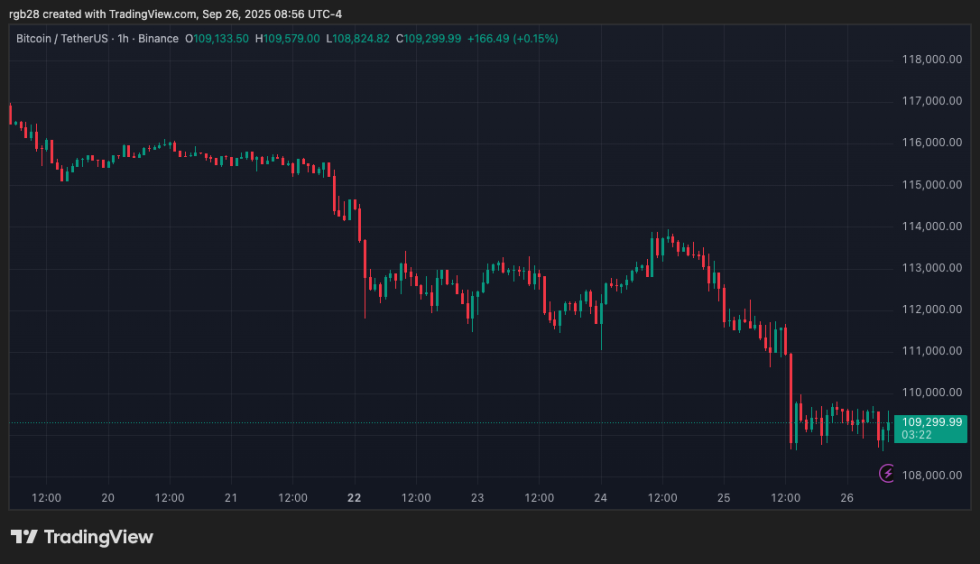
crypto, bitcoin, btc, btcusdt

Bitcoin trades at $109,229 in the one-week chart. Source: BTCUSDT on TradingView
Featured Image from NBC News, Chart from TradingView.com
Editorial Process for bitcoinist is centered on delivering thoroughly researched, accurate, and unbiased content. We uphold strict sourcing standards, and each page undergoes diligent review by our team of top technology experts and seasoned editors. This process ensures the integrity, relevance, and value of our content for our readers.

Rubmar is a crypto enthusiast who likes learning and improving constantly. She enjoys reporting on the latest news and developments in the crypto industry. Rubmar also enjoys scrapbooking, crafting, simulation games, and watching football.

Related Reads

Second Half of U.S. Crypto Policy: The Clarity Act Aims for 60 Votes, CFTC's "One-Person Commission" Becomes Biggest Variable

In a pivotal year for US crypto policy, the "CLARITY Act" is advancing in the Senate but faces a high hurdle, needing 60 votes to pass. Key challenges include bridging partisan divides on ethics and swaying undecided Republican senators within a tight legislative calendar of only about 40 working days. The policy "second half" involves intense negotiations on a broader framework for Web3 and DeFi, including crypto tax reforms and the Blockchain Regulatory Certainty Act. A significant uncertainty is the understaffed CFTC, operating with four commissioner vacancies, which complicates regulatory clarity. Meanwhile, the departure of key "crypto champions"—SEC Commissioner Hester Peirce and Senator Cynthia Lummis—will impact ongoing policy efforts. Industry experts are cautiously optimistic but realistic. Sara K. Weed notes that while progress is being made, CLARITY is unlikely to pass this Congress, pushing agencies like the SEC and CFTC to provide more guidance. Sulolit Mukherjee suggests meaningful crypto tax legislation is more likely to be attached to larger must-pass bills. Rashan Colbert discusses the jurisdictional debate over prediction markets, emphasizing the need for a regulatory framework that fosters their development as financial tools rather than treating them broadly as gambling. The clock is ticking, but opportunities remain for substantive progress through continued bipartisan dialogue and pragmatic efforts.

marsbit2h ago

Second Half of U.S. Crypto Policy: The Clarity Act Aims for 60 Votes, CFTC's "One-Person Commission" Becomes Biggest Variable

marsbit2h ago

Research Report Analysis: Morgan Stanley Details SanDisk SNDK, The Truth About Cloud Data Center Pricing Power and AI Inference Benefits

Morgan Stanley raised its price target for SanDisk (SNDK) from $1100 to $1750 on June 22, maintaining an Overweight rating. The upgrade is driven by AI inference demand reshaping the NAND market, particularly for KV Cache and context window storage in cloud data centers. These cloud clients exhibit price inelasticity and sign long-term contracts, granting SanDisk significant pricing power. SanDisk's New Business Model (NBM) agreements, covering over one-third of FY27 bit shipments with 3-5 year terms and fixed price/price collar structures, are crucial. They are projected to sustain gross margins around 80% even at floor prices, providing a buffer against cyclical downturns. Morgan Stanley forecasts gross margins to surge from 30.3% in FY25 to 86.7% in FY27e. With NAND supply expected to remain tight into 2026/2027 and cloud/data centers becoming the largest end-market, SanDisk holds supply-side pricing power. The company targets 15-19% bit growth via technology transitions, not capacity expansion. Revenue is projected to grow ~6.6x from FY25 to FY27, with EPS rising from $2.74 to $14.73, driven by high-margin cloud business. Key upside catalysts include faster enterprise SSD adoption and edge AI growth. Downside risks involve slower industry growth, competitor capex increases, market share loss, and competition from Chinese players like YMTC. The investment thesis rests on AI-driven structural demand, NBM's margin protection, and sustained supply tightness. The $1750 target implies ~28x FY27e P/E.

marsbit3h ago

Research Report Analysis: Morgan Stanley Details SanDisk SNDK, The Truth About Cloud Data Center Pricing Power and AI Inference Benefits

marsbit3h ago

Trading

Spot
Futures
活动图片