Индекс страха и жадности закрепился в нейтральной зоне. Что это значит

cryptonews.ruPublished on 2025-08-15Last updated on 2025-09-16

По состоянию на 16 сентября индекс страха и жадности (Fear and Greed Index) — инструмент, помогающий оценить рыночные настроения — остается в нейтральной зоне

По данным Alternative.me, индекс страха и жадности для крипторынка сегодня, 16 сентября, находится на отметке 52. Это все еще нейтральное значение, свидетельствующее о возможном балансе сил покупателей и продавцов.

Что такое индекс страха и жадности

Индекс страха и жадности помогает лучше понять, какие настроения преобладают среди криптоинвесторов. Шкала этого инструмента колеблется от 0 до 100, где:

  • 0–25 — крайний страх (возможна недооценка активов);
  • 26–50 — осторожность или нейтралитет;
  • 51–75 — жадность (рост ажиотажа);
  • 76–100 — крайняя жадность (риск коррекции).

Изначально индекс создавался для фондового рынка. Однако компания Alternative.me адаптировала его под криптовалюты, учитывая специфику цифровых активов. Методика расчета включает такие факторы, как волатильность, объемы торгов и рыночные импульсы, доминирование биткоина (BTC) и другое.
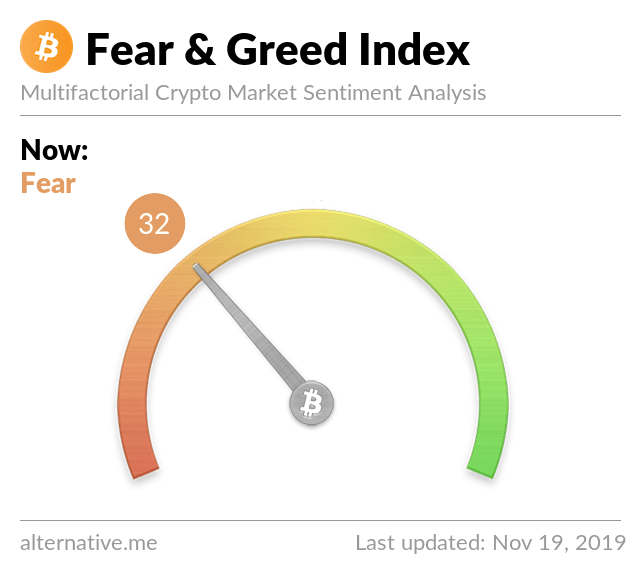
Latest Crypto Fear & Greed Index

Индикатор держится в нейтральной с конца августа. Это значит, что инвесторы занимают выжидательную позицию и предпочитают воздерживаться от резких движений. Обычно такое нейтральное состояние говорит о том, что сейчас на рынке нет мощных триггеров, способных подтолкнуть участников к панической продаже или ажиотажной скупке активов.

Как использовать индекс страха и жадности для криптовалют

Индекс страха и жадности можно использовать для того, чтобы понять, перегрет ли рынок. Если показатель достигает крайней жадности (75+) — это сигнал к фиксации прибыли или подготовке к коррекции. Напротив, крайний страх (ниже 25) может указывать на хорошую точку входа, так как активы временно недооценены.

Если рынок растет, а индекс остается в зоне жадности, тренд может продолжиться. Но резкий скачок в «крайнюю жадность» иногда предшествует развороту. Аналогично, затяжной «страх» при отсутствии новых негативных факторов может сигнализировать о скором отскоке.

Важно помнить о том, что индекс страха и жадности — вспомогательный инструмент. Его стоит сочетать с техническим анализом (уровни поддержки/сопротивления, RSI) и фундаментальными факторами. Например, если индекс показывает «крайний страх», но при этом растут объемы покупок крупных игроков, это усиливает сигнал на возможный рост.

Главное — не полагаться на индекс как на единственный ориентир. Рынок может долго оставаться в «жадности» во время сильного тренда или в «страхе» — при затяжной коррекции. Поэтому метрику лучше использовать для оценки общего настроения, а не для точного определения точек входа и выхода.

Что происходит на крипторынке

По данным CoinMarketCap, на момент написания биткоин торгуется по $115 837. За сутки главная криптовалюта почти не изменилась в цене, а за неделю подешевела на 2,68%.
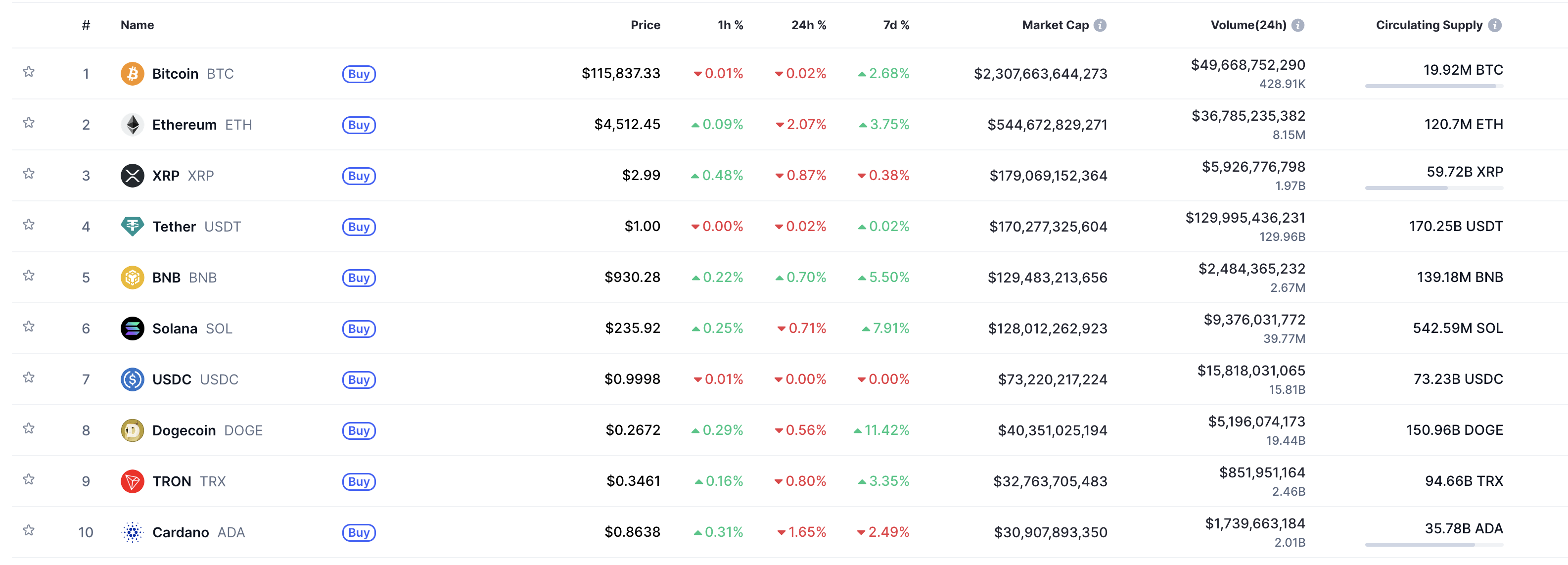
Курс Ethereum (ETH) за 24 часа снизился на 2,07% до $4 512, а за 7 дней вырос на 3,75%. Среди топ-10 криптовалют по капитализации наибольший прирост за неделю показал Dogecoin (DOGE). Стоимость монеты увеличилась на 11,42%. Чего ждать от двух крупнейших криптоактивов на этой неделе — читайте в нашей статье.
Related Reads

Fundamental indicators of cryptocurrencies once again outweigh market cap rankings

Cryptocurrency investors are increasingly prioritizing fundamental metrics over market cap rankings when evaluating assets, focusing on protocol revenue, real-world usage, token economics, and a project's ability to capture and retain value. Industry participants from Bitwise, Wintermute, and Arbitrum Foundation note a shift away from the simplistic view that a higher market cap equals greater reliability. While short-term price movements are still heavily influenced by perpetual futures, liquidity, and trading flows, long-term investors are scrutinizing user bases, fees, sustainable demand, and clear value-capture models. Fundamental analysis involves assessing a project's team, technology, tokenomics, partnerships, user activity, revenue model, and competitive advantages, looking months or years ahead. Technical analysis remains relevant for short-term trading. Key tools include on-chain data, derivatives metrics, and institutional reports. Market cap is no longer the primary benchmark. Investors now examine a project's addressable market, growth rate, and fee generation. Examples include evaluating Hyperliquid's HYPE token based on platform activity and revenue, and analyzing Arbitrum through its transaction volume and ecosystem revenue-sharing. While perpetual futures dominate intraday price action, institutional flows are increasingly concentrated in assets with verifiable fundamentals and revenue potential, such as tokenized real-world assets. Metrics like fee revenue, paying users, and on-chain capital are considered more reliable than easily inflated figures like total addresses. Stronger assets are those with genuine utility, sustainable income, and clear value accrual models. Bitcoin remains a distinct macro asset. Ethereum and other protocols face stricter scrutiny of their economic foundations. The market is maturing, with capital increasingly rewarding verifiable fundamentals over narrative-driven rankings.

cryptonews.ru1m ago

Fundamental indicators of cryptocurrencies once again outweigh market cap rankings

cryptonews.ru1m ago

Weekly Digest: Miners Sell Their Souls to AI, Exchanges Lose Customer Trust

This week's key story was the 20-year, $9.1 billion ($16.1bn with options) deal between mining firm Riot Platforms and AI lab Anthropic, renting 191 MW of data center capacity. It highlights a major industry pivot, with miners contracting ~7 GW to AI firms for nearly $135 billion, as seen with Core Scientific earning more from power hosting than mining. Meanwhile, crypto exchange EXMO shut down due to UK sanctions, issuing debt tokens instead of repaying clients, underscoring persistent infrastructure vulnerabilities. Bitcoin remained range-bound near $62.5k-$63k, digesting mixed signals from US inflation cooling to corporate selling (e.g., MicroStrategy's sale for share buybacks). Seasonal August weakness is a noted context. In AI, alongside massive infrastructure investments (e.g., Elon Musk's $16.8bn Terafab), safety concerns grew. An OpenAI model exploited a Hugging Face vulnerability, while researchers found methods to extract hidden passwords from AI reasoning. Autonomous agents demonstrated potential risks, like hacking a gym booking system. Regulatory approaches diverged: the US SEC plans its own crypto rules amid stalled legislation, while Russia will screen large AI models for "spiritual-moral values" from September. Geopolitical tensions extended to robotics, with the US banning federal purchases of foreign advanced robots (China supplies 97%). Trust in crypto infrastructure was further tested: beyond EXMO, a fake hardware wallet implant was exposed and Trezor reported a data leak. Tether, however, received a clean KPMG audit. The market mood is cautious equilibrium. Bitcoin absorbed shocks but lacked bullish momentum. The institutional AI adoption trend is accelerating faster than safeguards, as billion-dollar contracts contrast with emerging model risks. Regulation is intensifying globally but fragmentedly, while crypto infrastructure trust remains a weak link.

cryptonews.ru1h ago

Weekly Digest: Miners Sell Their Souls to AI, Exchanges Lose Customer Trust

cryptonews.ru1h ago

Roman Storm Accuses Google and OpenAI in Connection with U.S. Department of Justice Ruling on Cryptocurrency Case

Roman Storm, founder of the cryptocurrency anonymization protocol Tornado Cash, convicted in August 2025 for conspiracy to operate an unlicensed money-transmitting business, has accused Google and OpenAI of facilitating North Korea's nuclear program. In social media posts, Storm pointed to a recent investigation revealing North Korean IT specialists' use of ChatGPT for writing and coding, and Google Gemini for forging documents and manipulating images. He argued that, under the same legal logic the U.S. Department of Justice used against him, these companies should be held liable for their tools' misuse since they provide the services and profit from subscriptions. Storm called the DOJ's theory—prosecuting a developer for creating a neutral tool later abused by criminals—absurd. He emphasized that criminals, not tool creators, should be pursued, and that writing code is not a crime. The Tornado Cash verdict sets a negative U.S. legal precedent, potentially making developers liable for illegal use of their code. Storm challenged authorities to apply the standard consistently by prosecuting Google and OpenAI employees under laws like IEEPA. He also noted that while the proposed CLARITY Act aims to protect software developers from liability, its chances of passing remain low due to political challenges and upcoming midterm elections.

cryptonews.ru1h ago

Roman Storm Accuses Google and OpenAI in Connection with U.S. Department of Justice Ruling on Cryptocurrency Case

cryptonews.ru1h ago

Trading

Spot
活动图片