edgeX 积分实战:深度玩家揭秘「降本增效」获取策略

比推Published on 2025-09-10Last updated on 2025-09-10

作者:Jaleel加六

原标题:深度玩家的edgeX实战心得:「降本增效」的DeFi新打法


下一个大手笔的空投项目,十有八九会出自 Perp DEX 赛道。据律动 BlockBeats 不完全统计,眼下市面上未发币的 Perp DEX 至少有十家:edgeX、Lighter、paradex、variational、Pacifica、Aster……我们想知道:在这个赛道里,普通人究竟能做些什么,既不冒进,又不错过赛道的 Alpha?

为了回答这个问题,律动 BlockBeats 找到一位 Perp DEX 深度玩家 anymose(@anymose96),他是《从零开始读懂 Web3》和《NFT 极简入门》两本书的作者,也是一位深入研究早期 alpha 项目的选手。

在这些目前最有潜力的赛道选手之中,anymose 结合交易深度、移动端体验、API 体验、项目背景、空投盈亏比等综合因素的考虑,选择了 edgeX 作为他当前的主场。

接下来,我们将详细解析 anymose 在 edgeX 上的实战经验——从积分获取策略到权重放大技巧,从 TGE 时间预测到积分价值评估,为读者提供一套可复制的实操路径。

「降本增效」的积分打法

在这轮周期中,「积分制」已成为项目早期空投份额计算的主流方式。通过积分记录真实贡献,在 TGE 或空投时按账本分配奖励。这种机制的优势显而易见——更加合规、时机可控、激励精准、防刷效果更佳。Perp DEX 赛道中,Hyperliquid 已经成功验证了这套逻辑,edgeX 也采用了相同的机制。

edgeX 的积分发放采用"周度、阶梯制、按贡献拆分"的模式。具体运作机制如下:平台会在每周三进行积分发放,根据全体用户周累计成交额分五档设置积分总奖池,比如低于 42 亿美元 奖池是 10 万分;达到 42 亿美元 是 12 万分等等,一共五档奖池。据律动 BlockBeats 观察,最近几周的积分奖池多落在第三档(15 万分)与第四档(20 万分)。
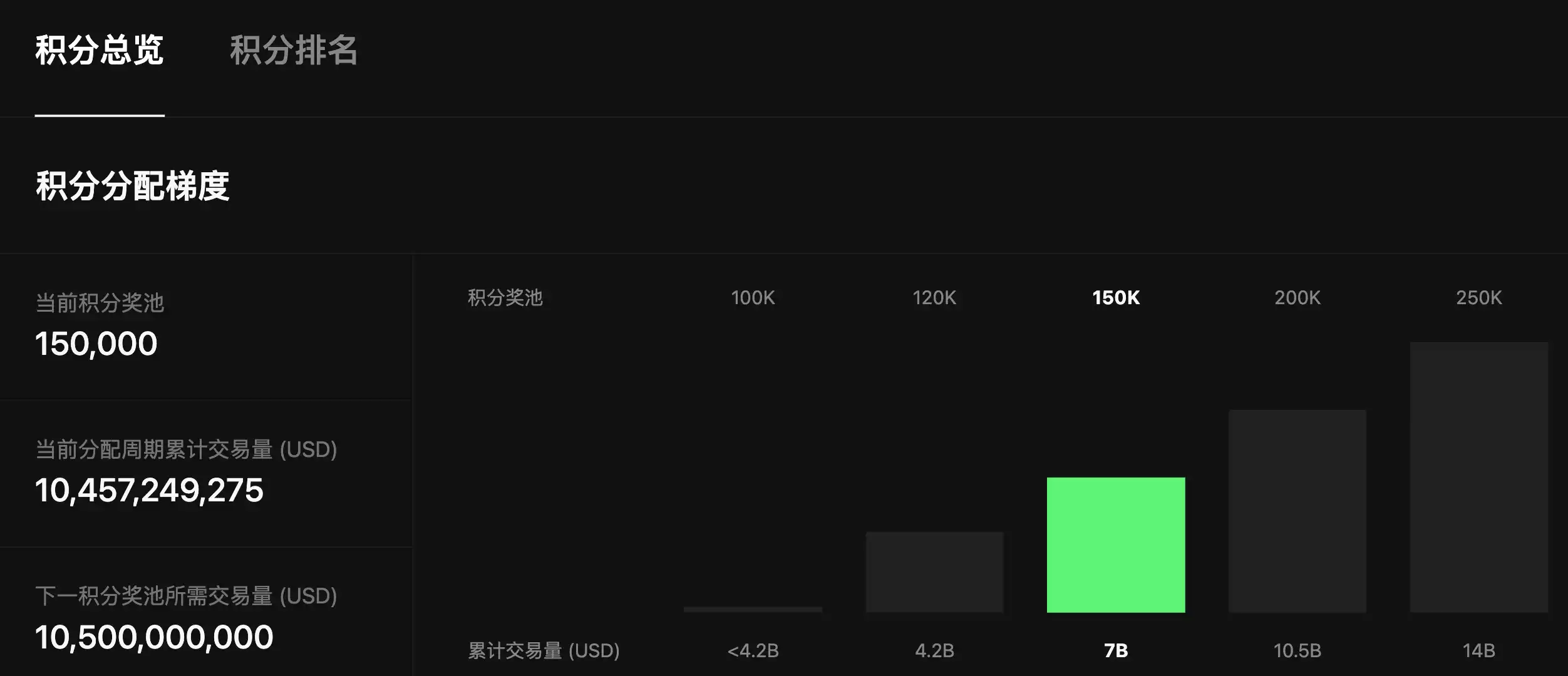
积分奖池阶梯示意图

确定奖池总量后,用户可通过以下 5 种途径获取积分,每种途径权重不同。
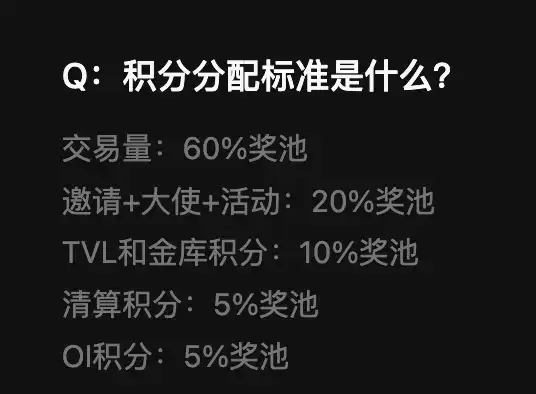
其中最大的积分奖池来源是交易量,这也与 anymose 的观察相符:「如果要对积分权重进行一个排序,我们测算是:开单金额(贡献手续费)> 持仓 > 损益。」

这也意味着交易量是获取积分的大头。那么多少交易量能获得 1 积分,积分获取的成本又大概是多少?这可能也是用户最关心的问题之一,anymose 从一线玩家的实操层面,给出了自己的答案。

「我们团队在 edegX 的交易上一共贡献了大概 20 万美元的手续费,」结合 edgeX 手续费比例计算,可以大致反推 anymose 的总成交量大致在 8.3 亿—15.4 亿美元区间。由于 edegX 现阶段的积分发放是一个动态积分,每周的获取难度都会变动,所以很难给出一个「多少交易量得到 1 积分」的准确数值,但根据 anymose 的估算:「1 积分的成本平均在 10 美元左右。」

因为参与比较早且深入,anymose 的成本是相对较低的。对于普通用户来说,成本会再高一些,据社区讨论,目前每 5-7 万美元交易量可获得 1 积分,成本约在 15 美元左右。

这也是 anymose 不再建议用户做「精品号」而不是刷多号的原因:「降本,是玩 edgex 最好、也应该是最重要的策略。」

把资金集中在一个「精品号」上,交易量和邀请人数达到一定程度后升级到 VIP 等级,手续费降低,那么积分获取的成本也会降低很多。相同资金体量下能用更低的成本获得更多的积分。如下图所示,根据不同的 VIP 等级可以有更低的交易手续费折扣。
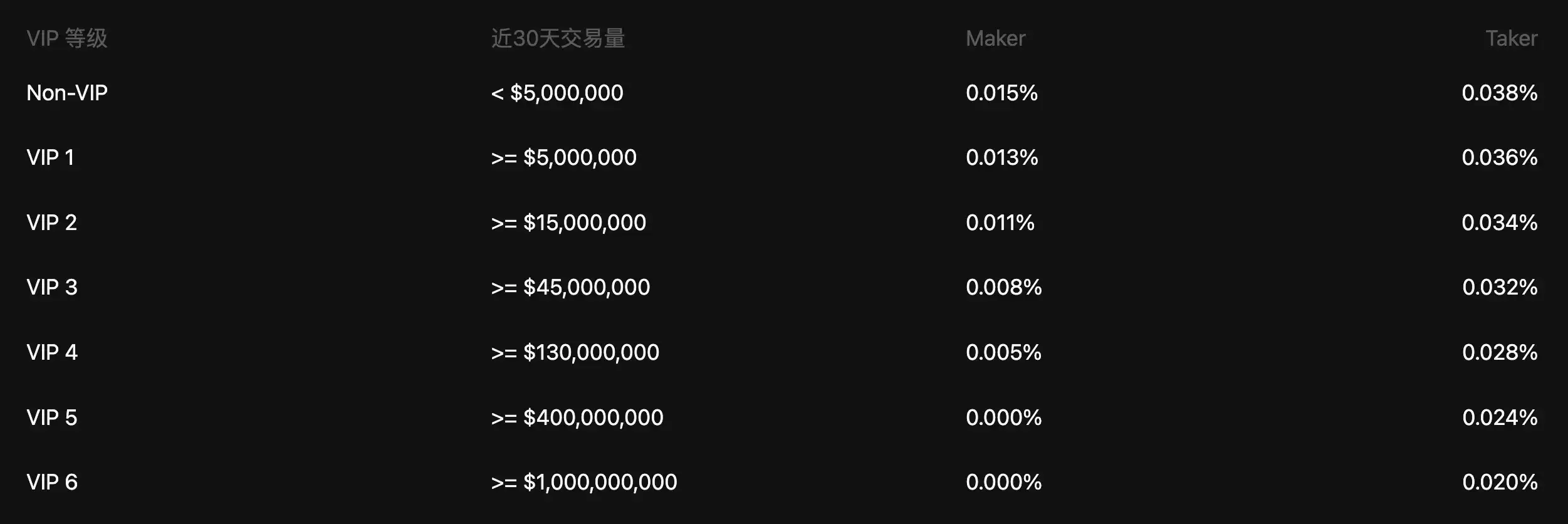
把成本做薄的方法,除了升级到 VIP 等级之外,还有新币上线阶段,往往会有活动给出额外积分。此外,anymose 还补充道:「多参加社区内的活动,还有交易大赛、邀请返佣、做大使等等各种方式,都可以获得额外积分,降低平均成本。」

跑 API +金库满额

「从历史数据来看,现在周平均钱包获取积分已经连续两周降到历史最低 24 分、交易人数连创新高,所以整体是更难了。」anymose 表示。

而像是早期的一些"取巧"玩法,比如开多新账户完成新手任务又或是用爆仓金额换取积分等等,随着 edgeX 热度的增加,获取积分的成本有所上升,许多玩法现在已经不适用了。因此,真实的交易量成为获取积分的核心要素。

「归根到底,还是跟你的交易量息息相关。」因此 anymose 也非常推荐做高频的大户或者一些量化交易员,接入 API 做自动化交易:「我们的策略还是比较简单的,就是看资金费率,然后接了 edgeX 的 API 做单边,体验非常好,非常丝滑,之前 API 申请暂停了一个多月,但现在已经开放了。」

除了 Perp 交易,eLP 金库是 edgeX 的另一大产品亮点。据官方文档显示,edgeX eLP 的 APY 收入来源于被动做市利润、清算费以及平台交易费的一部分。每位用户得到的 eLP 金库额度是随着 Perp 交易的增长而逐渐提升的。目前金库的额度分配规则为: 个人每达到 5 万美元交易量获得 30 美元额度;邀请的用户每达到 30 万美元得 30 美元额度;上限为 10 万美元的 50% 充值额度。

虽然 eLP 金库的只占据 10% 奖池的权重,但胜在其 APR 的高收益,过去一个月的表现为 13.65%APR 左右,因此 anymose 团队的选择是:「金库满额,随时增加额度,以此捕获积分和高 apy 收益。」
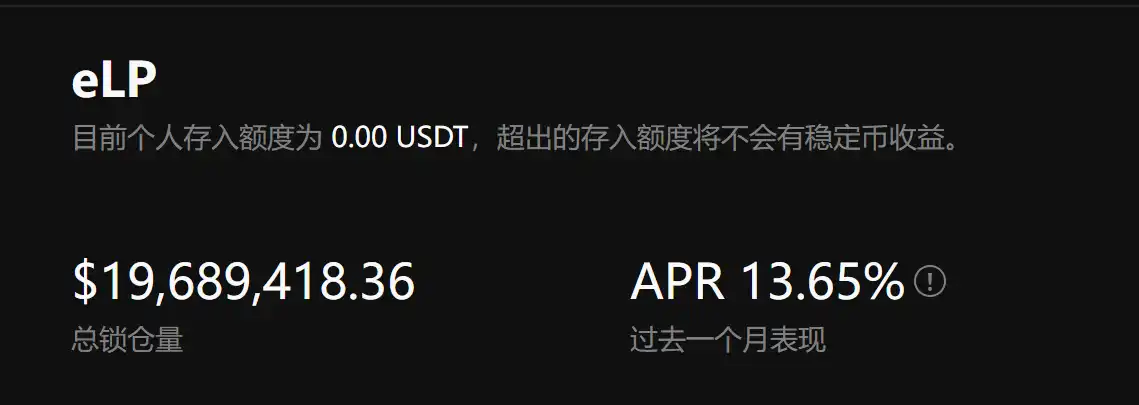
截止发文时间,eLP 金库的 TVL 为 1.96 亿美元;数据来源:edgeX

至于社区非常关心的「女巫规则」,anymose 表示 edgeX 团队对于女巫的说法是:「只要你拿到了积分,就没有女巫的说法」。

「这就意味着:如果有女巫,那你积分都拿不到」,anymose 说道。

不过唯一需要注意的是,edegX 的交易规则里有一条是:自成交不计分。「自成交就是自己挂单自己吃,这个很容易识别」anymose 解释道。另据律动 BlockBeats 在社区中获取的信息:超短回转(开完就马上平)的权重会低一些,在交易量相同的情况下持仓时间更长积分权重更大。

因此综合下来最稳妥的做法是:先集中资金体量做 1 个精品号提升 VIP 等级、优先做限价单降低手续费、真实交易避免自成交、叠加活动与大使返佣、eLP 金库满额或分批加仓。这样既能优化每分成本,也能把真实交易与稳健收益同时做厚。

1 积分 30 刀,高估还是低估?
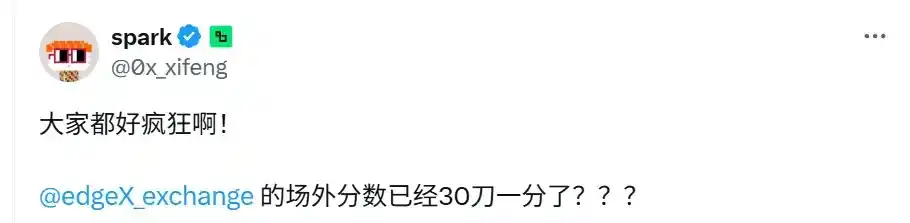
最近在社交媒体上能看到社区对 edgeX 积分价格的讨论,虽然场外交易量并不大,但$30 一积分的价格在 anymose 看来是合理的。

「我保守预计 edgeX 的 FDV 在 20 亿左右,空投比例为 20%,总积分按 600 万计算,那么 1 积分的价格是 67 刀,但考虑到估值方面又上下 50% 的弹性,所以我们最终计算下来 1 积分的价格在 30~50 刀 区间,因此现在的 OTC 价格并不离谱。」

据律动 BlockBeats 统计,目前 edgeX 已经发放了 283 万积分的总量,包括第一个赛季 Alpha Season 发放的积分现在第二个赛季 Open Season 发放的积分。如果接下来的 7 周每周都按照满额的 25 万积分发放,那么积分总额是 483 万。
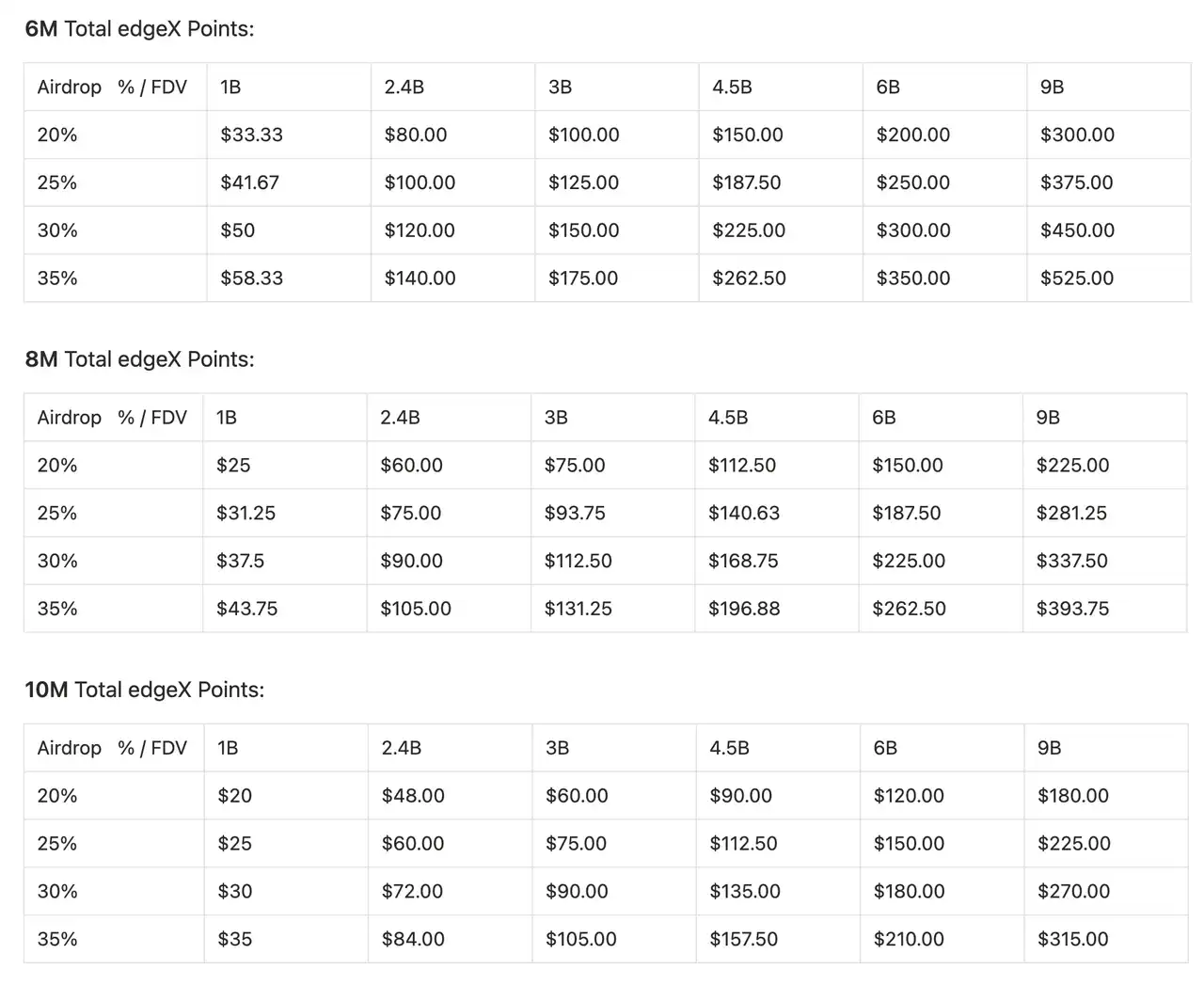
此时我们再参考另一位社区成员akonresearch 的计算模型:若当 edgeX 发币时,日交易量达到 1.5B,日交易用户数达到 8K,TVL 达到 500M 的情况下,那么 FDV 可合理估算为 hype 的 1/20,即 2.4B。那么用 600 万总积分的情况下估算空投份额为 20%-35% 时,积分的价值能达到 80 美元-140 美元,这比 anymose 的估算还要高许多。

当然这是基于「第二个赛季也是 21 周」的情况下估算的,如果市场表现差择机延期,积分价值的估算也会有所下调。不过从另一个角度来说,虽然积分母数可能继续增长造成摊薄,但产品面成熟、流动性与用户结构更健康,TGE 后的价格承接也可能更稳。「毕竟 edgeX 还有不少产品在打磨,主流以外的交易对深度、系统稳定性都需要时间继续优化」,anymose 坦率地说道。

时间线方面,官方口径是:若行情与产品进度顺利,目标在今年第四季度 TGE。anymose 给出的观察点更细:「所以接下来,第一个关键的时间点是 7 周后,也就是 10 月底。现在 open season 已经到了第 14 周,到了第 21 周这个赛季可能就会结束了。」

除了关注 7 周后的产品情况和市场环境之外,anymose 还建议关注 TGE 临近的几个信号:交易量是否会再次猛拉,合作伙伴的加入,以及产品上比如金库及 V2 测试网的进展等等。

赛道对手里,anymose 直言 Lighter 可能会抢跑 TGE:「Lighter 的模式与节奏更快,可能 VC 那边给资源也更多,产品更单一。不过从 perp 层面来说,和 edgex 差太多了。如果 Lighter 先发,我们在 edgeX 的边际投入会下降,转为防守策略。」但长期看来,anymose 还是更看好 edgeX 的成长性,「在团队方面,我和 edgex 的人接触下来,能感受到他们非常专注于业务,没那么浮夸和激进」。

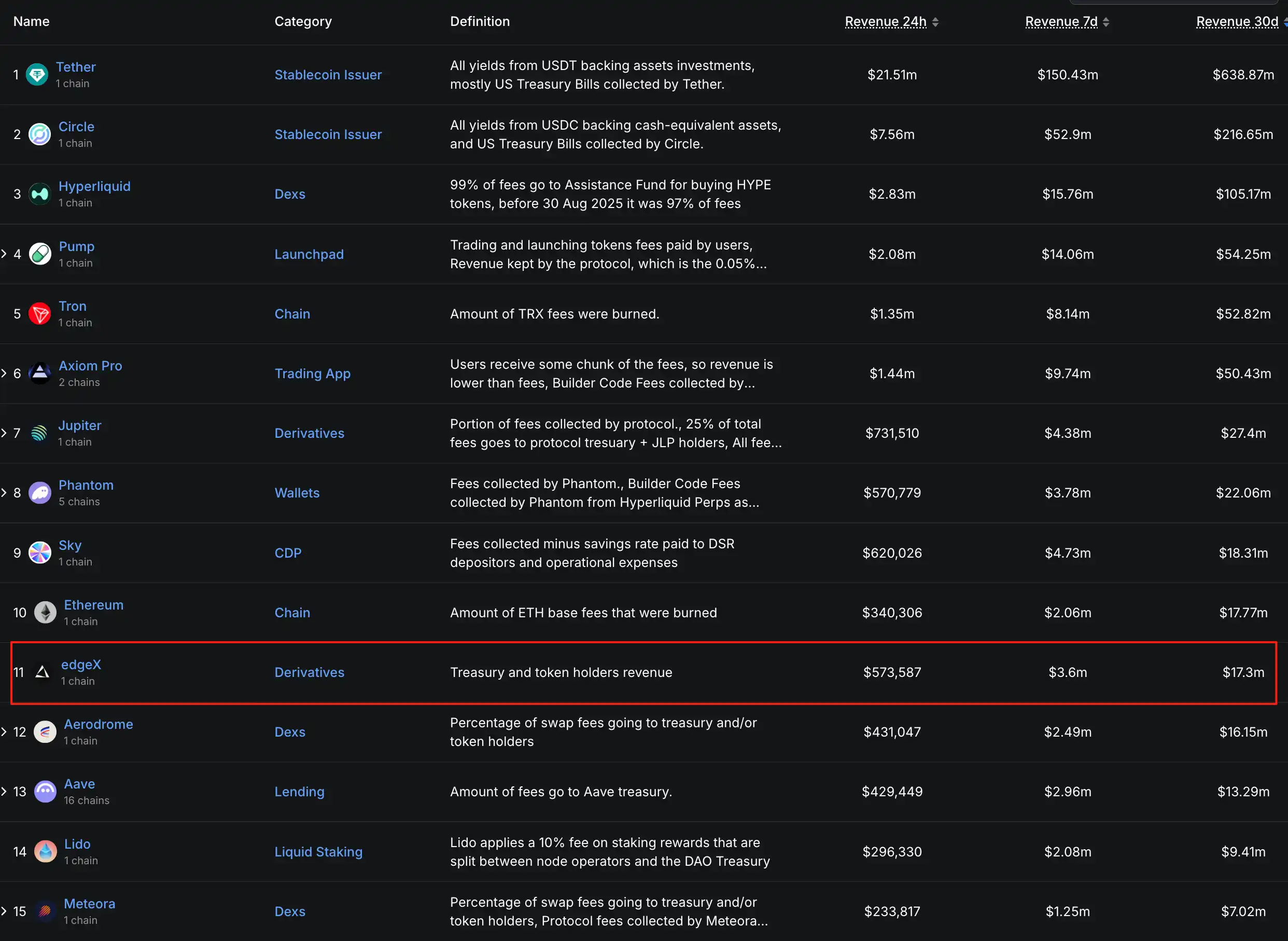
事实上,收入数据也支撑了 anymose 的判断。截止发文时间,edgeX 的 30 日收入在所有加密协议中排行 11。在 Top 前 15 的协议中(剔除 USDT、USDC 这两个稳定币发行方和 Axiom 这个多次说没有发币计划的交易 bot 之外),就只有剩下 edgeX 没有发币了。更多关于 edgeX 的收入可阅读:《这家没发币的 DEX,收入超过了 Uniswap》。
在流动性深度方面,在 0.01% 的价差区间内,eedgeX 的订单簿可承接最高约 600 万美元的 BTC 下单量,高于 Hyperliquid(约 500 万美元)、Aster(约 400 万美元)和 Lighter(约 100 万美元)。虽说整体深度仍略逊于 Hyperliquid,但在大多数币种上 edgeX 都是除 hyperliquid 外深度最好的 Perp DEX。叠加成交体量,edgeX 也仅次于 Hyperliquid 与 Lighter。也就意味着不论是产品完整度还是各项数据,edgeX 都在 Perp DEX 赛道中冲二保三。

所以 30 美元/分到底贵不贵?答案取决于你对 FDV、空投比例与积分母数的预期。更重要的是参与方式,这决定了你的边际成本。集中做「精品号」的交易量,提升等级降低手续费,叠加大使/活动/邀请与 eLP 金库,把每一分的成本打薄,再等待 TGE 窗口。

而其中最重要的八个法门或许就是降本增效,大道至简。


Twitter:https://twitter.com/BitpushNewsCN

比推 TG 交流群:https://t.me/BitPushCommunity

比推 TG 订阅: https://t.me/bitpush
说明: 比推所有文章只代表作者观点,不构成投资建议

Related Reads

The Philadelphia Semiconductor Index Tumbles Nearly 5% in a Single Night, Optical and Memory Sectors 'Collapse' Together: Surging U.S. Bond Yields Shake AI Belief

On the evening of August 18th, the US stock market saw a sharp sell-off concentrated in the AI hardware sector, with the Philadelphia Semiconductor Index plummeting nearly 5%. Leading AI infrastructure and components companies in fields like optical communication and memory chips experienced some of the steepest declines, such as Fabrinet (-19.38%) and Kioxia ADR (-13%). The sell-off was not broad-based but rather targeted the long-duration, high-momentum stocks previously driven by AI narrative optimism. This market shift is primarily attributed to a significant surge in long-term US Treasury yields, with the 30-year yield hitting its highest level since 2007. Rising yields increase discount rates, disproportionately impacting the valuations of growth stocks whose profits are projected far into the future—a category that includes most AI hardware plays. Additional pressure came from climbing oil prices due to Middle East tensions, which fueled inflation concerns. The article identifies three structural reasons for the severity of the drop in these specific subsectors: excessive prior gains and crowded positioning, high sensitivity to the sustainability of AI capital expenditure narratives, and inherent high volatility within the supply chain. Importantly, the sell-off appears to be a valuation and positioning reset rather than a fundamental repudiation of AI, evidenced by the relatively modest decline in a bellwether like Nvidia (-2.34%). Looking ahead, the direction hinges on three key indicators: whether the 30-year Treasury yield stabilizes, the trajectory of oil prices and geopolitical risks, and the market's pricing of new AI-related corporate debt. For related Asian and A-share markets, short-term negative sentiment spillover is expected, but medium-term drivers like domestic cloud capex may provide divergence. The episode signifies a market transition from pricing AI's "story" to rigorously evaluating its returns against a backdrop of higher financing costs.

marsbit6m ago

The Philadelphia Semiconductor Index Tumbles Nearly 5% in a Single Night, Optical and Memory Sectors 'Collapse' Together: Surging U.S. Bond Yields Shake AI Belief

marsbit6m ago

Ten Years, Wang Xingxing's Comeback: Unitree Valued at 400 Billion

Over a decade ago, Wang Xingxing, a 29-year-old with a passion for robotics but little funding, demonstrated his struggling robot dog to investors in Hangzhou. In 2019, with his company Unitree nearly out of cash, he captured the attention of Sequoia Capital China's managing director Li Yannan. Despite initial skepticism about the niche market for robot dogs, Wang's vision and deep technical conviction led Sequoia to make an initial seed investment. This marked a turning point. Following Sequoia's lead, a wave of prominent investors including Meituan, Tencent, Alibaba, and various venture capital and state-backed funds joined subsequent funding rounds. Wang's relentless focus and Unitree's technological advancements propelled the company to become a global leader in humanoid robotics. On August 19th, 2027, Unitree Robotics debuted on Shanghai's STAR Market as the first listed humanoid robotics company in China. Its shares skyrocketed over 500% at opening, reaching a market valuation of approximately 400 billion yuan. Wang Xingxing became one of the wealthiest individuals of his generation on the exchange, while Sequoia China, having invested across multiple rounds, remained a major shareholder. The story is celebrated as a classic outlier's triumph—a founder without elite credentials achieving success through pure belief and perseverance. Unitree's IPO is seen as a major milestone for China's embodied AI industry, providing a valuation benchmark and accelerating the sector's maturation. As Wang once stated, he aims to be "a small boat riding the mighty torrent of technology." His journey symbolizes the beginning of a new narrative for Chinese robotics on the global stage.

marsbit6m ago

Ten Years, Wang Xingxing's Comeback: Unitree Valued at 400 Billion

marsbit6m ago

Manufacturing's Share Drops Below 25%: Is Hangzhou Unconcerned?

Hangzhou is entering a critical phase of industrial restructuring. While its manufacturing-to-GDP ratio has fallen below 25%, the city is not alarmed. Instead, it is strategically navigating a dual focus: advancing advanced manufacturing and expanding its service sector, particularly producer services. Recently, the city celebrated the IPO of a humanoid robotics company, seen as a milestone in moving beyond its e-commerce era. Simultaneously, it set an ambitious target for its service sector: to exceed 2 trillion yuan in value by 2030, with producer services making up over 60%. Data shows a clear trend: the service sector's share of GDP has risen to 75.3%, while manufacturing's share has declined to around 20.1%. This shift revives the debate on whether a strong service sector weakens a city's manufacturing "foundation." Hangzhou's approach challenges the notion of a fixed manufacturing "red line" near 25%. The city argues that the quality and integration of industries matter more than simple ratios. Its strategy is "using software to drive hardware," leveraging its core strengths in digital economy and producer services—like R&D, software, and supply chain management—to empower and add value to manufacturing. This is embodied by its emerging "AI era" companies, whose innovation in Hangzhou feeds into national industrial chains. The city believes that for a hub like Hangzhou, the key is not merely boosting visible manufacturing output, but strengthening the "invisible" competitive edge provided by high-end producer services, which ultimately determine manufacturing profitability. National policy is also shifting from insisting on a "stable" manufacturing share to acknowledging a "reasonable" range, allowing for quality-focused development. Hangzhou's future industrial blueprint aims for a manufacturing share above 22% of GDP by 2027, coupled with a dominant, high-value service sector. The goal is not to choose between manufacturing and services, but to deeply integrate them, using advanced services as the accelerator for next-generation manufacturing.

marsbit31m ago

Manufacturing's Share Drops Below 25%: Is Hangzhou Unconcerned?

marsbit31m ago

SEC Suddenly Proposes "Regulation Crypto": U.S. Token Fundraising May Become Legal Again

On August 18, the U.S. Securities and Exchange Commission (SEC) proposed a landmark set of permanent rules, "Regulation Crypto Assets," specifically designed for crypto asset investment contracts. The 402-page proposal introduces two registration exemption paths and a groundbreaking safe harbor mechanism, representing the SEC's first dedicated crypto-specific regulatory framework. Two exemption tiers are proposed: a "Startup Exemption" allowing a one-time raise of up to $5 million within four years with basic disclosure requirements, and a "Financing Exemption" permitting raises of up to $75 million every 12 months with stricter obligations, including financial statements and ongoing reporting. Both paths require "principles-based narrative disclosure," a flexible approach distinct from traditional IPO forms. The most transformative element is the investment contract safe harbor. It provides a legal path for tokens to "graduate" from being classified as securities. If an issuer completes or permanently ceases its "essential managerial efforts" as promised in the investment contract and meets specific conditions, it can file with the SEC to have the token exit the securities framework. This creates a novel legal lifecycle where a token can begin as a regulated security for fundraising and later become a non-security asset as the network decentralizes. This move is seen as the SEC pragmatically filling a legislative vacuum, as the stalled CLARITY Act in Congress faces significant delays. The proposal aims to offer a compliant pathway for token offerings within the U.S., countering the trend of projects moving overseas. While currently a proposal open for a 60-day public comment period, it signals a major potential shift from an enforcement-heavy approach toward establishing clearer rules for the crypto industry.

marsbit35m ago

SEC Suddenly Proposes "Regulation Crypto": U.S. Token Fundraising May Become Legal Again

marsbit35m ago

Late Qing County Magistrates' 'Official Debt' and the Crypto World's 'Exchange Listings': The Cross-Temporal Truth of Financializing Power

This article draws parallels between financialization of power in late Qing Dynasty China and the modern cryptocurrency industry. It opens with a staggering contemporary corruption case involving billions, illustrating how official positions control massive cash flows, akin to toll booths. The core analysis focuses on Du Fengzhi, a late Qing county magistrate. His 22-year journey from passing the provincial exam to finally obtaining a post highlights how bureaucratic "qualification" (like a VC investment) doesn't guarantee immediate benefit. Crucially, upon receiving his appointment, Du had to borrow heavily—"official debt"—to cover travel and networking costs to actually assume his position. Lenders, seeing his future post as a revenue-generating asset, offered loans with exorbitant effective interest rates (e.g., borrowing 4000 taels but receiving only 2000), effectively discounting and financializing his future power. Once in office, Du faced immense pressure from both public tax quotas and his crippling private debt. His diaries reveal aggressive, sometimes extreme, tax collection methods (sealing ancestral temples, pressuring local gentry) to meet these demands. The article argues this created a system where public duty and private financial survival became indistinguishable, with corruption evolving from operational necessity to normalized practice. The piece consistently analogizes this to crypto: VC funding as mere "qualification," the costly "listing" process on exchanges, the role of market makers and KOLs as intermediaries akin to local gentry, and the relentless pressure on funded projects to deliver returns—often leading to perpetual pivots, artificial metrics, and ultimately, the extraction of value from retail liquidity. Both systems, it concludes, are driven by the financialization of future potential, trapping individuals in cycles of debt and obligation with limited alternatives for upward mobility.

marsbit42m ago

Late Qing County Magistrates' 'Official Debt' and the Crypto World's 'Exchange Listings': The Cross-Temporal Truth of Financializing Power

marsbit42m ago

Trading

Spot
活动图片