Eric Trump Explains Family’s Pro-Crypto Shift, Cites ‘Fragile’ Financial System

bitcoinistPublished on 2025-08-26Last updated on 2025-08-26

Abstract

US President Donald Trump’s son, Eric Trump, has shared some insight into his shift to the crypto industry, the problems...

Trusted Editorial content, reviewed by leading industry experts and seasoned editors. Ad Disclosure

US President Donald Trump’s son, Eric Trump, has shared some insight into his shift to the crypto industry, the problems with the traditional financial system, and how it was “weaponized” against the Trump family businesses.

Trump Family Pushed Into Crypto

In a recent interview with The Wall Street Journal, Eric Trump detailed how financial institutions “made him” embrace the crypto industry, explaining that after the January 6, 2021, riot at the US Capitol, several banks cut the Trump family off.

Trump shared that hundreds of accounts for the family’s business were shut down without an explicit reason, leaving the Trump Organization “debanked” and “scattering millions across accounts at regional banks before eventually migrating to a new bank,” which he did not name.

“At that time, I realized how fragile the financial system was and how easily it could be weaponized against you,” he affirmed, arguing that the decisions were likely political, leading him to turn to the crypto industry.

According to the interview, Eric Trump, executive vice president at the Trump Organization, began warming up to the industry during his father’s second presidential campaign, as he became aware of the struggles of crypto companies with banking services.

Previously, he told CNBC that being “the most canceled company, probably on Earth,” is what drove the Trump family towards crypto, explaining that his entry into the industry wasn’t a financial bet but “a form of resistance.”

“This whole system was weaponized against them, no different than it had been weaponized against us for different reasons,” Trump told the Wall Street Journal, noting that both conservatives and crypto firms have alleged that banks have denied them services for political or religious reasons.

The Trump administration has made stopping the crackdown on the sector a top priority. Crypto industry leaders have accused the previous administration of using financial exclusion as a weapon against numerous companies and founders, in what many have named “Operation Chokepoint 2.0.”

In December, the Securities and Exchange Commission (SEC) Commissioner Hester Peirce urged the regulatory agency to “stop the chokepoint aspect of government regulation.” Since then, the Commission dropped its “regulation by enforcement” approach, launched its Crypto Task Force, and recently unveiled the “Project Crypto” initiative to modernize securities rules and regulations.

Earlier this month, President Trump addressed this issue, signing an executive order that requires banks to ensure they do not refuse financial services based on political or religious beliefs and directs regulators to review all institutions for any discriminatory practices.

A Gateway To Financial Freedom

Eric Trump also addresses the conflicts of interest allegations, asserting that there’s a separation between the family’s crypto businesses and President Trump’s official businesses. “I literally have nothing to do with Washington, D.C.,” he affirmed.

It’s worth noting that multiple US lawmakers have argued that the Trump family’s crypto ventures, including World Liberty Financial’s (WLFI) USD1 stablecoin and the official TRUMP memecoin, enable corruption and represent a threat to America’s financial system.

Nonetheless, Trump said in the interview that memecoins serve as a “powerful gateway” for newcomers, arguing that “If somebody wants to go in and they want to buy $TRUMP, congratulations, now you have access to Bitcoin, you have access to Ethereum, you have access to USD1, you have access to the United States dollar.”

You just took the first step in actually creating some financial freedom that I think so many people around the world want.

He closed the interview discussing the benefits of tokenizing real-world assets (RWA). “Why is it that if I wanted to refinance Trump Tower, I couldn’t tokenize this asset and put it on the street for billions of people around the world to otherwise invest in it. They love New York. They love Fifth Avenue. They love Trump,” he concluded.
crypto, eth, ethusdt

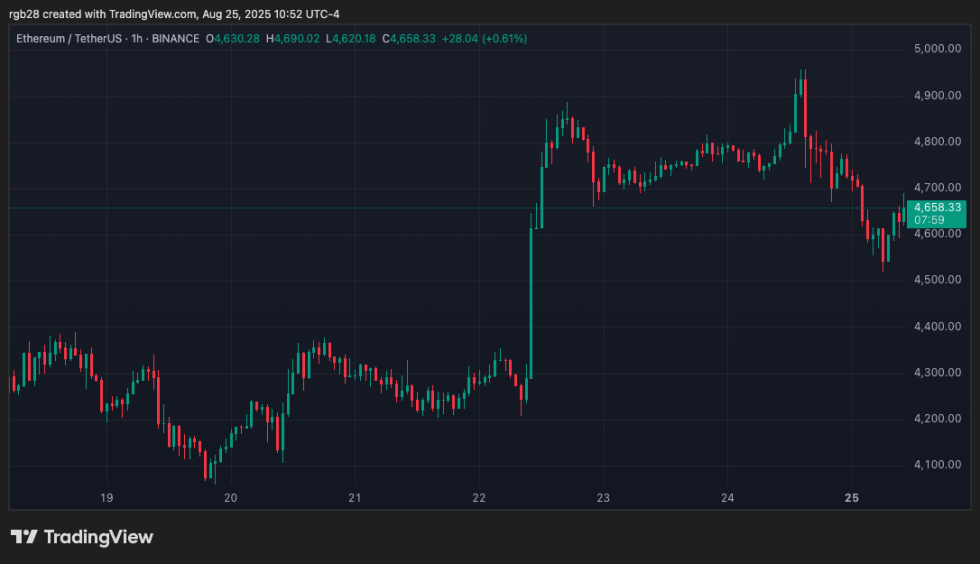
Ethereum (ETH) trades at $4,558 in the one-week chart. Source: ETHUSDT on TradingView
Featured Image from Unsplash.com, Chart from TradingView.com
Editorial Process for bitcoinist is centered on delivering thoroughly researched, accurate, and unbiased content. We uphold strict sourcing standards, and each page undergoes diligent review by our team of top technology experts and seasoned editors. This process ensures the integrity, relevance, and value of our content for our readers.

Rubmar is a crypto enthusiast who likes learning and improving constantly. She enjoys reporting on the latest news and developments in the crypto industry. Rubmar also enjoys scrapbooking, crafting, simulation games, and watching football.

Related Reads

Deforming the Transformer, LLMs Become Smarter

A new research paper proposes "Tapered Language Models (TLMs)," a method that improves large language model performance without adding any parameters. It challenges the standard Transformer design where each layer has the same number of parameters ("feed-forward network" width). Building on evidence that layers are not equally important—earlier layers handle foundational information like grammar, while later layers often reinforce existing judgments—the researchers suggest reallocating model capacity from later to earlier layers. The core idea is to make the layer width taper off monotonically from start to end, keeping total parameters and compute constant. Experiments compared linear, cosine, and sigmoid tapering curves on a 440M parameter model. The cosine curve (e.g., starting width 1.5x baseline, ending 0.5x) achieved the best result, reducing perplexity by 1.84 points compared to the uniform baseline—a significant gain at zero cost. This finding proved robust across four different model architectures (including gated attention and memory-augmented models) and at larger scales (760M and 1.3B parameters), consistently improving performance on commonsense reasoning and language modeling tasks without harming long-context retrieval ability. The work highlights a long-overlooked design dimension: optimal parameter allocation across depth. It offers a "free lever" for efficiency, potentially applicable beyond language models to vision Transformers and diffusion models. The study was conducted by researchers from Mila, Cornell University, and the University of Montreal.

marsbit10m ago

Deforming the Transformer, LLMs Become Smarter

marsbit10m ago

From SpaceX to Galaxy Digital: A Detailed Look at 37 New AI Companies and 7 Crypto Dark Horses Added to the Russell Indexes

On June 26th, following its annual reconstitution, the Russell US Indexes finalized their new components, with changes taking effect for market trading on June 29th. The Russell 3000 Index, representing approximately 98% of the investable US equity market, saw significant turnover. A record $334 billion was traded during Nasdaq's closing cross on reconstitution day, highlighting the massive passive fund flows tied to these benchmarks. Companies newly added to the index are set to benefit from mandatory buying by these funds. The reconstitution raised the market cap threshold between the large-cap Russell 1000 and small-cap Russell 2000 by 24% to $5.7 billion. Overall, 224 new companies entered the Russell 3000. Of these, 19 joined the Russell 1000, and 205 joined the Russell 2000, while 118 firms were removed. Notably, among the newcomers, approximately 37 are companies operating in the AI and semiconductor ecosystem, accounting for roughly 17% of new additions. The most prominent is SpaceX, which, following its recent IPO and soaring valuation, was fast-tracked directly into the Russell 1000 and Top 200 indexes. Additionally, about 7 cryptocurrency-related companies were newly included, representing about 3% of new entrants. These include Galaxy Digital, Bitmine, and Tron, among others. The inclusion of several Decentralized Autonomous Trust (DAT) entities signals the model's sustained market presence. For these smaller AI and crypto firms, index inclusion boosts visibility, potentially attracting further institutional investment and supporting their stock performance.

Odaily星球日报13m ago

From SpaceX to Galaxy Digital: A Detailed Look at 37 New AI Companies and 7 Crypto Dark Horses Added to the Russell Indexes

Odaily星球日报13m ago

Token Uneconomical

"Token Inefficiency" explores the rising economic burden of AI model token usage in enterprises, where escalating costs often fail to match tangible productivity gains. Major companies like Microsoft, Uber, and Meta are facing "token inefficiency"—characterized by budget overruns for tools like Claude Code with unclear returns. This inefficiency stems from supply-side factors like strategic model price hikes by leaders (e.g., Anthropic) and price increases in budget-friendly models, alongside technical waste in Agent systems through context traps, tokenizer inflation, redundant skill calls, and multi-Agent coordination overhead. A deeper demand-side challenge limits token value: their primary utility remains confined to highly digitalized domains like programming, which benefits from automatic, low-cost feedback loops. Extending tokens to physical world tasks or less digitalized industries faces the "Sim-to-Real Gap," where real-world validation is costly and slow, unlike in code compilation. The article warns that this inefficiency concentrates financial risk in mid-tier model developers, potentially fueling circular financing schemes and shadow credit bubbles. It also highlights societal externalities, as data center expansion strains local power grids and inflates utility costs for residents. To achieve a positive net token economy, the path forward requires dual efforts: technical optimizations (context compression, skill reduction, model routing, budget constraints) and business-side discipline (governance, cost attribution, ROI focus). The ultimate goal is shifting from showcasing AI capabilities to maximizing value per token, finding scalable commercial applications that justify the investment and bridge the digital-physical divide.

marsbit32m ago

Token Uneconomical

marsbit32m ago

Stock Price Halved in 45 Days, Is Circle Actually the "DeFi Barometer"?

Over a 45-day period, Circle's stock price plummeted by approximately 50% to around $63, coinciding with a significant $70 billion decline in the circulation of its USDC stablecoin from its peak. In contrast, Tether's USDT saw a much smaller reduction. Analyst Ed Engel posits that Circle acts as a barometer for DeFi activity, as a high correlation exists between USDC supply and ETH price movements. The vast majority of USDC is concentrated within crypto exchanges and DeFi protocols for yield generation, rather than for widespread daily use in payments or commerce, unlike USDT which has stronger real-world adoption in various regions. The recent contraction in DeFi Total Value Locked (TVL), following security incidents like the Kelp DAO attack, appears to mirror Circle's declining stock performance. While Circle is actively promoting USDC's use as a settlement asset on platforms like Hyperliquid and in institutional payment corridors—where its organic transfer volume surpasses USDT's—these efforts have not sufficiently driven growth in USDC's overall supply. The company's revenue remains heavily tied to DeFi's expansion. For Circle's investment narrative to change, it must either significantly reduce its reliance on the volatile DeFi sector or demonstrably prove that real-world adoption can substantially and sustainably increase USDC circulation. In the near term, market confidence hinges on DeFi addressing its inherent risk-reward imbalances.

marsbit1h ago

Stock Price Halved in 45 Days, Is Circle Actually the "DeFi Barometer"?

marsbit1h ago

Trading

Spot
活动图片