3 reasons why trader demand for XRP evaporated: Is $1 next?

cointelegraphPublished on 2025-12-16Last updated on 2025-12-16

Abstract

XRP is experiencing significant downside pressure as trader demand and market activity weaken. Key data shows a 95.7% decline in Binance futures taker buy volume since July, indicating a severe drop in demand. The Estimated Leverage Ratio has fallen to 0.18, reflecting widespread deleveraging and reduced speculative risk. On-chain data reveals consistent net selling across all wallet sizes, with negative cumulative volume delta throughout December. A major distribution event occurred where a long-term wallet realized over $721 million in profit. Overall, XRP remains in a low-liquidity, low-confidence environment, suggesting potential consolidation or further decline unless market conditions improve.

XRP (XRP) is facing renewed downside pressure as derivatives activity and onchain positioning continue to weaken across December. These signals point to a market still in risk-off mode, even as price hovers near a key technical support around $2.00.

Key takeaways:

  • XRP futures taker buy volume on Binance has decreased by 95.7% since July, indicating a decline in demand.

  • XRP’s Estimated Leverage Ratio (ELR) has fallen to 0.18, reflecting widespread deleveraging and reduced speculative risk.

  • Retail, mid-sized, and large wallets all show negative cumulative volume delta through December, confirming broad-based selling pressure.
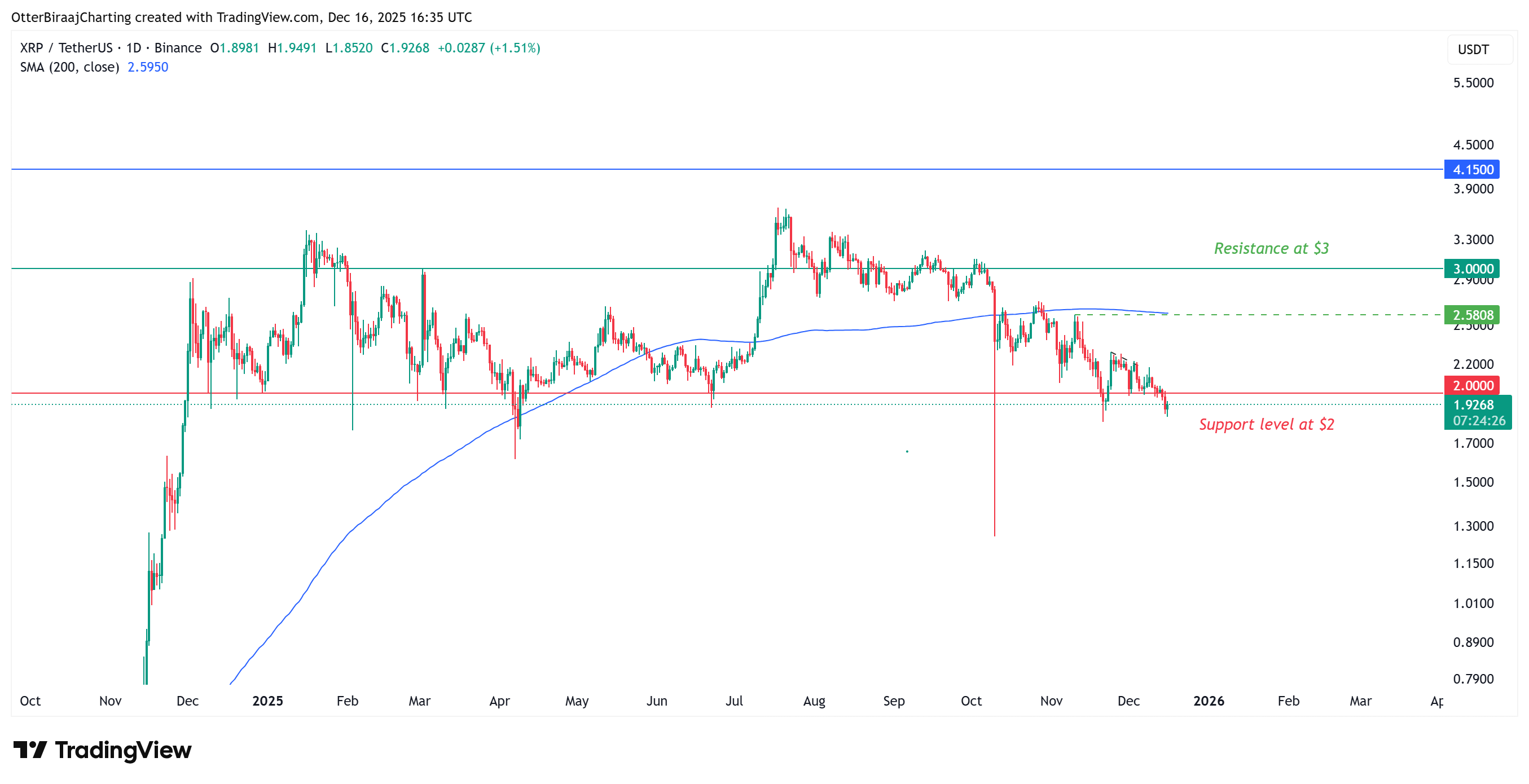
XRP one-day chart. Source: Cointelegraph/TradingView

XRP futures demand collapses as liquidity dries up

Data from CryptoQuant noted that XRP’s futures taker buy volume on Binance peaked above $5.8 billion in July but has since fallen to roughly $250 million, a decline of nearly 96%. This collapse highlighted a severe contraction in buying pressure, not just for XRP but across the broader altcoin market.
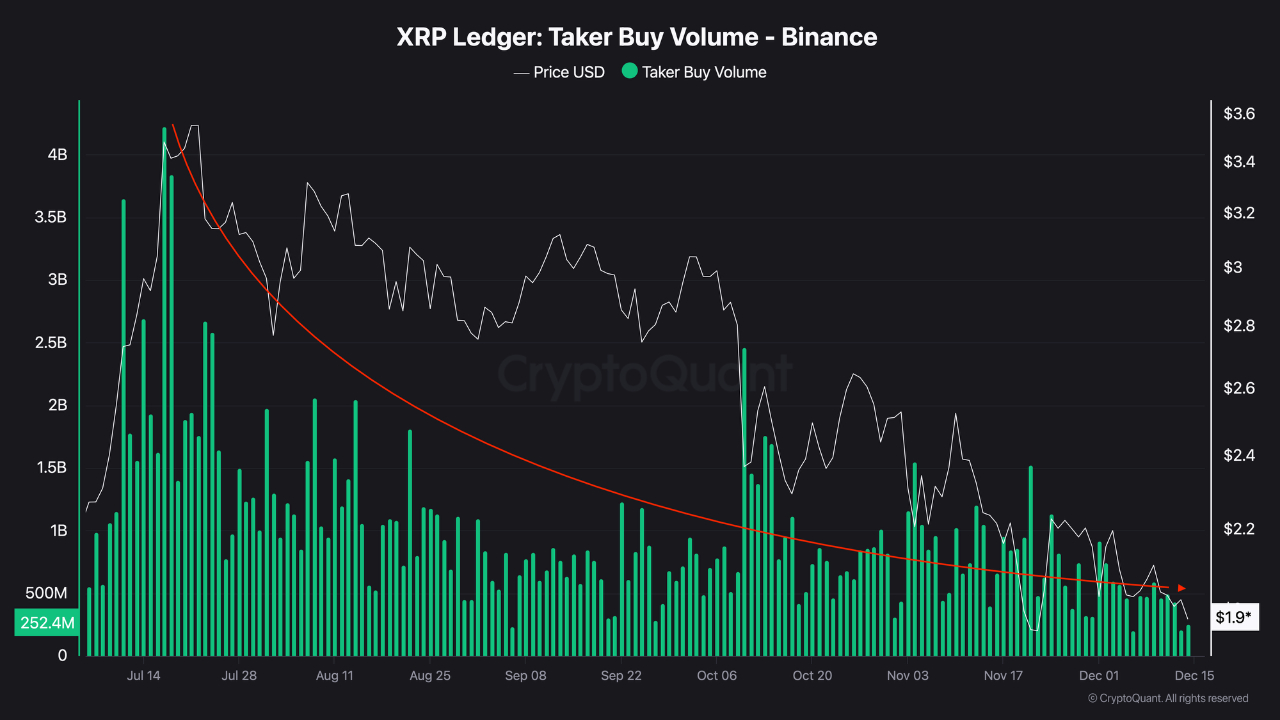
XRP ledger taker buys volume on Binance. Source: CryptoQuant

The taker buy-sell ratio has remained negative for most of this period, indicating that sellers have consistently dominated XRP derivatives flow. With liquidations accumulating and confidence still fragile after the Oct. 10 event, the lack of sustained bid-side activity suggests that downside risks remain elevated. Even ETF-related optimism has failed to materially revive demand.

XRP leveraged positions reset with strong market de-risking

Binance data shows XRP’s Estimated Leverage Ratio declining to around 0.18, one of the lowest readings of the current cycle, coinciding with price slipping from above $3.00 toward the $2.00 level. This drop suggests traders have actively reduced or closed leveraged positions, a reaction to the prolonged market dip.
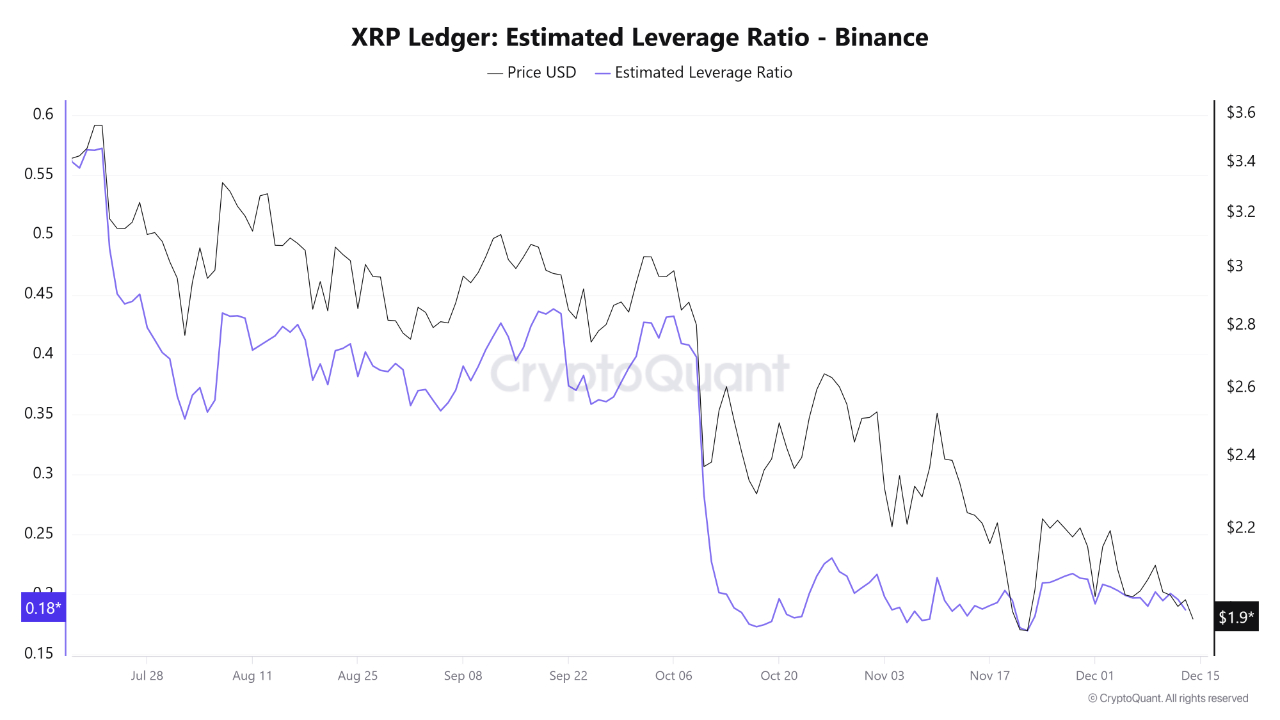
XRP ledger estimated leverage ratio. Source: CryptoQuant

While lower leverage reduces the risk of cascade liquidations, it also reflects subdued speculative interest. Such environments mark transitional phases where markets rebalance before establishing a clearer directional trend.

Related: Most crypto sectors lagged Bitcoin over past 3 months: Glassnode

Profit-taking and wallet data indicate blank order books

Glassnode senior researcher CryptoVizArt reported that on Dec. 11, a 5 to 7-year-old XRP wallet with a cost basis of $0.40 realized over $721.5 million in profit, which is a large-scale distribution event occurring as the price weakened at the $2.00 level.

Order-flow data from Hyblock Capital reinforced this bearish context. XRP’s cumulative volume delta for December is negative across all participant classes: retail wallets ($0–$10,000) at -$8.68 million, mid-sized wallets ($10,000–$100,000) at -$6.89 million, and large wallets ($100,000–$10 million) at -$34 million. The data shows consistent net selling, with no cohort exhibiting sustained buying pressure.
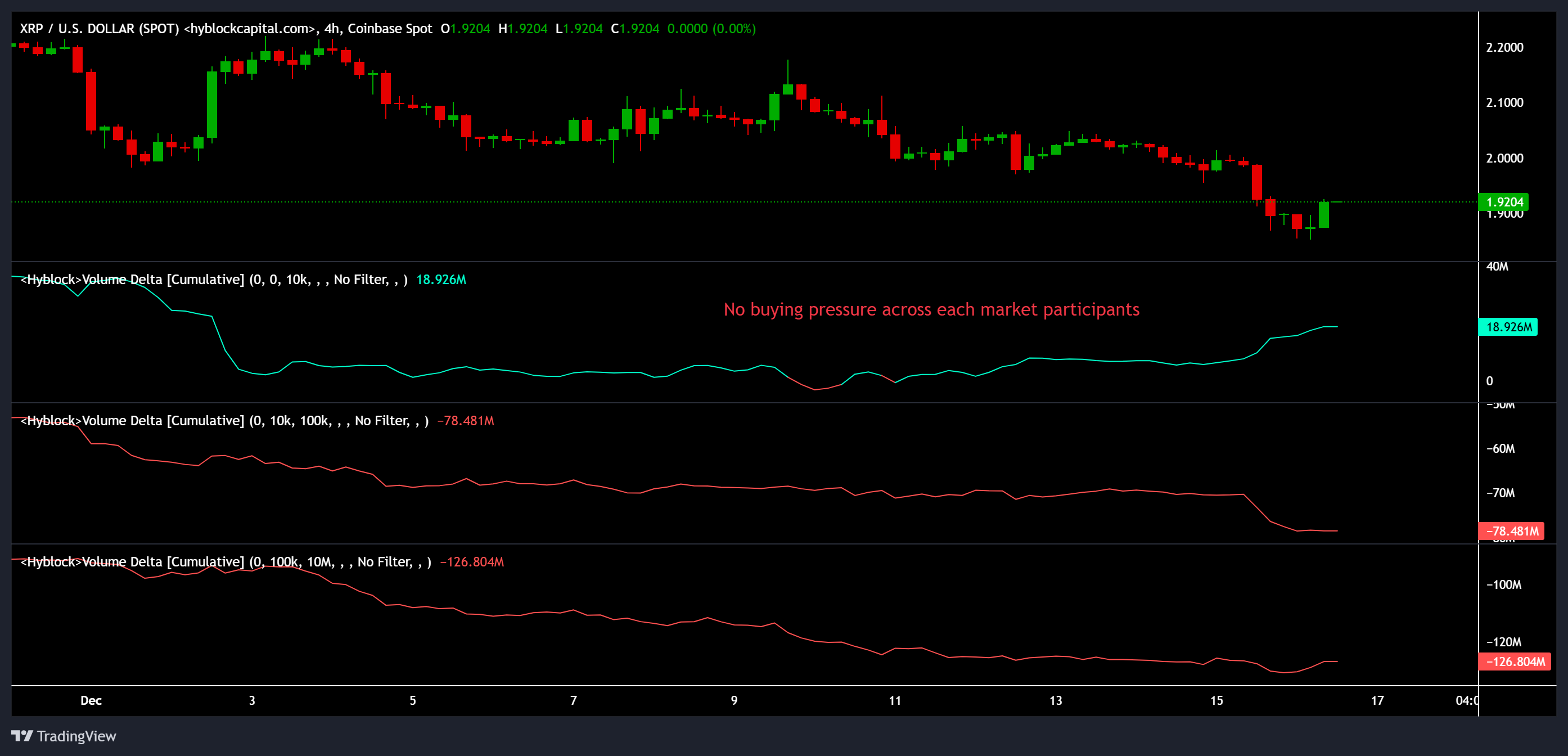
XRP four-hour chart volume delta cumulative. Source: Hyblock Capital

Overall, XRP remains in a low-demand, low-leverage environment, with data indicating consolidation or further downside unless liquidity conditions improve materially.

Related: Ripple pilots RLUSD on Ethereum L2s in multichain push

This article does not contain investment advice or recommendations. Every investment and trading move involves risk, and readers should conduct their own research when making a decision. While we strive to provide accurate and timely information, Cointelegraph does not guarantee the accuracy, completeness, or reliability of any information in this article. This article may contain forward-looking statements that are subject to risks and uncertainties. Cointelegraph will not be liable for any loss or damage arising from your reliance on this information.


Related Reads

AI Giants Enter the Dark Forest

In the AI industry's "dark forest," major players like Anthropic, OpenAI, and DeepSeek are strategically withholding their most advanced models to avoid becoming targets in a high-stakes competitive landscape. Anthropic released Claude Opus 4.7 but admitted it underperforms compared to their unreleased model Mythos, citing safety concerns. They delayed addressing user complaints about performance regression until OpenAI’s GPT-5.5 launch, highlighting a tactic of controlled disclosure aligned with competitors’ moves. OpenAI’s GPT-5.5, though a full retrain since GPT-4.5, was seen as incremental rather than revolutionary. Leaks revealed internal models like Glacier and Heisenberg, indicating significant unreleased capabilities. OpenAI acknowledges a "capability overhang," where real model power exceeds what users experience, often due to infrastructure-driven throttling. DeepSeek launched V4 Preview, a cost-efficient model, but its full potential (V4 Pro Max) awaits Huawei’s Ascend 950 super-nodes量产 in late 2026. Their strategy focuses on affordability and scalability, aiming to democratize AI access globally, a move noted even by NVIDIA’s CEO as a disruptive threat. Together, these actions reflect a broader trend: leading AI labs are deliberately pacing releases, hiding strengths, and aligning disclosures with competitive dynamics—each avoiding the risk of exposure in a forest where first movers become targets.

marsbit1h ago

AI Giants Enter the Dark Forest

marsbit1h ago

Trading

Spot
Futures

Hot Articles

What is XRP 2.0

XRP 2.0: A New Frontier in the Cryptocurrency Landscape Introduction to XRP 2.0 In the ever-evolving realm of cryptocurrency, new projects continuously emerge, vying for attention and adoption. One such promising initiative is XRP 2.0, a novel cryptocurrency project designed to leverage advanced blockchain technology and robust encryption methodologies. While the name draws parallels with Ripple’s XRP, it’s crucial to note that XRP 2.0 operates independently, focusing on enhancing transaction security, privacy, and scalability. As the digital financial landscape increasingly embraces decentralized solutions, XRP 2.0 aims to contribute meaningfully to web3 and the overall expansion of crypto projects. What is XRP 2.0? At its core, XRP 2.0 is a cryptocurrency project that aims to create a secure and decentralized digital currency ecosystem. Its foundational technology integrates sophisticated blockchain principles with cutting-edge encryption techniques. The overarching goal of XRP 2.0 is to establish itself as a reliable and efficient platform enabling swift transaction execution while prioritizing enhanced privacy protections for its users. The project is promoted as a solution to many limitations faced by existing cryptocurrencies, proposing a system that can handle a higher volume of transactions with improved speed and privacy. This versatility positions XRP 2.0 as a significant contender in a marketplace riddled with various digital currencies. Who is the Creator of XRP 2.0? The identity of the creator behind XRP 2.0 has been flagged as ‘Wilbur.’ However, comprehensive details regarding Wilbur or their associated entity remain elusive. The anonymity of many cryptocurrency creators is not an uncommon phenomenon in the industry, often designed to maintain a degree of privacy and security. Who are the Investors of XRP 2.0? As of now, specific information related to the investment foundations or organizations supporting XRP 2.0 is not publicly available. In the cryptocurrency sector, the backing by reputed investors can significantly influence a project's credibility and success, yet the transparency regarding the financial supporters of XRP 2.0 has not been established. How Does XRP 2.0 Work? XRP 2.0 stands out by employing a combination of blockchain technology and advanced encryption algorithms that ensures secure and decentralized transactions. Its innovative structure includes unique features designed to foster user engagement and broaden functionalities beyond conventional cryptocurrency transactions. Among these features, XRP 2.0 incorporates AI-powered capabilities, such as text-to-image and text-to-speech functionalities. These additions are designed to enhance the interactive experience for users, promoting broader applicability across various sectors. By bridging technological advancements with user-centered design, XRP 2.0 aims to capture the attention of a diverse range of individuals and enterprises looking to integrate cryptocurrency solutions into their operational frameworks. Timeline of XRP 2.0 Understanding XRP 2.0 requires examining the milestones that have defined its journey thus far: July 23, 2023: XRP 2.0 is introduced as a novel cryptocurrency project, aiming to revolutionize secure and decentralized transaction capabilities in the blockchain domain. September 8, 2023: The launching of another project, XRP20, occurs, marking the emergence of an ERC-20 token on the Ethereum blockchain that remains unrelated to XRP 2.0. November 13, 2023: The XRP Ledger undergoes a significant update with the release of rippled server software version 2.0.0. It is essential to note that this development is disconnected from the XRP 2.0 cryptocurrency project. Key Points About XRP 2.0 To distill the essence of XRP 2.0, several critical factors emerge: Unique Features: The inclusion of features like AI-powered text-to-image and text-to-speech further diversifies the potential applications of XRP 2.0. Blockchain Technology: The framework utilizes advanced blockchain mechanisms and encryption protocols, ensuring a secure and decentralized environment for transactions. Scalability and Privacy: XRP 2.0 prioritizes enhanced privacy protections in transaction processes and the scalability necessary to accommodate a growing user base. No Affiliation with Ripple: Importantly, despite its name, XRP 2.0 does not have any allegiance or collaboration with Ripple’s XRP, distinguishing its operational framework and objectives within the cryptocurrency ecosystem. Conclusion XRP 2.0 represents an ambitious venture into the cryptocurrency sphere, aiming to offer a combination of security, privacy, and efficiency in digital transactions. By integrating sophisticated technologies and user-friendly features, the project sets out to broaden the horizons of what cryptocurrency can achieve in today's digital economy. While the anonymity of its creator and lack of disclosed investors might raise questions for some, XRP 2.0's focus on advanced functionalities and decentralisation enhances its appeal amidst an increasingly crowded crypto market. As the cryptocurrency landscape continues to evolve, XRP 2.0 may yet emerge as a pivotal player in the expansion of secure and scalable blockchain solutions.

941 Total ViewsPublished 2024.04.01Updated 2024.12.03

What is XRP 2.0

Discussions

Welcome to the HTX Community. Here, you can stay informed about the latest platform developments and gain access to professional market insights. Users' opinions on the price of XRP (XRP) are presented below.

活动图片














