3 Major Cardano Announcements Just Landed: The Breakdown

bitcoinistPublished on 2026-02-12Last updated on 2026-02-12

Abstract

Three major announcements for the Cardano ecosystem were made at Consensus Hong Kong. First, the integration with LayerZero was approved, marking Cardano's largest interoperability expansion. This will connect Cardano to over 160 blockchains, providing access to $80 billion in omnichain assets and new liquidity. Second, founder Charles Hoskinson announced that USDCx, a new stablecoin with claimed privacy and immutability features, is scheduled to launch at the end of February. Finally, the privacy-focused network Midnight confirmed its mainnet will go live before the end of March, establishing a foundation for applications built on selective disclosure.

Three Cardano ecosystem announcements landed onstage at Consensus Hong Kong yesterday, spanning cross-chain rails, a new stablecoin rollout timeline, and a privacy-focused network’s march to mainnet.

#1 Cardano Taps LayerZero

Intersect said via X its Critical Cardano Integrations workstream has approved bringing LayerZero into the Cardano ecosystem, positioning the move as the network’s largest interoperability expansion to date. In its post, Intersect framed the integration as a step-change in access to cross-chain assets and infrastructure:

“LayerZero is one of the most widely adopted omnichain messaging protocols in Web3, connecting 150+ blockchains and enabling access to 400+ tokens and $80B+ in omnichain assets. This integration unlocks the largest cross-chain connectivity expansion in Cardano’s history, opening pathways to stablecoin liquidity, Bitcoin-backed assets, tokenized real-world assets, and shared DeFi infrastructure across the broader crypto ecosystem.”

A companion write-up describes the effort in similar terms, saying the protocol “connects over 160 blockchains” and “has facilitated over $200 billion in cross-chain volume,” with Cardano gaining technical access to “over 400 tokens” and “$80 billion in omnichain assets” once the LayerZero endpoint is deployed.

The post argues that LayerZero’s messaging-layer approach is chain-agnostic “regardless of the underlying execution model,” explicitly flagging Cardano’s extended UTXO design as a historical friction point for tooling built around account-based chains.

Intersect said delivery work now moves into deployment, with “further milestones and timelines to be shared as progress continues.”

#2 USDCx Gets A Launch Date

Cardano founder Charles Hoskinson used the event to put a calendar marker on USDCx, saying the product now has a target launch window at the end of February. “We’ve announced not long ago that we will have USDCx. Now we have a launch date for USDCx, end of February. We’ve done some amazing engineering to have a beautiful UX. You can go straight from any wallet to Coinbase, or Binance, and back, and there’s instant convertibility to USDC,” Hoskinson said.

He also claimed feature advantages versus standard USDC in circulation, saying USDCx has “privacy, and it’s also immutable and irreversible, so it’s actually better [than USDC].”

#3 Midnight Targets Mainnet Before End Of March

Midnight, the privacy-oriented network tied to the broader Cardano ecosystem, said its mainnet is now imminent. “On the ConsensusHK stage, we shared that Midnight mainnet will officially go live before the end of March,” the team posted via X, calling it “a major milestone and the beginning of a live, production network designed to support early applications built around selective disclosure and real-world privacy.”

Midnight added that mainnet is “foundational,” describing it as the stable base for teams to “launch, test, and iterate,” while setting expectations for “rapid protocol and tooling expansion ahead.”

At press time, Cardano traded at $0.261.
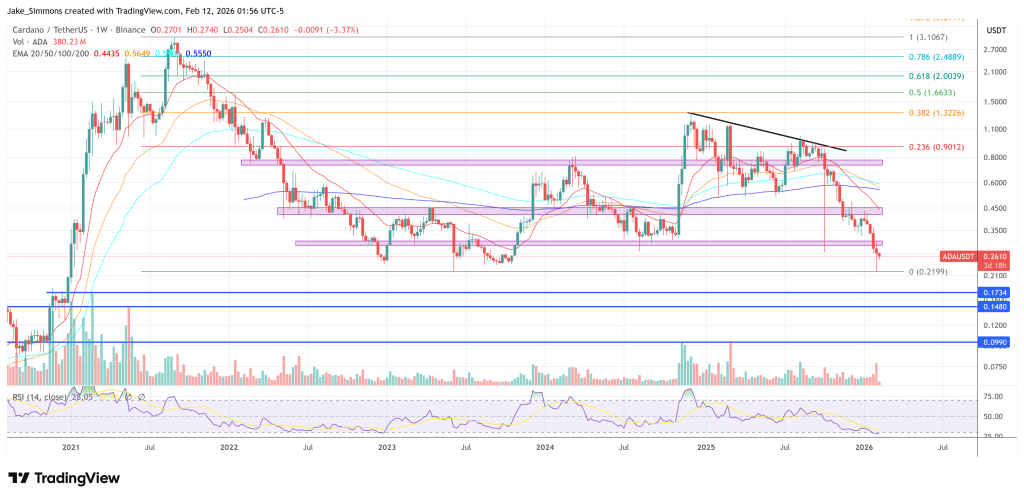
ADA hovers above key support, 1-week chart | Source: ADAUSDT on TradingView.com

Related Questions

QWhat are the three major Cardano announcements made at Consensus Hong Kong?

AThe three major announcements are: 1) The integration of LayerZero for cross-chain interoperability, 2) A launch date for USDCx set for the end of February, and 3) The imminent mainnet launch of the Midnight privacy network before the end of March.

QWhat benefits does the LayerZero integration bring to the Cardano ecosystem according to Intersect?

AIntersect states that LayerZero unlocks the largest cross-chain connectivity expansion in Cardano's history, providing access to over 400 tokens, $80 billion in omnichain assets, stablecoin liquidity, Bitcoin-backed assets, tokenized real-world assets, and shared DeFi infrastructure.

QWhat specific advantages did Charles Hoskinson claim USDCx has over standard USDC?

ACharles Hoskinson claimed that USDCx has privacy features, is immutable, and is irreversible, making it 'actually better' than the standard USDC in circulation.

QWhen is the Midnight network's mainnet expected to go live, and what is its primary purpose?

AThe Midnight network's mainnet is expected to go live before the end of March. Its primary purpose is to serve as a production network designed to support applications built around selective disclosure and real-world privacy.

QHow did the article describe the significance of LayerZero's technology for Cardano's unique eUTXO design?

AThe article described LayerZero's chain-agnostic, messaging-layer approach as a solution to the historical friction point posed by Cardano's extended UTXO (eUTXO) design, which had been a challenge for tooling built around account-based chains.

Related Reads

Google and Amazon Simultaneously Invest Heavily in a Competitor: The Most Absurd Business Logic of the AI Era Is Becoming Reality

In a span of four days, Amazon announced an additional $25 billion investment, and Google pledged up to $40 billion—both direct competitors pouring over $65 billion into the same AI startup, Anthropic. Rather than a typical venture capital move, this signals the latest escalation in the cloud wars. The core of the deal is not equity but compute pre-orders: Anthropic must spend the majority of these funds on AWS and Google Cloud services and chips, effectively locking in massive future compute consumption. This reflects a shift in cloud market dynamics—enterprises now choose cloud providers based on which hosts the best AI models, not just price or stability. With OpenAI deeply tied to Microsoft, Anthropic’s Claude has become the only viable strategic asset for Google and Amazon to remain competitive. Anthropic’s annualized revenue has surged to $30 billion, and it is expanding into verticals like biotech, positioning itself as a cross-industry AI infrastructure layer. However, this funding comes with constraints: Anthropic’s independence is challenged as it balances two rival investors, its safety-first narrative faces pressure from regulatory scrutiny, and its path to IPO introduces new financial pressures. Globally, this accelerates a "tri-polar" closed-loop structure in AI infrastructure, with Microsoft-OpenAI, Google-Anthropic, and Amazon-Anthropic forming exclusive model-cloud alliances. In contrast, China’s landscape differs—investments like Alibaba and Tencent backing open-source model firm DeepSeek reflect a more decoupled approach, though closed-source models from major cloud providers still dominate. The $65 billion bet is ultimately about securing a seat at the table in an AI-defined future—where missing the model layer means losing the cloud war.

marsbit2h ago

Google and Amazon Simultaneously Invest Heavily in a Competitor: The Most Absurd Business Logic of the AI Era Is Becoming Reality

marsbit2h ago

Computing Power Constrained, Why Did DeepSeek-V4 Open Source?

DeepSeek-V4 has been released as a preview open-source model, featuring 1 million tokens of context length as a baseline capability—previously a premium feature locked behind enterprise paywalls by major overseas AI firms. The official announcement, however, openly acknowledges computational constraints, particularly limited service throughput for the high-end DeepSeek-V4-Pro version due to restricted high-end computing power. Rather than competing on pure scale, DeepSeek adopts a pragmatic approach that balances algorithmic innovation with hardware realities in China’s AI ecosystem. The V4-Pro model uses a highly sparse architecture with 1.6T total parameters but only activates 49B during inference. It performs strongly in agentic coding, knowledge-intensive tasks, and STEM reasoning, competing closely with top-tier closed models like Gemini Pro 3.1 and Claude Opus 4.6 in certain scenarios. A key strategic product is the Flash edition, with 284B total parameters but only 13B activated—making it cost-effective and accessible for mid- and low-tier hardware, including domestic AI chips from Huawei (Ascend), Cambricon, and Hygon. This design supports broader adoption across developers and SMEs while stimulating China's domestic semiconductor ecosystem. Despite facing talent outflow and intense competition in user traffic—with rivals like Doubao and Qianwen leading in monthly active users—DeepSeek has maintained technical momentum. The release also comes amid reports of a new funding round targeting a valuation exceeding $10 billion, potentially setting a new record in China’s LLM sector. Ultimately, DeepSeek-V4 represents a shift toward open yet realistic infrastructure development in the constrained compute landscape of Chinese AI, emphasizing engineering efficiency and domestic hardware compatibility over pure model scale.

marsbit2h ago

Computing Power Constrained, Why Did DeepSeek-V4 Open Source?

marsbit2h ago

Trading

Spot
Futures

Hot Articles

Discussions

Welcome to the HTX Community. Here, you can stay informed about the latest platform developments and gain access to professional market insights. Users' opinions on the price of ADA (ADA) are presented below.

活动图片