“7月就业爆雷,9月降息50个基点”——去年夏天正在重演?

华尔街见闻Published on 2025-08-05Last updated on 2025-08-05

Abstract

美国7月就业数据意外爆冷,引发市场对美联储9月大幅降息的强烈预期,剧本酷似去年“7月按兵不动,9月降息50个基点”的“补救式”操作。花旗预计美联储将在9月降息25个基点,但如果8月就业数据同样疲软,50个基点降息的可能性显著增加。

美国就业市场的突然降温,正让华尔街的交易员和经济学家们回想起去年夏天美联储的政策路径。

当时,美联储在7月会议上选择按兵不动,但随后公布的疲软就业报告迅速扭转了局面,促使官员们在9月会议上采取了激进的50个基点降息“补救”措施。如今,类似的剧本似乎正在上演,市场正密切关注美联储是否会“故技重施”。

目前市场对大幅降息的预期正在升温。据追风交易台消息,花旗在8月1日的研报中预计美联储将在9月降息25个基点,但如果8月就业数据同样疲软,50个基点降息的可能性显著增加。

值得注意的是,今年美国经济面临与去年不同的挑战。尽管就业数据疲软,但特朗普政府的关税政策引发了通胀担忧,这是去年所没有的。美联储需判断经济放缓是暂时现象还是长期趋势。花旗认为,在需求和劳动力市场疲软下,通胀风险小。9月前,更多就业和通胀数据将决定美联储是否果断行动。

就业数据全面恶化,经济放缓信号明确

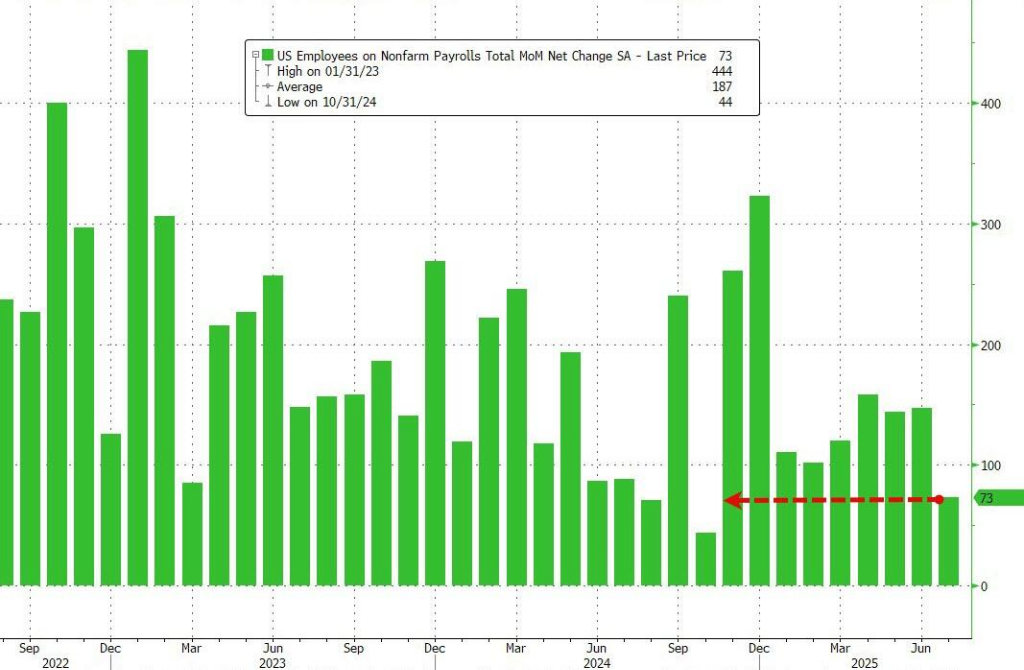
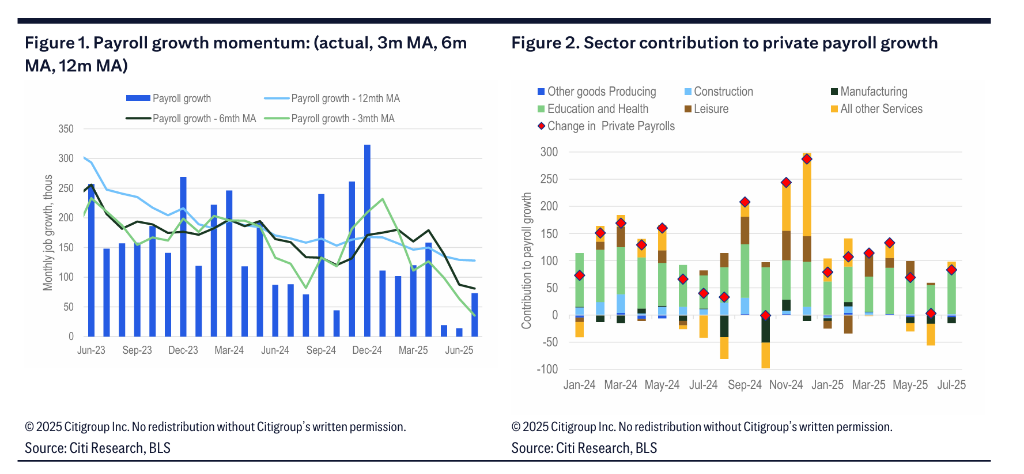
最新的7月非农就业数据显示,美国劳动力市场正在以惊人的速度降温,远低于市场预期。新增就业人数仅为73000人,更令人担忧的是,5月和6月的就业数据合计被大幅下修了258000人。其中,私营部门在6月仅新增3000个工作岗位,7月也仅增加83000人。制造业等商品生产行业更是连续三个月每月减少13000个工作岗位。就业增长高度集中在医疗保健领域,其他行业表现疲软,休闲和酒店业在7月仅增加5000人。
失业率从4.117%攀升至4.248%,家庭就业调查显示就业人数减少了260000人。劳动参与率连续第三个月下降,从62.3%降至62.2%。花旗分析师指出,如果劳动参与率保持不变,失业率本月将升至4.34%。

过去三个月,美国平均就业增长仅为35000人。花旗研究甚至通过QCEW数据推测,实际数字可能更低,初步修正数据预计将于9月9日发布,届时可能显示这一期间的就业增长为负值。此外,联邦政府在过去六个月累计减少84000个工作岗位,也进一步凸显了就业市场的全面疲软。
市场热议:美联储9月或将大幅降息

这份意外疲软的就业报告,立即引发了市场对美联储“7月按兵不动、9月大幅降息”剧本重演的热议。据见闻此前文章,有“新美联储通讯社”之称的知名财经记者Nick Timiraos表示,这幅场景有“似曾相识”之感:

去年,美联储官员在7月的政策会议上决定不降息,但两天后的就业报告却显示,劳动力市场并不像表面看起来那样强劲。最终,美联储在9月的会议上通过下调利率半个百分点(超过传统的四分之一个百分点)来“补课”。

本周,美联储同样选择按兵不动,但周五发布的就业数据却显示过去几个月劳动力市场意外降温。交易员们将9月降息的概率从周四的38%大幅上调至70%以上。

芝商所数据显示,美联储在9月会议上降息的概率已从周四的不足40%飙升至近90%(其中降息25个基点的概率高达89.6%)。尽管目前期货市场显示交易员认为降息50个基点的概率为零,但市场对大幅降息的预期正在升温。

花旗目前维持基准预测,即美联储将在9月降息25个基点,并在随后每次会议上降息25个基点,直至明年3月达到3.00%-3.25%的终点利率。然而,花旗分析师认为,风险平衡偏向更加宽松的政策。如果8月就业报告同样疲软(例如失业率上升至4.5%),可能引发50个基点的降息。

历史能否简单重演?通胀担忧是关键变数

然而,Timiraos也表示,今年的情况与去年存在一个关键差异:去年美国通胀正处于持续回落的通道中,而今年,由于特朗普政府春季以来实施的一系列广泛加征关税的举措,美联储官员们反而担心通胀压力可能卷土重来。

因此,Timiraos强调,美联储面临的关键问题在于:美国经济基本面是否真的在恶化,还是说近期的放缓只是某些政策影响滞后所致的暂时现象。

花旗分析师预计,在需求放缓和劳动力市场宽松的经济环境下,持续通胀压力的风险很小,这将克服对关税相关通胀的担忧。如果增长和劳动力市场的疲软状态持续更长时间,官员们明年可能将利率降至3%以下。

在9月会议之前,决策者还将获得一份就业报告和两个月的通胀数据,这些信息将共同决定美联储是选择谨慎观望,还是会像去年一样,用一次果断的行动来回应正在变化的经济前景。

Related Reads

Interpreting Investment Opportunities in the Age of Great Navigation, Invesco Great Wall Fund Releases '2026 Report on Chinese Enterprises Going Global'

Invesco Great Wall Fund has released its "2026 China Corporate Globalization Report," titled "The 'Great Navigation Era' of Chinese Enterprises." The report analyzes the new trends and investment opportunities as Chinese companies expand globally, moving from simple product exports to comprehensive overseas operations involving services, branding, and local production. Driven by factors like trade friction, the pursuit of higher profit margins abroad, and policy support, globalization is becoming essential for Chinese companies. The report outlines an evolution: from early product export ("Globalization 1.0") to the current "Globalization 2.0," characterized by overseas capacity, capital goods investment, consumer brand expansion, and service exports. Chinese firms' competitive advantages are highlighted, including a vast engineer talent pool, low-cost and robust infrastructure, and complete industrial clusters. Specific sectors with significant出海 potential are identified: * **Capital Goods** (e.g., engineering machinery, power equipment): Benefiting from global demand, especially in Belt & Road markets and the AI-driven power grid upgrade cycle. * **Consumer Brands**: Transitioning from cost to brand advantage, leveraging供应链 efficiency. * **Technology & Innovation**: Including AI applications, optical modules within global tech supply chains, and new energy vehicles focusing on local production. * **Pharmaceuticals**: Chinese biotech firms are becoming preferred partners for global pharma, with potential for breakthrough drugs in areas like oncology and weight loss. The report concludes that corporate globalization represents a sustained, core theme for China's capital markets, though companies must navigate challenges like geopolitics and localization.

marsbit3m ago

Interpreting Investment Opportunities in the Age of Great Navigation, Invesco Great Wall Fund Releases '2026 Report on Chinese Enterprises Going Global'

marsbit3m ago

GitHub, Transfixed by AI

On the night of February 9th, GitHub suffered a major outage caused by a simple configuration change—reducing a cache refresh interval from 12 to 2 hours—that triggered a cascade of failures. This was not an isolated event, but part of a broader pattern. In early 2026, GitHub experienced at least 8 major incidents, failing to meet its promised 99.9% availability. These outages stemmed from structural issues: explosive growth in load, tight service coupling, and insufficient protection against abnormal traffic. This unprecedented load is driven by AI Agents. In 2025, GitHub handled ~1 billion commits. By 2026, weekly commits reached 275 million, projecting to ~14 billion for the year—a 14x increase. AI tools like Claude Code now contribute 4.5% of all public repository commits, with weekly submissions surging 25x in just three months. AI-generated pull requests jumped from 4 million to 17 million per month in half a year. Unlike human developers, AI Agents work continuously, generating commits at a scale that overwhelms infrastructure designed for human rhythms. The surge also shattered GitHub's business model. Copilot's flat-rate pricing, based on assisting human developers, became unsustainable as Agentic AI sessions consumed resources worth hundreds of dollars for a few dollars in fees. In response, GitHub imposed usage limits and, by June 1st, shifted to a pay-per-use "AI Credits" system. Facing this new reality, GitHub realized a 10x scaling plan was insufficient. It announced a need to *redesign* its architecture for 30x current scale—decoupling services, adding fault isolation, and improving change management to prevent cascading failures. Other platforms like Stripe and AWS are facing similar challenges with AI Agents. Fundamentally, GitHub is transitioning from a human collaboration platform to an "exhaust pipe" for automated AI workflows. Its detailed post-mortem reports aim to maintain trust during this turbulent rebuild. The February outage was not just a technical glitch, but a signal of the software industry's entry into a new, AI-driven era.

marsbit43m ago

GitHub, Transfixed by AI

marsbit43m ago

Both Suffer Massive Losses Exceeding $90 Billion, Which Is in Greater Peril: Strategy or Bitmine?

Facing massive paper losses exceeding $90 billion each amidst a sharp market downturn, "Digital Asset Treasury" (DAT) giants Strategy and Bitmine find themselves in a precarious position, but with different underlying risks. Strategy, heavily invested in Bitcoin (BTC), faces significant financial strain. Its strategy relies heavily on debt, including convertible notes and preferred stock (STRC) requiring substantial dividend payments. With its cash reserves dwindling and BTC offering no staking yield for cash flow, Strategy's high leverage makes it vulnerable. A continued price decline could force asset sales to meet obligations, potentially creating a negative feedback loop. Its market value has already fallen sharply. In contrast, Bitmine, an Ethereum (ETH) holder, appears on firmer financial ground. It primarily funds its purchases through equity offerings (like ATM programs), avoiding debt pressure. It also generates income by staking a large portion of its ETH holdings. While not immune to market drops and shareholder dilution concerns, Bitmine maintains more flexibility, recently announcing a new preferred share offering to raise further capital. The core divergence lies in their financing: Bitmine uses equity (investor money), while Strategy uses debt (borrowed money). Consequently, Bitmine currently faces less immediate liquidity pressure than Strategy, which must navigate the dual challenge of servicing debt/dividends and a declining core asset (BTC) price.

marsbit50m ago

Both Suffer Massive Losses Exceeding $90 Billion, Which Is in Greater Peril: Strategy or Bitmine?

marsbit50m ago

Trading

Spot
Futures

Hot Articles

What is $BITCOIN

DIGITAL GOLD ($BITCOIN): A Comprehensive Analysis Introduction to DIGITAL GOLD ($BITCOIN) DIGITAL GOLD ($BITCOIN) is a blockchain-based project operating on the Solana network, which aims to combine the characteristics of traditional precious metals with the innovation of decentralized technologies. While it shares a name with Bitcoin, often referred to as “digital gold” due to its perception as a store of value, DIGITAL GOLD is a separate token designed to create a unique ecosystem within the Web3 landscape. Its goal is to position itself as a viable alternative digital asset, although specifics regarding its applications and functionalities are still developing. What is DIGITAL GOLD ($BITCOIN)? DIGITAL GOLD ($BITCOIN) is a cryptocurrency token explicitly designed for use on the Solana blockchain. In contrast to Bitcoin, which provides a widely recognized value storage role, this token appears to focus on broader applications and characteristics. Notable aspects include: Blockchain Infrastructure: The token is built on the Solana blockchain, known for its capacity to handle high-speed and low-cost transactions. Supply Dynamics: DIGITAL GOLD has a maximum supply capped at 100 quadrillion tokens (100P $BITCOIN), although details regarding its circulating supply are currently undisclosed. Utility: While precise functionalities are not explicitly outlined, there are indications that the token could be utilized for various applications, potentially involving decentralized applications (dApps) or asset tokenization strategies. Who is the Creator of DIGITAL GOLD ($BITCOIN)? At present, the identity of the creators and development team behind DIGITAL GOLD ($BITCOIN) remains unknown. This situation is typical among many innovative projects within the blockchain space, particularly those aligning with decentralized finance and meme coin phenomena. While such anonymity may foster a community-driven culture, it intensifies concerns about governance and accountability. Who are the Investors of DIGITAL GOLD ($BITCOIN)? The available information indicates that DIGITAL GOLD ($BITCOIN) does not have any known institutional backers or prominent venture capital investments. The project seems to operate on a peer-to-peer model focused on community support and adoption rather than traditional funding routes. Its activity and liquidity are primarily situated on decentralized exchanges (DEXs), such as PumpSwap, rather than established centralized trading platforms, further highlighting its grassroots approach. How DIGITAL GOLD ($BITCOIN) Works The operational mechanics of DIGITAL GOLD ($BITCOIN) can be elaborated on based on its blockchain design and network attributes: Consensus Mechanism: By leveraging Solana’s unique proof-of-history (PoH) combined with a proof-of-stake (PoS) model, the project ensures efficient transaction validation contributing to the network's high performance. Tokenomics: While specific deflationary mechanisms have not been extensively detailed, the vast maximum token supply implies that it may cater to microtransactions or niche use cases that are still to be defined. Interoperability: There exists the potential for integration with Solana’s broader ecosystem, including various decentralized finance (DeFi) platforms. However, the details regarding specific integrations remain unspecified. Timeline of Key Events Here is a timeline that highlights significant milestones concerning DIGITAL GOLD ($BITCOIN): 2023: The initial deployment of the token occurs on the Solana blockchain, marked by its contract address. 2024: DIGITAL GOLD gains visibility as it becomes available for trading on decentralized exchanges like PumpSwap, allowing users to trade it against SOL. 2025: The project witnesses sporadic trading activity and potential interest in community-led engagements, although no noteworthy partnerships or technical advancements have been documented as of yet. Critical Analysis Strengths Scalability: The underlying Solana infrastructure supports high transaction volumes, which could enhance the utility of $BITCOIN in various transaction scenarios. Accessibility: The potential low trading price per token could attract retail investors, facilitating wider participation due to fractional ownership opportunities. Risks Lack of Transparency: The absence of publicly known backers, developers, or an audit process may yield skepticism regarding the project's sustainability and trustworthiness. Market Volatility: The trading activity is heavily reliant on speculative behavior, which can result in significant price volatility and uncertainty for investors. Conclusion DIGITAL GOLD ($BITCOIN) emerges as an intriguing yet ambiguous project within the rapidly evolving Solana ecosystem. While it attempts to leverage the “digital gold” narrative, its departure from Bitcoin's established role as a store of value underscores the need for a clearer differentiation of its intended utility and governance structure. Future acceptance and adoption will likely depend on addressing the current opacity and defining its operational and economic strategies more explicitly. Note: This report encompasses synthesised information available as of October 2023, and developments may have transpired beyond the research period.

363 Total ViewsPublished 2025.05.13Updated 2025.05.13

What is $BITCOIN

Discussions

Welcome to the HTX Community. Here, you can stay informed about the latest platform developments and gain access to professional market insights. Users' opinions on the price of BTC (BTC) are presented below.

活动图片