70倍神盘崩了,meme的DeFi IMF还能回来吗?

marsbitPublished on 2025-07-30Last updated on 2025-07-31

以太坊上的「meme飞轮」骤然崩塌

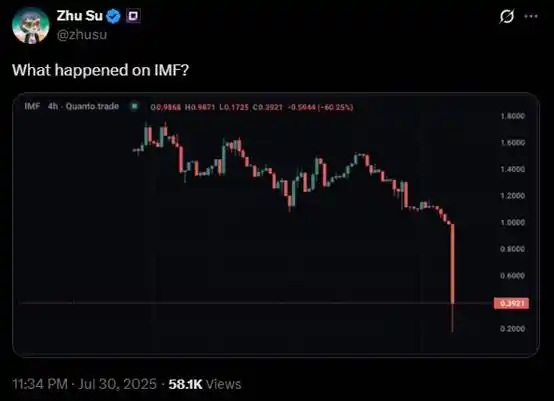
自今年 6 月上旬至 7 月上旬,$IMF 作为以太坊主网上的 MemeFi 项目最高上涨了近 70 倍。虽然在创下 7000 万美元市值的历史新高后,$IMF 逐渐回调了 50%,但在昨天,一波最高接近 85% 的巨大下跌引起了市场的震动。
 meme币

$IMF 的下跌震惊了 Zhu Su

究竟发生了什么,让 $IMF 出现了如此巨大的下跌?

什么是 IMF?

IMF(International Meme Fund)是一个为主网 meme 量身定制的去中心化金融平台,允许用户用手中的 $PEPE、$JOE、$MOG 等 meme 币抵押借出稳定币 $USDS,无需出售即可变现。同时,通过 Accelerate 和 Amplify 等模块,项目方或巨鲸还可加杠杆拉盘、循环借贷护盘,甚至制造「锁仓」假象,实则实现提前出货与影子资金管理。

通过 IMF 可以实现 meme 币的循环借贷,实现「左脚踩右脚」,比如:

· 买入 1 万美元 PEPE

· 将 PEPE 存入 IMF,并借出 5000 美元 USDS 贷款

· 将 USDS 换成 PEPE

· 将剩余的 5000 美元 PEPE 存入以降低贷款价值比(LTV)

目前,IMF 的 TVL 仍有约 1.665 亿美元,总共有约 5400 万美元的 $USDS 存入,有约 2922 万美元的 $PEPE、约 2058 万美元的 $stETH、约 4440 万美元的 $MOG、约 588 万美元的 $JOE、约 494 万美元的 $SPX 和约 750 万美元的 $IMF 作为抵押物。

$IMF 为什么暴跌?

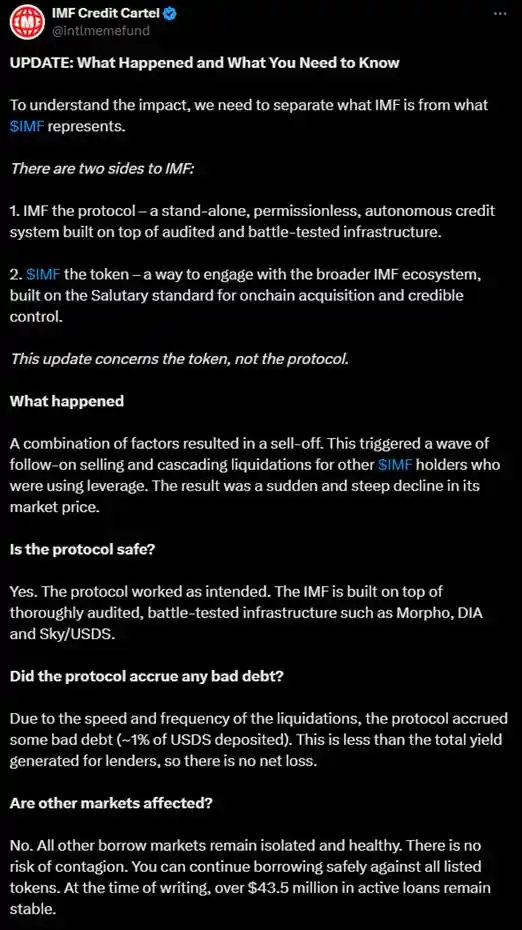
根据 IMF 官方发布的推文,这次 $IMF 突发的暴跌不是因为协议本身出现了问题,而是因为 $IMF 这个代币本身遭遇了抛售,而抛售引发的更多恐慌抛售以及连环清算导致 $IMF 的价格出现了大幅的下跌。

官方还在推文中表示,由于清算的速度和频率,累积了一些坏账(约占存入 USDS 的 1%)。这低于贷款人产生的总收益,因此没有净损失。此外,$IMF 借贷市场发生的问题也不影响平台上其它的借贷币对。
 meme币

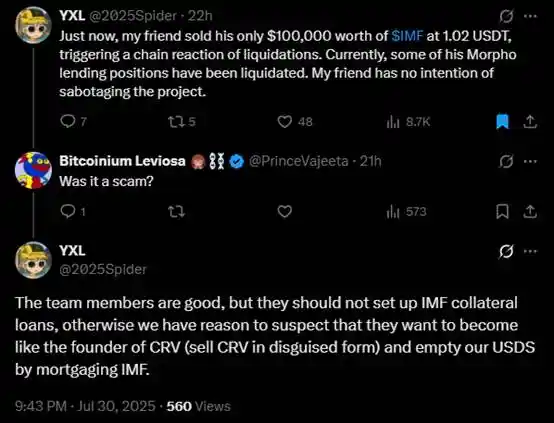
@2025Spider 发表推文称,他的朋友以 1.02U 的价格卖掉了价值 10 万美元的 $IMF,从而引发了连环清算。他表示,他的朋友无意破坏 IMF 项目,并表示项目方应该平仓 IMF 借贷仓位,否则 USDS 会面临巨大风险。他还表示团队的预言机更新速度很慢,当大多数 IMF/USDT 仓位已无力偿债时,预言机仍然没有及时更新到最新的价格。

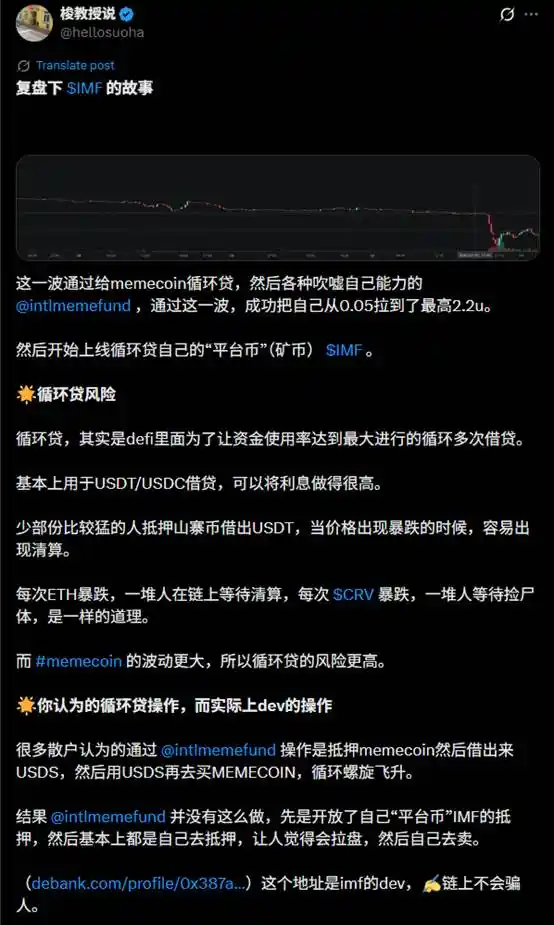
对于 IMF 开放自家平台币 $IMF 的抵押借贷这件事情,@2025Spider 与华语 KOL「梭教授说」都提出了质疑:
 meme币

有人在 @2025Spider 的推文下问他,「IMF 是骗局吗」?@2025Spider 表示,团队成员是好的,但是不应该开放 $IMF 的抵押借贷,否则就有理由认为他们想和 CRV 创始人那样通过变相卖出自家代币套现。他还表示,开给 $IMF 的贷款额度超过了 $IMF 的 UniSwap 池子本身,从风控的角度来说这也是不应该的

「梭教授说」则是通过链上的记录,更直接地质疑 IMF 团队自己抵押引发 FOMO 然后自己卖出代币套现:
 meme币

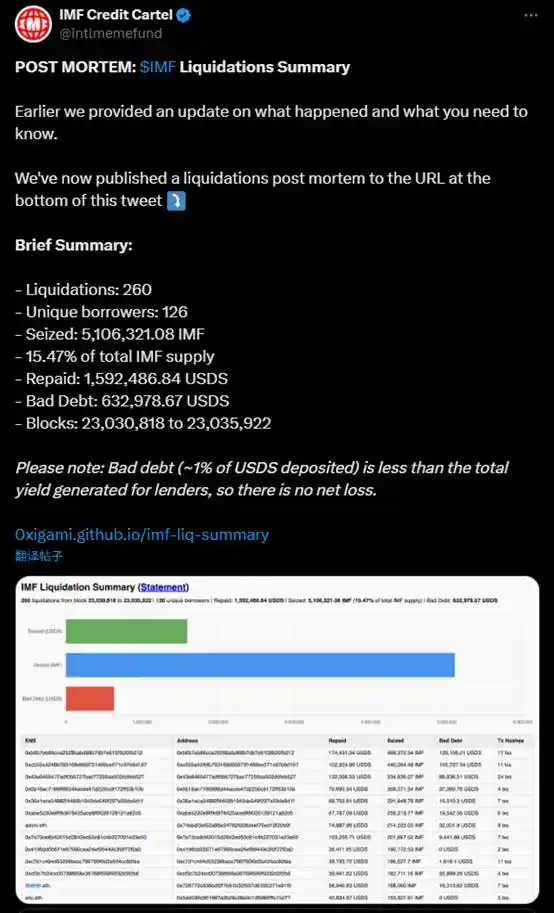
IMF 官推在今天下午发表了该次连环清算事件的详细报告。总计有 260 笔清算,涉及 126 个独立借款人,占 $IMF 总供应量的 15.47% 被清算。
 meme币

结语

事件发生后,$IMF 从最低点一度反弹近 4 倍,目前相较于最低点仍有接近 3 倍的价格,市值回升到了近 2100 万美元。

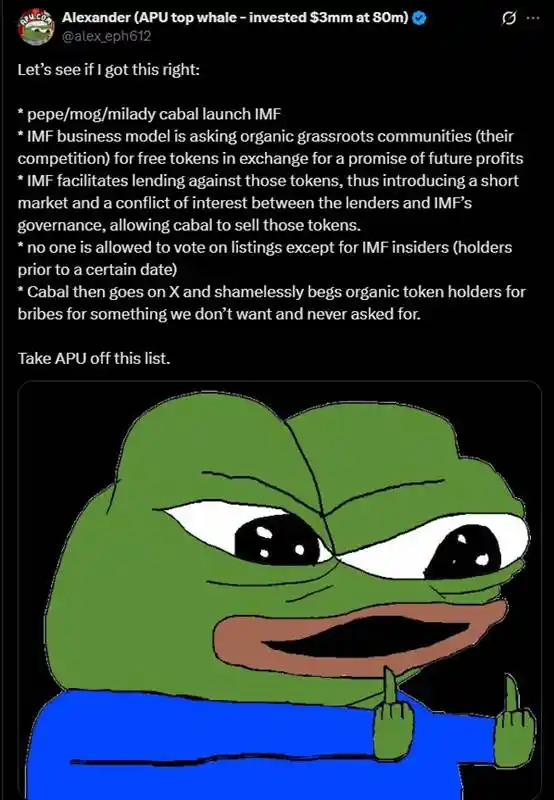
不过,伴随着 $IMF 的争议恐怕并不会结束。在 7 月 24 日时,以太坊上知名 meme 币 $APU 的大户 @alex_eph612 就对 IMF 开炮。他表示,IMF 是 $PEPE、$MOG 和 Milady 的阴谋团体发起的,其商业模型实际上是向其它有机的 meme 币社区索要免费代币以换取 IMF 能够带来的短期买盘,然后阴谋集团再拿着代币出售:
 meme币

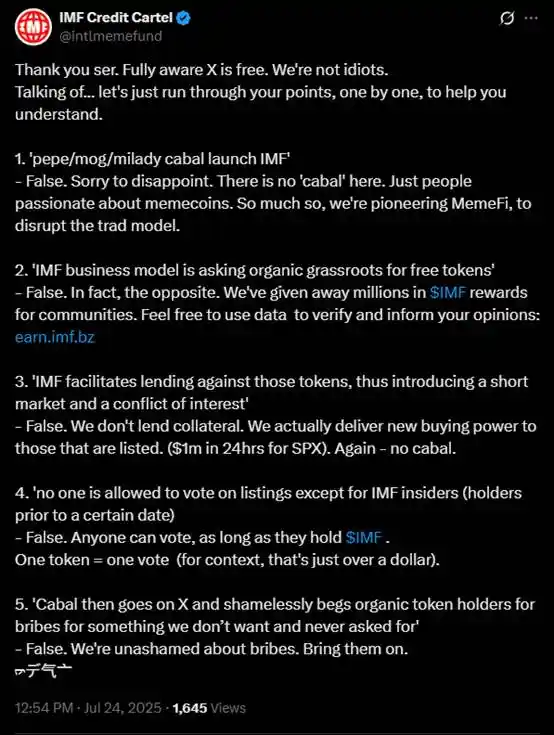
IMF 很快对此进行了回击,声称并没有索要任何贿赂,上架借贷对的标准也是公开的并且由 $IMF 持有者进行投票:
 meme币

以太坊的「meme 飞轮」,恐怕还要经受风浪。

Related Reads

Should You Buy SpaceX Stock at $1.7 Trillion? Here's What the Market Is Worried About

SpaceX is preparing for a massive IPO aiming to raise around $75 billion at a valuation of approximately $1.75 trillion. While its achievements in reusable rockets and the profitable Starlink satellite internet service are clear, the market is concerned about the aggressive valuation. Key issues include: the current $1.75 trillion valuation, which is about 94 times 2025 revenue, seems to price in not just existing businesses but also unproven future ventures like AI infrastructure and orbital data centers. Financially, while Starlink is profitable, the AI division, bolstered by the acquisition of xAI, is incurring massive losses and consuming the majority of capital expenditures. This acquisition also introduced complex related-party financing arrangements and debt onto SpaceX's balance sheet. Furthermore, corporate governance poses a challenge. SpaceX's dual-class share structure ensures founder Elon Musk retains absolute control, limiting ordinary shareholders' influence over high-risk, long-term strategic decisions. The future success of ambitious projects like the Starship rocket—critical for lowering costs and enabling new services—remains a significant variable for the valuation. In summary, the market's apprehension (FUD) centers not on doubting SpaceX's past technological triumphs but on questioning how much premium public investors should pay for a future that combines proven profits with highly speculative and capital-intensive new ventures, all under a governance structure that offers limited shareholder oversight.

marsbit2m ago

Should You Buy SpaceX Stock at $1.7 Trillion? Here's What the Market Is Worried About

marsbit2m ago

Breaking the DeFi Cascading Liquidation Curse: Vitalik Proposes a New Solution

Vitalik Buterin has proposed a new DeFi design to eliminate the automatic liquidation mechanism that causes market instability during sharp downturns. The current system, used by protocols like Aave, triggers forced sales when collateral value falls below a threshold, often exacerbating price drops and creating systemic selling pressure. Buterin's alternative model is based on splitting an asset like ETH into two synthetic option-like tokens, P and N, pegged to a price index. Their combined value always equals one ETH. Instead of sudden liquidation, a position's value gradually drifts from its target peg if the market moves. Users must proactively rebalance their holdings to maintain their desired exposure, transferring the management burden from the protocol to the user or automated tools. A key advantage is the reduced reliance on real-time oracles. Pricing decisions are deferred until contract expiry, allowing for more robust, fault-tolerant oracle designs. This removes a clear liquidation threshold that speculators can target for manipulation or MEV extraction. However, significant challenges remain. Frequent rebalancing could incur high slippage and transaction costs, necessitating new liquidity provider models. The design is better suited for hedging instruments than for stablecoins requiring a rigid 1:1 peg. While not an immediate replacement for existing systems, the proposal challenges the foundational assumption that instantaneous forced liquidation is an unavoidable necessity in DeFi, opening the door for fundamentally different risk management architectures.

marsbit7m ago

Breaking the DeFi Cascading Liquidation Curse: Vitalik Proposes a New Solution

marsbit7m ago

The End of Single-Factor Cryptography

The article "The End of Single-Factor Crypto" posits a fundamental shift in the cryptocurrency ecosystem. It argues the era where crypto asset valuations were predominantly driven by, and correlated with, Bitcoin's price is ending. The space is bifurcating into two distinct economies: endogenous and exogenous. The endogenous economy represents traditional crypto, where token and project values are directly tied to crypto market prices. The emerging exogenous economy comprises projects and businesses that may utilize blockchain technology or tokens but derive their fundamental value from external, non-crypto factors like consumer demand, subscription revenue, or real-world utility. Examples include AI inference platforms like Venice, fintech lenders using blockchain for efficiency, and stablecoin/payment infrastructure companies acquired by giants like Mastercard and Stripe. This shift means investment analysis must change. For exogenous assets, evaluating traditional business fundamentals—such as revenue streams, unit economics, and competitive moats—becomes more critical than tracking Bitcoin charts. While endogenous assets like Bitcoin remain relevant, the growth of the exogenous category is driven by measurable demand independent of crypto price cycles, paving the way for a new, more diversified market phase. Consequently, crypto is evolving from a single-factor, reflexive asset class into a multifaceted ecosystem with varied drivers and investment theses.

marsbit7m ago

The End of Single-Factor Cryptography

marsbit7m ago

Morning Post | Bitmine Plans to Raise $300 Million Through Preferred Stock Issuance; Polymarket Accuses Kalshi of Commercial Espionage

ChainCatcher's Daily Crypto Brief: Key developments from the past 24 hours include significant funding moves, regulatory actions, and market predictions. Bitmine announced a $300 million preferred stock fundraising. Polymarket accused rival prediction platform Kalshi of corporate espionage, citing numerous suspicious coincidences in product launches, a claim Kalshi strongly denied. The U.S. Department of Justice, in a joint "Disruption Week" anti-fraud operation with companies like Coinbase and Meta, froze over $3.8 million in cryptocurrency linked to scams. In infrastructure news, Macau completed its integration with the multi-central bank digital currency bridge, mBridge, aiming to build efficient cross-border payment channels. Cosmos Labs acquired the block explorer Mintscan. Market-wise, Geoffrey Kendrick, Standard Chartered's Head of Digital Assets Research, stated Bitcoin is nearing a bottom around $63,000, maintaining a year-end target of $100,000. He noted stability in U.S. spot Bitcoin ETF holdings. Ahead of SpaceX's anticipated IPO, internal insiders at Rocket Lab (RKLB) sold over $18.41 million in stock. In tokenization, Goldman Sachs partnered with Apex and Archax to launch a tokenized real estate fund. The meme token tracker GMGN reported the top trending tokens: on Ethereum, HEX, SHIB, LINK, PEPE, mUSD; on Solana, TROLL, swarms, WORLDCUP, neet, Buttcoin; and on Base, PEPE, toby, ODDS, ELSA, SKI.

链捕手22m ago

Morning Post | Bitmine Plans to Raise $300 Million Through Preferred Stock Issuance; Polymarket Accuses Kalshi of Commercial Espionage

链捕手22m ago

55TB to 28TB? The Rumor and Panic Behind Rubin's Memory Being Halved

Title: 55TB to 28TB? The Rumor and Panic Behind the Potential Halving of Rubin's Memory. On June 4th, a report from SemiAnalysis suggested NVIDIA's next-gen Vera Rubin NVL72 AI rack may ship with roughly 28TB of SOCAMM DRAM per rack instead of the anticipated 55TB, primarily using 96GB modules. This sparked a market panic, causing Micron's stock to drop over 10% on fears of halved memory demand. However, the article argues this panic is misguided for several key reasons. First, SOCAMM modules are socketed and upgradeable, not soldered. Lower initial configuration doesn't mean permanent demand loss. Second, the primary driver is a severe 2026 LPDDR5X supply shortage, not diminished need. NVIDIA is likely prioritizing rack shipments with available components. Third, with fixed total LPDDR5X supply, using less per rack could allow NVIDIA to ship *more* racks, not necessarily reducing overall memory orders. Micron's sharp drop was also attributed to a broader semiconductor sell-off triggered by Broadcom's earnings, with the SemiAnalysis report providing a convenient narrative for profit-taking after Micron's massive rally. In summary: the report on lower default configurations is likely accurate, but interpreting it as a demand collapse is wrong. The real risk for Micron lies in its reportedly minimal HBM4 share for Rubin, not in potentially flexible SOCAMM demand. The sell-off appears more like a correction amplified by coinciding negative catalysts.

marsbit39m ago

55TB to 28TB? The Rumor and Panic Behind Rubin's Memory Being Halved

marsbit39m ago

Trading

Spot
Futures

Hot Articles

Discussions

Welcome to the HTX Community. Here, you can stay informed about the latest platform developments and gain access to professional market insights. Users' opinions on the price of MEME (MEME) are presented below.

活动图片