Solana Meme Coins Surge: $PENGU, $USELESS & $WIF On Fire; Snorter Token Next?

bitcoinistPublished on 2025-07-04Last updated on 2025-07-04

Abstract

Solana meme coins are undoubtedly in the middle of a strong rally, with $USELESS leading the charge. This new crypto,...

Trusted Editorial content, reviewed by leading industry experts and seasoned editors. Ad Disclosure

Solana meme coins are undoubtedly in the middle of a strong rally, with $USELESS leading the charge.

This new crypto, which is quite literally a satirical take on the meme coin space, has gained over 85% over the past 7 days and an eye-watering 209% in the last 30 days.

Despite having no real utility or intrinsic value, $USELESS now commands around 4% of the Solana ecosystem mindshare, with a market capitalization of $225M, showing how powerful community sentiment and viral momentum can be.
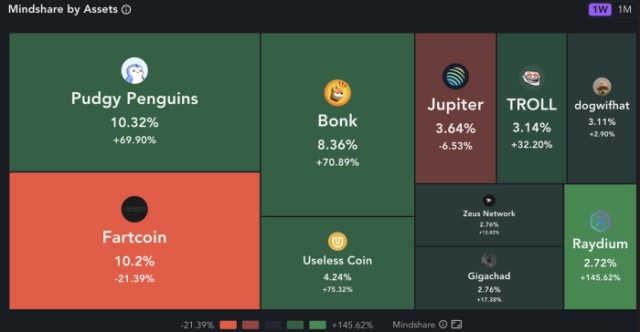
A visual showing Solana Mindshare by Assets.
Source: Messari Portals

And $USELESS isn’t alone. A flurry of Solana meme coins has been lighting up the charts in recent weeks. Keep reading to learn more about them.

We’ll also suggest one new contender, Snorter Token ($SNORT), that could deliver outsized gains and help you ride the wave.

Solana Meme Coins Are Booming

In addition to $USELESS, other Solana-based tokens have also seen explosive growth.

$PENGU has surged roughly 68% in the past week, capturing 10% of the Solana ecosystem’s mindshare, while $BONK has rallied over 24% in the same period.
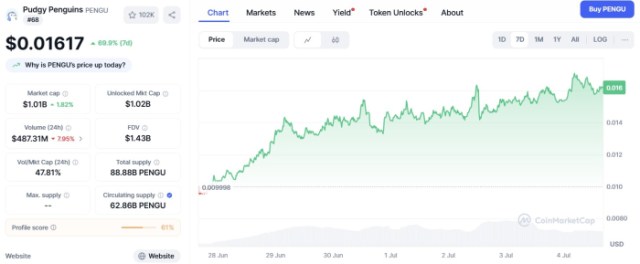
Pudgy Penguins ($PENGU) CoinMarketCap graph.

Data from Dune shows that Pump.fun, Solana’s meme coin launchpad, leads all platforms in metrics like daily token launches and active addresses.

This highlights Solana’s ability to handle large-scale retail adoption with unmatched speed and efficiency. Plus, the launchpad is reportedly preparing for a token sale of its own, looking to raise a whopping $1B.

With new meme coins launching daily and the Solana ecosystem gaining traction, investors are now looking for the next best crypto to invest in, one that hasn’t already pumped but shows serious upside potential.

Enter Snorter Token ($SNORT). Backed by real utility and riding the same wave that’s propelled $USELESS and $PENGU, it could be the next crypto to explode.

What is Snorter Token?

$SNORT is the token behind the Snorter Bot, a fresh Telegram-native trading bot designed to help retail meme coin traders snipe liquidity in newly listed tokens.

Conventionally, institutional traders have had the upper hand when it comes to sniping new meme coins before they pump, which they usually do soon after listing.

Thanks to Snorter Bot’s automated sniping, though, even the average Joe will be able to buy meme coins when they’re piping hot and benefit from the initial pump.

Refreshingly Simple Yet Mighty Secure

The best part? While it’ll work just as well as a high-end trading tool, Snorter Bot promises an accessible and easy-to-use interface.

For instance, you’ll be able to place buy/sell limits and stop orders directly from Telegram chat. No complicated dashboards. No confusing UI.
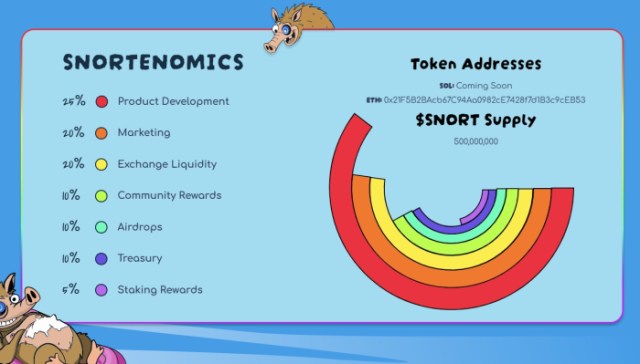
Snorter Token Tokenomics

And don’t be mistaken into thinking that Snorter’s emphasis on ease of use has come at the cost of essential privacy and security features.

In fact, the bot will come equipped with a comprehensive security suite, including front-running protection and priority execution.

Additionally, Snorter will independently verify every token before allowing its users to place any trades — shielding you from scams, including honeypots and rug pulls, as well as sandwich attacks.

Benefit from Seasoned Pros with Snorter’s Copy Trading Feature

There are hundreds of meme coins on Solana alone, making it impossible for you to stay on top of every lucrative opportunity on your own.

That’s where Snorter’s copy trading feature comes in. It’ll let you link your wallet with top-performing traders and automatically mimic their trades.

Whether you’re short on time or expertise, or perhaps you just want a proven edge, Snorter’s copy-trading feature will let you tap into professional expertise and paint your portfolio green.

Buy $SNORT for Exclusive Perks & Outsized Gains

For starters, $SNORT holders will only have to pay 0.85% as trading fees, compared to the 1.5% charged to non-holders.

It’s worth noting that this is the lowest fee in the entire Telegram trading bot space, with top rivals like Banana Gun and Bonk Bot charging upwards of 1%.

Holding $SNORT will also mean you’ll unlock advanced analytics and get access to staking rewards (currently yielding a massive 231%) — plus, it’ll remove daily sniping limits.
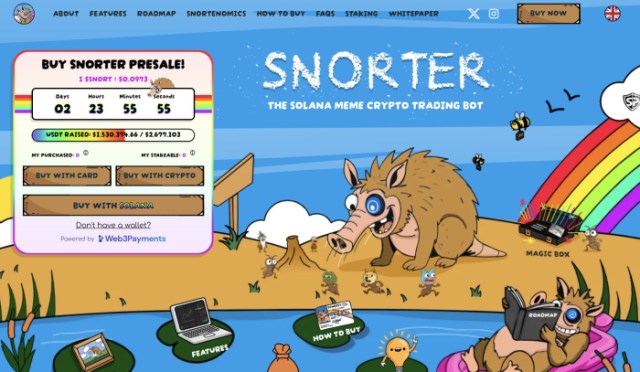
Snorter Token ($SNORT)

And then there’s the upside potential. According to our Snorter Token price prediction, this Solana meme coin could surge 1,900% and reach $1.96 by 2026, offering holders a chance to make brain-melting gains.

Interested? Snorter is currently in presale, so you can grab it for a low price of $0.0971. The project has raised over $1.53M at the time of writing; for more information, check out the whitepaper.

And check out our detailed guide on how to buy $SNORT for any help with making your first purchase.

Bottom Line

Solana’s meme coin scene is on fire, with tokens like $USELESS and $PENGU feeling the full force of community-driven hype and delivering explosive gains almost overnight.

As interest from traders grows and buzz around recent ETF developments continues to build, Snorter Token ($SNORT), a new crypto project offering the right tools to capitalize on the meme coin frenzy, could be the next breakout winner.

However, make sure you do your own research before investing. After all, investments in crypto are risky, and none of the above is financial advice.

Editorial Process for bitcoinist is centered on delivering thoroughly researched, accurate, and unbiased content. We uphold strict sourcing standards, and each page undergoes diligent review by our team of top technology experts and seasoned editors. This process ensures the integrity, relevance, and value of our content for our readers.

As a crypto writer, Bogdan’s responsibilities are split between researching and writing articles and entertaining the team with his humor bordering on the politically incorrect, an aspiring Bill Burr, if you will. Thanks to his 12+ years of writing experience in just as many fields, including tech, cybersecurity, modelling, fitness, crypto, and other topics-that-shall-not-be-named, he's become a genuine asset to the team. While his position as a senior writer at PrivacyAffairs thought him valuable lessons about the power of self-management, his entire writing career was and is an exercise in self-improvement. Now, he's ready to sink his teeth into crypto and teach people how to take control of their own money on the blockchain. With fiat as an eternally devaluing currency, Bitcoin and altcoins seem like the best-fitting alternative for Bogdan. Bogdan’s biggest professional accomplishment, aside from securing a position as a main writer for Bitcoinist, was his 5-year run as a writing manager at Blackwood Productions, where he coordinated a team of four writers. During that time, he learned the value of teamwork and that of creating a working environment that breeds efficiency, positivity, and friendship.

Related Reads

Google TPU Shipments Revised Up by 50%

Recent industry research indicates a significant upward revision in the shipments of Google's TPU (Tensor Processing Unit) chips. Previous expectations for 2027 were set at around 10 million units, but new estimates now point to 15 million units, a 50% increase. This substantial boost directly translates to higher demand across the entire supporting supply chain. Google's TPU clusters utilize a standardized all-optical interconnect architecture. Consequently, key hardware components are deeply integrated and scaled in fixed ratios with the chips. The 15 million TPU target will drive corresponding demand increases for NPO optical engines (roughly a 1:1 match), 1.6T optical modules, OCS optical switches, high-end server power supplies, fiber optics & MPO connectors, and liquid cooling solutions. Among these, liquid cooling is highlighted as the sector experiencing the most significant transformation and offering the most stable potential for excess returns. As next-generation TPU chips reach power levels where traditional air cooling is insufficient, liquid cooling becomes essential. 2026 is forecasted as the first year of substantial adoption for Google's liquid cooling solutions. This shift, coupled with delivery and capacity bottlenecks faced by incumbent overseas manufacturers, is creating a prime window for domestic Chinese suppliers to enter and secure Google's core supply chain. The market size for Google-specific liquid cooling is projected to potentially triple from a baseline of hundreds of billions to around 300 billion units by 2028. The logic for the fiber optic sector is also being rewritten. Once considered a cyclical commodity tied to telecom operator procurement, fiber is now a strategic and scarce resource for AI Data Centers (AIDC). A severe supply-demand imbalance, driven by the long lead time for preform production (18-24 months) and surging demand from cloud giants, is supporting strong performance. Chinese fiber manufacturers are well-positioned to capture a significant share of global AIDC demand, with exports potentially reaching 200-300 million core kilometers in 2026. Overall, the investment focus within the AI computing industry is shifting from pure "chip performance speculation" towards the more certain incremental growth in computing infrastructure and its supporting ecosystem. The upward revision in Google TPU shipments, along with the potential for further doubling by 2028, is seen as solidifying performance visibility for the entire supporting supply chain over the next two years.

marsbit58m ago

Google TPU Shipments Revised Up by 50%

marsbit58m ago

What Wall Street Really Wants After the Crypto Story Recedes

The tide of speculative crypto narratives has receded, revealing Wall Street's true objective: building a controlled, yield-generating, and compliant financial pipeline on distributed ledgers. They are migrating core functions onto blockchains, not for decentralization, but for efficiency and new revenue streams. Key developments include BlackRock's BUIDL fund, a tokenized treasury fund acting as a foundational reserve asset, and the rise of Securitize, which is going public and partnering with the NYSE to build a 24/7 digital securities trading and settlement system. This signals a major shift of securities clearing to blockchain technology. To make volatile assets like Bitcoin palatable for institutional investors, firms like BlackRock and Goldman Sachs are creating "covered call" ETFs (e.g., BITA). These products systematically sell options on Bitcoin holdings, transforming price volatility into stable monthly income, effectively repackaging crypto as a yield-bearing asset. Stablecoins are being positioned not as speculative tools but as efficient payment rails. Companies like Stripe and Mastercard are integrating them for instant, low-cost merchant settlements and cross-border card payments, respectively. Critically, new legislation like the GENIUS Act shapes them as non-interest-bearing, heavily regulated extensions of the US dollar system. In summary, Wall Street is quietly constructing a parallel, blockchain-based financial infrastructure featuring tokenized traditional assets, structured crypto yields, and programmable dollar pipelines—all under its control and fully integrated with existing regulatory and credit frameworks.

marsbit1h ago

What Wall Street Really Wants After the Crypto Story Recedes

marsbit1h ago

Tying Itself to SpaceX: Cursor's $60 Billion Rise

This article recounts the rapid rise of AI-powered coding startup Cursor and its 25-year-old MIT graduate CEO, Michael Truell. Launched in 2023, Cursor achieved explosive growth, reaching over 10 billion USD in revenue by late 2025. However, its journey highlights a central dilemma for AI application companies: dependence on foundational model providers. Cursor initially relied heavily on Anthropic's models but faced an existential threat when Anthropic launched its own competing coding tool, Claude Code. In response, Cursor declared an internal emergency in early 2026 and accelerated development of its own model, Composer. To secure the immense computing power needed, Truell struck a pivotal deal with Elon Musk's SpaceX in April 2026. The collaboration grants Cursor access to SpaceX's supercomputing resources for Composer, while SpaceX's Grok model benefits from Cursor's programming data. The agreement includes a potential 600 billion USD acquisition of Cursor by SpaceX later in the year, though a substantial termination fee is in place if the deal falls through. The story explores Cursor's intense, sometimes controversial hiring practices involving lengthy unpaid "work trials," its complex partnership-turned-rivalry with Anthropic, and its high-stakes gamble to ensure independence through the SpaceX alliance. The core question remains: will Cursor evolve into a defining, independent "generational" software company, or become a key piece in a tech giant's AI arsenal?

marsbit1h ago

Tying Itself to SpaceX: Cursor's $60 Billion Rise

marsbit1h ago

Trading

Spot
Futures

Hot Articles

Discussions

Welcome to the HTX Community. Here, you can stay informed about the latest platform developments and gain access to professional market insights. Users' opinions on the price of MEME (MEME) are presented below.

活动图片