В Glassnode объяснили падение ончейн-активности в биткоине

cryptonews.ruPublished on 2023-08-20Last updated on 2025-06-20

Падение суточного числа транзакций в сети первой криптовалюты во многом связано с обвалом нефинансовых операций и ростом доминирования крупных игроков. К таким выводам пришли аналитики Glassnode.

Despite #Bitcoin’s elevated price, a clear divergence has emerged between market valuation and network activity. In this report, we explore activity across both on and off-chain markets, and examine how network metrics have changed this cycle.

Discover more in the latest Week… pic.twitter.com/vLhL7sllKK

— glassnode (@glassnode) June 19, 2025

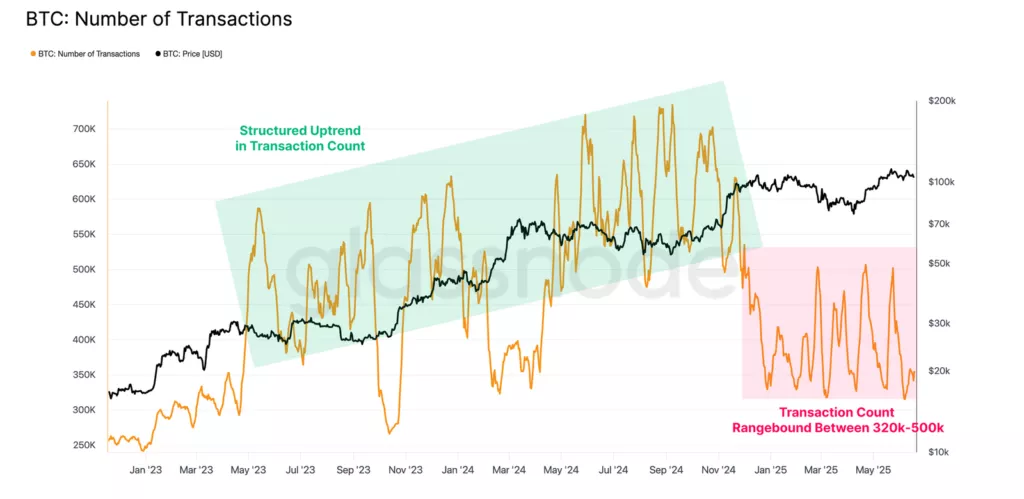
На протяжении 2023-2024 годов количество ончейн-операций в сутки демонстрировало восходящий тренд, достигнув пика в 734 000 в ноябре. После начала 2025 года показатель обвалился до значений 320 000-500 000, приблизившись к минимумам с октября 2023 года.
Данные: Glassnode.

При этом объем ежедневно перемещаемой стоимости остается на исторически высоком уровне — $7,5 млрд в среднем.

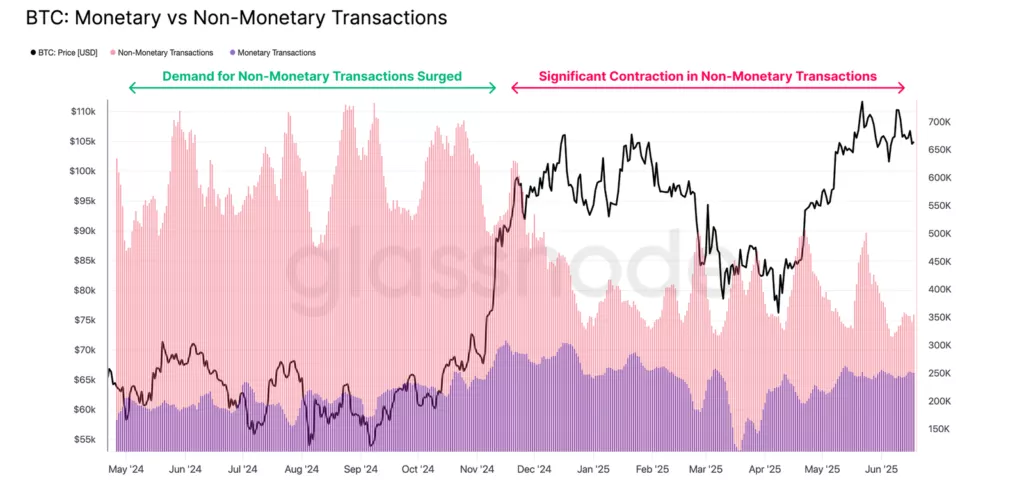
По оценке экспертов, это свидетельствует о том, что падение числа транзакций на блокчейне связано с прекращением ажиотажа вокруг активов, выпущенных с помощью свидетельских данных Taproot (Ordinals) и полей OP_Return (Runes).
Данные: Glassnode.

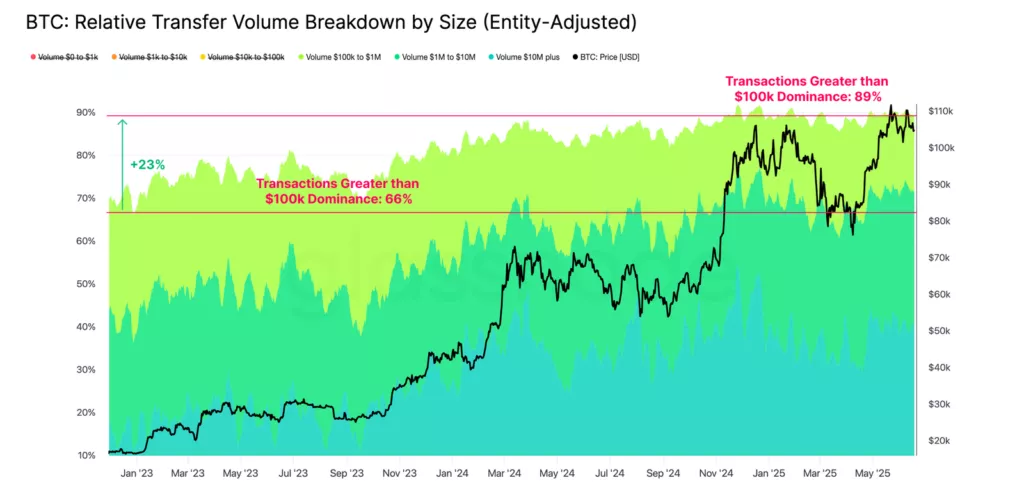
В Glassnode также отметили, что количество финансовых транзакций остается примерно неизменным, но их средняя долларовая стоимость достигла $36 200. Доля операций на сумму от $100 000 увеличилась с 66% в ноябре 2022 года до 80% на текущий момент.

Для сравнения, в декабре 2022 года на сделки до $100 000 приходилось 34% от общего количества, сейчас значение упало до 11%.
Данные: Glassnode.

«Эта тенденция подтверждает мнение о том, что участники с высокой стоимостью становятся все более доминирующими в ончейн-активности», — подчеркнули аналитики.

Значительная часть экономики биткоина переместилась в офчейн, констатировали в Glassnode. В сегменте спотовой торговли это обеспечивают централизованные биржи. За последний год среднесуточный объем торгов на CEX составлял около $10 млрд с пиком $23 млрд в ноябре, но подобные операции чаще всего не подразумевают передачи активов в сети.

Также в текущем цикле резко выросла торговая активность по фьючерсным контрактам и опционам, а также использование кредитного плеча.

По данным аналитиков, объем офчейн-рынка биткоина регулярно превышает суммарный показатель операций на блокчейне в 7-16 раз.

Эксперты Glassnode признали, что все перечисленные тренды оказали давление на комиссионные доходы майнеров. Доля сетевых сборов в выручке уже упала ниже 1%. В июне средний показатель составил $530 000 в сутки.

Напомним, после очередного перерасчета сложность сети биткоина скорректировалась от ATH всего на 0,45%, продолжая оказывать давление на рентабельность добытчиков.


Related Reads

"King of Shilling" Hayes Strikes Again, This Time Setting His Sights on Deribit

On June 29, BitMEX co-founder Arthur Hayes acquired approximately 6.16 million SYN tokens via OTC platform Flowdesk, valued at around $2.2 million. Subsequently, Hayes publicly endorsed SYN on X, calling it one of the most asymmetric investments he's seen since HYPE and declaring it time for an on-chain options DEX to challenge industry leader Deribit, naming Hypercall as that challenger. The article details the evolution of the Synapse Protocol, originally launched in 2021 as a cross-chain messaging and liquidity network. While its TVL peaked above $1 billion during the last bull market, it has since declined. The protocol's team has since built Hypercall, an on-chain options trading platform on Hyperliquid's HyperEVM, which supports trading options on "any asset" with features like 24/7 trading and defined risk limited to the premium paid. Deribit, founded in 2016, is highlighted as the dominant centralized crypto options exchange, commanding roughly 85% market share in BTC and ETH options. Its strengths include deep liquidity and professional tools, though it faces critiques over custody risk, KYC requirements, and regulatory uncertainty. The analysis suggests Hypercall's potential lies in decentralization, permissionless access, and transparency, potentially carving a niche in DeFi-native and emerging asset options. However, it faces significant challenges competing with Deribit's established network effect and liquidity depth. The piece concludes by noting Hayes's recent and mixed "call" history, referencing his previous promotion and subsequent sale of HYPE, as well as a controversial price target report for CARDS from his family office, Maelstrom, which was followed by a significant price drop for the asset. This activity has drawn criticism, with some accusing Hayes of creating exit liquidity for his followers.

Foresight News30m ago

"King of Shilling" Hayes Strikes Again, This Time Setting His Sights on Deribit

Foresight News30m ago

One Year After the Crash of Crypto Treasury Companies, Copycats Are Already Making a Comeback

One year after the collapse of digital asset treasury (DAT) companies, which wiped out up to 99% for early investors, the scheme has returned in a new guise. Recently, Triller Group announced it would become a "SpaceX treasury company," causing its market cap to surge. This follows the rebranding of another firm, LGHL, now targeting a token called HYPE. The original model, popularized by MicroStrategy (MSTR) and its "Bitcoin yield" narrative, saw companies trading at massive premiums to their underlying crypto holdings. However, most followers like TwentyOne, Metaplanet, and Nakamoto have crashed 80-95%+ from their peaks, erasing nearly all value for late investors. The author argues these structures have no fundamental reason to trade at premiums when low-fee Bitcoin ETFs or direct ownership exist. The cycle persists due to speculative demand driven by FOMO, gamification, and a belief the system is rigged, met by insiders and promoters who profit from the pump-and-dump dynamics. Drawing a parallel to the 1637 Tulip Mania, the piece concludes that such frenzies are not a bug but a recurring product of markets, where greater fools provide demand and insiders supply the schemes. Despite holding Bitcoin personally, the author condemns this specific packaging of assets into leveraged corporate vehicles marketed as innovation, a cycle seemingly unstoppable until a major crash.

marsbit42m ago

One Year After the Crash of Crypto Treasury Companies, Copycats Are Already Making a Comeback

marsbit42m ago

Trading

Spot
活动图片