Принятие биткоина подпитывается «деглобализацией» и «большим, красивым законопроектом» Трампа

cryptonews.ruPublished on 2024-07-13Last updated on 2025-06-13

Институциональное принятие биткоина переживает новую волну корпоративных инвестиций, которые могут выиграть от большей глобальной неопределенности до того, как будет окончательно заключено торговое соглашение или принят спорный законопроект о расходах США.

Президент США Дональд Трамп продвигает «Один большой красивый законопроект», который, по его словам, сократит федеральные расходы на 1,6 триллиона долларов.

«Великий, значимый, красивый законопроект приведет к росту экономики так, как никогда прежде, — написал Трамп в своем сообщении на Truth Social. — Он направит нашу страну на правильный путь, плюсую!»

Это заявление появилось вскоре после того, как Трамп сообщил в среду, что торговая сделка между США и Китаем находится «на стадии окончательного одобрения» со стороны обеих сторон.
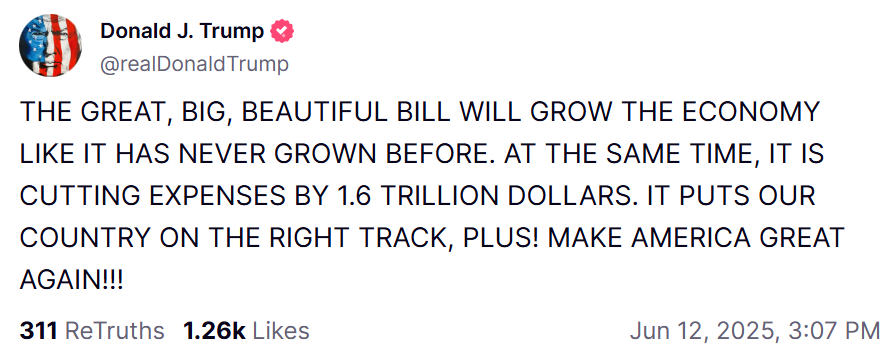

Источник: Дональд Дж. Трамп.

Илон Маск раскритиковал этот законопроект в своём посте на X от 5 июня, предупредив, что текущие меры приведут к увеличению дефицита до $2,5 триллионов долларов. Такой рост бюджетного дефицита может побудить Федеральную резервную систему прибегнуть к количественному смягчению (QE), предусматривающему покупку государственных облигаций и вливание новых денег в экономику.

Артур Хейс, сооснователь BitMEX и главный инвестиционный директор Maelstrom, предположил, что биткоин может достичь $250 000, если ФРС начнёт QE из-за давления со стороны роста тарифов.

Лукас Оутумуро, вице-президент институционального DeFi в Sentora, отметил, что растущая неопределённость, связанная с тарифами, может способствовать росту цены биткоина. Выступая в ежедневном шоу Chain Reaction в X Spaces 5 июня, он сказал:

«Биткоин выигрывает от этой деглобализации, которую запустил Трамп. Тарифы создают большее недоверие между странами и заставляют крупные организации и государства задумываться о том, безопасно ли их богатство в американской экономике».

4 апреля Трамп уже объявлял о своих планах ввести ответные импортные пошлины, чтобы сократить предполагаемый торговый дефицит США в размере $1,2 триллиона по товарам и стимулировать внутреннее производство.

Новые биткоин-киты достигли рекордной реализованной капитализации

По данным CryptoQuant, рост институционального принятия биткоина привёл к тому, что реализованная капитализация среди новых крупных держателей — китов с менее чем 155-дневным сроком владения — достигла исторического максимума в $113,7 млрд во вторник. В метрику не входят централизованные биржи и адреса майнеров.

Средний возраст держателей биткоина также снижается, что указывает на рост числа краткосрочных инвесторов, готовых активно участвовать на рынке. По словам Оутумуро, это свидетельствует о его нагревании.

«Приобретение биткоина через ETF и другие публичные инструменты, такие как Twenty One Capital, компенсирует значительную часть давления на продажу со стороны долгосрочных держателей», — добавил аналитик.

Под руководством генерального директора Strike Джека Маллерса компания Twenty One Capital работает над развитием инфраструктуры рынков капитала, основанной на биткоине, позволяя таким операциям, как кредитование, хранение и выпуск активов, происходить напрямую в блокчейне.


Related Reads

Founder of Baixing.com: The Notion That Large Language Models Will Devour Everything, I Believe Half of It

Founder of Baixing.com: I Only Half-Believe the Saying “Large Language Models Will Devour Everything” Author: Wang Jianshuo, Founder of Baixing.com Many proclaim that large models are everything, but the author is skeptical. He argues that such sweeping claims often stem from a limited understanding of the future. Drawing parallels to past technologies like electricity and the internet—which were predicted to “devour everything” but didn’t—he suggests that large language models (LLMs) are better seen as a foundational base. Like electricity, this base is essential for modern development, but its real value emerges only when applied to specific scenarios through various “machines” or “tools” (e.g., Claude Code for programming, Claude Design for design). The author acknowledges that LLMs may indeed replace many existing software systems built on rigid rules, workflows, and forms (e.g., CRMs, SaaS tools), as these are precisely what LLMs excel at processing. However, he emphasizes that beyond software, elements like customer data, execution capabilities (e.g., booking a flight), trust, and physical-world interactions will not be “devoured.” Instead, he foresees that after streamlining existing software, LLMs will open up a larger space for innovative, next-generation applications. These new tools will likely feature fluid interfaces and rely less on fixed rules, unleashing greater creativity. The author cautions against short-sightedness, recalling how in 2004 many believed internet giants like Sina, Sohu, and NetEase would monopolize the market—only to be proven wrong by subsequent disruptions. In conclusion, while LLMs are a crucial foundation and a current focal point, the true mainstream of this wave lies in the diverse applications built atop them to solve concrete problems. The phrase “devour everything” is imprecise; the real opportunity lies in identifying and leveraging the areas where LLMs do bring transformative change.

marsbit27m ago

Founder of Baixing.com: The Notion That Large Language Models Will Devour Everything, I Believe Half of It

marsbit27m ago

Founder of Baixing.com: I Only Half Believe in the Notion that Large Language Models Devour Everything

The founder of Baixing Wang states that while large language models (LLMs) are an extremely important foundational technology—akin to electricity or the internet—he only "half believes" the notion that they will "consume everything." He argues that LLMs provide a base layer of intelligence, but real-world value and transformation come from integrating this intelligence into specific applications and devices designed for particular scenarios—like how electricity powers various appliances from washing machines to TVs. He agrees LLMs will likely consume or replace a significant portion of existing rule-based, workflow-driven software (e.g., many SaaS systems, CRMs), as these are precisely what LLMs excel at handling. However, numerous other elements—such as customer data, execution capabilities (e.g., booking a flight), trust, and physical-world interactions—will not be consumed. Wang emphasizes that after LLMs absorb certain software layers, they will open up a much larger space for innovation: new types of "streaming" software with less rigid interfaces, where fixed rules are managed by AI. This next wave of applications built on top of the stable LLM foundation is where the true mainstream opportunity lies. He cautions against the short-sightedness of declaring any technology as all-consuming, drawing parallels to past premature predictions about internet giants monopolizing the web. The key is to find opportunities within the areas LLMs do transform.

链捕手32m ago

Founder of Baixing.com: I Only Half Believe in the Notion that Large Language Models Devour Everything

链捕手32m ago

Trading

Spot
活动图片