US Military Backs Bitcoin Reserve To Counter China, Says Senator Lummis

bitcoinistPublished on 2025-06-04Last updated on 2025-06-04

Abstract

United States Senator Cynthia Lummis (R-Wyo.) says elements of the nation’s uniformed leadership are now “big supporters” of plans to...

Trusted Editorial content, reviewed by leading industry experts and seasoned editors. Ad Disclosure

United States Senator Cynthia Lummis (R-Wyo.) says elements of the nation’s uniformed leadership are now “big supporters” of plans to build a Strategic Bitcoin Reserve (SBR), marking the first time a sitting law-maker has publicly claimed high-level military backing for the project.

Bitcoin Reserve Gains Military Support

“There are generals, especially in Southeast Asia, who believe it is important to have strategic Bitcoin stockpiles, because we are in an economic war with China,” Lummis told Bloomberg Television late Tuesday. “All we need to do is look to the leadership of the current US military to find support for a Strategic Bitcoin Reserve.”

Lummis reiterated her plan to accumulate 1 million BTC — roughly 5 percent of the supply — and hold it for twenty years. “My purpose is to… illuminate half of the US debt,” she said. The senator’s first funding tranche would rely on Bitcoin already in federal custody: “The place to start is to use the money held by the US Marshals Service… asset-forfeiture monies in the form of digital assets. That can be the basis for year one of a strategic Bitcoin reserve.”

Lummis’ remarks land two months after President Donald Trump issued Executive Order 14233, creating a SBR capitalised with all BTC forfeited in federal cases and instructing agencies to transfer their holdings to Treasury-run cold wallets.

The House and Senate are now considering companion “BITCOIN Act” bills that would codify the reserve in statute and authorise Treasury to purchase additional coins with “no incremental cost to taxpayers.” Even so, Lummis conceded legislation to expand or finance the reserve directly is unlikely to surface this session.

“I don’t think we’re going to get to this bill in 2025, because our next priority is market-structure,” she said, referring to the looming fight over jurisdictional boundaries between the Securities and Exchange Commission and the Commodity Futures Trading Commission.

Responding to concerns that a BTC build-up might displace bullion, Lummis stressed she has “never proposed selling any of our gold or hard assets.” Instead she would re-value Treasury’s 1934-vintage gold certificates at fair-market prices and swap the accounting uplift into BTC: “convert[ing] our gold certificates to current fair-market value and use those to convert to Bitcoin.”

Asked about JPMorgan Chase chief Jamie Dimon’s call for Washington to hoard “bullets, drones and rare earths” instead of BTC, the senator fired back: “Even the United States military disagrees with him… We have to prepare for a guns-and-bullets war, but we need both.”

Notably, Lummis wants the reserve to be Bitcoin-only. “Bitcoin is based on proof-of-work,” she argued, indicating no appetite to diversify into proof-of-stake assets or stablecoins at the sovereign-reserve level.

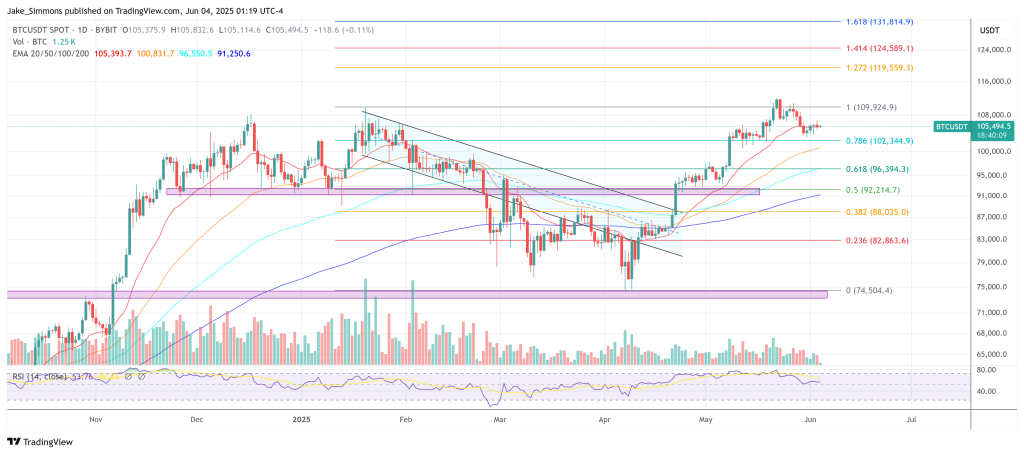
At press time, BTC traded at $105,494.
Bitcoin price
BTC continues to consolidate, 1-day chart | Source: BTCUSDT on TradingView.com
Featured image created with DALL.E, chart from TradingView.com
Editorial Process for bitcoinist is centered on delivering thoroughly researched, accurate, and unbiased content. We uphold strict sourcing standards, and each page undergoes diligent review by our team of top technology experts and seasoned editors. This process ensures the integrity, relevance, and value of our content for our readers.

Jake Simmons has been a Bitcoin enthusiast since 2016. Ever since he heard about Bitcoin, he has been studying the topic every day and trying to share his knowledge with others. His goal is to contribute to Bitcoin's financial revolution, which will replace the fiat money system. Besides BTC and crypto, Jake studied Business Informatics at a university. After graduation in 2017, he has been working in the blockchain and crypto sector. You can follow Jake on Twitter at @realJakeSimmons.

Related Reads

From Transaction Fees to Stablecoins: The Revenue Drivers and Economic Moats Behind Web3 Business Models

"From Transaction Fees to Stablecoins: Revenue Drivers and Moats in Verified Web3 Business Models" This analysis explores five established Web3 revenue models, examining their drivers and long-term sustainability. 1. **Transaction Fees**: This model is highly cyclical, with income tied to market activity and user risk appetite (formula: volume × fee rate). Growth depends on expanding the market, gaining market share, and maintaining stable fees amid intense competition. 2. **Stablecoin Reserve Yield**: Revenue stems from the scale of issued stablecoins and the interest earned on their underlying reserves (like US Treasuries). While predictable with strong moats (high user migration costs), growth is tied to adoption as on-chain dollar infrastructure and is sensitive to interest rate cycles. 3. **Funding Rate Arbitrage & Lending Spreads**: Protocols like Aave and Ethena profit from capital supply-demand imbalances. Similar to transaction fees, this model is cyclical and driven by user leverage demand during bullish market phases. 4. **Block Space Sales**: Chains sell computational resources (formula: demand × gas price). A key challenge is the ongoing decline in gas fees due to technological advances and competition among L1s and L2s. Future viability hinges on whether demand growth can offset falling unit prices. 5. **Protocol-Level Service Fees**: Similar to SaaS, this model involves charging other protocols for essential services (e.g., oracles like Chainlink). Revenue scales with ecosystem adoption. The primary moat is high switching costs once integrated, making market leadership crucial. In summary: Transaction fees and funding spreads are highly cyclical. Stablecoin yields and protocol services build strong, durable moats. Block space sales face the structural challenge of perpetually declining unit revenue despite growing demand.

marsbit2h ago

From Transaction Fees to Stablecoins: The Revenue Drivers and Economic Moats Behind Web3 Business Models

marsbit2h ago

Trading

Spot
活动图片