Aave launches Stable Vaults—but can AAVE extend its rally?

ambcryptoPublished on 2026-07-11Last updated on 2026-07-11

Abstract

DeFi protocol Aave introduced Stable Vaults, allowing fintechs and payment providers to embed fixed-rate stablecoin yields. The announcement, alongside record deposit numbers from the Aave V4 upgrade, boosted the AAVE token, with its price and trading volume rising. Technical analysis, however, suggests caution. While a short-term rally towards the $100-$106 resistance zone is possible, the higher-timeframe trend remains bearish. A move above the key $118.87 level would signal a bullish shift; until then, the current upward momentum might be a trap for buyers.

In a blog post on Thursday, July 9, DeFi giant Aave [AAVE] introduced Stable Vaults. This infrastructure allows fintechs, wallets, exchanges, and payment providers to embed fixed-rate stablecoin yield into their products.

Possible use cases include neobank embedded savings powered by Aave market, and a payments company letting merchants earn on idle settlement balances, among others, according to the announcement.

The Aave V4 upgrade also drew record deposit numbers, AMBCrypto reported. This has given the AAVE token a positive jolt. The daily trading volume of the token was up 14.5%, and the price was up by just under 3.5% in the past 24 hours.

Here’s why this momentum might be able to push prices another 12% higher.

Should investors buy the Aave move beyond $100?

In short, buyers might be on the wrong side in this battle. Here’s why.
Source: AAVE/USDT on TradingView

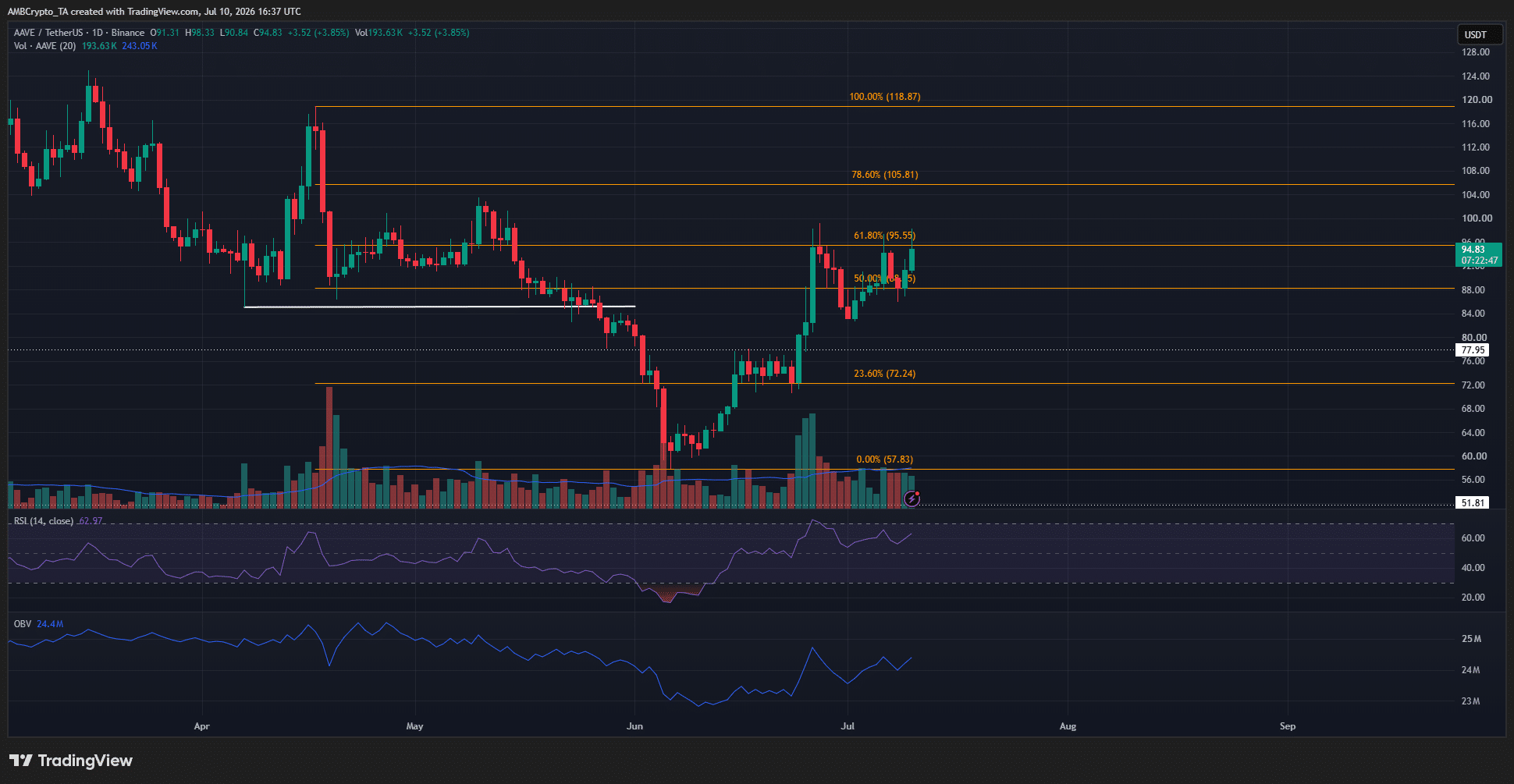
The 1-day chart showed a bearish swing structure in place. A bearish continuation was established in May, when Aave prices slid below the swing low at $85.05 to reach a new low of $57.83.

This downward impulse move was used to plot a set of Fibonacci retracement levels [orange]. At the time of writing, AAVE bulls were battling against the 61.8% retracement level at $95.55.

This resistance was also just below the $100 round-number resistance. On one hand, it appeared that a breach of this level would be bullish confirmation.

Traders’ call to action- Watch out for a trap

Such a rally could prove to be a bullish trap if AAVE fails to reclaim the higher-timeframe resistance levels. The trend on the higher timeframes, such as daily and weekly, were firmly bearish. A continued move up to $105.81, the 78.6% retracement level, is possible.

This is the trap traders and investors should watch out for. Short-term holders might want to use this bounce to exit at a profit.

If the rally continues and breaks the $118.87 swing high, a bullish structural shift would have occurred. Until then, caution would be the safer approach.


Final Summary

  • Aave’s Stable Vaults launch adds another fundamental catalyst to the protocol’s growing ecosystem, helping lift short-term sentiment around AAVE.
  • However, the higher-timeframe trend remains bearish, meaning any rally toward $100–$106 could face heavy selling unless buyers reclaim $118.87.


Related Questions

QWhat new product did Aave launch on July 9th, and what is its purpose?

AAave launched Stable Vaults. Its purpose is to allow fintechs, wallets, exchanges, and payment providers to embed fixed-rate stablecoin yield into their products.

QAccording to the article, what was the immediate impact of the Aave V4 upgrade and the new launch on the AAVE token?

AThe Aave V4 upgrade drew record deposit numbers. This gave the AAVE token a positive jolt, with its daily trading volume up 14.5% and its price up by just under 3.5% in the past 24 hours.

QWhat key resistance level are AAVE bulls battling against according to the 1-day chart analysis?

AAccording to the 1-day chart, AAVE bulls are battling against the 61.8% Fibonacci retracement level at $95.55, which is also just below the $100 round-number resistance.

QWhy does the article warn that a rally towards $100-$106 could be a 'bullish trap'?

AThe article warns it could be a bullish trap because the higher-timeframe (daily and weekly) trends are still firmly bearish. A rally without reclaiming the key higher-timeframe resistance level of $118.87 could lead to heavy selling.

QAccording to the final summary, what condition must be met for a bullish structural shift to occur for AAVE?

AAccording to the final summary, for a bullish structural shift to occur, the rally must continue and break the $118.87 swing high.

Related Reads

Latest Interview with Cyber Godfather Tibo: Dedicated Physical Button for Resets, 'I Reset Whenever I Want'

Tibo, the head of OpenAI's Codex project, recently discussed AI's future and OpenAI's strategy in an interview. He revealed that Codex and ChatGPT are set to merge into a single, highly personalized AGI that adapts its interface to individual users. The future of AI Agents, he believes, lies in making complex mechanisms like skill management "disappear," creating a seamless partner that understands context and goals. As models grow more powerful, local hardware will become a bottleneck, pushing agents to the cloud for greater computational resources. He highlighted the upcoming "Ultra Fast" mode, which will significantly reduce response times, shifting workflows back to real-time interaction and "flow" states rather than constant context switching. OpenAI's focus, according to Tibo, isn't just on building the strongest models but on delivering powerful capabilities to as many people as possible, emphasizing broad distribution, community involvement, and lowering barriers to use. Tibo also touched on OpenAI's culture of rapid iteration and empowerment, contrasting it with his past experience at Google. He confirmed that OpenAI is already practicing "recursive self-improvement," using powerful models to optimize infrastructure, creating a feedback loop of increasing capability and efficiency. The interview concluded with his thoughts on future human-AI interaction, which he envisions as increasingly natural, multimodal, and voice-first, adapting to human communication styles rather than the reverse. He also humorously noted the existence of a physical "reset" button for user quotas, symbolizing OpenAI's user-centric approach of compensating users during service issues.

marsbit5m ago

Latest Interview with Cyber Godfather Tibo: Dedicated Physical Button for Resets, 'I Reset Whenever I Want'

marsbit5m ago

IOSG | EIP-8363 Quantitative Review: Slashing Staking 'Subsidies'—What Does Ethereum Want in Return?

**Title: IOSG | EIP-8363 Quantitative Review: Cutting Staking "Subsidies"—What Does Ethereum Aim to Gain?** **Summary:** EIP-8363 proposes a mechanism to progressively destroy a larger portion of validator rewards as the staking ratio increases, reaching 100% destruction when 50% of ETH supply is staked. This analysis models its impact on issuance, yield, and staking equilibrium, investigates whether ETH's yield truly explains its price, quantifies the on-chain economy's dependence on this yield, and presents conclusions. Key findings: 1. EIP-1559's fee-burn mechanism has become largely ineffective, with burn rates down 98% since 2022. Issuance policy is now Ethereum's primary remaining lever over ETH supply. 2. At the current staking level (~35% of supply), EIP-8363 would cut issuance by ~58.6% and staking APR by ~56.4%, not eliminate it entirely. The mechanism is self-limiting; under reasonable yield thresholds, the system would stabilize at 26–34% staking with 0.3–0.5% annual issuance. 3. No statistically significant correlation exists between historical staking yield changes and ETH price movements. The natural 37% yield decline since 2023 showed no detectable price impact. 4. The on-chain economy's direct dependence on this yield is limited. Liquid staking tokens (LSTs) like wstETH are crucial as collateral (e.g., 34.2% in major lending markets), but their utility persists as long as yield is positive. Staking-focused ETFs represent a tiny fraction (0.19% of supply) of current demand. 5. The debate is essentially a zero-sum wealth redistribution: cutting ~$1.55B in annual issuance transfers value from concentrated staker/intermediary interests (35% of holders) to the diffuse majority of non-staking holders (65%). The proposal is economically rational but faces high political hurdles due to this concentrated opposition. Verdict: The proposal is mildly bullish for ETH (reducing a structural sell-pressure) but bearish for staking intermediaries/protocols. However, its passage is unlikely due to governance dynamics favoring concentrated, organized opposition over diffuse benefits.

marsbit5m ago

IOSG | EIP-8363 Quantitative Review: Slashing Staking 'Subsidies'—What Does Ethereum Want in Return?

marsbit5m ago

BTC Returns to $80,000, Crypto-Related Stocks Finally Stand Tall

Bitcoin Breaches $80,000 Mark, Boosting Crypto-Related Stocks With the crypto market heating up, Bitcoin has surged back above the $80,000 level after more than a hundred days, posting nearly a 30% gain in a week. This rally has ignited bullish sentiment across the board. Concurrently, crypto-related stocks, which had been experiencing a months-long slump, are staging a powerful comeback, led by key players in digital asset treasuries, exchanges, and trading platforms. Many of these stocks have seen substantial rebounds from their recent lows. Leading the charge is MicroStrategy (MSTR), a major Bitcoin treasury company, whose stock has rebounded nearly 50% from its 52-week low. Close behind is Bitmine (BMNR), the largest public Ethereum treasury, with a staggering 88.6% rebound. Other notable performers include the stablecoin issuer Circle (CRCL), up 75.5%, and the Ethereum-focused company Sharplink (SBET), up 83.7%. While the "crypto market proxy" Coinbase (COIN) has rebounded 29%, its unique position has faced some dilution from new market entrants. Robinhood (HOOD), bolstered by strong Q2 earnings and its expanding crypto ecosystem, has risen 63.2%. The exchange Bullish (BLSH) is up 45.8%. Perhaps the most dramatic rebound belongs to Hyperliquid Strategies (PURR), linked to the Hyperliquid ecosystem, which has skyrocketed over 254% from its low. The analysis highlights that most of these stocks hit their lows around late June, marking a market bottom. It emphasizes the strategy of focusing on leading companies and notes that while the rebound is strong, many stocks remain significantly below their yearly highs. Ultimately, these public companies serve as leveraged proxies for underlying crypto assets like Bitcoin and Ethereum in the current market upswing.

Odaily星球日报16m ago

BTC Returns to $80,000, Crypto-Related Stocks Finally Stand Tall

Odaily星球日报16m ago

Trading

Spot
活动图片