Cardano Foundation CEO: We Can Run VISA On Chain

BitcoinistPublished on 2025-04-11Last updated on 2025-04-12

Abstract

Cardano Foundation CEO Frederik Gregaard took the main stage at Paris Blockchain Week on Thursday, covering everything from the original...

Trusted Editorial content, reviewed by leading industry experts and seasoned editors. Ad Disclosure

Cardano Foundation CEO Frederik Gregaard took the main stage at Paris Blockchain Week on Thursday, covering everything from the original ideals behind Bitcoin to the rapid expansion of AI and the crucial role of decentralized infrastructure.


Vision For Blockchains And Cardano
Gregaard started by reflecting on the early vision of Bitcoin and what drew so many to decentralized technology in the first place. “We thought about this opportunity that there’s a lot of people who don’t have access to financial markets, who don’t have access to technology we take for granted, who is being blocked because they don’t have a passport or a national identity,” he said.


He emphasized that the core ethos behind Bitcoin was the capacity to move value without intermediaries and to truly own one’s assets. Yet he also acknowledged that the second generation of blockchain, typified by Ethereum, shifted the conversation toward broader capital markets. “Ethereum did extremely well in basically disrupting that model,” he remarked, yet he cautioned that traditional financial power structures often found their way back in. He cited examples of equity demands and sizable listing fees, observing that, in many ways, “Wall Street is creeping in on us again.”
Related Reading: Cardano Founder Teases Airdrop To 37 Million Users Across 8 Blockchains
Against this backdrop, Gregaard stressed the global transformations now underway, highlighting the pivotal rise of artificial intelligence. “I actually do think the world will be dominated by AI,” he said, posing the critical question of how best to harness it so that people remain in control. He warned that the appetite for AI’s “fantastic user experience” often overshadows concerns over energy consumption, data provenance, and transparency.
For him, this is precisely where blockchain can deliver robust solutions, because the trustless computing model and immutable data storage ensure that information cannot be tampered with. “When you look at it now, the idea about blockchain was really two things. We want blockchain as a trustless computing platform, and we want blockchain as an immutable data storage,” he explained, referencing real-world deployments such as a Cardano-based project in Eastern Africa, where village-level land registration helped reduce local violence by transparently mapping property ownership.


Gregaard underscored the importance of verifiable data in an era dominated by AI-driven analytics and decision-making. He raised concerns about the reliability of information that is not traceable to a trustworthy source, observing that political decisions or international trade policies could rest on flawed or manipulated data. “We are being exposed to things we cannot verify,” he said, cautioning that governments might be adopting measures “without being exposed to the right data.”
He then pointed out that large language models only amplify these concerns, since they rely on massive data sets that may or may not be accurate. “It does matter,” he stressed, arguing that pairing AI with on-chain, verified information is the only way to ground these technologies in “what’s the truth.”

Cardano Can Scale Above Visa-Levels


Turning to Cardano’s own ecosystem, Gregaard spoke of identity solutions and the growing importance of agentic AI, where machine-driven “agents” communicate based on assured credentials rather than risking data leaks to centralized platforms. “We launched a wallet which is compatible with the LEI,” he said, referring to the Legal Entity Identifier system used in global trade.

He called the solution open-source and not limited to Cardano alone, noting that others could deploy it on different blockchains. The principle, he said, is that all of us will hold multiple types of identities, and these should be managed in a way that fosters security, privacy, and interoperability. He also mentioned practical applications such as brand security, carbon credits in Kenya, and decentralized accounting, revealing that the Cardano Foundation itself places its financial statements on-chain. “Why are we doing that?” he asked. “Because we need to get to a place where we can actually not just trust the data but know that the data is truth.”


Gregaard confronted the critique that public permissionless blockchains cannot scale to handle global-level volume, specifically in finance. “Yes, you can run Visa and MasterCard on a public permissionless blockchain,” he asserted, introducing a striking claim that Cardano can do it.


“We did over 90 million transactions in one day, fully secured by 3,000 stake pool operators. So all those things they’re talking about cannot be done. It can be done.” It was a direct response to the pervasive belief that major networks such as Visa are out of reach for decentralized architectures.
He attributed this to an evolving technological stack that has advanced well beyond the early days of permissioned blockchain experiments. According to him, anyone can now harness a “footprint of innovation” across multiple sectors on the Cardano blockchain—supply chain, healthcare, data management, real estate—without the need for entirely new chain architectures.


TODAY: 🔥 Frederik Gregaard (@F_Gregaard), CEO of @Cardano_CF, spoke on the main stage at Paris Blockchain Week. 🇫🇷
Here’s the full keynote. pic.twitter.com/LcHQTR3BRp
— Cardanians (CRDN) (@Cardanians_io) April 10, 2025

In his concluding thought experiment, Gregaard challenged the audience to envisage a near future in which the world’s most valuable companies employ only a handful of people but reach trillion-dollar valuations, all while regulators scramble to implement effective oversight. “We’re not going to get to self-sovereign identity tomorrow,” he admitted, “but we can get to a wallet” that addresses many of today’s regulatory and practical demands.


He also argued that more transparency, particularly on blockchains, would enable stakeholders, shareholders, and citizens to hold large enterprises genuinely accountable. “With a large language model on top of this kind of information, you can be the most intelligent shareholder ever,” he said, suggesting that verifiable on-chain data can empower even small shareholders with potent insights.
At press time, Cardano traded at $0.63.
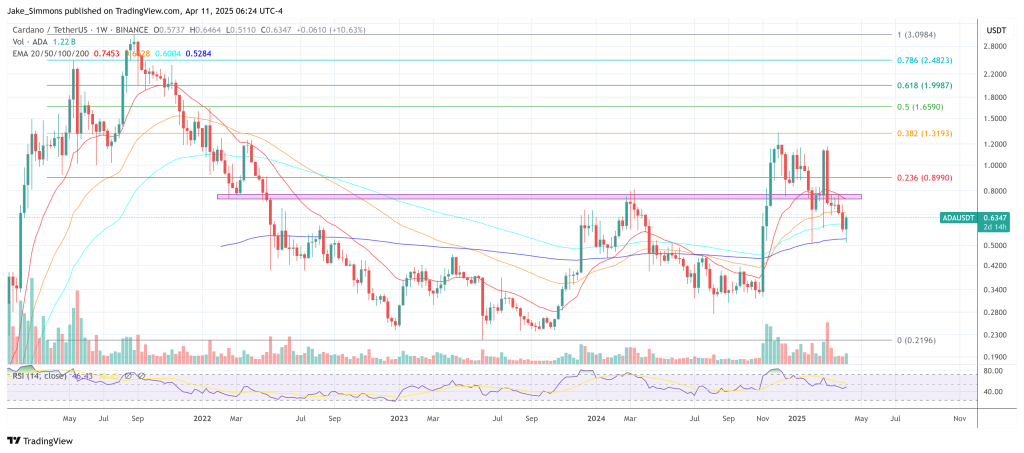
Cardano price

ADA needs to break the red resistance zone, 1-week chart | Source: ADAUSDT on TradingView.com Featured image from X, chart from TradingView.com


Related Reads

In the Era of Agent Users, Where Does Crypto Value Flow?

Title: Who Makes Money from Agents? The rise of AI Agents as potential blockchain users raises a crucial question: if they become the next billion users, who will capture the value? Traditional crypto value capture theories—like "fat protocols" (where value accrues to the base layer) and "fat applications" (where value accrues to user-facing apps)—assume human users who value UX, brand, and convenience. Agents, however, operate differently: they interact via APIs, have no brand loyalty, and can switch services with near-zero cost. This shift could disrupt existing value flows. Applications might become "headless," offering their routing and infrastructure as APIs to Agents. Alternatively, Agents might bypass intermediaries entirely, allowing protocols to regain value capture ("fat protocols" reborn). A more extreme scenario is that Agents, being purely rational and cost-sensitive, could commoditize the entire stack, compressing margins toward marginal cost and turning crypto into a low-margin utility. However, Agents may not just amplify existing activities; they could enable entirely new ones—like continuous, sub-penny portfolio rebalancing, machine-to-machine commerce, and new market types only viable at automated speeds. This expands the economic pie rather than just redistributing it. Ultimately, the key question for builders is: what will make an Agent return to your service instead of a cheaper alternative? The answer may not be UX but factors like liquidity, latency, settlement guarantees, or a yet-unnamed business model. As humans and Agents will coexist as users, value capture may split: "fat apps" for human-facing services, and a new, evolving model for the Agent-dominated layer.

marsbitJust now

In the Era of Agent Users, Where Does Crypto Value Flow?

marsbitJust now

Base MCP, The Next Step for x402

Base has officially launched Base MCP, allowing users to connect their Base Account to AI Agents to perform actions like swaps, transfers, portfolio tracking, and transaction history queries through conversational commands. This move aligns with Base's strategic focus on AI, driven by the broader competition in the emerging Agent-to-Agent payment sector. The evolution of Agent payments has accelerated. In late 2024, the primary method involved insecure browser automation. By 2025, solutions like Coinbase's x402 (providing crypto wallets for Agents), Google's AP2, and Visa's token-based system emerged. x402 has since processed 176 million transactions totaling over $70 million, with a median value between $0.01 and $0.10. Stablecoins, particularly USDC, dominate these settlements due to their negligible transaction costs compared to traditional payment fees, which are prohibitive for micro-payments. Coinbase faces competition from Stripe, which has built a comparable infrastructure for Agent payments with its Tempo blockchain, Privy wallets, Bridge routing (acquired for $1.1B), and the recently launched MPP protocol. Both companies are now competing at the application layer. The core reason AI is central to Base's strategy is to expand the scenarios for Agent payments, ensuring more transactions occur on its network. By securing a dominant position and scale advantage in this nascent field, Coinbase aims to capture the future commercial potential of Agent-driven payments. The launch of Base MCP is thus a strategic step in this larger ambition.

marsbit6m ago

Base MCP, The Next Step for x402

marsbit6m ago

Reframing Ethereum's Valuation: Why the Fee Model is Wrong, and the 'Treasury Logic' is the Future?

"Rethinking Ethereum's Value: The 'Vault Logic' Framework" Traditional valuation models incorrectly treat Ethereum as a company, valuing ETH based on transaction fees ("revenue"). This is flawed. Fees are network friction; a successful network aims to reduce them to zero. Ethereum's average fee has dropped from over $50 in 2021 to around $0.20 today, while transaction volume has tripled. Instead, view Ethereum as a digital vault securing ~$250 billion in on-chain assets (stablecoins, RWAs, L2 bridged funds, wBTC, etc.). Post-merge, Ethereum's security is directly purchased with its own asset: ETH. To attack the network, an attacker must acquire and control staked ETH. Therefore, the vault's security level is intrinsically tied to ETH's market value. Currently, the value of all staked ETH is only ~$72B, protecting ~$250B in assets—a dangerous imbalance. For robust security, the staked ETH securing the network should be valued significantly *higher* than the total value it protects. Applying a conservative security multiplier suggests ETH's fair value should be closer to ~$6,900 (vs. ~$2,070 currently). As on-chain asset value grows into the trillions, ETH's price must rise proportionally to maintain this security budget. Comparisons to free infrastructure like Linux or low-margin utilities like the DTCC are misguided. Their security is provided externally (community, law, banks). Ethereum's security is internal and must be purchased in the open market using ETH. ETH is not the clearinghouse; it is the collateral backing it. The model is not a short-term price predictor but a structural framework. The economic force for ETH appreciation grows monotonically with the adoption of Ethereum for settling value. The narrative that high fees are good is backwards; low fees enable more activity, which increases the value needing protection, thus demanding a more valuable ETH.

marsbit12m ago

Reframing Ethereum's Valuation: Why the Fee Model is Wrong, and the 'Treasury Logic' is the Future?

marsbit12m ago

Justin Sun’s Interview with Hurun Report: A New Order and Certainty for Value Flow in the Era of Transformation

In an interview with *Hurun Report*, Justin Sun, founder of TRON, discussed the evolution of the Web3 industry as it moves from initial exploration to large-scale adoption. He emphasized that the core value of blockchain lies in building an open and inclusive internet of value, enabling anyone globally to transfer and use funds efficiently and at low cost, regardless of location or access to banking. Sun highlighted that projects with lasting impact are those built on genuine demand and real-world usage. He pointed to the stablecoin payment ecosystem as the most mature and scalable application currently, noting that TRON has rapidly become one of the world's largest stablecoin networks. The circulation of USDT on TRON has surpassed $86.3 billion, driven by actual use cases such as cross-border transfers and daily payments, demonstrating strong network effects. Regarding strategy, Sun outlined a methodology combining data-driven iteration, rapid execution, and user-centric focus. He cited the decision to partner with Tether to launch TRC-20 USDT as a key strategic move, based on an assessment of market trends and long-term potential, which has become a significant growth engine for the TRON ecosystem. On globalization, Sun stressed the importance of local compliance and cultural adaptation, noting that success in different markets depends on deep understanding and local partnerships. He also addressed the convergence of AI and blockchain, describing it as a transformative direction where blockchain provides decentralized infrastructure for AI, while AI enhances the intelligence and user experience of blockchain systems. For industry participants and young entrepreneurs, Sun advised continuous learning and adaptability in a fast-changing environment, focusing on building irreplaceable core strengths rather than spreading resources too thinly. Through infrastructure development, global strategy, and technological foresight, TRON aims to advance the practical implementation and evolution of the value internet.

marsbit45m ago

Justin Sun’s Interview with Hurun Report: A New Order and Certainty for Value Flow in the Era of Transformation

marsbit45m ago

Samsung Leverages Technology Cycles, SK Hynix Relies on HBM, What Enabled Micron to Win a Trillion-Dollar Market Cap?

Micron Technology, the Idaho-based memory chip maker, recently saw its market cap surpass $1 trillion, securing its position as one of the top three DRAM manufacturers alongside Samsung and SK Hynix. Its survival and growth story is marked by a unique combination of political maneuvering and hard-won manufacturing efficiency, but also strategic missteps that now challenge its future. Founded in 1978 in Boise without significant government or capital backing, Micron repeatedly turned to Washington for survival during critical junctures. In the 1980s, it filed anti-dumping complaints against Japanese firms, leading to the U.S.-Japan Semiconductor Agreement. Ironically, this created an opening for Samsung, which Micron had earlier licensed its 64K DRAM technology to. In 2002, Micron avoided heavy fines in a price-fixing investigation by acting as a whistleblower against its competitors, cementing its reputation as a "political opportunist." A major strategic error occurred in 2013 with its $2.5 billion acquisition of bankrupt Japanese firm Elpida. This deal burdened Micron with integrating incompatible manufacturing processes just as the industry was pivoting toward HBM (High Bandwidth Memory), a critical technology for AI. SK Hynix had launched its first HBM chip that same year. By the time AI demand exploded with ChatGPT in 2022, SK Hynix commanded about 85% of the HBM3 market, while Micron, playing catch-up, held only around 3%. In 2017, Micron employed similar tactics against a new competitor, Chinese startup Fujian Jinhua, by alleging intellectual property theft, which led to U.S. sanctions effectively crippling the firm. However, this strategy backfired in 2023 when China banned Micron's products from its critical infrastructure, causing its revenue share from China to plummet from 14% in FY2023 to just 7.1% by FY2025. Today, Micron faces a triple squeeze: it lags in the high-margin HBM race, faces pricing pressure in low-end DRAM from Chinese manufacturers like CXMT, and has lost crucial access to the booming Chinese AI server market. Despite its political strategies, Micron's core strength is its exceptional manufacturing cost control, achieved through decades of engineering. Its DRAM chips have a smaller cell area than its rivals, yielding more chips per wafer. This efficiency has been vital for weathering industry downturns. However, this advantage cannot compensate for the decade lost in HBM development. Micron is now racing to ramp up production of its HBM3E, certified by NVIDIA, and develop HBM4. Its future hinges on whether it can close this technological "time debt" through relentless R&D and execution, in a marathon where its competitors, having started earlier, are not slowing down.

marsbit1h ago

Samsung Leverages Technology Cycles, SK Hynix Relies on HBM, What Enabled Micron to Win a Trillion-Dollar Market Cap?

marsbit1h ago

Trading

Spot
Futures

Hot Articles

Discussions

Welcome to the HTX Community. Here, you can stay informed about the latest platform developments and gain access to professional market insights. Users' opinions on the price of ADA (ADA) are presented below.

活动图片