Курс токена Pi Network взлетел на 101% после разворота на рынке

cryptonews.ruPublished on 2022-06-06Last updated on 2025-04-06

Токен Pi Network (PI), сильно подешевевший после выпуска в феврале 2025 года, подорожал вдвое за считанные часы и выбрался из глубокой ямы.

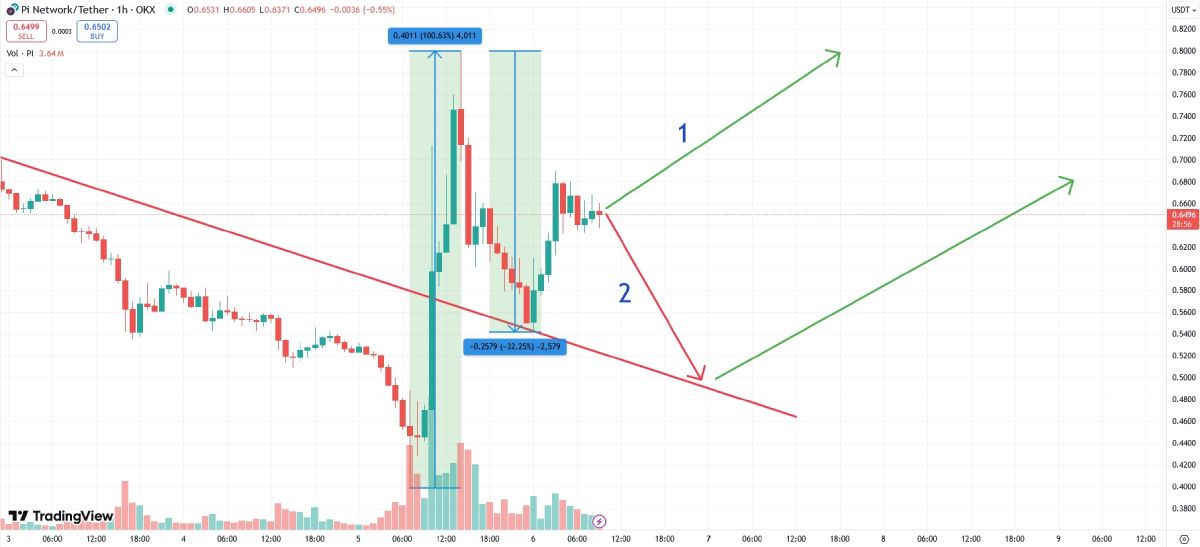
Цену Pi Network начали пампить 5 апреля в 07:00 по Москве, и уже к 14:00 она повысилась почти на 101%. Затем произошла коррекция, в рамках которой стоимость криптовалюты упала на треть, но в ходе бычьего тренда курс монеты пробил линию нисходящей тенденции, стартовавшей 13 марта, и закрепился над ней. Поэтому возможны два сценария развития событий:

  1. PI продолжит дорожать, пока его курс не достигнет хотя бы $0,8;
  2. Цена Pi Network сначала снизится до линии медвежьего тренда в районе $0,5, оттолкнётся от неё и пойдёт вверх к $0,68.
pi-price-change-6-april

Вероятное изменение стоимости Pi Network

Разработчик софта и PI-энтузиаст Косаси Накамото придерживается негативного прогноза, заявляя:

Общий тренд остаётся медвежьим, потому что цена колеблется ниже ключевых уровней сопротивления (например, в диапазоне $0,6475–0,65), и ей не удалось преодолеть значимые скользящие средние или линии тенденций.

Объём торгов уменьшается во время медвежьего тренда с небольшими всплесками активности. Основная масса недавних свеч были немного большего объёма, что может указывать на рост интереса со стороны покупателей.

Тем не менее Косаси высоко оценивает потенциал Pi Network в долгосрочной перспективе и считает, что падение курса криптовалюты на 87% от пикового показателя на отметке $3 оздоровило рынок, вытеснив с него спекулянтов. Если команда проекта преуспеет в сфере создания устойчивой экосистемы и повышения практической ценности PI, то стоимость монеты неминуемо вырастет и владельцы активов заработают прибыль.


Related Reads

The Final Piece of Franklin Templeton's Crypto Ambition

Franklin Templeton Completes Crypto Ambition with Acquisition of 250 Digital On June 22, Franklin Templeton announced the acquisition of 250 Digital and established Franklin Crypto, a new division focused on actively managed cryptocurrency strategies for institutional investors. The unit is led by Christopher Perkins and Seth Ginns. This acquisition marks a key piece in Franklin Templeton's multi-year crypto strategy, which began in 2018 with a digital assets team. The firm's crypto product suite now spans three layers: tokenized funds like the blockchain-based money market fund BENJI (~$831M AUM); a series of passive ETFs including Bitcoin (EZBC, ~$368M), Ethereum (EZET), XRP (XRPZ, ~$252M), Solana (SOEZ), and a multi-crypto index fund (EZPZ); and the newly added active management strategies from Franklin Crypto. The company has also expanded its crypto ecosystem through investments in projects like Ethena and Crossmint, and collaborations with blockchains such as Aptos and Sui. With approximately $18B in digital asset AUM and a total firm AUM of ~$1.78T, Franklin Templeton is positioning itself as a comprehensive crypto asset manager for pensions and sovereign wealth funds. In contrast, competitor Fidelity Investments has taken a different path, focusing early on building its own custody and trading infrastructure. Fidelity's Bitcoin ETF (FBTC) holds over $11B, significantly larger than Franklin Templeton's equivalent offering. Both giants' moves underscore the deepening trend of traditional finance entering the crypto space.

Foresight News14m ago

The Final Piece of Franklin Templeton's Crypto Ambition

Foresight News14m ago

Black Tuesday in Japanese and Korean Stock Markets: South Korea Triggers Circuit Breaker, Nikkei Plummets, AI Boom Undergoes Phased Adjustment

"Black Tuesday" for Asian Markets: Korean Stocks Halted by Circuit Breaker, Nikkei Plunges as AI Rally Undergoes Correction Asian stock markets experienced severe turbulence on Tuesday, with South Korea's benchmark KOSPI index plummeting nearly 10% after triggering a market-wide trading halt when its losses exceeded 8%. Japan's Nikkei 225 index also fell sharply by approximately 3.5%, ending an eight-day winning streak. The sell-off was heavily concentrated in the technology and semiconductor sectors, with giants like Samsung Electronics and SK Hynix leading the declines. The plunge reflected a rapid reversal from recent highs, with the KOSPI having retreated over 12% from its mid-June peak. Analysts attribute the sharp correction to multiple converging factors. The direct trigger was weakness in U.S. tech stocks, which fueled profit-taking in overbought Asian markets. Furthermore, stronger-than-expected U.S. jobs data has reinforced expectations that the Federal Reserve will maintain or even raise interest rates, putting pressure on rate-sensitive growth stocks. Structural vulnerabilities also played a role, particularly in South Korea, where the market is highly concentrated in a few semiconductor heavyweights, making it susceptible to shifts in global AI demand and foreign capital outflows. Despite the short-term volatility, the long-term narrative for AI and semiconductors remains intact. Industry forecasts still point to massive growth in global AI capital expenditure over the coming years. South Korean firms like SK Hynix maintain a dominant position in critical segments like High Bandwidth Memory (HBM), with long-term orders secured well into 2027. While near-term fluctuations are expected to continue, driven by U.S. monetary policy signals and upcoming corporate earnings, the current correction may present a buying opportunity for quality assets tied to the enduring AI infrastructure build-out.

marsbit29m ago

Black Tuesday in Japanese and Korean Stock Markets: South Korea Triggers Circuit Breaker, Nikkei Plummets, AI Boom Undergoes Phased Adjustment

marsbit29m ago

Trading

Spot
Futures
活动图片