Analyst Says Dogecoin Is In ‘No Trade Zone’, Here Are The Major Support And Resistance

bitcoinistPublished on 2025-03-21Last updated on 2025-03-22

Abstract

Crypto analyst Crypto VIP has revealed that the Dogecoin price is in a no-trade zone. His analysis also revealed the...

Trusted Editorial content, reviewed by leading industry experts and seasoned editors. Ad Disclosure

Crypto analyst Crypto VIP has revealed that the Dogecoin price is in a no-trade zone. His analysis also revealed the major support and resistance levels to watch out for as the foremost meme coin continues to trade sideways. 

Dogecoin Price Trading In A No Trade Zone

In an X post, Crypto VIP stated that the Dogecoin price is currently in a no-trade zone. He noted that after a downtrend, DOGE is now trading within a range. The analyst added that a break out of this range will determine the next movement. As such, he believes that it is better to wait for a break above the resistance area or a retest of the support area before making any new entries. 

Crypto VIP mentioned $0.143 to $0.149 as the support area to watch out for and $0.176 to $0.187 as the resistance areas to watch out for. His accompanying chart showed that DOGE could face another major resistance between $0.23 and $0.24 if it breaks out from the $0.187 resistance. 
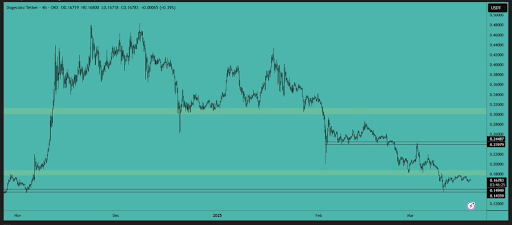
Dogecoin
Source: Crypto VIP on X

Crypto analyst Ali Martinez seems more confident that the Dogecoin price will break out to the upside. In an X post, he asserted that DOGE will break out. Martinez remarked that a close outside $0.16 to $0.18 could trigger a 16% price move. His accompanying chart showed that DOGE could reclaim the psychological $0.20 price level in the process. 

Crypto analyst Master Kenobi stated that these days might be the last time that market participants see the Dogecoin price under $0.18, suggesting that a bullish reversal was on the horizon. His accompanying chart showed that the foremost meme coin would still rally to as high as $0.8, which would mark a new all-time high (ATH) for DOGE. The analyst also recently predicted that Dogecoin could hit $1 by June. 

DOGE Could First Retest $0.143 Support Level

In an X post, crypto analyst Trader Tardigrade predicted that the Dogecoin price could first retest the $0.14 support level before any bullish reversal. Alluding to the daily chart, he noted that DOGE is giving out a bearish candlestick pattern, the Bearish Tweezer, with a false breakout at the $0.176 resistance level. 

In line with this, he remarked that it is more likely to move downward to test the previous support level of $0.143 again, potentially forming a sideways range between $0.143 and $0.176. For the Dogecoin price to break $0.176, the analyst remarked that it needs to build momentum with higher lows just below $0.176. 

At the time of writing, the Dogecoin price is trading at around $0.164, down over 3% in the last 24 hours, according to data from CoinMarketCap.

Dogecoin
DOGE trading at $0.16 on the 1D chart | Source: DOGEUSDT on Tradingview.com
Featured image from Unsplash, chart from Tradingview.com
Editorial Process for bitcoinist is centered on delivering thoroughly researched, accurate, and unbiased content. We uphold strict sourcing standards, and each page undergoes diligent review by our team of top technology experts and seasoned editors. This process ensures the integrity, relevance, and value of our content for our readers.

Scott Matherson is a leading crypto writer at Bitcoinist, who possesses a sharp analytical mind and a deep understanding of the digital currency landscape. Scott has earned a reputation for delivering thought-provoking and well-researched articles that resonate with both newcomers and seasoned crypto enthusiasts. Outside of his writing, Scott is passionate about promoting crypto literacy and often works to educate the public on the potential of blockchain.

Related Reads

A Decade of Change: The Demise of Crypto Startups

"The Decade-Long Transformation: The Demise of Crypto Startups" The article traces the dramatic evolution of the cryptocurrency industry from its anarchic beginnings to its current highly regulated and institutionalized state. In the early days (circa 2017), launching a crypto startup was remarkably simple: a whitepaper, a GitHub repository, and a Telegram group could attract thousands of retail investors via an Initial Coin Offering (ICO). Founders operated anonymously with near-zero regulatory and financial barriers, enabling rapid, global innovation but also widespread fraud. By 2026, the landscape is fundamentally different. To operate in major markets like the US, EU, and Asia, crypto businesses must now navigate a complex web of regulations akin to traditional finance. Compliance costs are prohibitive: estimates for a US multi-state operation range from $750,000 to $1.2 million in the first three years, with annual costs exceeding $2 million thereafter. Regulations like MiCA in the EU and New York's BitLicense have created high capital and operational hurdles that act as barriers to entry. Simultaneously, venture capital investment has shifted dramatically. Following the collapses of Terra and FTX, funding has concentrated in later-stage, established companies, creating a "barbell market." Early-stage and seed funding has shrunk significantly, while mega-funds like Andreessen Horowitz's $15 billion pool dominate. Most capital now flows to trading platforms, lending infrastructure, and B2B services. This environment favors mergers and acquisitions as the primary path for growth. Companies like Coinbase and Ripple are acquiring firms like Deribit and Hidden Road not for their technology, but for their licenses, banking relationships, and institutional trust—assets far more valuable than code. Distribution channels, compliance, and brand reputation have become the new moats, overshadowing pure technical innovation. The industry's maturation brings benefits: reduced scams, increased institutional participation, and clearer regulatory frameworks. However, it comes at a cost. The low-barrier, experimental ethos that defined crypto's first decade is fading. Entrepreneurs without substantial capital, pre-existing licenses, or institutional connections face immense challenges. Funding for exploratory fields like decentralized social media or novel governance models is drying up. Ultimately, the crypto industry is replicating the consolidation pattern seen in banking and tech after the 2008 financial crisis. While this brings stability and legitimacy, it raises a critical question: in this new, resource-intensive reality, is there still room for the disruptive, from-scratch innovation that gave birth to the sector?

Foresight News1h ago

A Decade of Change: The Demise of Crypto Startups

Foresight News1h ago

Trading

Spot
活动图片