Arizona Leads Bitcoin Reserve Race As Two Bills Pass House Commerce Committee Vote

bitcoinistPublished on 2025-03-20Last updated on 2025-03-20

Abstract

Arizona has taken the lead in the US Strategic Bitcoin Reserve (SBR) race after two bills passed the House of...

Trusted Editorial content, reviewed by leading industry experts and seasoned editors. Ad Disclosure

Arizona has taken the lead in the US Strategic Bitcoin Reserve (SBR) race after two bills passed the House of Representatives Commerce Committee vote on March 18. The state now has two active crypto reserve legislations and a legal tender bill, which have also advanced to the next stage.

House Commerce Committee Passes Bitcoin Reserve Bills

On Tuesday, the Arizona House Commerce Committee met to consider three Bitcoin-related legislations, including two strategic reserve bills, which passed the vote to advance to the next legislative stage.

Senate Bill 1025 (SB1025), also known as the “Arizona Strategic Bitcoin Reserve Act,” passed the vote with a 6 – 4 majority. Bitcoin Laws noted that the vote “was along partisan lines: Republicans for; Democrats against.”

bitcoin


SB1025 passes with a 6 - 4 majority. Source: Bitcoin Laws

If passed, the legislation, sponsored by Republican Senator Wendy Rogers, would allow public funds in Arizona, such as the state treasurer or state retirement system, to invest up to 10% of their assets under management in cryptocurrencies, focusing on Bitcoin (BTC).

“If the United States Secretary of the Treasury establishes a strategic Bitcoin reserve for the storage of government Bitcoin holdings, a public fund may store the virtual currency holdings of the public fund in a secure segregated account within the strategic Bitcoin reserve,” SB1025 reads.

The bill also provides a framework for public funds to diversify their investments and establishes clear guidelines and definitions to manage them.

Meanwhile, Senate Bill 1373 (SB1373), sponsored by Republican Senator Mark Finchem, passed with a 6 – 4 vote on Tuesday. The legislation aims to establish a Digital Assets Strategic Reserve Fund in the state, comprised of seized cryptocurrencies and appropriated legislative funds that can be held through secure custody solutions or exchange-traded products (ETPs).

The fund would be managed by the state treasurer, who could invest up to 10% of its total deposit in any fiscal year and may loan its assets to generate additional returns if it doesn’t increase the state’s financial risks.

“The bill also outlines strict requirements for secure custody solutions, including exclusive key access, encrypted environments, hardware maintenance in multiple secure data centers, multi-party governance, comprehensive logging, regular security audits, and disaster recovery protocols,” Bitcoin Laws explains.

Arizona Takes The SBR Lead

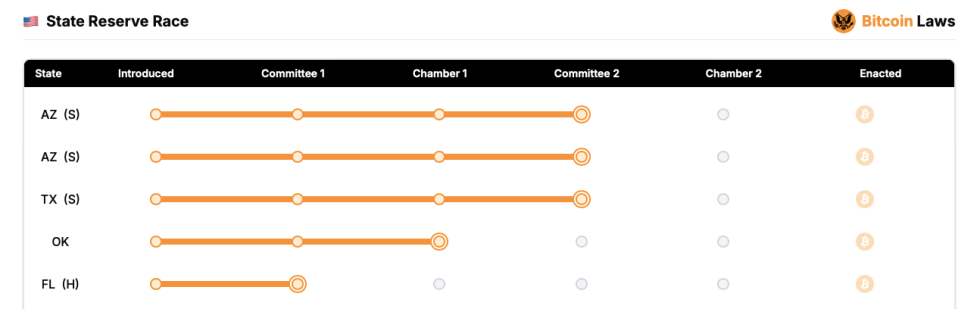
After Utah scrapped its BTC reserve clause, Arizona became the state with the most advanced SBR legislation. As reported by Bitcoinist, the Utah State Senate exited the SBR race this month after amending the proposed bill allowing the state treasury to invest in digital assets.
bitcoin

Arizona has advanced two SBR bills. Source: Bitcoin Laws

Following this development, Arizona took the lead with two reserve bills awaiting a final floor vote in the Senate before moving to the House Commerce Committee. Both strategic reserve bills now move to the House Rules Committee, which has a 5 – 3 Republican majority.

If they pass the Rules Committee vote, SB1015 and SB1373 will only require a vote by the full House before heading to the governor’s desk. Similarly, another BTC-related bill passed the House Commerce Committee on Tuesday with a 6-4 vote and heads to the next stage.

Senate Bill 1062 (SB1062), also sponsored by Senator Mark Finchem, aims to expand the state’s definition of legal tender to include cryptocurrencies, including BTC, alongside traditional currencies.

The legislation also updates different sections of Arizona’s tax code to include the new legal tender definition and ensure consistency across different statutes, suggesting an effort to recognize the industry as a key sector.
Bitcoin

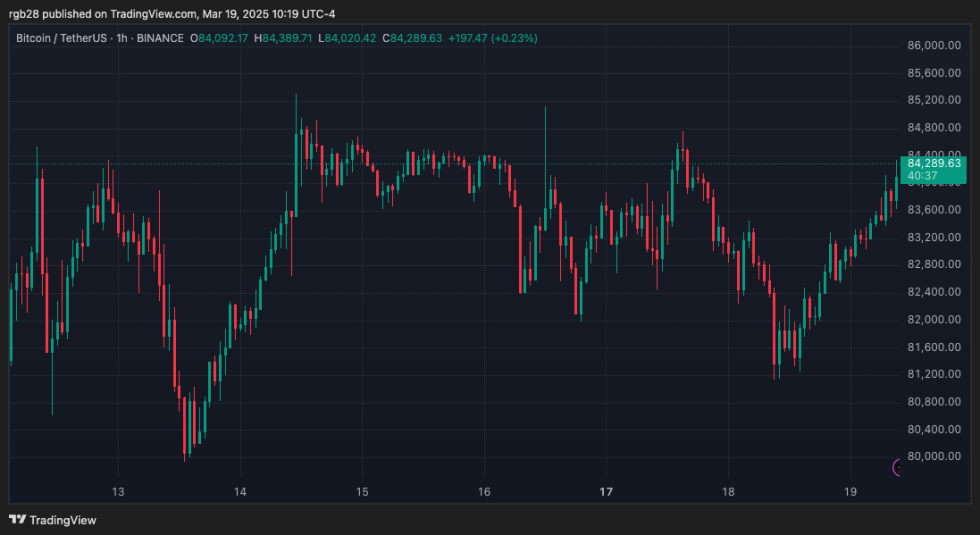
BTC trades at $84,289 in the one-week chart. Source: BTCUSDT on TradingView
Featured Image from Unsplash.com, Chart from TradingView.com
Editorial Process for bitcoinist is centered on delivering thoroughly researched, accurate, and unbiased content. We uphold strict sourcing standards, and each page undergoes diligent review by our team of top technology experts and seasoned editors. This process ensures the integrity, relevance, and value of our content for our readers.

Rubmar is a crypto enthusiast who likes learning and improving constantly. She enjoys reporting on the latest news and developments in the crypto industry. Rubmar also enjoys scrapbooking, crafting, simulation games, and watching football.

Related Reads

Will ONDO's 'Tokenization Narrative' Change After Its CEO's Unexpected Passing?

Ondo Finance founder and CEO Nathan Allman has passed away unexpectedly. Allman, a Brown University graduate with a background in private credit and Goldman Sachs' digital asset team, was a key architect of Ondo's pivot from DeFi structured yield products to becoming a leading Real-World Asset (RWA) protocol. He drove the strategy to tokenize traditional financial assets like US Treasuries (OUSG), yield-generating dollar assets (USDY), and US stocks/ETFs (Ondo Global Markets) for on-chain accessibility. The company announced that President Ian De Bode, a former McKinsey partner with a strong institutional strategy and operations background, will succeed Allman as CEO. While Allman's sudden departure presents a near-term challenge, testing market confidence and Ondo's continuity, the project is seen as more than a founder-driven narrative. It has an established product suite and a management team with deep traditional finance experience. The long-term impact hinges on the new leadership's ability to execute. De Bode's expertise in compliance, distribution, and institutional partnerships aligns with RWA's next phase of scaling infrastructure. The core question is whether Ondo can maintain its product momentum and institutional relationships. Ondo's native ONDO token represents governance and RWA narrative value, not direct revenue from the underlying assets. Its future as a "top tokenization play" will depend on the team's continued delivery of product growth, asset scale, and real-world demand, moving beyond the initial emotional shock.

marsbit30m ago

Will ONDO's 'Tokenization Narrative' Change After Its CEO's Unexpected Passing?

marsbit30m ago

Bankless Co-founder's Confession on Selling Off ETH: Ethereum Did the Right Thing, but 'ETH as Money' Has No Future

Bankless co-founder David Hoffman recently sold his remaining ETH holdings, sparking debate within the Ethereum community. In a detailed explanation, Hoffman clarifies that his decision was not based on bearish sentiment towards Ethereum itself, which he remains highly optimistic about, but rather on the conclusion that the "ETH is Money" narrative has largely run its course. Hoffman argues that for ETH to achieve its envisioned status as global money, Ethereum needed to execute flawlessly across multiple layers—governance, technology, and market dominance—in a highly coordinated manner. He acknowledges Ethereum's significant successes and current justified valuation but suggests the window for a major revaluation based on this monetary narrative is closing. The post examines several challenges: the strong correlation between L1 chain activity/fees and native token value; the perceived failure of the "strong version" of crypto (user-owned, egalitarian systems) versus the rise of a "weak version" (efficient ledger technology for traditional finance); and the possibility that ETH's momentum as money was uniquely tied to the distorted conditions of the 2020-2021 period. Crucially, Hoffman highlights a structural tension: Ethereum is architected as a "giver, not a taker," providing critical infrastructure like secure block space and tokenization at cost. This ethos benefits the broader ecosystem (applications, L2s) but doesn't prioritize extracting maximum value for ETH itself. The "ETH is Money" thesis required Ethereum to win a war of overwhelming market dominance—a war its design philosophy refuses to explicitly fight. Therefore, while he sees continued immense success for the Ethereum network and its ecosystem (following a "fat application" theory where value accrues to apps and L2s), Hoffman finds it increasingly difficult to foresee a structural upward revaluation for the ETH asset based on the monetary narrative. His capital reallocation reflects a belief that this particular investment thesis has played out.

Odaily星球日报37m ago

Bankless Co-founder's Confession on Selling Off ETH: Ethereum Did the Right Thing, but 'ETH as Money' Has No Future

Odaily星球日报37m ago

Trading

Spot
Futures
活动图片