Lara Trump And Michael Saylor On Bitcoin – Must-See Insights

bitcoinistPublished on 2025-03-17Last updated on 2025-03-17

Abstract

In a segment, Fox News contributor Lara Trump —wife of Eric Trump, son of US President Donald Trump—interviewed Michael Saylor...

Trusted Editorial content, reviewed by leading industry experts and seasoned editors. Ad Disclosure

In a segment, Fox News contributor Lara Trump —wife of Eric Trump, son of US President Donald Trump—interviewed Michael Saylor on the increasingly pivotal role of Bitcoin in the global financial landscape. Often hailed as a “Bitcoin evangelist,” Saylor recounted his initial skepticism towards BTC, explained why he ultimately chose to bet on it as digital gold, and provided a vision for how wider adoption could reshape economic systems, both in the United States and internationally.

Lara Trump Meets Bitcoin Bull Saylor

During the discussion, Saylor traced his introduction to Bitcoin back to 2013, when he regarded it as “an oddity.” It was not until 2020—amid what he described as an “existential crisis” at his company—that he turned to Bitcoin as a means to preserve and potentially grow corporate value.

Explaining his perspective, Saylor noted: “I realized that I was either going to have a fast death or a slow death or I needed to take a risk and transform the business. So what we did is we looked around for something like digital gold that we could purchase on our company’s balance sheet that would save the company and give us a future.”
Although MicroStrategy is primarily known for enterprise analytics software, Saylor pivoted to a Bitcoin strategy at a time of heightened uncertainty in global markets. This move, he said, was driven by a belief that the standard fiat-based financial system offered insufficient protection against economic shocks.

A significant portion of the interview centered on why Saylor considers Bitcoin a logical improvement on physical gold. He underscored the asset’s fixed supply—capped at 21 million coins—its portability, and its verifiable ownership through decentralized networks: “How do you make gold better? You make it digital so I can send it from New York to Tokyo in a few minutes. […] There’s only 21 million bitcoins—21 million forever. You can take it with you. Nobody can take it away from you.”

Saylor argued that Bitcoin functions less like a speculative investment and more like a savings vehicle—akin to putting money in a bank, but without intermediaries who can freeze or withhold funds. “What if you just wanted to take your life savings and put it into a bank in cyberspace that promises to never freeze your funds, that isn’t run by humans, it’s run by incorruptible software?” he asked.

He described Bitcoin’s creation by the pseudonymous Satoshi Nakamoto as “a reaction to the great financial crisis” of 2008–2009, when trust in traditional banking and government-backed currencies wavered. This historical context underpins Saylor’s view that Bitcoin, unlike earlier attempts at digital currencies, has successfully established itself as “sovereign money” outside the control of any single entity or government.

At one point, Lara Trump asked Saylor to clarify how he singled out Bitcoin among the sea of alternative cryptocurrencies. Saylor noted: “When I first started looking for digital gold, I saw there were 10,000 different crypto networks. […] What’s the winner? What’s the safe one? […] The largest, most valuable one appears to be bitcoin. Has it been copied? Can it be copied? Well, it had been copied 10,000 times and they had all failed.”

According to Saylor, Bitcoin’s market dominance and transparent monetary policy make it the “secure choice.” He also highlighted the singular moment when its creator, Nakamoto, effectively disappeared, relinquishing any claim to control or ownership. In Saylor’s words, “It is my gift. It is sovereign money.”

Saylor’s appearance at the White House Crypto Summit was also a focal point of the interview. Saylor emphasized the summit’s importance in guiding US policy to embrace emerging digital asset technologies: “If we want to make America great again, we have to do it with creativity, with imagination, with innovation, with inspiration. […] This administration […] believes we can grow and innovate our way to a better world. We can create digital tokens that 40 million businesses can issue overnight and they can raise 10 trillion dollars in order to engage in capital creation and innovation.”

Speaking on the Strategic Bitcoin Reserve order by President Trump, Saylor stated: “If the United States government begins to hold it in a strategic reserve, the beneficiary will be America.” Saylor also urged the creation of clear legal pathways for US companies to issue digital tokens, digital securities, and digital currencies—arguing that such frameworks would transform the United States into “bankers to the world.”

When asked what he would tell President Trump to do for the crypto sector, Saylor responded that the former President had already “done the first thing” by “highlight[ing] Bitcoin as a store of value, as digital gold.” But Saylor also wants federal endorsement to extend further: “The second thing is to support the creation in law of a legitimate path for issuers in the United States to issue digital tokens, digital securities, and digital currency.”

Asked about the future five, 10, or even 100 years from now, Saylor expressed confidence that major tech firms—Apple, Google, Microsoft, Amazon—will integrate Bitcoin custody and transactional capabilities into their software and services. He predicted: “I think that banks are going to embrace Bitcoin […] Families will increasingly begin to see it as their savings account. The yoga studio, the restaurant, the hotel chain—they’ll be able to raise capital in order to improve their business and to innovate.”

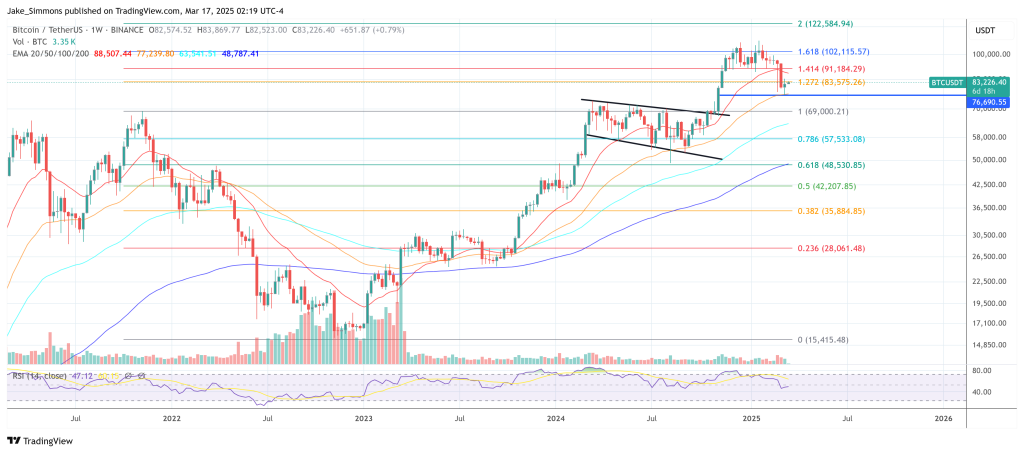
At press time, BTC traded at $83,226.
Bitcoin price
BTC price sits below key resistance, 1-week chart | Source: BTCUSDT on TradingView.com
Featured image created with DALL.E, chart from TradingView.com
Editorial Process for bitcoinist is centered on delivering thoroughly researched, accurate, and unbiased content. We uphold strict sourcing standards, and each page undergoes diligent review by our team of top technology experts and seasoned editors. This process ensures the integrity, relevance, and value of our content for our readers.

Jake Simmons has been a Bitcoin enthusiast since 2016. Ever since he heard about Bitcoin, he has been studying the topic every day and trying to share his knowledge with others. His goal is to contribute to Bitcoin's financial revolution, which will replace the fiat money system. Besides BTC and crypto, Jake studied Business Informatics at a university. After graduation in 2017, he has been working in the blockchain and crypto sector. You can follow Jake on Twitter at @realJakeSimmons.

Related Reads

From Mining Pool to Mars: Why Is Wang Chun in the SpaceX Cockpit?

Title: From Mining Pool to Mars: Why Wang Chun is in the SpaceX Cockpit? When SpaceX announced that Wang Chun, co-founder of F2Pool, would command the first commercial crewed interplanetary mission, many were shocked. Why would a Bitcoin mining pool founder be on a Mars mission roster? However, understanding Wang Chun's journey over the past decade and the deepening ties between the crypto industry and SpaceX reveals this is not accidental, but an inevitable result of a new era taking shape. Today's Mars plan is no longer just a space engineering project; it is evolving into a civilization-upgrading experiment driven by global tech capital, AI, computing power, energy, and the crypto economy. Wang Chun stands precisely at the intersection of these forces. Part 1: From F2Pool to SpaceX – Wang Chun's Leap F2Pool, founded when Bitcoin was still niche, is one of the earliest large-scale mining pools and once held a significant share of global Bitcoin hash rate. Wang Chun belongs to the first generation of Chinese Bitcoin advocates and infrastructure builders—idealists and engineers who believed in a new value network independent of traditional finance. Miners like him built the hardware, energy, and computing power foundational to decentralized networks. This aligns with the long-term, high-engineering, future-oriented vision required for space civilization. Elon Musk’s space endeavors value such long-term builders over mere capital players, which explains Wang Chun's entry into the SpaceX ecosystem. Part 2: Why Crypto and SpaceX Are Growing Closer The core of global tech competition is shifting from internet applications to next-generation infrastructure. Both crypto and SpaceX are part of this. SpaceX's goal is to drastically reduce space access costs. If successful, it could enable orbital servers, space-based energy, global satellite internet, and Martian bases. These new frontiers will require new payment systems, value networks, and global financial architectures. Cryptocurrencies, inherently global and trustless, are poised to become key to off-planet economies. Moreover, crypto and SpaceX share a high-risk, long-termist ethos—believing in ambitious, world-changing goals despite early skepticism. Part 3: Human Spaceflight Enters the Commercial Era Space exploration, long dominated by state actors, is now being transformed by commercial entities like SpaceX. Wang Chun's involvement signifies that future deep-space participants may include not just career astronauts, but also entrepreneurs, engineers, and AI researchers. This mirrors the Age of Exploration, where commercial capital eventually drove global expansion. Wang Chun has emphasized that Mars colonization must not be delayed for future generations, countering a potential over-focus on nearer-term, commercial lunar projects. His presence symbolizes how new capital, technical communities, and idealists from the crypto world are now entering the interstellar age. In summary, the true significance is not an individual's journey to Mars, but the shift in the driving force of human civilization expansion from state machinery to tech companies, AI systems, and global technology capital. Wang Chun's path—from mining pool to Mars, from the Bitcoin network to starships—may be a preview of technological civilization's evolution in the coming decades.

marsbit4h ago

From Mining Pool to Mars: Why Is Wang Chun in the SpaceX Cockpit?

marsbit4h ago

Trading

Spot
Futures

Hot Articles

What is $BITCOIN

DIGITAL GOLD ($BITCOIN): A Comprehensive Analysis Introduction to DIGITAL GOLD ($BITCOIN) DIGITAL GOLD ($BITCOIN) is a blockchain-based project operating on the Solana network, which aims to combine the characteristics of traditional precious metals with the innovation of decentralized technologies. While it shares a name with Bitcoin, often referred to as “digital gold” due to its perception as a store of value, DIGITAL GOLD is a separate token designed to create a unique ecosystem within the Web3 landscape. Its goal is to position itself as a viable alternative digital asset, although specifics regarding its applications and functionalities are still developing. What is DIGITAL GOLD ($BITCOIN)? DIGITAL GOLD ($BITCOIN) is a cryptocurrency token explicitly designed for use on the Solana blockchain. In contrast to Bitcoin, which provides a widely recognized value storage role, this token appears to focus on broader applications and characteristics. Notable aspects include: Blockchain Infrastructure: The token is built on the Solana blockchain, known for its capacity to handle high-speed and low-cost transactions. Supply Dynamics: DIGITAL GOLD has a maximum supply capped at 100 quadrillion tokens (100P $BITCOIN), although details regarding its circulating supply are currently undisclosed. Utility: While precise functionalities are not explicitly outlined, there are indications that the token could be utilized for various applications, potentially involving decentralized applications (dApps) or asset tokenization strategies. Who is the Creator of DIGITAL GOLD ($BITCOIN)? At present, the identity of the creators and development team behind DIGITAL GOLD ($BITCOIN) remains unknown. This situation is typical among many innovative projects within the blockchain space, particularly those aligning with decentralized finance and meme coin phenomena. While such anonymity may foster a community-driven culture, it intensifies concerns about governance and accountability. Who are the Investors of DIGITAL GOLD ($BITCOIN)? The available information indicates that DIGITAL GOLD ($BITCOIN) does not have any known institutional backers or prominent venture capital investments. The project seems to operate on a peer-to-peer model focused on community support and adoption rather than traditional funding routes. Its activity and liquidity are primarily situated on decentralized exchanges (DEXs), such as PumpSwap, rather than established centralized trading platforms, further highlighting its grassroots approach. How DIGITAL GOLD ($BITCOIN) Works The operational mechanics of DIGITAL GOLD ($BITCOIN) can be elaborated on based on its blockchain design and network attributes: Consensus Mechanism: By leveraging Solana’s unique proof-of-history (PoH) combined with a proof-of-stake (PoS) model, the project ensures efficient transaction validation contributing to the network's high performance. Tokenomics: While specific deflationary mechanisms have not been extensively detailed, the vast maximum token supply implies that it may cater to microtransactions or niche use cases that are still to be defined. Interoperability: There exists the potential for integration with Solana’s broader ecosystem, including various decentralized finance (DeFi) platforms. However, the details regarding specific integrations remain unspecified. Timeline of Key Events Here is a timeline that highlights significant milestones concerning DIGITAL GOLD ($BITCOIN): 2023: The initial deployment of the token occurs on the Solana blockchain, marked by its contract address. 2024: DIGITAL GOLD gains visibility as it becomes available for trading on decentralized exchanges like PumpSwap, allowing users to trade it against SOL. 2025: The project witnesses sporadic trading activity and potential interest in community-led engagements, although no noteworthy partnerships or technical advancements have been documented as of yet. Critical Analysis Strengths Scalability: The underlying Solana infrastructure supports high transaction volumes, which could enhance the utility of $BITCOIN in various transaction scenarios. Accessibility: The potential low trading price per token could attract retail investors, facilitating wider participation due to fractional ownership opportunities. Risks Lack of Transparency: The absence of publicly known backers, developers, or an audit process may yield skepticism regarding the project's sustainability and trustworthiness. Market Volatility: The trading activity is heavily reliant on speculative behavior, which can result in significant price volatility and uncertainty for investors. Conclusion DIGITAL GOLD ($BITCOIN) emerges as an intriguing yet ambiguous project within the rapidly evolving Solana ecosystem. While it attempts to leverage the “digital gold” narrative, its departure from Bitcoin's established role as a store of value underscores the need for a clearer differentiation of its intended utility and governance structure. Future acceptance and adoption will likely depend on addressing the current opacity and defining its operational and economic strategies more explicitly. Note: This report encompasses synthesised information available as of October 2023, and developments may have transpired beyond the research period.

363 Total ViewsPublished 2025.05.13Updated 2025.05.13

What is $BITCOIN

Discussions

Welcome to the HTX Community. Here, you can stay informed about the latest platform developments and gain access to professional market insights. Users' opinions on the price of BTC (BTC) are presented below.

活动图片