Ethereum Addresses Holding Over 10,000 ETH Droped To 919 In Two Weeks – Insights

bitcoinistPublished on 2025-03-06Last updated on 2025-03-06

Abstract

Ethereum (ETH) has struggled below the $2,300 mark for the past few days, following two weeks of massive volatility and...

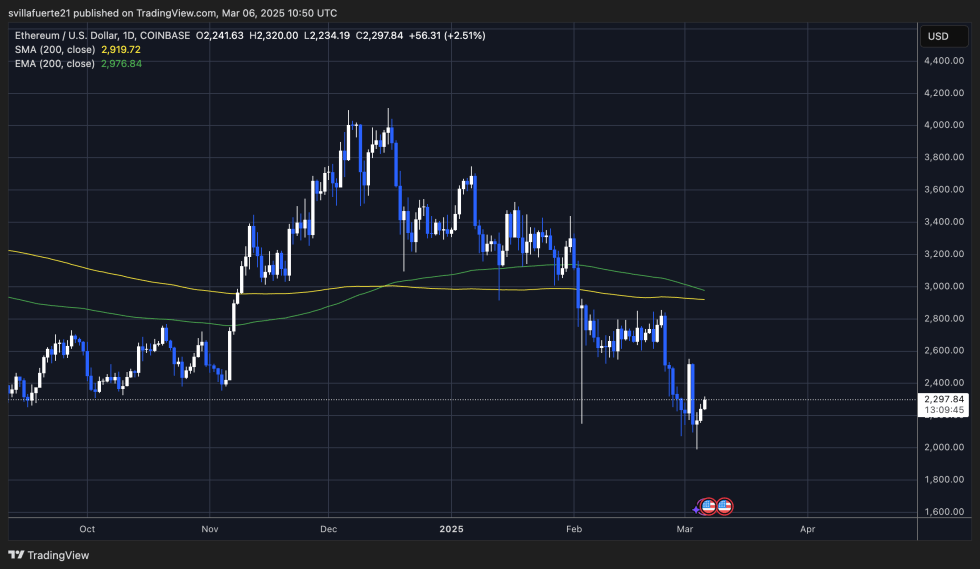
Ethereum (ETH) has struggled below the $2,300 mark for the past few days, following two weeks of massive volatility and aggressive price swings. After a period of uncertainty, Ethereum remains in a downtrend, with bulls unable to reclaim key resistance levels.

Since the start of February, ETH has lost over 40% of its value, reflecting the broader market weakness and increasing negative sentiment toward the asset. The lack of bullish momentum has left traders cautious as Ethereum continues to trade near multi-month lows.

On-chain data from Glassnode reveals a concerning trend—the number of addresses holding more than 10,000 ETH has dropped to 919, down from 999 in late February. This significant decline suggests that large holders have been offloading their ETH, likely due to strong selling pressure and fear-driven market conditions.

With Ethereum facing continued resistance and heavy selling, all eyes are on whether ETH can stabilize or if further downside is ahead. The coming days will be crucial in determining if Ethereum can reclaim key price levels or if selling pressure will push the asset even lower. Traders are watching for a potential shift in momentum, but for now, Ethereum remains under bearish control.

Ethereum Whales Sell During Price Breakdown

Ethereum is trading at low levels after failing to reclaim the $2,500 mark, leaving the market uncertain about its next move. Analysts remain divided, with some calling for a continued drop as ETH’s price action remains unstable, while others see signs of a potential recovery forming at key support levels.

Top analyst Ali Martinez shared on-chain data from Glassnode, revealing that the number of Ethereum addresses holding more than 10,000 ETH has dropped to 919, down from 999 in late February. This suggests that whales have been selling heavily during the latest correction, likely driven by fear and liquidity issues. The capitulation of big players is often a bearish sign, signaling uncertainty among institutional investors and raising concerns about further downside risk.

Ethereum number of Addresses with Balance > 10K | Source: Ali Martinez on X

Despite this wave of selling, Ethereum has held a key demand level around $2,200, suggesting that a potential reversal could be forming. If ETH manages to stabilize at this level, it could build momentum for a rebound in the coming weeks.

The next few weeks will be crucial for ETH’s price action. If bulls regain control, Ethereum could attempt another push toward $2,500 and beyond. However, failure to hold current levels could result in another leg down, extending its bearish phase and keeping traders on edge.

Price Action Details: Key Levels To Watch

Ethereum (ETH) is currently trading at $2,300, stuck in a range after failing to hold above $2,500 or break below $2,000. The market remains uncertain, with volatility swinging ETH’s price up and down, preventing a clear trend from forming.

ETH trading below $2,500 | Source: ETHUSDT chart on TradingView

For bulls to confirm a recovery rally, a push above the $2,500-$2,600 range is essential. Reclaiming this zone would signal strong buying momentum, potentially shifting sentiment back in favor of bulls. Without this move, Ethereum remains at risk of continued consolidation or another leg down.

However, for now, the main focus is on holding the $2,200 demand level. This key support zone has kept ETH from breaking lower, but if it fails, selling pressure could intensify, pushing Ethereum toward sub-$2,000 levels.

With market uncertainty still high, traders are watching whether ETH can stabilize above $2,200 or gain momentum toward higher resistance levels. Until Ethereum breaks out of its current range, volatility is expected to continue, keeping both bulls and bears cautious about the next major price move.

Featured image from Dall-E, chart from TradingView

Sebastian Villafuerte

Sebastian Villafuerte

Sebastian's journey into the world of crypto began four years ago, driven by a fascination with the potential of blockchain technology to revolutionize financial systems. His initial exploration focused on understanding the intricacies of various crypto projects, particularly those focused on building innovative financial solutions. Through countless hours of research and learning, Sebastian developed a deep understanding of the underlying technologies, market dynamics, and potential applications of cryptocurrencies. As his knowledge grew, Sebastian felt compelled to share his insights with others. He began actively contributing to online discussions on platforms like X and LinkedIn, focusing on fintech and crypto-related content. His goal was to expose valuable trends and insights to a wider audience, fostering a deeper understanding of the rapidly evolving crypto landscape. Sebastian's contributions quickly gained recognition, and he became a trusted voice in the online crypto community. To further enhance his expertise, Sebastian pursued a UC Berkeley Fintech: Frameworks, Applications, and Strategies certification. This rigorous program equipped him with valuable skills and knowledge regarding Financial Technology, bridging the gap between traditional finance (TradFi) and decentralized finance (DeFi). The certification deepened his understanding of the broader financial landscape and its intersection with blockchain technology. Sebastian's passion for finance and writing is evident in his work. He enjoys delving into financial research, analyzing market trends, and exploring the latest developments in the crypto space. In his spare time, Sebastian can often be found immersed in charts, studying 10-K forms, or engaging in thought-provoking discussions about the future of finance. Sebastian's journey as a crypto analyst and investor has been marked by a relentless pursuit of knowledge and a dedication to sharing his insights. His ability to navigate the complex world of crypto, combined with his passion for financial research and communication, makes him a valuable asset to the industry. As the crypto landscape continues to evolve, Sebastian remains at the forefront, providing valuable insights and contributing to the growth of this revolutionary technology.

Related Reads

Metrics Ventures Market Watch: The Brewing Storm

In the past month, the market has been actively trading contrasting expectations, balancing global supply chain disruptions fueling re-inflation against both actual and anticipated (Walsh) interest rate hikes. This volatility has impacted commodities and most equities, though tech has temporarily benefited from concentrated short-term liquidity. Fundamentally, as previously analyzed regarding the Strait of Hormuz situation, the US faces deep-seated balance sheet issues beyond what any single Fed chair can resolve. Hypotheses around a figure like Walsh could only materialize if AI fundamentally reshapes production relations. Until then, most non-AI-leading nations (effectively all except the US and China) risk fiscal and monetary policy collapse, rendering the identity of the Fed chair ultimately irrelevant. For crypto assets, there is currently no clear role in these dominant narratives. The market remains strongly capped by the 200-day moving average. While trends may shift from "anything but AI" to "anything but mines," this phase is dominated by the silicon vs. carbon (AI vs. traditional) dichotomy, leaving little room for crypto—though its time will come. **Market Overview & Commentary** The crypto market lacks significant catalysts beyond hype, plagued by low volume and scarce innovation, with clear technical resistance. Currently, crypto struggles for attention as global focus lies elsewhere. Assets like gold, oil, and grains are more direct hedges against supply-chain-driven inflation/stagflation. Bitcoin needs more time for capitulation and consolidation; this reset is expected to last until at least Q4 2026. Looking ahead, three factors will likely drive future market volatility: 1. Whether Walsh repeats the patterns of predecessors like Bassant or Musk, shifting stance into a new policy cycle. 2. The market underestimates the severity of global supply chain damage and the prolonged time needed for repair, which will eventually lead to recognition of acute resource shortages and price swings. 3. AI non-beneficiary, high-inflation nations (e.g., UK, Japan) will face severe fiscal and monetary crises. Rapid AI-driven displacement could trigger a collapse of existing credit and welfare systems. Ultimately, the market may realize that an AI bubble burst could spark contagious sovereign credit crises. The monetary and fiscal responses to such a scenario could serve as the ultimate catalyst for Bitcoin's next major bull run.

marsbit45m ago

Metrics Ventures Market Watch: The Brewing Storm

marsbit45m ago

Insiders Betting on Musk Are Reaping 'Historic Returns'

The largest IPO in history is imminent as SpaceX, led by Elon Musk, is set to price its offering on June 12. At a targeted valuation near $2 trillion, this event will mint new billionaires from Musk's inner circle of long-time allies, rewarding their loyalty with unprecedented returns. Key beneficiaries include Antonio Gracias, Musk's close friend and confidant, who holds a 7.3% stake potentially worth over $140 billion, making him the second-largest individual shareholder. Gwynne Shotwell, President and COO since 2002, holds shares valued at roughly $2 billion. Bret Johnsen, the CFO, holds stock worth approximately $1.4 billion. Luke Nosek, a PayPal co-founder and early investor, stands to gain about $5.3 billion. The IPO filing also reveals complex and controversial financial arrangements. SpaceX has guaranteed nearly $20 billion in payments from xAI's subsidiary to Gracias's Valor Equity Partners for AI hardware leases—deals auditors flagged as "failed sale-leaseback" transactions, forcing SpaceX to record them as debt. Despite rapid revenue growth, SpaceX is not profitable, posting a $49 billion loss in 2025 and a $4.3 billion loss in Q1 2026. Capital expenditures are soaring, with over 60% directed toward AI. Public investors will inherit these losses, significant debts, and a governance structure heavily controlled by insiders, including a provision granting Musk up to a billion additional shares if one million people live on Mars.

链捕手47m ago

Insiders Betting on Musk Are Reaping 'Historic Returns'

链捕手47m ago

Ethereum Reduced to a Chinese Concept Stock

The article titled "Ethereum Becomes a Chinese Concept Stock" presents a critical analysis of Ethereum's perceived decline in market confidence and its structural parallels to Chinese companies listed on US stock exchanges. It begins by noting significant sell-offs by early investors like Wanxiang and key figures like Bankless's Hoffman in 2026, despite Ethereum's strong fundamental activity. The piece questions the erosion of trust in Vitalik Buterin and the Ethereum Foundation (EF), arguing that while other ecosystems have faced founder controversies, Ethereum's issues stem from its internal governance model. The author draws a direct comparison to "China concept stocks," which are Chinese businesses operating globally but reliant on foreign capital and listings. Similarly, Ethereum, funded early by Chinese capital like Wanxiang, developed a strong institutional framework from its IXO to its PoS transition. The core problem, according to the article, is a leadership vacuum regarding price and direction. Vitalik's move to make the EF smaller and less active is framed as a mistake. While he advocates for ETH as a "commodity," the ecosystem lacks a clear entity to steward its price stability, creating tension within the PoS system, as seen with Lido's challenges. The narrative suggests that excessive abstraction and a hands-off approach from the EF have left the community adrift, contrasting with more proactive foundations like Solana's. The article then examines emerging technical narratives for Ethereum: privacy (ZK-proofs), AI integration, and a refocus on Layer-1. However, it observes a shift from Ethereum leading as a "world computer" to merely adapting to trends like AI, where crypto-native projects are finding success independently of Ethereum. The piece posits that Ethereum's unique value in an increasingly fragmented world may be as a permissionless, global financial testing ground—a neutral platform amid geopolitical tensions. In conclusion, it asserts that Ethereum's fate mirrors that of China concept stocks: an asset born from one region (conceptually "A"), funded by another ("B"), and dependent on "B" for exit liquidity. While Ethereum's "golden age" may be over, and selling pressure from early backers will continue, it remains positioned as a critical linkage point in a divided global landscape, standing at a new, albeit uncertain, starting point.

marsbit1h ago

Ethereum Reduced to a Chinese Concept Stock

marsbit1h ago

AI Agents Fundamentally Transform Web3 Gaming: From the Rugpull Bakery Bot Controversy to the New Agent Paradigm in 2026

AI Agents Are Redefining Web3 Gaming: From the Rugpull Bakery Bot Controversy to the 2026 Agentic Paradigm The recent controversy in Rugpull Bakery, a competitive baking game on Abstract chain, highlighted a pivotal shift. Player complaints about unfair bot automation in Season 2 led developers to not ban them, but instead formally integrate AI agents as core gameplay in Season 3, providing official guides (skill.md, agent.json). This move signals Web3 gaming's transition into the "Agentic Gaming" era, where AI agents are sovereign entities with independent strategy and economic rights, moving beyond simple automation. By 2026, AI agent integration has evolved into three core models reshaping the ecosystem: 1. **Autonomous Competitors & Economic Entities:** Agents act as independent players. Examples include TEN Protocol's poker-playing agents, AI Arena's trainable NFT fighters, Satoshi Strike Force's "Digital Athletes" trained on player data, and Somnia's "Agentic L1" blockchain providing native infrastructure for millions of autonomous agents. 2. **Modular Infrastructure & Programmable Environments:** Games like EVE Frontier enable "server-side modding," allowing AI agents to program game world logic directly into structures like smart storage, turrets, and stargates via Smart Assemblies. Coupled with standards like ERC-8183, which enables autonomous job creation and payment between agents, in-game infrastructure gains a "commercial soul." 3. **Hybrid Companions & Dynamic Adaptive Worlds:** This model focuses on human-AI collaboration. In Parallel Colony, players guide highly autonomous AI Avatars with unique personalities and goals. Illuvium plans to use AI to transform NPCs into dynamic, context-aware entities that create personalized, emergent narratives. The conclusion is clear: blocking automation is futile. The future lies in leveraging blockchain's transparency and programmability to empower AI agents as first-class citizens. Web3 gaming is shifting from inefficient human labor to efficient algorithmic interplay and emergent intelligence, creating a "post-human" digital frontier where players become commanders and symbiotic partners in a new socioeconomic experiment.

marsbit1h ago

AI Agents Fundamentally Transform Web3 Gaming: From the Rugpull Bakery Bot Controversy to the New Agent Paradigm in 2026

marsbit1h ago

Trading

Spot
Futures

Hot Articles

Discussions

Welcome to the HTX Community. Here, you can stay informed about the latest platform developments and gain access to professional market insights. Users' opinions on the price of ETH (ETH) are presented below.

活动图片