Cardano Founder Unveils Next Steps For Scaling Solution Hydra

bitcoinistPublished on 2025-01-09Last updated on 2025-01-09

Abstract

In a newly released video titled “The next steps for Hydra,” Cardano founder Charles Hoskinson outlined the trajectory of the...

In a newly released video titled “The next steps for Hydra,” Cardano founder Charles Hoskinson outlined the trajectory of the Hydra scaling solution and provided insights into how independent companies will soon spearhead fresh developments in the ecosystem. The announcement comes shortly before the Hydra Doom initiative’s official conclusion, which will be marked by a tournament in Las Vegas on January 20.

Next Steps For Cardano’s Hydra

According to Hoskinson, Hydra Doom began last year to demonstrate Hydra’s capabilities under extreme conditions. He explained the rationale for using a classic video game as the testing ground: “We chose a video game because video games are ubiquitously understandable and also video games historically have always pushed the boundaries of what computers are capable of.”

By converting every frame into a transaction and enabling competitive multiplayer, the Hydra Doom setup tested Hydra’s performance and resilience in a “Byzantine environment.” Hoskinson noted that this environment “stress tested” Hydra both in terms of hardware requirements and the game-theoretic behavior of players who had strong incentives to cheat.

“The Hydra Doom program has been tremendously successful. It’s brought a lot of partners together and it’s inspired a lot of people to invest and build in the Hydra ecosystem.”

The Hydra Doom tournament, concluding on January 20 in Las Vegas, will crown a winner determined by a merit-based competition. Although Hoskinson expressed some sadness at seeing the initiative end, he emphasized excitement for the next phase of Hydra’s growth.

With Hydra Doom coming to a close, Hydra’s development is entering what Hoskinson described as the “next stage of its evolution.” He highlighted that companies such as Anastasia and Sunday Labs are already building their own Hydra infrastructure, specifically referencing the Midgard and Gummy Worm protocols:

“We’re going to invite them into the IO innovation group and get them through at least three to six months of R&D prototyping so that things like Midgard and Gummy Worm protocols, respectively built by Anastasia and Sunday, can start working their way into production Cardano applications.”

Hoskinson cited additional areas of Hydra research and implementation, including “head-to-head communication, introducing zero technologies into the Hydra heads, [and] Hydra tail protocol.” He underscored that Cardano’s approach to scaling is iterative, pointing out that each year will bring improvements, rather than one single “magic” milestone.

The Hydra solution, which Hoskinson described as a “hidden gem,” is already in use. Input Output (IO), the software development company behind Cardano, has found the technology invaluable for reducing costs in projects such as Midnight and the Glacier Drop. Meanwhile, external projects continue to explore Hydra’s potential for gaming, micropayments, decentralized exchanges (DEXs), and decentralized finance (DeFi) applications:

“The hope is to get these things integrated into DEXs and DeFi experiences, micropayment experiences, and games.” Hoskinson further elaborated on the synergy between Hydra and other forthcoming scalability approaches: “It’s a complementary scaling solution to things like ZK Fold, to things like Partner Chains, to things like Ouroboros Leios.”

He also indicated a long-term plan to integrate zero-knowledge proofs and cross-chain technologies into Hydra, aligning with Cardano’s broader objective of pursuing an “all of the above scalability menu.”

Reflecting on the future, Hoskinson reiterated that Hydra remains critical to Cardano’s evolution as the blockchain project enters new eras: “When we look to the next three to five to ten years, we’ll watch ourselves walk in that direction as a complementary scaling solution to what has already been achieved with Cardano as of today and what will be achieved as we enter in the age of Leios and the age of zero knowledge as well as partner chains.”

Although Hydra Doom’s tournament finale will signify the end of the current phase, its legacy seems poised to influence Cardano’s scaling roadmap for years to come. Hoskinson expressed optimism about practical, real-world integrations on the mainnet, saying that while these are “the early days,” they mark a pivotal step in revealing Hydra’s true potential.

“Hydra Doom really showcased the capabilities of it. So it’s sad to see that come to a close…but I’m excited to see the next generation where we take it to the next level and we showcase it in real life applications on the Cardano blockchain on mainnet.”

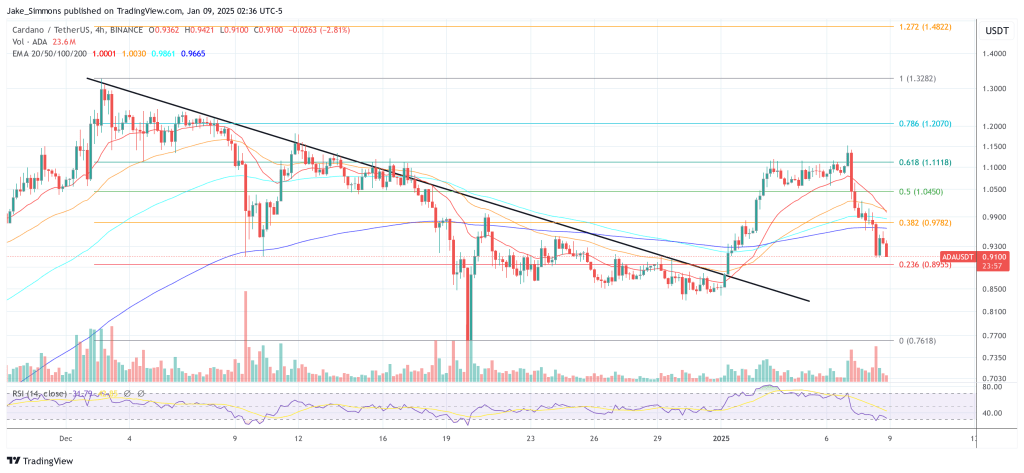
At press time, ADA traded at $0.91.
Cardano price
Cardano drops below $1, 4-hour chart | Source: ADAUSDT on TradingView.com
Featured image from YouTube, chart from TradingView.com
Jake Simmons

Jake Simmons

Jake Simmons has been a Bitcoin enthusiast since 2016. Ever since he heard about Bitcoin, he has been studying the topic every day and trying to share his knowledge with others. His goal is to contribute to Bitcoin's financial revolution, which will replace the fiat money system. Besides BTC and crypto, Jake studied Business Informatics at a university. After graduation in 2017, he has been working in the blockchain and crypto sector. You can follow Jake on Twitter at @realJakeSimmons.

Related Reads

Why Did Zhipu Surge Nearly 30% in a Single Day?

"Global AI Model Unicorn" Zhipu's stock surged nearly 30% in a single day, reaching a new market cap high. The catalyst was the launch of its GLM-5.1-highspeed API, boasting a generation speed of **400 tokens per second**, setting a new global benchmark. This speed, roughly 3-5 times faster than industry leaders like OpenAI's GPT-4o and Anthropic's Claude, is achieved **without compromising the full-scale model's capabilities**. In the era of AI Agents requiring dozens of self-calls, such latency reduction is critical, transforming speed from a system metric into a determinant of intelligence limits. The breakthrough stems from a three-layer technical overhaul: 1. **TileRT Inference Engine**: Compiles the entire model into a continuous, always-on computation pipeline using "Warp Specialization," minimizing GPU idle time by having different processor groups handle data loading, computation, and communication in parallel. 2. **Heterogeneous Parallelism for MLA**: To efficiently run the GLM-5.1 model using the MLA attention mechanism, TileRT employs a heterogeneous strategy. One GPU handles sparse indexing/routing, while the others perform dense computation, optimizing for MLA's unique workflow. 3. **ZCube Network Architecture**: Replaces the standard Spine-Leaf (ROFT) network topology with a flat, dual-group interconnect. This design creates a single optimal path between any two GPUs, eliminating network congestion at scale and reducing latency. The business impact is significant: a 15% increase in cluster throughput (free extra capacity), a 40.6% reduction in tail latency (improved stability), and a one-third cut in networking hardware costs. Long-term, this innovation challenges the dominance of NVIDIA's integrated hardware-software stack (GPU+NVLink+InfiniBand), potentially benefiting manufacturers of high-density Leaf switches and optical modules while lowering the software barrier for domestic AI chips like Huawei's Ascend. The innovation proves that more can be achieved with the same compute, reshaping the infrastructure beyond just GPUs.

marsbit46m ago

Why Did Zhipu Surge Nearly 30% in a Single Day?

marsbit46m ago

Bidding Farewell to the 'Gray Gambling Game'! Polymarket Charges into the Compliance Track—How Will This Impact the Entire Crypto Industry?

From Gray to Regulated: How Polymarket’s Compliance Journey Reshapes Crypto The evolution of Polymarket, a decentralized prediction market platform, illustrates a critical trend in crypto: innovative, high-value sectors ultimately integrate into regulatory frameworks. Founded in 2020, Polymarket quickly gained traction by leveraging low-cost Layer 2 blockchain technology for event-based trading, notably during the 2024 US presidential election where its markets outperformed traditional polls. However, its "build first, comply later" approach led to a 2022 CFTC enforcement action, resulting in a $1.4 million fine and a ban from the US market. A pivotal shift occurred in 2025 under a new US administration. Polymarket strategically acquired CFTC-licensed derivatives exchange QCX for $112 million, securing a regulated pathway back into the US. This move coincided with a regulatory reversal, as the CFTC withdrew a prior proposal to ban political event contracts. The platform’s successful "regulatory acquisition" strategy, avoiding a lengthy independent licensing process, highlights a viable compliance path for crypto-native projects. Its journey from regulatory target to a CFTC-recognized entity—bolstered by a major data partnership and investment from Intercontinental Exchange (ICE)—signals the maturation of prediction markets from a "crypto novelty" into acknowledged financial infrastructure. The story underscores that genuine utility provides negotiating power with regulators and that embracing compliance does not necessarily mean sacrificing core technological advantages.

marsbit1h ago

Bidding Farewell to the 'Gray Gambling Game'! Polymarket Charges into the Compliance Track—How Will This Impact the Entire Crypto Industry?

marsbit1h ago

Trading

Spot
Futures

Hot Articles

Discussions

Welcome to the HTX Community. Here, you can stay informed about the latest platform developments and gain access to professional market insights. Users' opinions on the price of ADA (ADA) are presented below.

活动图片