Nuvei стала партнером Visa по платежам в стейблкоинах для латиноамериканских торговцев

cryptonews.ruPublished on 2021-10-09Last updated on 2024-12-09

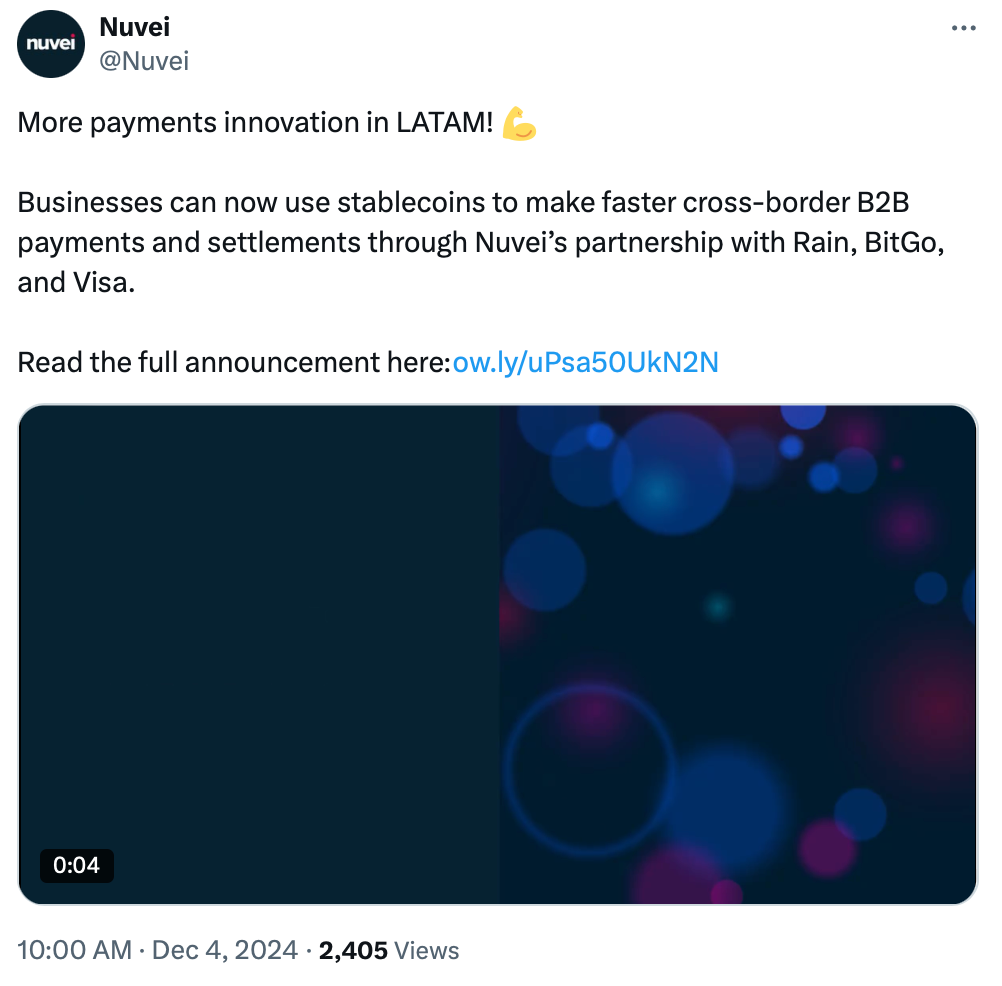
Канадская финтех-компания Nuvei запустила расчет платежей с использованием стейблкоина для торговцев в Латинской Америке. Платформа взаимодействия Rain, цифровой кастодиан BitGo и эмитент карт Visa являются ее партнерами в решении на основе блокчейна.

Все более тесная интеграция в Латинской Америке

Латиноамериканские торговцы, участвующие в решении Nuvei, смогут использовать физическую или виртуальную карту Visa для совершения платежей в стейблкоинах из цифрового кошелька. BitGo обеспечит хранение цифровых активов.

Услуга будет доступна везде, где принимается Visa. Она обеспечит более быстрые трансграничные транзакции, снижение сложности и улучшенную операционную ликвидность по сравнению с традиционными платежными системами, согласно заявлению.

В заявлении новое решение названо «расширением Nuvei в блокчейн-платежи», хотя компания запустила транзакции почти в 40 криптовалютах в 2021 году.

Visa выпустила криптовалютную карту для потребителей, привязанную к кошелькам с самообслуживанием в Латинской Америке в сотрудничестве с Avalanche Foundation в октябре.

Visa и Nuvei уже сотрудничали ранее, когда Nuvei и Worldpay интегрировались с Visa для предоставления платежей с использованием монеты USD Coin (USDC) от Circle на блокчейнах Solana и Ethereum в пилотных проектах.

USDC упоминался в объявлении о новом решении, но только как пример стейблкоина, который можно было бы использовать. USDC уже интегрирован в системы платежей в реальном времени Бразилии и Мексики.

Nuvei быстро расширяется в регионе Латинской Америки. В 2024 году она внедрила услуги локального эквайринга в Колумбии и Мексике. Локальный эквайринг — это использование внутреннего финансового учреждения для обработки карточных платежей. Nuvei также получила лицензию платежного учреждения в Бразилии.

Mastercard участвует в других регионах

В июле Nuvei заключила партнерство с Mastercard, чтобы предоставить европейским потребителям возможность выхода на цифровые активы через Move от Mastercard. Mastercard запустила коммерческое решение Move совместно с платежной компанией Fnality на основе блокчейна.

Источник: Nuvei.

В 2023 году Mastercard заключила партнерство с австралийской платформой стейблкоинов Stables, чтобы позволить потребителям Азиатско-Тихоокеанского региона тратить USDC везде, где принимается карта. Stables предоставила услуги кошелька и расчетный механизм для сделки. Депозиты на кошельки можно вносить различными способами. Депозиты в других стейблкоинах автоматически конвертируются в USDC.


Related Reads

The Hunter Becomes the Hunted: The Most Profitable MEV Bot Gets Hacked

A well-known and highly profitable Ethereum MEV Bot, Jaredfromsubway.eth, suffered a sophisticated on-chain attack this Saturday, losing over $7.5 million. Analysis by Blockaid and others reveals this was not a conventional phishing or smart contract exploit, but a targeted "counter-MEV honeypot attack." The attacker meticulously laid a trap over several weeks, deploying 66 fake token contracts and liquidity pools disguised as major assets like WETH and USDC. These pools created the illusion of arbitrage opportunities. The MEV Bot's automated system detected these signals, executed trades, and in the process, granted approval permissions to attacker-controlled contracts. These approvals were not revoked, creating a persistent vulnerability. The attacker then exploited this in a single transaction, draining the bot's ETH, USDC, and USDT holdings. Jaredfromsubway.eth is notorious as one of Ethereum's most active and profitable MEV Bots, primarily known for executing "sandwich attacks" to profit from transaction slippage. Estimates suggest it has earned tens of millions in MEV revenue. The incident highlights escalating crypto security threats, demonstrating that even top-tier automated "predators" are vulnerable to novel, logic-based attacks designed to exploit their own operational rules. Following the hack, an unverified X account impersonating Jaredfromsubway.eth emerged, falsely offering a bounty for the return of funds, prompting developer warnings for users to stay vigilant.

marsbit28m ago

The Hunter Becomes the Hunted: The Most Profitable MEV Bot Gets Hacked

marsbit28m ago

The Reality of Payments in Latin America Is Not What You Think

The payment landscape in Latin America is undergoing a fundamental shift, driven by on-the-ground realities that challenge common perceptions. Based on over 500 hours of field research across the region, key insights emerge. Firstly, QR code payments, like Brazil's Pix, are becoming the dominant payment method in most emerging markets, overtaking cards. However, these domestic instant payment systems lack international interoperability, creating a significant gap for cross-border users. Secondly, the narrative around crypto cards is often misunderstood; their primary volume comes from high-net-worth professionals using them for salary conversions (e.g., USDT to local currency via Pix), not retail micro-payments. Competition in payments is shifting from customer acquisition to controlling the settlement layer, leading fintechs to acquire banking licenses for efficiency. Thirdly, treating "Latin America" as a single market is a mistake. Countries like Argentina, Brazil, and Mexico have distinct economic realities, user segments, and regulatory approaches. Brazil alone has at least five distinct user segments with different financial flows. Overlooked markets like Guatemala, Honduras, and El Salvador (the "forgotten five") offer high remittance volumes with lower competitive density. Finally, regulation in Latin America is often ahead of the US, with clearer frameworks for digital assets and a pragmatic approach from regulators focused on safety rather than obstruction. The margin on stablecoin forex is rapidly compressing toward zero, meaning future winners will be those building value-added services on top of the infrastructure, not just the cheapest exchange.

marsbit43m ago

The Reality of Payments in Latin America Is Not What You Think

marsbit43m ago

Making Music in a Bear Market: The Survival Experiment of a Bitcoin Band

"Orange Pill Jam: A Bitcoin Band's Survival in the Bear Market" Orange Pill Jam is a musical group exploring themes of financial sovereignty and privacy, born from the Bitcoin community. Formed after singer Mermaid performed her song "Dollar Apocalypse" at a 2022 conference, the band creates music intended for both Bitcoin enthusiasts and general audiences. Their creative process involves Mermaid writing lyrics and melodies, which producer/multi-instrumentalist Michi then shapes with a precise, rhythm-focused approach, often demanding numerous retakes to achieve his unique standard of timing. Their songs, like "Cypherpunks' Manifesto" and "Fire of Freedom," tackle concepts of digital privacy, the pitfalls of "free" services, and personal sovereignty, influenced by experiences in places like El Salvador. Despite operating in a crypto bear market with a Copyleft model (offering music for free sharing/remixing and accepting optional Bitcoin donations), they face practical challenges. Their growth is slow on platforms like YouTube and Spotify, which aren't optimized for their niche content. The band also navigates the rise of AI-generated music. While acknowledging AI's efficiency for certain tasks, they believe human creativity occupies a unique space that algorithms cannot replicate—the ability to create new genres and capture intangible rhythmic feeling. For Orange Pill Jam, the core argument for both Bitcoin in a downturn and human artistry in the AI age lies in this irreplaceable, intentional, and imperfectly human creative process. Their project persists as an anti-algorithm experiment, valuing the unquantifiable impact of music over scalable metrics.

marsbit49m ago

Making Music in a Bear Market: The Survival Experiment of a Bitcoin Band

marsbit49m ago

Trading

Spot
Futures
活动图片