Ethereum mining no longer profitable for many miners as energy prices and ETH dip cause perfect storm

cryptoslatePublished on 2022-06-14Last updated on 2022-06-14

Abstract

For the first time since 2020, Ethereum mining has become unprofitable for many miners connected to a traditional energy grid.

For the first time since 2020, Ethereum mining has become unprofitable for many miners connected to a traditional energy grid. The price of Ethereum has dropped below $1,250 while energy prices are skyrocketing.

The average cost of electricity in states such as New England, Connecticut, Maine, Massachusetts, New Hampshire, and Rhode Island is over $0.22 per kWh.
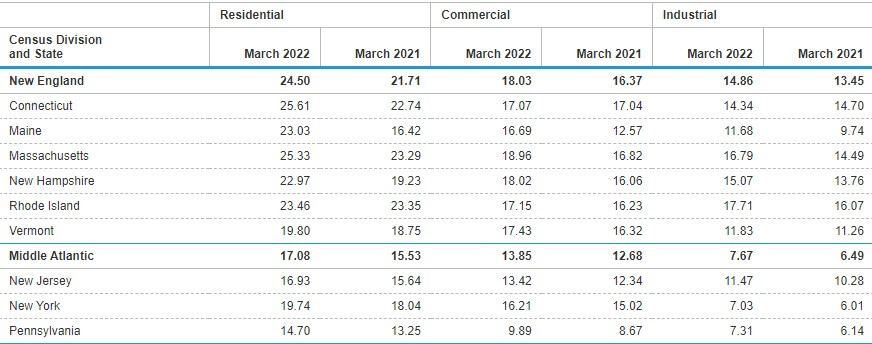
Using a single Nvidia 3090 overclocked to generate 130mh/s will cost miners around $1.85-$2.13 per day in electricity. The Ethereum reward for the same GPU is just (0.001625 ETH) $2.03 at today’s price. Therefore any miner paying more than $0.245 for electricity is now paying more for electricity than the value of Ethereum being mined. At this point, it becomes more cost-effective to turn off the mining rig and buy Ethereum spot using the money that would otherwise be used on electricity. The profitability of mining with GPUs has been steadily decreasing over time. Ethereum is still the most profitable cryptocurrency to mine with a GPU meaning the others are even less profitable. The below graph shows Ethereum’s profitability over time.
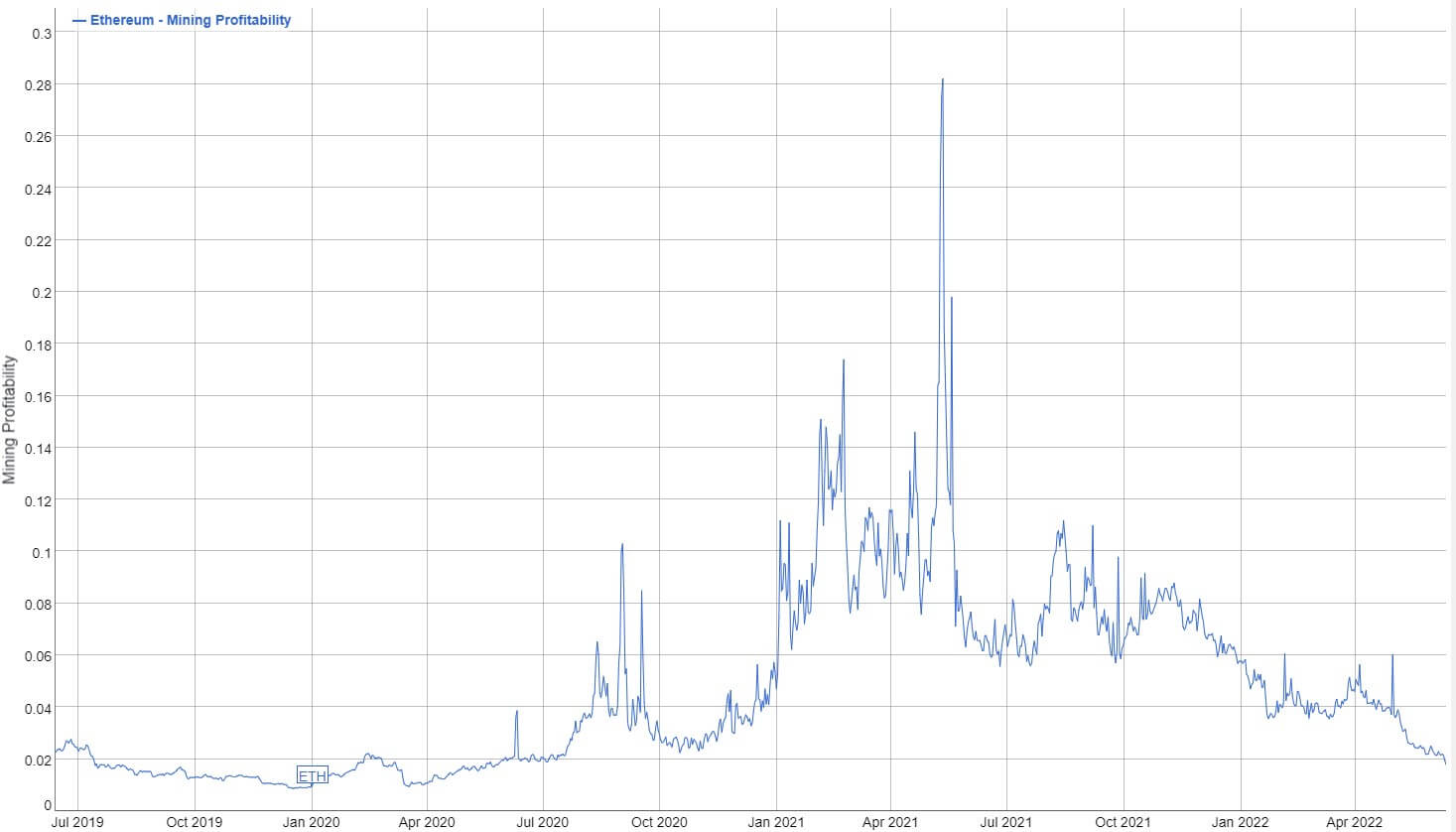
eth mining profit

Source: Bitinfocharts

Other options to mine

There are plenty of alternative cryptocurrencies that can be mined with a GPU. However, the others are also down considerably. At $0.245kwh, Ergo yields -$0.06, RavenCoin -$0.58/day, Ethereum Classic -$0.66, and Firo -$0.70 using a single Nvidia 3090. These are the contenders for GPU hashrate when Ethereum finally goes to proof of stake. The issue is that an increase in miners on the network will dramatically increase the mining difficulty meaning that, to be remotely profitable, the price of the tokens will also have to increase considerably.

For Ethereum to become profitable again, either the difficulty needs to decrease or the price needs to rise above $1,400. Alternatively, should energy prices drop below $0.24kwh to match average costs in other parts of the United States, Ethereum would also become profitable.

Electricity prices in other countries are even higher than even the highest-priced states. The average cost in the United Kingdom, Germany, Belgium, Spain, and Denmark is above $0.25kwh, making GPU mining unprofitable across most of Europe.


Related Reads

$9.4 Billion: The Largest Robotics Funding This Year Has Emerged

Munich-based humanoid robotics company Neura has completed a $1.4 billion (approximately RMB 94.9 billion) Series C funding round, valuing the company at around $7 billion and positioning it among the global leaders in the sector. The investment round is notable not just for its size—reportedly the largest in robotics this year—but also for its strategic backers, which include tech giants like NVIDIA and Amazon, alongside established industrial players such as German engineering firms Bosch and Schaeffler. This mix of investors signals a significant shift in the industry's focus from technological demonstrations and general-purpose narratives toward practical, industrial deployment and commercialization. Neura's approach centers on developing humanoid robots for defined, high-value industrial tasks rather than pursuing a general-purpose model. Its early validation comes from a partnership with BMW, where its robots are being tested on actual production lines. The involvement of Bosch and Schaeffler, companies deeply embedded in global manufacturing, underscores a growing belief that humanoid robots are transitioning from labs to viable factory-floor solutions. The article highlights two converging trends driving investment: advancements in AI and large language models, which enhance robots' perception and decision-making in unstructured environments, and mounting pressure from labor shortages and rising costs in major manufacturing regions. The funding landscape is now bifurcating between companies like Figure AI, focusing on versatile general-purpose robots, and firms like Neura, targeting specific vertical industrial applications with clearer, shorter paths to ROI. While technical hurdles remain, the core challenges for widespread adoption are increasingly seen as engineering and commercial in nature: managing the high integration and customization costs for different factory environments and establishing robust, localized maintenance and service networks. The record investment in Neura, particularly from industrial capital, indicates the industry's growing confidence in moving from proving feasibility to solving the practical problems of scalability, reliability, and building sustainable business models around humanoid robots in real-world settings like automotive manufacturing and hazardous labor environments.

marsbit5h ago

$9.4 Billion: The Largest Robotics Funding This Year Has Emerged

marsbit5h ago

"119 to 176 Dollars": Behind SpaceX's Listing, MSX Once Again Successfully Executes the Pre-IPO Closed Loop

Following May's 300% gain on Cerebras, MSX delivered another outstanding performance during SpaceX's listing night. On June 12, SpaceX (SPCX) launched on Nasdaq, reaching a high of $176. This marked the successful culmination of MSX's Pre-IPO project launched in March, where users subscribed at $119, achieving gains of approximately 40-48%. This event validated MSX's complete Pre-IPO mechanism, a crucial advantage in a market where access to top-tier private company equity is typically limited to institutions. MSX's model provides a full cycle for users: subscription (at $119 for SpaceX), real-time on-chain portfolio tracking, optional early redemption, seamless conversion to tradable spot assets (SPCX.M) upon IPO, and final settlement in stablecoins. This end-to-end process distinguishes MSX from platforms that faced settlement issues during the SpaceX IPO, highlighting that the core challenge of Pre-IPO is not just access, but a clear exit and conversion path post-listing. This success with SpaceX is MSX's second major Pre-IPO verification, following the Cerebras listing in May, which yielded ~300% returns for early participants. These back-to-back achievements demonstrate MSX's capability to source, structure, and deliver real assets through a replicable on-chain model. The true barrier for Pre-IPO products lies not in providing an entry point, but in ensuring reliable fulfillment from subscription through to post-IPO liquidity. MSX's proven闭环 (closed-loop) process addresses this, offering Web3 users a structured way to access high-growth, pre-public companies in sectors like AI and frontier tech. MSX plans to continue expanding its Pre-IPO portfolio with this focus on authenticity, transparency, and post-listing execution.

Odaily星球日报17h ago

"119 to 176 Dollars": Behind SpaceX's Listing, MSX Once Again Successfully Executes the Pre-IPO Closed Loop

Odaily星球日报17h ago

Trading

Spot
Futures

Hot Articles

Discussions

Welcome to the HTX Community. Here, you can stay informed about the latest platform developments and gain access to professional market insights. Users' opinions on the price of ETH (ETH) are presented below.

活动图片