Ripple Announces First Tokenized Money Market Fund On The XRP Ledger

bitcoinistPublished on 2024-11-25Last updated on 2024-11-26

Abstract

Ripple Labs has introduced the first tokenized money market fund on the XRP Ledger (XRPL). The initiative, in partnership with...

Ripple Labs has introduced the first tokenized money market fund on the XRP Ledger (XRPL). The initiative, in partnership with Archax and UK-based asset manager abrdn, signifies a notable advancement in the tokenization of real-world assets (RWA) and the expansion of institutional decentralized finance (DeFi) for the XRP ledger ecosystem.

Ripple Enters The RWA Sector

Archax, recognized as the first Financial Conduct Authority (FCA) regulated digital asset exchange, broker, and custodian, has facilitated access to abrdn’s £3.8 billion US dollar Liquidity Fund (Lux) in a tokenized format on the XRPL. The tokenized Lux fund aims to optimize operational costs and settlement processes by leveraging the XRPL’s infrastructure.

Duncan Moir, Senior Investment Manager at abrdn, commented on the development: “The next evolution of financial market infrastructure will be driven by the broader adoption of digital securities. Real benefits are to be had from leveraging the efficiency of moving the end-to-end investment and cash settlement process on-chain.”

Ripple has committed $5 million to tokens within abrdn’s Lux fund, forming part of a broader strategy to invest in RWAs on the XRPL through collaborations with various asset managers. Markus Infanger, Senior Vice President at RippleX, stated, “The arrival of abrdn’s money market fund on XRPL demonstrates how real-world assets are being tokenized to enhance operational efficiencies, while further reinforcing the XRPL as one of the leading blockchains for real-world asset tokenization.”

Graham Rodford, CEO of Archax, highlighted the increasing momentum in asset tokenization: “Financial institutions are understanding the value of adopting digital assets for real world use cases. There is now real momentum building for tokenized real-world assets, and Archax is at the forefront of tokenizing assets such as equities, debt instruments and money market funds.”

The collaboration builds on Archax’s use of Ripple’s digital asset custody solutions since 2022. As investor interest in tokenized money market funds on the XRPL grows, Ripple Custody leverages its experience with institutional clients to support the tokenization, storage, exchange, and movement of digital assets.

According to the press release, the XRP Ledger capabilities provide a robust foundation for RWA tokenization and institutional-grade DeFi applications. Ripple has utilized the XRPL for over a decade, supporting various financial services such as global payments, digital asset custody, and stablecoin issuance.

Market analysis from McKinsey indicates that tokenized money market funds have surpassed $1 billion in assets under management, with projections suggesting the value of tokenized assets could reach $16 trillion by 2030.

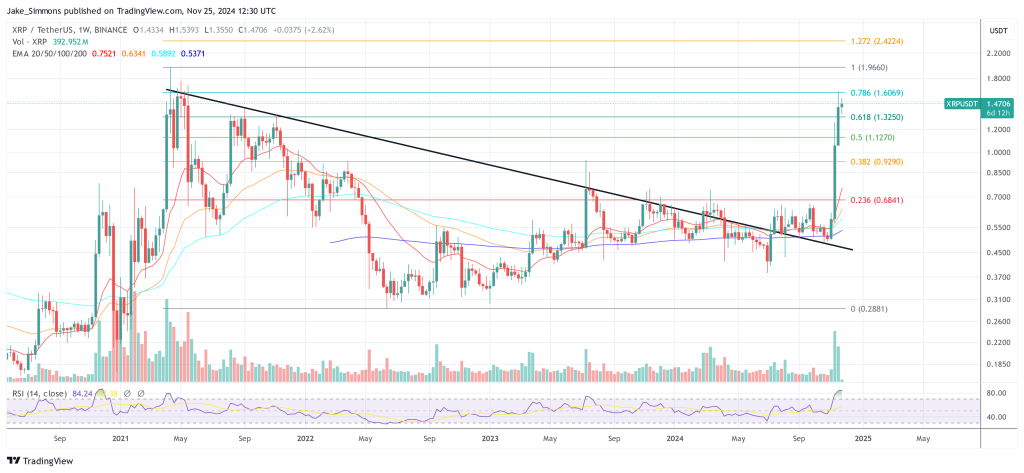
At press time, XRP traded at $1.47.
XRP price
XRP price, 1-week chart | Source: XRPUSDT on TradingView.com
Featured image from Shutterstock, chart from TradingView.com
Jake Simmons

Jake Simmons

Jake Simmons has been a Bitcoin enthusiast since 2016. Ever since he heard about Bitcoin, he has been studying the topic every day and trying to share his knowledge with others. His goal is to contribute to Bitcoin's financial revolution, which will replace the fiat money system. Besides BTC and crypto, Jake studied Business Informatics at a university. After graduation in 2017, he has been working in the blockchain and crypto sector. You can follow Jake on Twitter at @realJakeSimmons.

Related Reads

DeFi Has Reached Its Most Dangerous Moment: The Real Vulnerabilities Are Not in the Code

DeFi in Peril: The Real Vulnerability Isn't in the Code April 2026 marked a paradigm shift in DeFi security, with over $625 million lost across 30 incidents—the worst month in crypto history by event count. Crucially, none of the major exploits (Drift Protocol: $285M, KelpDAO: $292M, Wasabi Protocol: $4.5M) resulted from smart contract vulnerabilities. Instead, failures occurred in the operational "plumbing": social engineering to compromise multi-signature councils, a single-point-of-failure 1-of-1 bridge validator, and stolen admin private keys. These events expose a fundamental misalignment: the industry's security model has long focused on code audits, while the actual attack surface has shifted to privileged access points and off-chain infrastructure. The article introduces the term "OpenFi" to describe this reality: permissionless, on-chain, yet operationally dependent on trusted third parties (admins, validators, oracles) at key junctures. The KelpDAO exploit vividly demonstrated asymmetric "contagion risk." A configuration error in a smaller protocol triggered a panic, causing approximately $13.2 billion in outflows from larger, unaffected protocols like Aave within 48 hours, as users fled uncertain collateral. The core dilemma is the double-edged sword of centralization. Operational levers like emergency councils (e.g., Arbitrum freezing stolen funds post-KelpDAO) enable crisis response but also create catastrophic attack surfaces if compromised (e.g., Drift). The path forward demands radical honesty: protocols must clearly disclose their trust assumptions, operational levers, and failure modes. The industry must treat operational security (key management, configurations, incident response) with the same rigor as code security. Survival depends on building systems whose risks can be understood, priced, and insured, moving beyond the outdated "code is law" mantra to a mature model of disclosed and managed trust.

链捕手2h ago

DeFi Has Reached Its Most Dangerous Moment: The Real Vulnerabilities Are Not in the Code

链捕手2h ago

Vitalik's Article Emphasizes Ethereum Must Be 'Amazing', But Foundation Is Not the Center

Vitalik Buterin has published a lengthy response to recent community criticism directed at the Ethereum Foundation (EF). Acknowledging a sense of "unease," he addresses concerns about the EF's strategic direction, its perceived disconnect from ETH's price performance, and calls for its reduced central role. Vitalik rejects the notion that the EF should be the central governing body of Ethereum, framing it instead as one "node with a clear mandate" among many within the ecosystem. He highlights the EF's limited ETH holdings (≈0.16% of supply) compared to other blockchain foundations and states it will no longer sell significant amounts of ETH. Its future focus will be on long-term, critical projects that align with Ethereum's core values of censorship-resistance and decentralization, which might not otherwise happen. A core argument is that Ethereum must be "amazing," but not by merely chasing higher transaction speeds at the cost of decentralization. He proposes focusing on the "CROPS" dimensions: creating a Cryptographically provable, Reliable, Open, Private, and Secure network. This includes pursuing goals like a formally verifiable, bug-free Ethereum client and minimizing protocol-level reliance on intermediaries. The article concludes by noting that while Vitalik clarifies the EF's refocused role, he does not directly address community suggestions for creating a new organization explicitly aligned with ETH's economic interests. This "alignment gap" is presented as a key challenge for Ethereum's future.

链捕手3h ago

Vitalik's Article Emphasizes Ethereum Must Be 'Amazing', But Foundation Is Not the Center

链捕手3h ago

Galxe: How a Quest Platform Evolved into Web3's Growth Infrastructure

Galxe, once perceived as a simple Web3 quest platform, has evolved into a core growth infrastructure within the Web3 ecosystem. It addresses a fundamental Web3 growth dilemma: the lack of a mature, systematic user acquisition and retention system akin to Web2's advertising and analytics platforms. While users complete quests (social tasks, on-chain interactions) for rewards, Galxe's true innovation lies in transforming these fragmented, one-off actions into lasting, verifiable identity credentials. This process of *behavioral assetization* creates a persistent record of a user's activities across projects and chains. For users, their wallet accumulates a valuable history that can unlock future access and rewards, fostering a "profile-building" mentality. For projects, Galxe provides a pre-screened user pool with rich behavioral data, enabling targeted outreach to users based on their specific on-chain history and community engagement. Galxe employs a gamefied growth path, guiding users from low-friction social tasks into deeper, valuable on-chain interactions through a structured progression of quests. This solves the incentive-behavior mismatch common in Web3, filtering users by their willingness to engage. Beyond quests, products like Passport (identity verification) and Starboard (community analytics) position Galxe as a comprehensive growth operating system. The platform's defensible advantage is its self-reinforcing data and network flywheel: more projects attract more users, enriching behavioral data; richer data enables better user targeting, attracting more projects. Ultimately, Galxe is shifting Web3's growth logic from short-term "reward-driven" traffic towards a long-term "identity-driven" relationship model, where a user's accumulated on-chain履历 becomes a core asset.

marsbit3h ago

Galxe: How a Quest Platform Evolved into Web3's Growth Infrastructure

marsbit3h ago

Trading

Spot
Futures

Hot Articles

What is XRP 2.0

XRP 2.0: A New Frontier in the Cryptocurrency Landscape Introduction to XRP 2.0 In the ever-evolving realm of cryptocurrency, new projects continuously emerge, vying for attention and adoption. One such promising initiative is XRP 2.0, a novel cryptocurrency project designed to leverage advanced blockchain technology and robust encryption methodologies. While the name draws parallels with Ripple’s XRP, it’s crucial to note that XRP 2.0 operates independently, focusing on enhancing transaction security, privacy, and scalability. As the digital financial landscape increasingly embraces decentralized solutions, XRP 2.0 aims to contribute meaningfully to web3 and the overall expansion of crypto projects. What is XRP 2.0? At its core, XRP 2.0 is a cryptocurrency project that aims to create a secure and decentralized digital currency ecosystem. Its foundational technology integrates sophisticated blockchain principles with cutting-edge encryption techniques. The overarching goal of XRP 2.0 is to establish itself as a reliable and efficient platform enabling swift transaction execution while prioritizing enhanced privacy protections for its users. The project is promoted as a solution to many limitations faced by existing cryptocurrencies, proposing a system that can handle a higher volume of transactions with improved speed and privacy. This versatility positions XRP 2.0 as a significant contender in a marketplace riddled with various digital currencies. Who is the Creator of XRP 2.0? The identity of the creator behind XRP 2.0 has been flagged as ‘Wilbur.’ However, comprehensive details regarding Wilbur or their associated entity remain elusive. The anonymity of many cryptocurrency creators is not an uncommon phenomenon in the industry, often designed to maintain a degree of privacy and security. Who are the Investors of XRP 2.0? As of now, specific information related to the investment foundations or organizations supporting XRP 2.0 is not publicly available. In the cryptocurrency sector, the backing by reputed investors can significantly influence a project's credibility and success, yet the transparency regarding the financial supporters of XRP 2.0 has not been established. How Does XRP 2.0 Work? XRP 2.0 stands out by employing a combination of blockchain technology and advanced encryption algorithms that ensures secure and decentralized transactions. Its innovative structure includes unique features designed to foster user engagement and broaden functionalities beyond conventional cryptocurrency transactions. Among these features, XRP 2.0 incorporates AI-powered capabilities, such as text-to-image and text-to-speech functionalities. These additions are designed to enhance the interactive experience for users, promoting broader applicability across various sectors. By bridging technological advancements with user-centered design, XRP 2.0 aims to capture the attention of a diverse range of individuals and enterprises looking to integrate cryptocurrency solutions into their operational frameworks. Timeline of XRP 2.0 Understanding XRP 2.0 requires examining the milestones that have defined its journey thus far: July 23, 2023: XRP 2.0 is introduced as a novel cryptocurrency project, aiming to revolutionize secure and decentralized transaction capabilities in the blockchain domain. September 8, 2023: The launching of another project, XRP20, occurs, marking the emergence of an ERC-20 token on the Ethereum blockchain that remains unrelated to XRP 2.0. November 13, 2023: The XRP Ledger undergoes a significant update with the release of rippled server software version 2.0.0. It is essential to note that this development is disconnected from the XRP 2.0 cryptocurrency project. Key Points About XRP 2.0 To distill the essence of XRP 2.0, several critical factors emerge: Unique Features: The inclusion of features like AI-powered text-to-image and text-to-speech further diversifies the potential applications of XRP 2.0. Blockchain Technology: The framework utilizes advanced blockchain mechanisms and encryption protocols, ensuring a secure and decentralized environment for transactions. Scalability and Privacy: XRP 2.0 prioritizes enhanced privacy protections in transaction processes and the scalability necessary to accommodate a growing user base. No Affiliation with Ripple: Importantly, despite its name, XRP 2.0 does not have any allegiance or collaboration with Ripple’s XRP, distinguishing its operational framework and objectives within the cryptocurrency ecosystem. Conclusion XRP 2.0 represents an ambitious venture into the cryptocurrency sphere, aiming to offer a combination of security, privacy, and efficiency in digital transactions. By integrating sophisticated technologies and user-friendly features, the project sets out to broaden the horizons of what cryptocurrency can achieve in today's digital economy. While the anonymity of its creator and lack of disclosed investors might raise questions for some, XRP 2.0's focus on advanced functionalities and decentralisation enhances its appeal amidst an increasingly crowded crypto market. As the cryptocurrency landscape continues to evolve, XRP 2.0 may yet emerge as a pivotal player in the expansion of secure and scalable blockchain solutions.

942 Total ViewsPublished 2024.04.01Updated 2024.12.03

What is XRP 2.0

Discussions

Welcome to the HTX Community. Here, you can stay informed about the latest platform developments and gain access to professional market insights. Users' opinions on the price of XRP (XRP) are presented below.

活动图片