Lowest weekly close since December 2020 — 5 things to know in Bitcoin this week

CointelegraphPublished on 2022-06-13Last updated on 2022-06-13

Abstract

Bitcoin (BTC) begins a new week with a totally different feel to last as BTC/USD seals its lowest weekly close since December 2020.

Bitcoin (BTC) begins a new week with a totally different feel to last as BTC/USD seals its lowest weekly close since December 2020.
A night of losses into June 13 means that the largest cryptocurrency is now edging closer to beating its ten-month lows from May.
The weakness has left few guessing — shock inflation data from the United States last week sparked a chain reaction across risk assets, and low weekend liquidity appeared to exacerbate the consequences for cryptoassets.
The macro pain continues this week — the Federal Reserve is due to provide information on rate hikes and the economy more broadly, the first official policy update since the inflation figures.
The mood among analysts on both Bitcoin and altcoins — while not unanimously bearish — is thus one of resignation. A period of painful trading and hodling conditions may have to be endured before a return to upside, something which at least chimes with the historical patterns of Bitcoin’s halving cycles.
What could be the market triggers in the coming week? Cointelegraph takes a look at five factors to consider as a Bitcoin trader.
Celsius “collapse” looms, sending Bitcoin tumbling
It was a long time coming, but Bitcoin has finally broken out of the tight range in which it has traded since first dipping to ten-month lows last month.
After bouncing from $23,800, BTC/USD then circled the $30,000 zone for weeks on end, failing to deliver a decisive move up or down. Now, while not what investors would like, the direction seems clear.
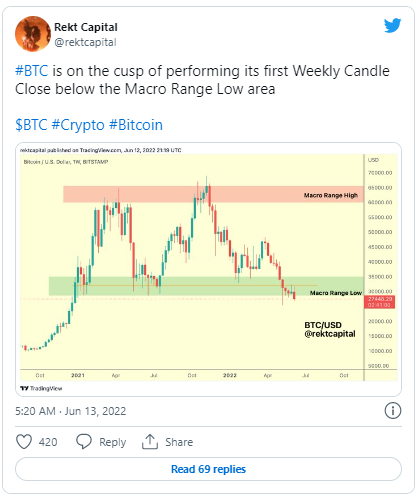

It is not just one range that Bitcoin has exited — as trader and analyst Rekt Capital noted on June 12, in abandoning the zone near $30,000, BTC/USD is also ditching a macro trading range in place since the start of 2021.
As such, the most recent weekly close, at around $26,600, was Bitcoin’s lowest since December 2020, data from Cointelegraph Markets Pro and TradingView shows.
“Worst is over. $BTC 25k defended. Think can squeeze a little now, resume selling tomorrow with equities,” economist, trader and entrepreneur Alex Krueger predicted.
An accompanying chart showed a band of buy support in place at $25,000, helping peg 24-hour losses at 12%.

BTC/USD order book data chart (Binance). Source: Alex Krueger/ TwitterThe market at the time of writing was nonetheless in a state of flux as the dust settled on a grim reminder of what happened during May’s spike below $24,000.
Whereas then it was Blockchain protocol Terra’s LUNA and TerraUSD (UST) tokens imploding, this weekend, it was the turn of FinTech platform Celsius and its CEL token to follow suit.
Down 40% on the day in USD terms, CEL predictably suffered from a decision by Celsius to halt withdrawals and transfers altogether in order to “stabilize liquidity.”
“Due to extreme market conditions, today we are announcing that Celsius is pausing all withdrawals, Swap, and transfers between accounts. We are taking this action today to put Celsius in a better position to honor, over time, its withdrawal obligations,” a blog post issued on June 13 reads.
Reacting, Bitcoin pundits already skeptical of the altcoin space following the Terra debacle wasted no time in pinning the blame for the extent of BTC price losses on events at Celsius.
gox hack was rough, ICO bubble was frustrating, but celsius hits the hardest because it's as though we learned nothing from 2008 
it was literally on the first page of the bitcoin white paper 
and yet time feels like a flat circle sometimes
— juthica (@juthica) June 13, 2022
“Celsius looks like it could collapse and take a bunch of customer money with it,” Robert Breedlove, host of the What is Money podcast, added in part of Twitter comments.
Fed policy update looms on 40-year record inflation
A black swan event copying Terra is arguably the last thing that Bitcoin needs given already shaky macro conditions.
Regardless, the scope for fresh turmoil remains this week as the Fed’s Federal Open Markets Committee (FOMC) prepares its June policy meeting which starts June 15.
Coming after Friday’s 8.6% inflation readout, expectations are that the gathering will hasten the pace of key rate hikes — something which neither stocks nor cryptoassets would welcome.
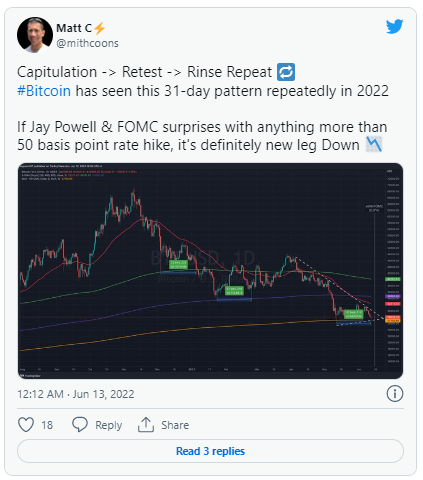

Krueger, like others, added that the Fed would most likely be the clinch factor in determining the remaining downside for risk assets.
“For the bottom have to wait for the Fed (or equities) to turn,” he wrote.
“Can scalps levels, but seriously doubt any level will bring a trend change by itself. Slight chance the Fed does not turn hawkish on Wed and if so rally hard. Hawkish acceleration more likely.”
An Asian sell-off made life worse for equities at the start of the week, impacting risk-sensitive currencies such as the Japanese yen and Australian dollar.
“At some point financial conditions will tighten enough and/or growth will weaken enough such that the Fed can pause from hiking,” Goldman Sachs strategists including Zach Pandl wrote in a note quoted by Bloomberg on June 13.
“But we still seem far from that point, which suggests upside risks to bond yields, ongoing pressure on risky assets, and likely broad US dollar strength for now.”
Bloomberg additionally reported that a 75-basis-point rate hike may be on the table, as markets price in base rates of 3% or more by the end of the year.
U.S. dollar wastes no time challenging 20-year highs
Where risk assets suffer, the U.S. dollar has made the most of its power over the past two years.
That trend looks set to continue as macro conditions pressure practically every other world currency and risk assets provide no realistic safe haven.
The U.S. dollar index (DXY), despite retracing in recent weeks, is now firmly back in the saddle and targeting the highs of 105 seen in May. These reflect peak USD strength since 2002, and at the time of writing are just 0.5 points away.
“$DXY is going strong, no wonder assets are tanking,” Tony Edward, host of the Thinking Crypto Podcast, responded.
Since the cross-market crash of March 2020, DXY strength has been a reliable counter-indicator for BTC price performance. Until a significant trend change enters, the outlook for Bitcoin could thus stay skewed to the sell-side.
“Dollar strength often leads to contractions in corporate earnings globally. Today’s inflation problem adds even further pressure on profit margins to be squeezed,” Otavio Costa, founder of global macro asset management firm Crescat Capital, told Twitter followers about the dollar versus the Fed’s inflation narrative on June 12.
“Only a matter of time before the ‘soft landing’ narrative turns into the same old ‘transitory’ nonsense.”

U.S. dollar index (DXY) 1-day candle chart. Source: TradingView"Misery Index" underscores market fear
There will be no surprises when it comes to cryptocurrency market sentiment this week, with the macro mood likewise taking a turn for the worse.
The Crypto Fear & Greed Index, which uses a basket of factors to determine overall conditions among traders, is teetering on the edge of a dip into single figures.

Crypto Fear & Greed Index (screenshot). Source: Alternative.meHaving spent much of 2022 in an area traditionally reserved for market bottoms, Fear & Greed has yet to convince anyone that a floor could be in.
On June 13, it measured 11/100, just three points higher than its macro lows from March 2020.
Last week’s inflation print similarly took its toll on the traditional market Fear & Greed Index, which is now back in its “fear” zone at 28/100, according to data from CNN.
It is not just the financial world feeling the pinch — the so-called “Misery Index,” which measures inflation and unemployment, is giving signs that economist Lyn Alden describes as “not great.”
“Combined with how much debt/GDP exists now compared to the past, no wonder consumer sentiment is at record lows,” she commented on Fed data.

Misery Index chart. Source: Lyn Alden/ Twitter“Opportunity of a lifetime?”
Given current circumstances, it may feel like there are no Bitcoin bulls left to offer a silver lining to the multiple clouds on the horizon.
Zooming out, however, there are many who view the current market setup as a golden investment opportunity if exploited correctly.
Among them is Filbfilb, co-founder of trading suite Decentrader, who over the weekend called Bitcoin the “opportunity of a lifetime.”
“Just to be clear, despite short/medium term issues which unfortunately are across the board, if you can survive and play your moves right without blowing up or risking too much so you have no capital, this is IMO the opportunity of a lifetime,” he wrote as part of a Twitter thread.
Like others, Filbfilb tied BTC performance to stocks, warning that the average hodler is blind to the “overleveraged” conditions that still exist on exchanges.
“They will feel the pinch,” he continued.
Contextualizing Bitcoin now within its four-year halving cycle, analyst Venturefounder meanwhile argued that the max pain scenario could enter in the coming weeks.
#Bitcoin cycle end capitulation is perhaps happening now.
Just another 15% downside to reach #200WMA and 1 fib extension level ($22-23k) from #BTC cycle top, this can happen quickly, in the next few weeks. pic.twitter.com/8cp6Oes7PK
— venturefoundΞr (@venturefounder) June 13, 2022
Currently midway through its cycle, BTC is in a place which has felt like bearish capitulation twice before — in both 2014 and 2018.


Related Reads

$9.4 Billion: The Largest Robotics Funding This Year Has Emerged

Munich-based humanoid robotics company Neura has completed a $1.4 billion (approximately RMB 94.9 billion) Series C funding round, valuing the company at around $7 billion and positioning it among the global leaders in the sector. The investment round is notable not just for its size—reportedly the largest in robotics this year—but also for its strategic backers, which include tech giants like NVIDIA and Amazon, alongside established industrial players such as German engineering firms Bosch and Schaeffler. This mix of investors signals a significant shift in the industry's focus from technological demonstrations and general-purpose narratives toward practical, industrial deployment and commercialization. Neura's approach centers on developing humanoid robots for defined, high-value industrial tasks rather than pursuing a general-purpose model. Its early validation comes from a partnership with BMW, where its robots are being tested on actual production lines. The involvement of Bosch and Schaeffler, companies deeply embedded in global manufacturing, underscores a growing belief that humanoid robots are transitioning from labs to viable factory-floor solutions. The article highlights two converging trends driving investment: advancements in AI and large language models, which enhance robots' perception and decision-making in unstructured environments, and mounting pressure from labor shortages and rising costs in major manufacturing regions. The funding landscape is now bifurcating between companies like Figure AI, focusing on versatile general-purpose robots, and firms like Neura, targeting specific vertical industrial applications with clearer, shorter paths to ROI. While technical hurdles remain, the core challenges for widespread adoption are increasingly seen as engineering and commercial in nature: managing the high integration and customization costs for different factory environments and establishing robust, localized maintenance and service networks. The record investment in Neura, particularly from industrial capital, indicates the industry's growing confidence in moving from proving feasibility to solving the practical problems of scalability, reliability, and building sustainable business models around humanoid robots in real-world settings like automotive manufacturing and hazardous labor environments.

marsbit2h ago

$9.4 Billion: The Largest Robotics Funding This Year Has Emerged

marsbit2h ago

"119 to 176 Dollars": Behind SpaceX's Listing, MSX Once Again Successfully Executes the Pre-IPO Closed Loop

Following May's 300% gain on Cerebras, MSX delivered another outstanding performance during SpaceX's listing night. On June 12, SpaceX (SPCX) launched on Nasdaq, reaching a high of $176. This marked the successful culmination of MSX's Pre-IPO project launched in March, where users subscribed at $119, achieving gains of approximately 40-48%. This event validated MSX's complete Pre-IPO mechanism, a crucial advantage in a market where access to top-tier private company equity is typically limited to institutions. MSX's model provides a full cycle for users: subscription (at $119 for SpaceX), real-time on-chain portfolio tracking, optional early redemption, seamless conversion to tradable spot assets (SPCX.M) upon IPO, and final settlement in stablecoins. This end-to-end process distinguishes MSX from platforms that faced settlement issues during the SpaceX IPO, highlighting that the core challenge of Pre-IPO is not just access, but a clear exit and conversion path post-listing. This success with SpaceX is MSX's second major Pre-IPO verification, following the Cerebras listing in May, which yielded ~300% returns for early participants. These back-to-back achievements demonstrate MSX's capability to source, structure, and deliver real assets through a replicable on-chain model. The true barrier for Pre-IPO products lies not in providing an entry point, but in ensuring reliable fulfillment from subscription through to post-IPO liquidity. MSX's proven闭环 (closed-loop) process addresses this, offering Web3 users a structured way to access high-growth, pre-public companies in sectors like AI and frontier tech. MSX plans to continue expanding its Pre-IPO portfolio with this focus on authenticity, transparency, and post-listing execution.

Odaily星球日报15h ago

"119 to 176 Dollars": Behind SpaceX's Listing, MSX Once Again Successfully Executes the Pre-IPO Closed Loop

Odaily星球日报15h ago

Trading

Spot
Futures

Hot Articles

What is $BITCOIN

DIGITAL GOLD ($BITCOIN): A Comprehensive Analysis Introduction to DIGITAL GOLD ($BITCOIN) DIGITAL GOLD ($BITCOIN) is a blockchain-based project operating on the Solana network, which aims to combine the characteristics of traditional precious metals with the innovation of decentralized technologies. While it shares a name with Bitcoin, often referred to as “digital gold” due to its perception as a store of value, DIGITAL GOLD is a separate token designed to create a unique ecosystem within the Web3 landscape. Its goal is to position itself as a viable alternative digital asset, although specifics regarding its applications and functionalities are still developing. What is DIGITAL GOLD ($BITCOIN)? DIGITAL GOLD ($BITCOIN) is a cryptocurrency token explicitly designed for use on the Solana blockchain. In contrast to Bitcoin, which provides a widely recognized value storage role, this token appears to focus on broader applications and characteristics. Notable aspects include: Blockchain Infrastructure: The token is built on the Solana blockchain, known for its capacity to handle high-speed and low-cost transactions. Supply Dynamics: DIGITAL GOLD has a maximum supply capped at 100 quadrillion tokens (100P $BITCOIN), although details regarding its circulating supply are currently undisclosed. Utility: While precise functionalities are not explicitly outlined, there are indications that the token could be utilized for various applications, potentially involving decentralized applications (dApps) or asset tokenization strategies. Who is the Creator of DIGITAL GOLD ($BITCOIN)? At present, the identity of the creators and development team behind DIGITAL GOLD ($BITCOIN) remains unknown. This situation is typical among many innovative projects within the blockchain space, particularly those aligning with decentralized finance and meme coin phenomena. While such anonymity may foster a community-driven culture, it intensifies concerns about governance and accountability. Who are the Investors of DIGITAL GOLD ($BITCOIN)? The available information indicates that DIGITAL GOLD ($BITCOIN) does not have any known institutional backers or prominent venture capital investments. The project seems to operate on a peer-to-peer model focused on community support and adoption rather than traditional funding routes. Its activity and liquidity are primarily situated on decentralized exchanges (DEXs), such as PumpSwap, rather than established centralized trading platforms, further highlighting its grassroots approach. How DIGITAL GOLD ($BITCOIN) Works The operational mechanics of DIGITAL GOLD ($BITCOIN) can be elaborated on based on its blockchain design and network attributes: Consensus Mechanism: By leveraging Solana’s unique proof-of-history (PoH) combined with a proof-of-stake (PoS) model, the project ensures efficient transaction validation contributing to the network's high performance. Tokenomics: While specific deflationary mechanisms have not been extensively detailed, the vast maximum token supply implies that it may cater to microtransactions or niche use cases that are still to be defined. Interoperability: There exists the potential for integration with Solana’s broader ecosystem, including various decentralized finance (DeFi) platforms. However, the details regarding specific integrations remain unspecified. Timeline of Key Events Here is a timeline that highlights significant milestones concerning DIGITAL GOLD ($BITCOIN): 2023: The initial deployment of the token occurs on the Solana blockchain, marked by its contract address. 2024: DIGITAL GOLD gains visibility as it becomes available for trading on decentralized exchanges like PumpSwap, allowing users to trade it against SOL. 2025: The project witnesses sporadic trading activity and potential interest in community-led engagements, although no noteworthy partnerships or technical advancements have been documented as of yet. Critical Analysis Strengths Scalability: The underlying Solana infrastructure supports high transaction volumes, which could enhance the utility of $BITCOIN in various transaction scenarios. Accessibility: The potential low trading price per token could attract retail investors, facilitating wider participation due to fractional ownership opportunities. Risks Lack of Transparency: The absence of publicly known backers, developers, or an audit process may yield skepticism regarding the project's sustainability and trustworthiness. Market Volatility: The trading activity is heavily reliant on speculative behavior, which can result in significant price volatility and uncertainty for investors. Conclusion DIGITAL GOLD ($BITCOIN) emerges as an intriguing yet ambiguous project within the rapidly evolving Solana ecosystem. While it attempts to leverage the “digital gold” narrative, its departure from Bitcoin's established role as a store of value underscores the need for a clearer differentiation of its intended utility and governance structure. Future acceptance and adoption will likely depend on addressing the current opacity and defining its operational and economic strategies more explicitly. Note: This report encompasses synthesised information available as of October 2023, and developments may have transpired beyond the research period.

363 Total ViewsPublished 2025.05.13Updated 2025.05.13

What is $BITCOIN

Discussions

Welcome to the HTX Community. Here, you can stay informed about the latest platform developments and gain access to professional market insights. Users' opinions on the price of BTC (BTC) are presented below.

活动图片