Сиба-ину готовится к 400%-ному росту из-за формирования бычьего флага, аналитик прогнозирует $0,000074

cryptonews.ruPublished on 2023-09-15Last updated on 2024-10-15

Ведущий аналитик прогнозирует, что Shiba Inu может вырасти на 400% до $0,000074, что обусловлено недавним ценовым действием и техническими индикаторами.

Shiba Inu в последние дни переживает умеренный подъем. Сейчас он торгуется по $0,00001834 после кратковременного касания диапазона $0,000016 на прошлой неделе.

Хотя рост Shiba Inu ниже по сравнению с некоторыми другими популярными мем-токенами, аналитики полагают, что вторая по величине мем-монета готовится к крупному ралли.

Аналитик TradingView недавно заявил, что сейчас самое подходящее время для открытия длинной позиции по Shiba Inu. Аналитик первым признал трудности долгосрочных держателей, отметив, что Shiba Inu упал на 75% с марта.

Хотя эта коррекция нанесла ущерб тем, кто вышел на рынок SHIB по $0,000045 семь месяцев назад, аналитик заявил, что сейчас есть несколько причин для оптимистичного отношения к Shiba Inu. К ним относятся недавние ценовые действия, прорывы сопротивления RSI, развороты тренда и формирование более высоких максимумов с прорывами флага.

Шиба-ину может вырасти на 400% до $0,000074

Действительно, Шиба-ину показала значительный рост за последние 30 дней, показав рост на 32% по сравнению с нижним диапазоном в $0,000013, который она наблюдала в сентябре. Затянувшийся нисходящий тренд Шиба-ину изменился в конце сентября, когда она показала рост цены почти на 50% в течение двух дней.

Это удивительное ценовое действие возродило оптимизм вокруг SHIB. Между тем, поскольку Шиба-ину скорректировала свои позднесентябрьские достижения в октябре, аналитики прогнозируют, что вторая фаза подъема не за горами.

В частности, аналитик TradingView заявил, что следующее импульсивное движение Шиба-ину может привести к увеличению ее цены до области $0,000074, что указывает на потенциальный рост на 400%.
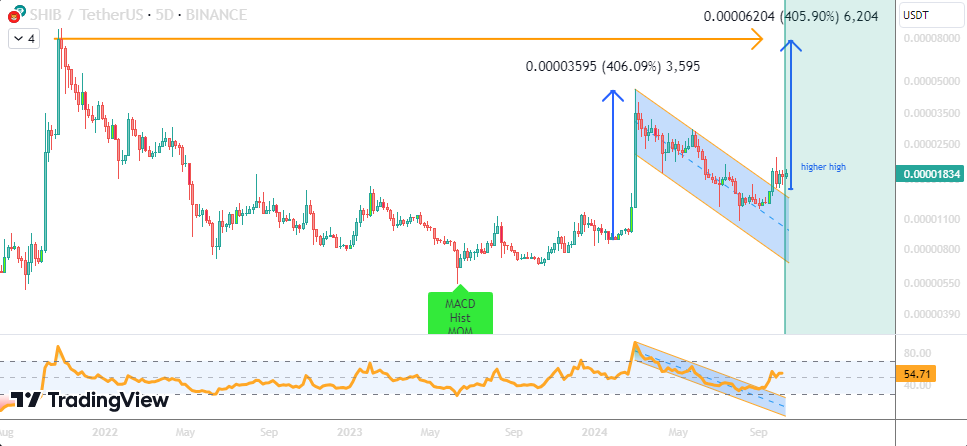
Этот рост будет отражать то, что произошло между февралем и мартом, когда сиба-ину показала приблизительно 4-кратный подъем, достигнув трехлетнего максимума в $0,000045.

Сопротивление сиба-ину, за которым стоит следить

В отдельном анализе на TradingView наблюдатель рынка Клейди Куни взвесил целевые уровни сопротивления, которые сиба-ину должна преодолеть, прежде чем попытаться достичь $0,000074.

Куни признал, что сиба-ину готова к еще одному крупному ралли. Однако он считает, что впереди SHIB столкнется со значительным сопротивлением.

Непосредственное сопротивление составляет $0,00001865. На момент написания SHIB торговался около $0,00001796, но с тех пор преодолел это сопротивление. Сейчас сиба-ину уже установил внутридневной максимум на уровне $0,00001893, приблизившись к восстановлению $0,000019.
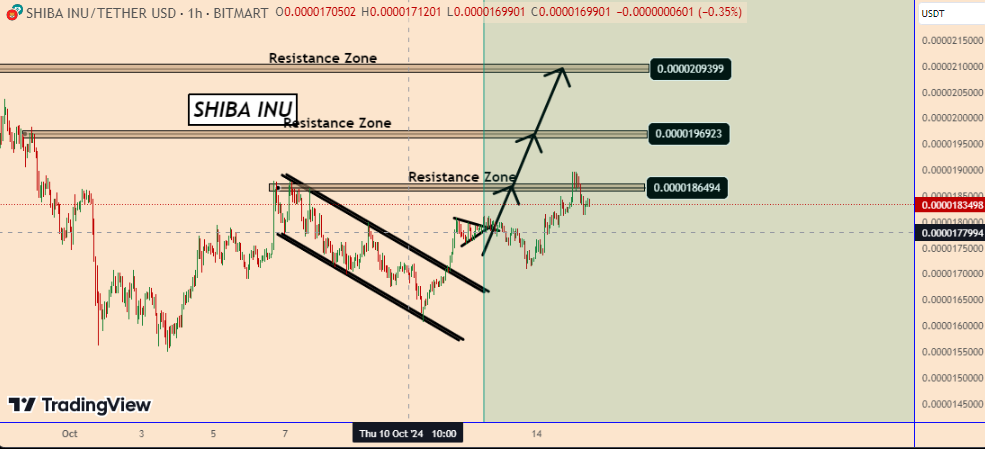
Заглядывая вперед, сиба-ину столкнется со следующими уровнями сопротивления на $0,00001969 и $0,00002094.

Стоит отметить, что ранее сиба-ину преодолевал эти барьеры в течение 24-часового окна в прошлом месяце. В частности, SHIB подскочил с минимума в $0,00001494 26 сентября до $0,00002146 на следующий день, что подчеркивает способность мем-монеты преодолевать значительные препятствия, когда начинается ее бычий забег.
Related Reads

Deforming the Transformer, LLMs Become Smarter

A new research paper proposes "Tapered Language Models (TLMs)," a method that improves large language model performance without adding any parameters. It challenges the standard Transformer design where each layer has the same number of parameters ("feed-forward network" width). Building on evidence that layers are not equally important—earlier layers handle foundational information like grammar, while later layers often reinforce existing judgments—the researchers suggest reallocating model capacity from later to earlier layers. The core idea is to make the layer width taper off monotonically from start to end, keeping total parameters and compute constant. Experiments compared linear, cosine, and sigmoid tapering curves on a 440M parameter model. The cosine curve (e.g., starting width 1.5x baseline, ending 0.5x) achieved the best result, reducing perplexity by 1.84 points compared to the uniform baseline—a significant gain at zero cost. This finding proved robust across four different model architectures (including gated attention and memory-augmented models) and at larger scales (760M and 1.3B parameters), consistently improving performance on commonsense reasoning and language modeling tasks without harming long-context retrieval ability. The work highlights a long-overlooked design dimension: optimal parameter allocation across depth. It offers a "free lever" for efficiency, potentially applicable beyond language models to vision Transformers and diffusion models. The study was conducted by researchers from Mila, Cornell University, and the University of Montreal.

marsbit4m ago

Deforming the Transformer, LLMs Become Smarter

marsbit4m ago

From SpaceX to Galaxy Digital: A Detailed Look at 37 New AI Companies and 7 Crypto Dark Horses Added to the Russell Indexes

On June 26th, following its annual reconstitution, the Russell US Indexes finalized their new components, with changes taking effect for market trading on June 29th. The Russell 3000 Index, representing approximately 98% of the investable US equity market, saw significant turnover. A record $334 billion was traded during Nasdaq's closing cross on reconstitution day, highlighting the massive passive fund flows tied to these benchmarks. Companies newly added to the index are set to benefit from mandatory buying by these funds. The reconstitution raised the market cap threshold between the large-cap Russell 1000 and small-cap Russell 2000 by 24% to $5.7 billion. Overall, 224 new companies entered the Russell 3000. Of these, 19 joined the Russell 1000, and 205 joined the Russell 2000, while 118 firms were removed. Notably, among the newcomers, approximately 37 are companies operating in the AI and semiconductor ecosystem, accounting for roughly 17% of new additions. The most prominent is SpaceX, which, following its recent IPO and soaring valuation, was fast-tracked directly into the Russell 1000 and Top 200 indexes. Additionally, about 7 cryptocurrency-related companies were newly included, representing about 3% of new entrants. These include Galaxy Digital, Bitmine, and Tron, among others. The inclusion of several Decentralized Autonomous Trust (DAT) entities signals the model's sustained market presence. For these smaller AI and crypto firms, index inclusion boosts visibility, potentially attracting further institutional investment and supporting their stock performance.

Odaily星球日报8m ago

From SpaceX to Galaxy Digital: A Detailed Look at 37 New AI Companies and 7 Crypto Dark Horses Added to the Russell Indexes

Odaily星球日报8m ago

Token Uneconomical

"Token Inefficiency" explores the rising economic burden of AI model token usage in enterprises, where escalating costs often fail to match tangible productivity gains. Major companies like Microsoft, Uber, and Meta are facing "token inefficiency"—characterized by budget overruns for tools like Claude Code with unclear returns. This inefficiency stems from supply-side factors like strategic model price hikes by leaders (e.g., Anthropic) and price increases in budget-friendly models, alongside technical waste in Agent systems through context traps, tokenizer inflation, redundant skill calls, and multi-Agent coordination overhead. A deeper demand-side challenge limits token value: their primary utility remains confined to highly digitalized domains like programming, which benefits from automatic, low-cost feedback loops. Extending tokens to physical world tasks or less digitalized industries faces the "Sim-to-Real Gap," where real-world validation is costly and slow, unlike in code compilation. The article warns that this inefficiency concentrates financial risk in mid-tier model developers, potentially fueling circular financing schemes and shadow credit bubbles. It also highlights societal externalities, as data center expansion strains local power grids and inflates utility costs for residents. To achieve a positive net token economy, the path forward requires dual efforts: technical optimizations (context compression, skill reduction, model routing, budget constraints) and business-side discipline (governance, cost attribution, ROI focus). The ultimate goal is shifting from showcasing AI capabilities to maximizing value per token, finding scalable commercial applications that justify the investment and bridge the digital-physical divide.

marsbit26m ago

Token Uneconomical

marsbit26m ago

Stock Price Halved in 45 Days, Is Circle Actually the "DeFi Barometer"?

Over a 45-day period, Circle's stock price plummeted by approximately 50% to around $63, coinciding with a significant $70 billion decline in the circulation of its USDC stablecoin from its peak. In contrast, Tether's USDT saw a much smaller reduction. Analyst Ed Engel posits that Circle acts as a barometer for DeFi activity, as a high correlation exists between USDC supply and ETH price movements. The vast majority of USDC is concentrated within crypto exchanges and DeFi protocols for yield generation, rather than for widespread daily use in payments or commerce, unlike USDT which has stronger real-world adoption in various regions. The recent contraction in DeFi Total Value Locked (TVL), following security incidents like the Kelp DAO attack, appears to mirror Circle's declining stock performance. While Circle is actively promoting USDC's use as a settlement asset on platforms like Hyperliquid and in institutional payment corridors—where its organic transfer volume surpasses USDT's—these efforts have not sufficiently driven growth in USDC's overall supply. The company's revenue remains heavily tied to DeFi's expansion. For Circle's investment narrative to change, it must either significantly reduce its reliance on the volatile DeFi sector or demonstrably prove that real-world adoption can substantially and sustainably increase USDC circulation. In the near term, market confidence hinges on DeFi addressing its inherent risk-reward imbalances.

marsbit59m ago

Stock Price Halved in 45 Days, Is Circle Actually the "DeFi Barometer"?

marsbit59m ago

Trading

Spot
活动图片