比特币突破 65,000 美元,后市怎么走?

链捕手Published on 2024-09-27Last updated on 2024-09-27

作者:0xFacai,BlockBeats


7 月 29 日 BTC 突破 70,000 美元 后,开启了一轮下跌趋势,在 8 月 5 日到达 49,000 美元又反弹至 65,000 美元 继续下跌在 9 月 6 日在 53,000 美元附近形成了类双底结构后,9 月 19 日美联储确定降息,BTC 顺势上涨。9 月 26 日美盘时段,伴随着美股指数的强势上涨,BTC 已经突破前一轮高点 65,000 美元,破坏了更低的低点和更高的高点的结构。

这里是否是真实的下跌结构的破坏还是对于前高点的假突破,从技术层面如何理解,结合合约 / 现货订单薄深度、清算地图对于后市如何判断,宏观环境上是否能支持牛市的下半场,市场后续如何定价降息,交易博主有着各自的看法。
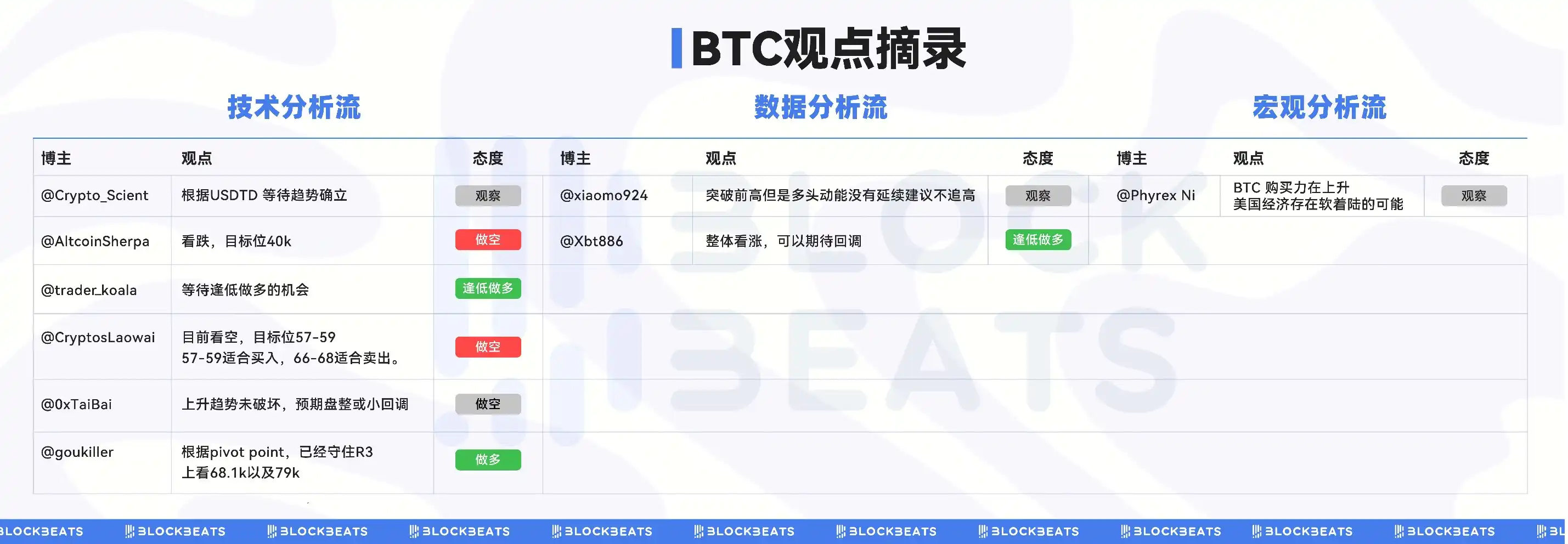
技术分析流

@Crypto_Scient 认为可以用 USDT.D (USDT Dominance) 的走势来推测后续 BTC 的发展:如果 USDT.D 遵循红色路径,在日线流动性聚集区域中抢占流动性,然后回踩上升趋势线后上涨,那么 BTC 会呈现空头走势;如果 USDT.D 遵循蓝色路径,突破趋势,将趋势反转,那么 BTC 会走出多头趋势到达历史新高。现在需要等待观察 USDT.D 走出确切的信号,再决定后续的交易策略

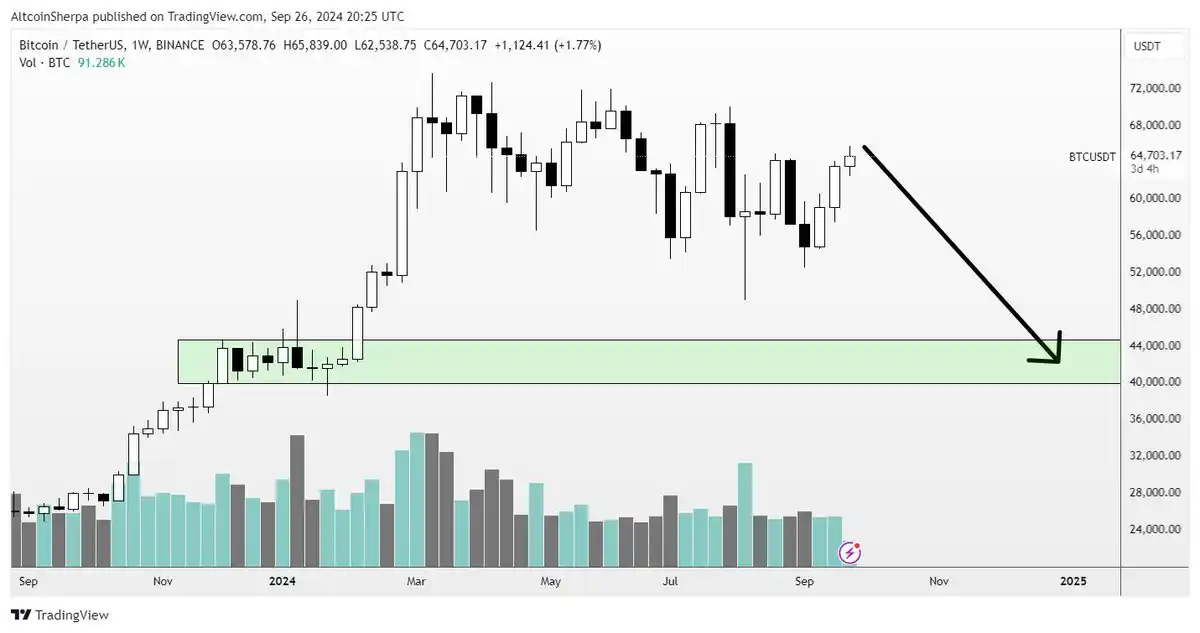
@AltcoinSherpa 认为这里是看跌的价格走势,需要获取 BTC 在 40,000 美元的流动性。
@trader_koala 认为这里需要观察,准备了两种交易策略:如果支撑位回踩有效,就在订单区块附近买入;如果支撑位失效,那么将在更深的下跌中买入,如果出现日 K 实体收盘低于大约 59,000 美元 这样的更深的下跌,那么上涨的目标是 68,000 美元至 70,000 美元。

@CryptosLaowai 认为 BTC 已经捕捉了 65,000 美元的流动性,这里可能会出现暴跌。BTC 从 53,000 美元 以来开启的上涨趋势的形态是上升的扩张楔形,楔形接近尾声会出现方向的选择,大概率会向下,目标是回测 57,000 美元至 59,000 美元的支撑,然后捕捉上升趋势线的流动性大概在 68,000 美元的位置随后下跌。

@0xtaibai 认为 BTC 在 4 小时级别的前波段高点的阻力位停滞,突破没有成功,可能进行盘整,但没有出现下跌的反转结构,如果后续出现空头结构跌破的反弹失败才会尝试做空。主要观察绿色区域这个潜在的震荡区间。目前整体的上涨趋势没有破坏,预期盘整或者小回调然后继续向上。

@goukiller 认为在周线级别的博弈中,Pivot Point 的 R3 防守成功,还是处在上涨行情中,后续上涨目标为 R4 68,100 美元和 R5 79,000 美元。

数据分析流

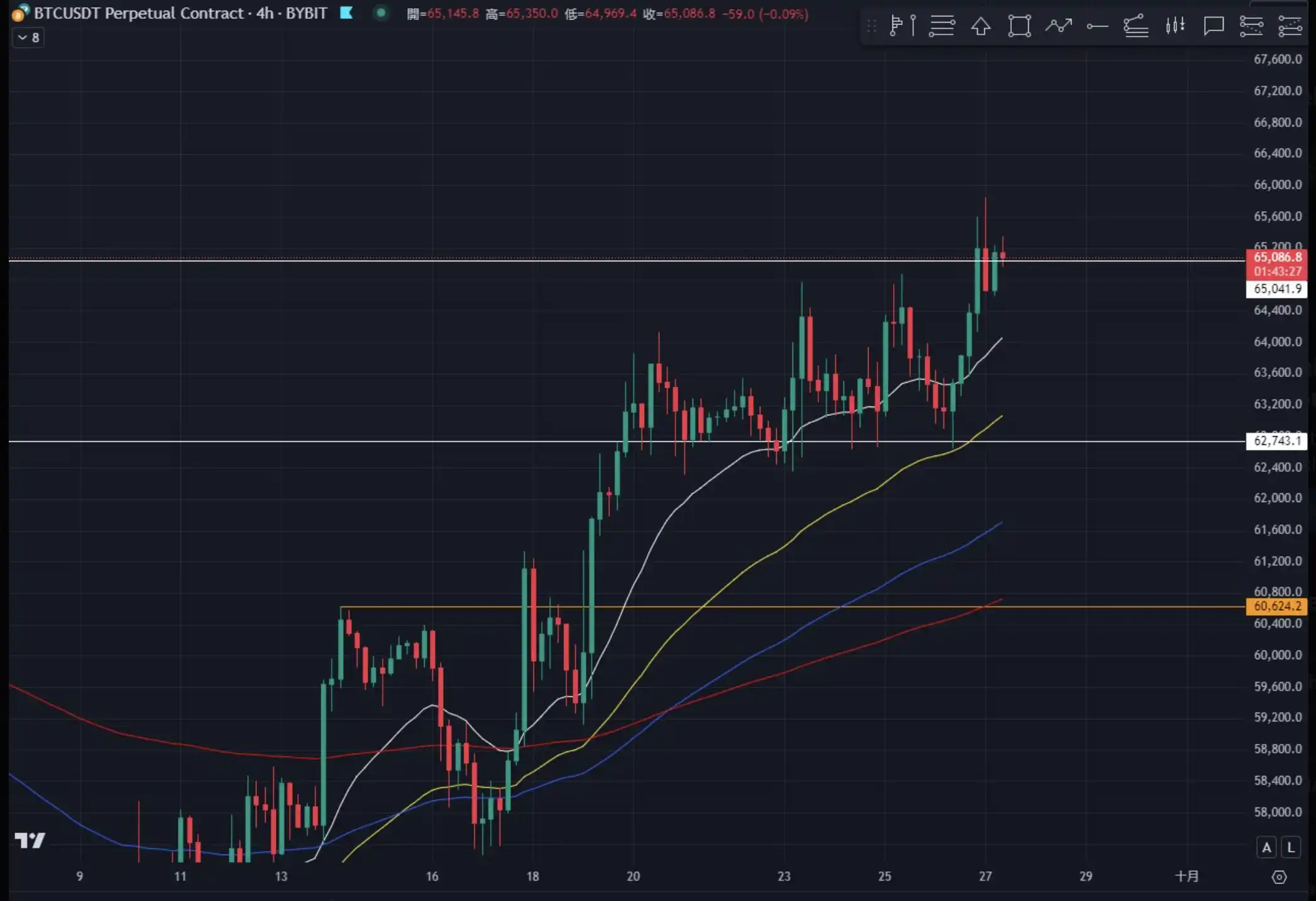
@xiaomo924 认为 BTC 已经突破前高,但是多头的动能并没有持续延续,如果没有持续买入的话短时间内需要盘整和回调,后续需要关注 4 小时级别 EMA20 和 50 的回测力度,是否在那里得到支撑,
在拉升中的合约订单深度差值大于现货订单深度差值,意味着合约买量大于现货,如果未来没有更多的现货买量时,将会有假突破的风险

多空比此时又来到低位,巨鲸有平多的状态,需要注意短期需求释放后的回调

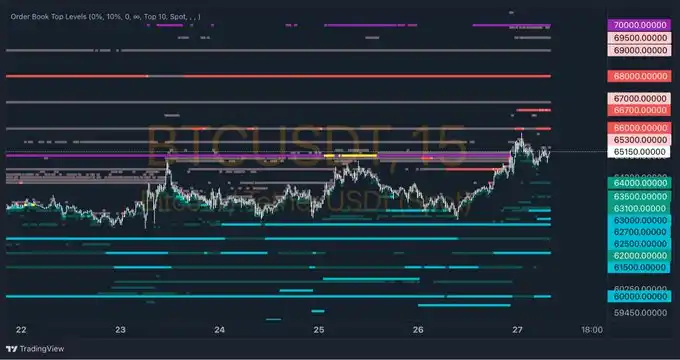
@Xbt886 从订单薄中发现,66,000 至 66,700 美元 有大量卖单,62,000 美元至 63,000 美元有大量买单,整体看涨,可以期待回调,但是也有可能仅为挂单吸引,不会实际成交,不要盲目奔着 62,000 美元至 63,000 美元做空,目前看来获取空头流动性后追高的已经被套,后续还是以保守观察为主。
 

宏观分析流

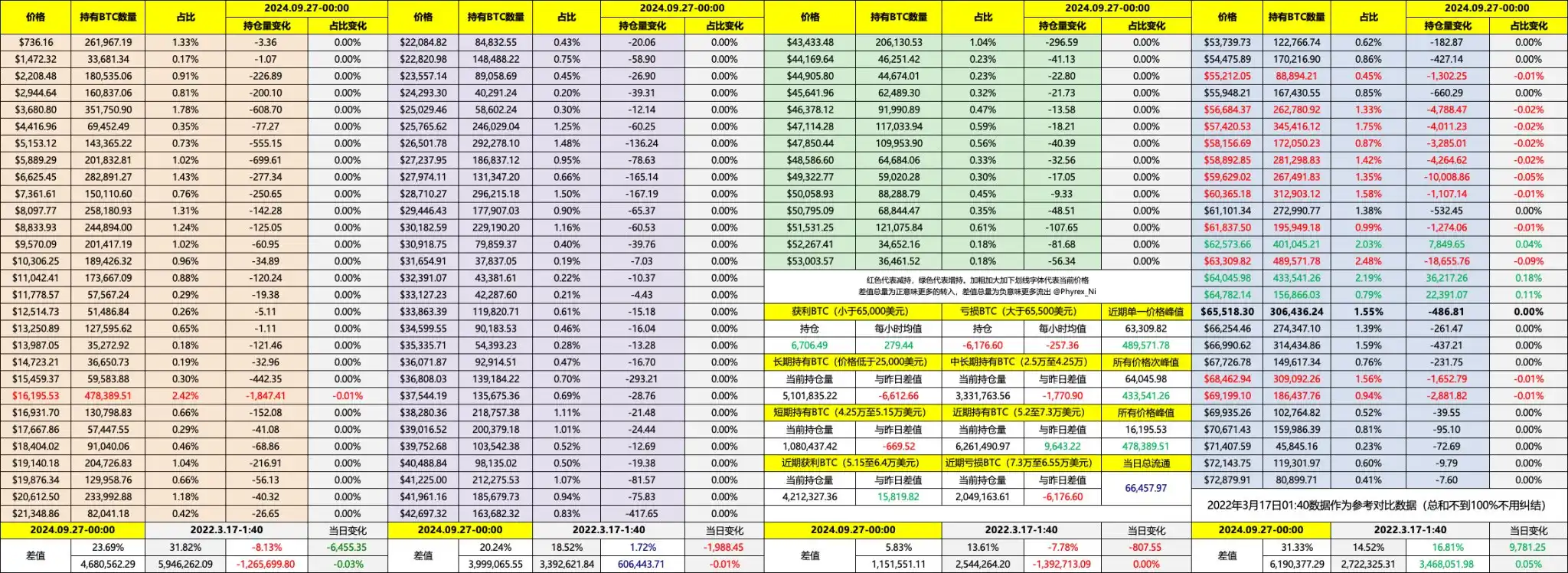
@Phyrex_Ni 认为牛回暂且还不能确定,BTC 在链上的换手较低,上涨的最大可能性仍然是低流动性的原因。耶伦的讲话中透出来宏观环境上的两个重点:一个是目前美国的经济还是不错的,有软着陆的可能,其次就是劳动力市场目前虽然是稳定的,但仍然比较脆弱,需要美联储继续降息来保持劳动力市场不会崩溃。BTC 购买的数据中,用户的情绪似乎调动起来一些,能明显感觉到购买力在上升,甚至是阶段性报出 ETF 的购买都有显著的提升,大量投资者开始谨慎卖出,即便是短期获利者都开始期待有更高的价格。

而较早期持仓的投资者仍然是无动于衷,62,500 美元到 64,000 美元之间的筹码密集区仍然在增加,目前已经超过了 132.4 万枚,而 64,000 美元到 69,000 美元的支撑仍然保持很良好的状态,目前价格的变化仍然要看短期持有者是不是愿意释放手中的筹码。
Related Reads

Retail Investors' 'Lead Brother' Serenity vs. Newly Minted Stock God Leopold: How Are the Two Top Hunters Mining AI's 'Physical Limits'?

The article profiles two prominent figures, Serenity and Leopold Aschenbrenner, who are gaining attention for their unconventional investment strategies focused on the physical constraints of the AI boom, moving beyond mainstream software narratives. Serenity, an anonymous online trader, advocates a "shiso leaf" theory. He targets small-cap companies with monopolies on critical, overlooked components in the AI hardware supply chain, such as specific semiconductor materials. His deep, technical analysis of bottlenecks in areas like co-packaged optics (CPO) has reportedly yielded massive returns, though his anonymity and focus on illiquid micro-cap stocks pose significant risks for followers. Leopold Aschenbrenner, a former OpenAI researcher, founded a multi-billion dollar hedge fund. His macro thesis argues that physical infrastructure—power grids, land, data centers—is the true bottleneck for AI growth, lagging far behind chip production. Consequently, his fund employs an infrastructure arbitrage strategy: heavily investing in storage and compute infrastructure companies while placing massive bearish bets (put options) against major semiconductor stocks, betting their valuations will correct as physical constraints become apparent. While their methods differ—Serenity drills into microscopic supply chain details, while Leopold takes a macroscopic, infrastructure-focused view—both share a core belief: the real power and investment alpha in the AI era lie in controlling scarce physical resources, not just software. The article concludes by noting the inherent risks in both approaches, such as liquidity issues for micro-caps and timing risks for macro bets, but suggests they signal a broader market re-evaluation of AI's foundational assets.

marsbit2h ago

Retail Investors' 'Lead Brother' Serenity vs. Newly Minted Stock God Leopold: How Are the Two Top Hunters Mining AI's 'Physical Limits'?

marsbit2h ago

Who Will Make Money in the Age of Agents?

In the Agents era of blockchain, traditional value capture theories face challenges. The "Fat Protocol" theory, dominant since 2016, suggested protocols capture most value as their tokens are essential for network use. However, the proliferation of interchangeable L1s, L2s, and modular layers has eroded protocol scarcity and pricing power. Conversely, the "Fat App" theory posits that applications capturing user relationships (like wallets and exchanges) become the primary value layer by controlling distribution and transaction flows. This aligns with the current "Great Repricing" cycle. Agents disrupt this logic. As software users, they lack brand loyalty, prioritize cost and efficiency, and switch between platforms seamlessly. This undermines the front-end UX moats that "Fat Apps" rely on. The article explores several potential futures: 1. **Headless Applications:** Current leading apps could strip their front-ends and become backend API infrastructure for Agents, preserving their role. 2. **Protocol Resurgence:** If integration becomes trivial, Agents might bypass aggregators and interact directly with protocols, reviving "Fat Protocol" dynamics. 3. **Pricing Power Collapse:** Agents' rational, frictionless routing could commoditize the entire stack, compressing margins toward cost and leaving little profit for intermediaries. 4. **Unprecedented Activity:** Agents may enable new, high-frequency, machine-to-machine economic activities, expanding the total value pie even if margins are thin. 5. **A New, Unnamed Model:** Historically, major tech shifts (like the internet's attention economy) create unforeseen business models. The Agents era may spawn entirely new ways to capture value. The most likely outcome is a coexistence where "Fat Apps" continue to serve human users valuing UX, while a separate, Agent-driven economy emerges governed by different rules—where loyalty is based on factors like liquidity, latency, and settlement guarantees rather than brand.

marsbit3h ago

Who Will Make Money in the Age of Agents?

marsbit3h ago

Trading

Spot
Futures

Hot Articles

What is $BITCOIN

DIGITAL GOLD ($BITCOIN): A Comprehensive Analysis Introduction to DIGITAL GOLD ($BITCOIN) DIGITAL GOLD ($BITCOIN) is a blockchain-based project operating on the Solana network, which aims to combine the characteristics of traditional precious metals with the innovation of decentralized technologies. While it shares a name with Bitcoin, often referred to as “digital gold” due to its perception as a store of value, DIGITAL GOLD is a separate token designed to create a unique ecosystem within the Web3 landscape. Its goal is to position itself as a viable alternative digital asset, although specifics regarding its applications and functionalities are still developing. What is DIGITAL GOLD ($BITCOIN)? DIGITAL GOLD ($BITCOIN) is a cryptocurrency token explicitly designed for use on the Solana blockchain. In contrast to Bitcoin, which provides a widely recognized value storage role, this token appears to focus on broader applications and characteristics. Notable aspects include: Blockchain Infrastructure: The token is built on the Solana blockchain, known for its capacity to handle high-speed and low-cost transactions. Supply Dynamics: DIGITAL GOLD has a maximum supply capped at 100 quadrillion tokens (100P $BITCOIN), although details regarding its circulating supply are currently undisclosed. Utility: While precise functionalities are not explicitly outlined, there are indications that the token could be utilized for various applications, potentially involving decentralized applications (dApps) or asset tokenization strategies. Who is the Creator of DIGITAL GOLD ($BITCOIN)? At present, the identity of the creators and development team behind DIGITAL GOLD ($BITCOIN) remains unknown. This situation is typical among many innovative projects within the blockchain space, particularly those aligning with decentralized finance and meme coin phenomena. While such anonymity may foster a community-driven culture, it intensifies concerns about governance and accountability. Who are the Investors of DIGITAL GOLD ($BITCOIN)? The available information indicates that DIGITAL GOLD ($BITCOIN) does not have any known institutional backers or prominent venture capital investments. The project seems to operate on a peer-to-peer model focused on community support and adoption rather than traditional funding routes. Its activity and liquidity are primarily situated on decentralized exchanges (DEXs), such as PumpSwap, rather than established centralized trading platforms, further highlighting its grassroots approach. How DIGITAL GOLD ($BITCOIN) Works The operational mechanics of DIGITAL GOLD ($BITCOIN) can be elaborated on based on its blockchain design and network attributes: Consensus Mechanism: By leveraging Solana’s unique proof-of-history (PoH) combined with a proof-of-stake (PoS) model, the project ensures efficient transaction validation contributing to the network's high performance. Tokenomics: While specific deflationary mechanisms have not been extensively detailed, the vast maximum token supply implies that it may cater to microtransactions or niche use cases that are still to be defined. Interoperability: There exists the potential for integration with Solana’s broader ecosystem, including various decentralized finance (DeFi) platforms. However, the details regarding specific integrations remain unspecified. Timeline of Key Events Here is a timeline that highlights significant milestones concerning DIGITAL GOLD ($BITCOIN): 2023: The initial deployment of the token occurs on the Solana blockchain, marked by its contract address. 2024: DIGITAL GOLD gains visibility as it becomes available for trading on decentralized exchanges like PumpSwap, allowing users to trade it against SOL. 2025: The project witnesses sporadic trading activity and potential interest in community-led engagements, although no noteworthy partnerships or technical advancements have been documented as of yet. Critical Analysis Strengths Scalability: The underlying Solana infrastructure supports high transaction volumes, which could enhance the utility of $BITCOIN in various transaction scenarios. Accessibility: The potential low trading price per token could attract retail investors, facilitating wider participation due to fractional ownership opportunities. Risks Lack of Transparency: The absence of publicly known backers, developers, or an audit process may yield skepticism regarding the project's sustainability and trustworthiness. Market Volatility: The trading activity is heavily reliant on speculative behavior, which can result in significant price volatility and uncertainty for investors. Conclusion DIGITAL GOLD ($BITCOIN) emerges as an intriguing yet ambiguous project within the rapidly evolving Solana ecosystem. While it attempts to leverage the “digital gold” narrative, its departure from Bitcoin's established role as a store of value underscores the need for a clearer differentiation of its intended utility and governance structure. Future acceptance and adoption will likely depend on addressing the current opacity and defining its operational and economic strategies more explicitly. Note: This report encompasses synthesised information available as of October 2023, and developments may have transpired beyond the research period.

363 Total ViewsPublished 2025.05.13Updated 2025.05.13

What is $BITCOIN

Discussions

Welcome to the HTX Community. Here, you can stay informed about the latest platform developments and gain access to professional market insights. Users' opinions on the price of BTC (BTC) are presented below.

活动图片