APT 反弹才刚刚开始 会涨至 10 美元以上吗 需要关注哪些关键水平?

金色财经Published on 2024-09-27Last updated on 2024-09-27

过去一周,Aptos [APT]表现出色,涨幅达 29.98%。然而,过去 24 小时内涨幅放缓,仅增长 1.59%。
v2-18a8c2329348c940f223455530735716_720w.png

尽管出现这种放缓,但图表分析表明这可能是一个积累阶段,APT 的价格可能很快再次飙升。

Aptos 为何能实现两位数的价格

在此之前,APT 在上升三角形内交易,这是一种看涨模式,AMBCrypto 将其确定为潜在反弹的初始阶段——这一预测现已实现。

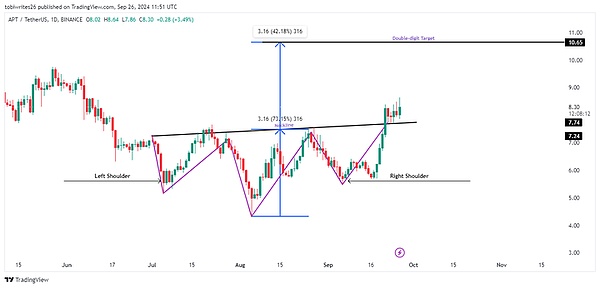
截至最新更新,APT 已引入额外看涨信号,形成倒头肩形态,通常被视为大幅反弹的前兆。

通常情况下,上涨趋势反映了形态头部和颈线之间的距离。就 APT 而言,这种动态的重复将推动其交易价格突破 10 美元。
v2-aa3a4efce9101d6dbc700ab7b094bfb4_720w.png

尽管呈现上升趋势,但价格走势却较为缓慢,市场参与者抛售 APT 导致价格下跌。

然而,AMBCrypto 的分析提供了不同的观点,并且持续的看涨前景仍然存在。

每周结构突破有助于看涨 Aptos 价格预测
v2-091e43a205f873a6912ee72aa04c7923_720w.png

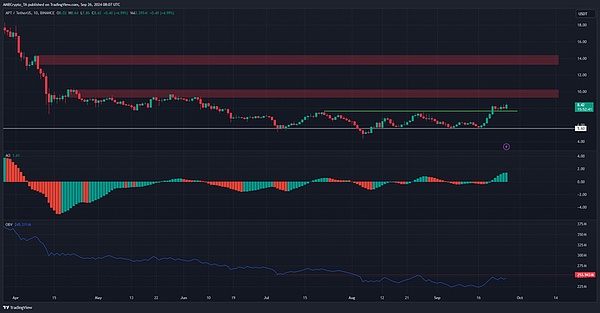
47% 的涨幅仅用了四天时间。代币一路飙升至每周最低点 7.66 美元。每周收盘价高于这一水平,从而扭转了较高时间框架的市场结构。

为了将 6 月份以来的盘整趋势转变为上升趋势,Aptos 多头必须在未来几周继续推高价格,并创下更高的低点和更高的高点。

根据 Awesome Oscillator,每日动能为看涨。然而,OBV 未能突破可追溯至 8 月的局部高点。这令人担忧,因为这意味着突破发生在成交量下降的情况下。

向北,每日看跌订单块位于 10 美元和 14 美元,是 APT 的下一个关键阻力位。这些区域的价格反应将说明上升趋势是否能够持续。

APT短期下跌利好反弹

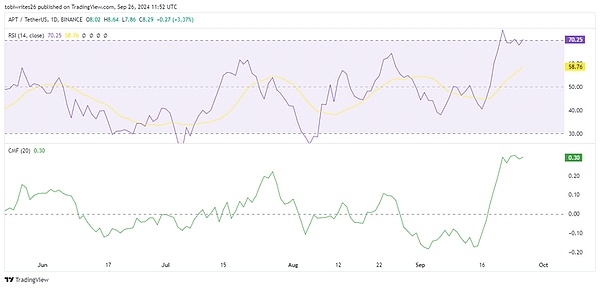
相对强弱指数 (RSI) 和 Chaikin 资金流量 (CMF) 指标均表明 APT 的发展势头正在放缓。

RSI 近期达到峰值 74,表明处于超买状态,但此后已调整至 70.25。

这种趋势线向上的下降趋势表明,市场正处于参与者购买更多 APT 单位以期未来上涨的阶段。

Chaikin 资金流进一步证实了这一积累阶段。CMF 评估了积累和分配的成交量加权平均值,显示正值为 0.30,表明购买压力持续存在。
v2-2ccd9db66b011033c8c32ab8b4d83077_720w.png

截至目前,CMF 的上升趋势表明,近期价格下跌是市场参与者在另一轮反弹之前以较低价格购买 APT 的战略时机。

市场参与者寻求更低的 APT 价格

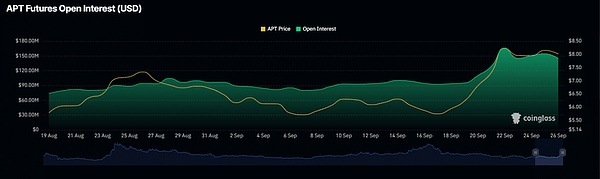
据Coinglass称,未平仓合约 (OI) 已从 9 月 25 日的高点 1.5445 亿美元下降至 1.4502 亿美元,表明各方齐心协力压低 APT 的价格。

尽管 OI 有所下降,但 OI 却增长了 1.66%,这表明多头正通过开设更多多头仓位逐渐进入市场。
v2-2e8944dfc06fc84dbdbea27bfa2839e9_720w.png

如果未平仓合约的这种上升趋势持续下去,则表明 APT 即将退出积累阶段,并开始向两位数的价值上涨。

与此同时,APT 图表上出现的倒头肩形态为其带来潜在收益。预计市场可能会经历一段积累期,为 APT 进入两位数增长奠定基础。

Related Reads

Retail Investors' 'Lead Brother' Serenity vs. Newly Minted Stock God Leopold: How Are the Two Top Hunters Mining AI's 'Physical Limits'?

The article profiles two prominent figures, Serenity and Leopold Aschenbrenner, who are gaining attention for their unconventional investment strategies focused on the physical constraints of the AI boom, moving beyond mainstream software narratives. Serenity, an anonymous online trader, advocates a "shiso leaf" theory. He targets small-cap companies with monopolies on critical, overlooked components in the AI hardware supply chain, such as specific semiconductor materials. His deep, technical analysis of bottlenecks in areas like co-packaged optics (CPO) has reportedly yielded massive returns, though his anonymity and focus on illiquid micro-cap stocks pose significant risks for followers. Leopold Aschenbrenner, a former OpenAI researcher, founded a multi-billion dollar hedge fund. His macro thesis argues that physical infrastructure—power grids, land, data centers—is the true bottleneck for AI growth, lagging far behind chip production. Consequently, his fund employs an infrastructure arbitrage strategy: heavily investing in storage and compute infrastructure companies while placing massive bearish bets (put options) against major semiconductor stocks, betting their valuations will correct as physical constraints become apparent. While their methods differ—Serenity drills into microscopic supply chain details, while Leopold takes a macroscopic, infrastructure-focused view—both share a core belief: the real power and investment alpha in the AI era lie in controlling scarce physical resources, not just software. The article concludes by noting the inherent risks in both approaches, such as liquidity issues for micro-caps and timing risks for macro bets, but suggests they signal a broader market re-evaluation of AI's foundational assets.

marsbit6m ago

Retail Investors' 'Lead Brother' Serenity vs. Newly Minted Stock God Leopold: How Are the Two Top Hunters Mining AI's 'Physical Limits'?

marsbit6m ago

Who Will Make Money in the Age of Agents?

In the Agents era of blockchain, traditional value capture theories face challenges. The "Fat Protocol" theory, dominant since 2016, suggested protocols capture most value as their tokens are essential for network use. However, the proliferation of interchangeable L1s, L2s, and modular layers has eroded protocol scarcity and pricing power. Conversely, the "Fat App" theory posits that applications capturing user relationships (like wallets and exchanges) become the primary value layer by controlling distribution and transaction flows. This aligns with the current "Great Repricing" cycle. Agents disrupt this logic. As software users, they lack brand loyalty, prioritize cost and efficiency, and switch between platforms seamlessly. This undermines the front-end UX moats that "Fat Apps" rely on. The article explores several potential futures: 1. **Headless Applications:** Current leading apps could strip their front-ends and become backend API infrastructure for Agents, preserving their role. 2. **Protocol Resurgence:** If integration becomes trivial, Agents might bypass aggregators and interact directly with protocols, reviving "Fat Protocol" dynamics. 3. **Pricing Power Collapse:** Agents' rational, frictionless routing could commoditize the entire stack, compressing margins toward cost and leaving little profit for intermediaries. 4. **Unprecedented Activity:** Agents may enable new, high-frequency, machine-to-machine economic activities, expanding the total value pie even if margins are thin. 5. **A New, Unnamed Model:** Historically, major tech shifts (like the internet's attention economy) create unforeseen business models. The Agents era may spawn entirely new ways to capture value. The most likely outcome is a coexistence where "Fat Apps" continue to serve human users valuing UX, while a separate, Agent-driven economy emerges governed by different rules—where loyalty is based on factors like liquidity, latency, and settlement guarantees rather than brand.

marsbit1h ago

Who Will Make Money in the Age of Agents?

marsbit1h ago

Trading

Spot
Futures

Hot Articles

How to Buy APT

Welcome to HTX.com! We've made purchasing Aptos (APT) simple and convenient. Follow our step-by-step guide to embark on your crypto journey.Step 1: Create Your HTX AccountUse your email or phone number to sign up for a free account on HTX. Experience a hassle-free registration journey and unlock all features.Get My AccountStep 2: Go to Buy Crypto and Choose Your Payment MethodCredit/Debit Card: Use your Visa or Mastercard to buy Aptos (APT) instantly.Balance: Use funds from your HTX account balance to trade seamlessly.Third Parties: We've added popular payment methods such as Google Pay and Apple Pay to enhance convenience.P2P: Trade directly with other users on HTX.Over-the-Counter (OTC): We offer tailor-made services and competitive exchange rates for traders.Step 3: Store Your Aptos (APT)After purchasing your Aptos (APT), store it in your HTX account. Alternatively, you can send it elsewhere via blockchain transfer or use it to trade other cryptocurrencies.Step 4: Trade Aptos (APT)Easily trade Aptos (APT) on HTX's spot market. Simply access your account, select your trading pair, execute your trades, and monitor in real-time. We offer a user-friendly experience for both beginners and seasoned traders.

2.3k Total ViewsPublished 2024.03.29Updated 2026.03.04

How to Buy APT

Discussions

Welcome to the HTX Community. Here, you can stay informed about the latest platform developments and gain access to professional market insights. Users' opinions on the price of APT (APT) are presented below.

活动图片