NFT 链上专题:以太坊占据高端 NFT 市场 97% 的销售份额,Punk 自低点涨幅超 45%

深潮Published on 2024-09-26Last updated on 2024-09-26

在过去的 30 天里,前四大区块链的 NFT 总交易量超过了 3 亿美元。

作者:OurNetwork

编译:深潮TechFlow

NFTs

Mad Lads | Pudgy Penguins | NodeMonkes | CryptoPunks | Milady Maker

Diaro | Dashboard

高端 NFT 市场中,以太坊仍占据绝对优势,占据97%的销售份额

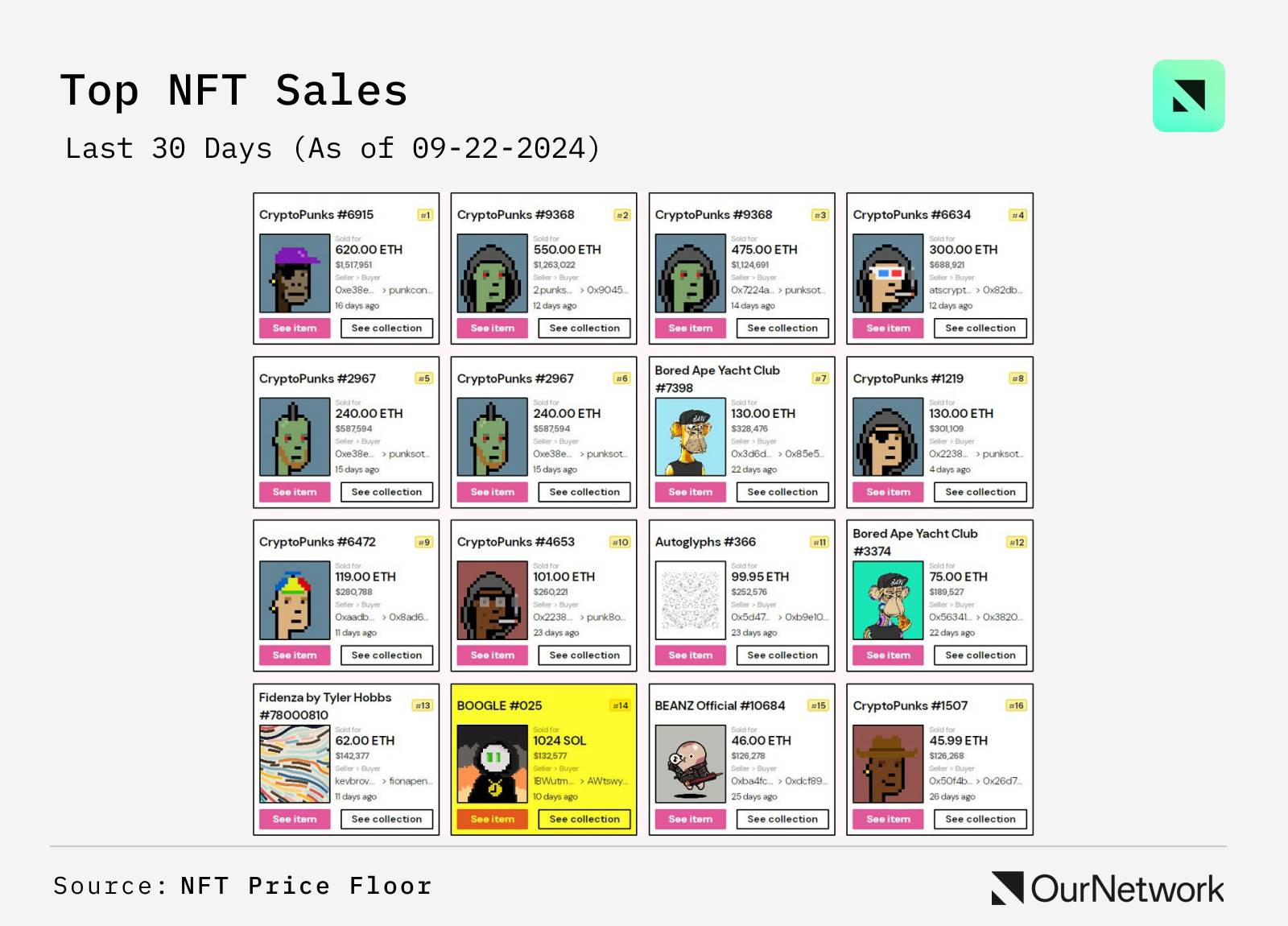
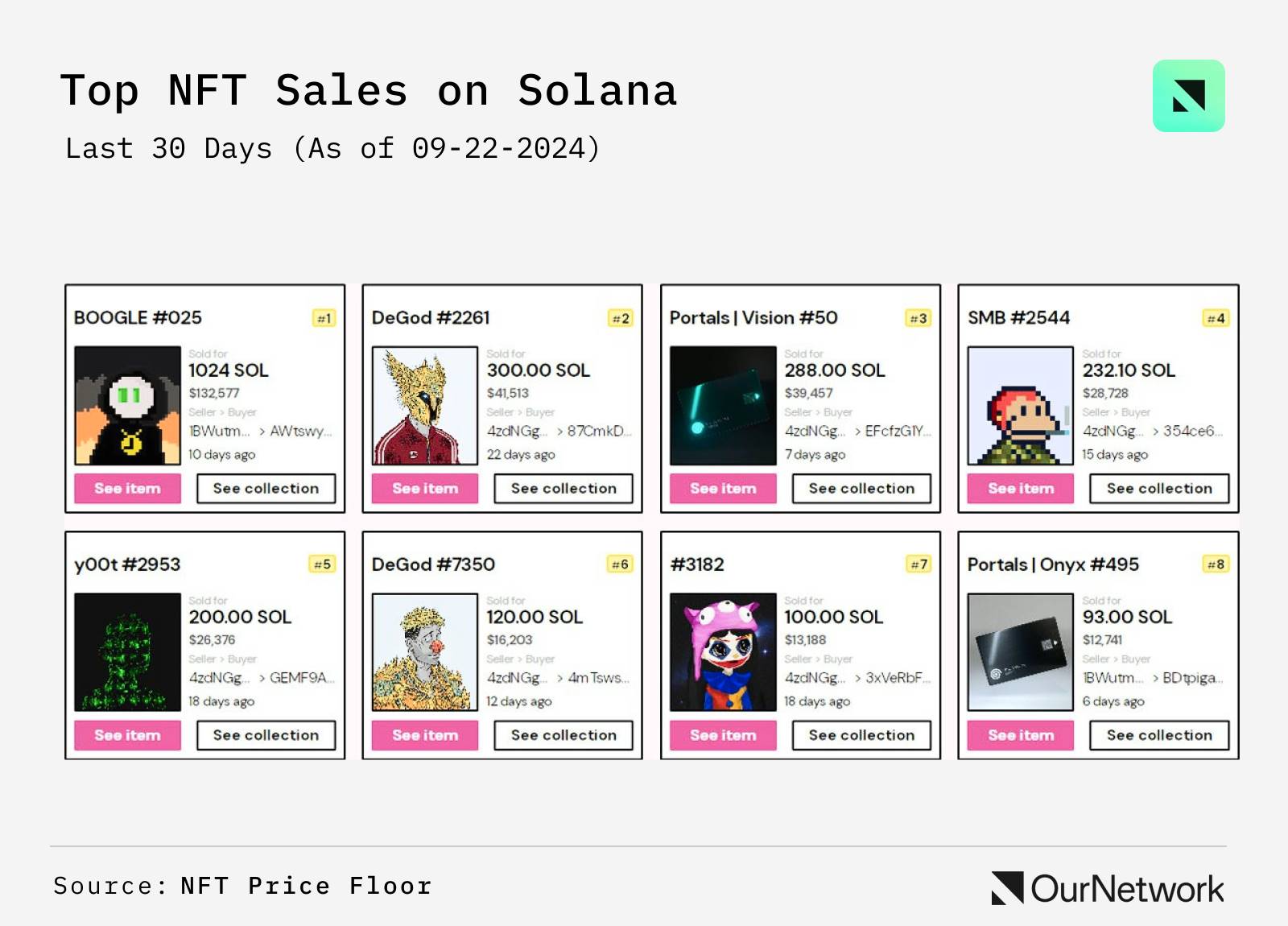
  • 在过去的30天里,前四大区块链的 NFT 总交易量超过了3亿美元。其中,以太坊占42%,Solana 占23.5%,比特币占18%,Polygon 占16.5%。尽管以太坊的市场份额相比前几年有所下降——在2023年时约占70%——它仍然在高端 NFT 市场中占据主导地位。比如,在这段时间内的前30笔销售(不包括 1-of-1 NFT)中,以太坊占据了29个席位,而 Solana 仅占1个。值得一提的是,这些以太坊销售中的前三名都是 CryptoPunks,其中一个具有猿特征,两个具有僵尸特征,每个售价都超过100万美元。

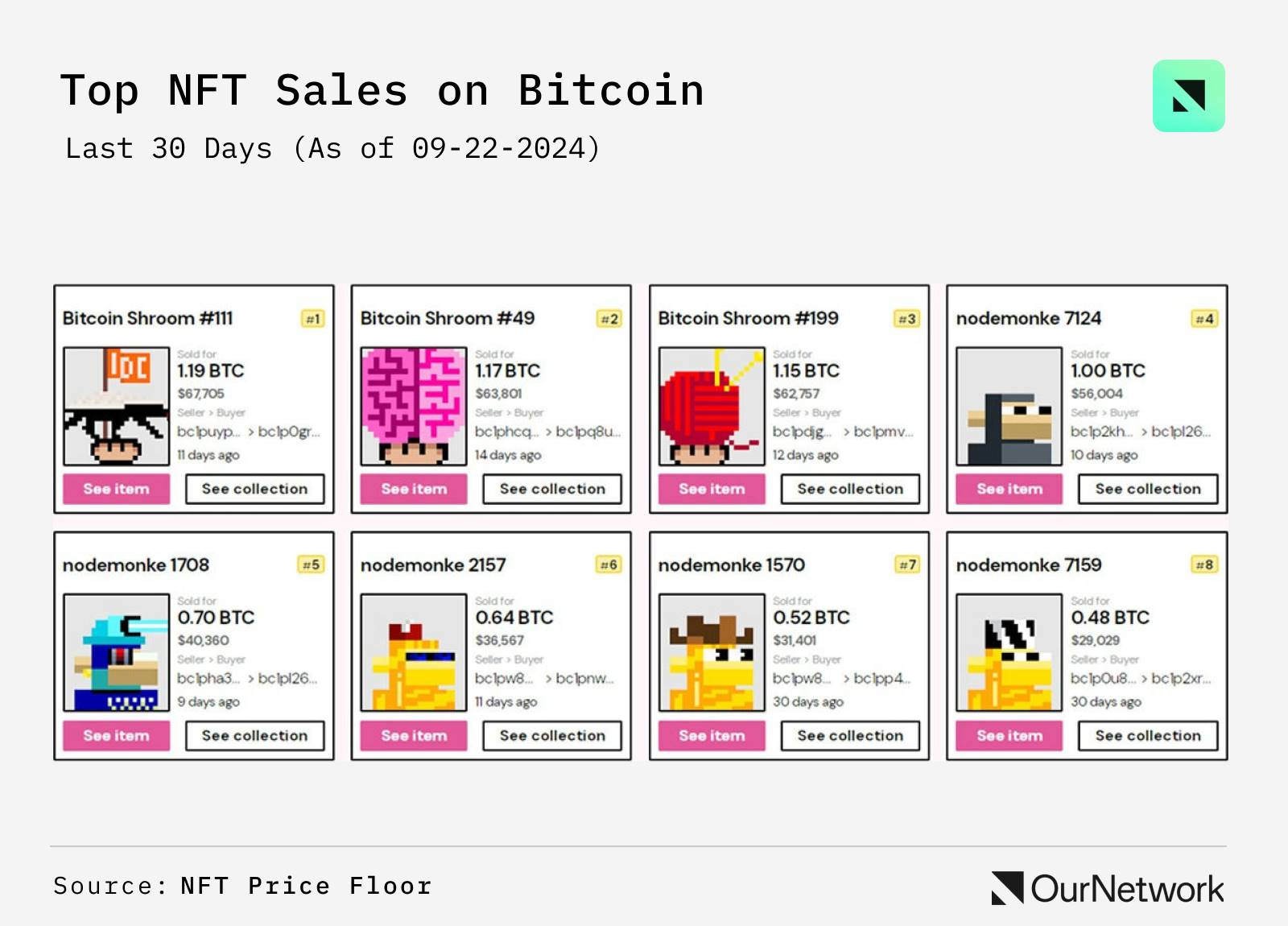
  • 作为对比,在过去 30 天内,Solana 的前 30 笔销售中,仅有 1 笔超过 100,000 美元。13% 的销售额落在 30,000 到 40,000 美元之间,而 84% 的销售额则在 10,000 到 15,000 美元之间。至于比特币,其前 4 笔销售均在 60,000 到 65,000 美元之间,20% 的销售额在 25,000 到 40,000 美元之间,66% 则约在 20,000 美元。

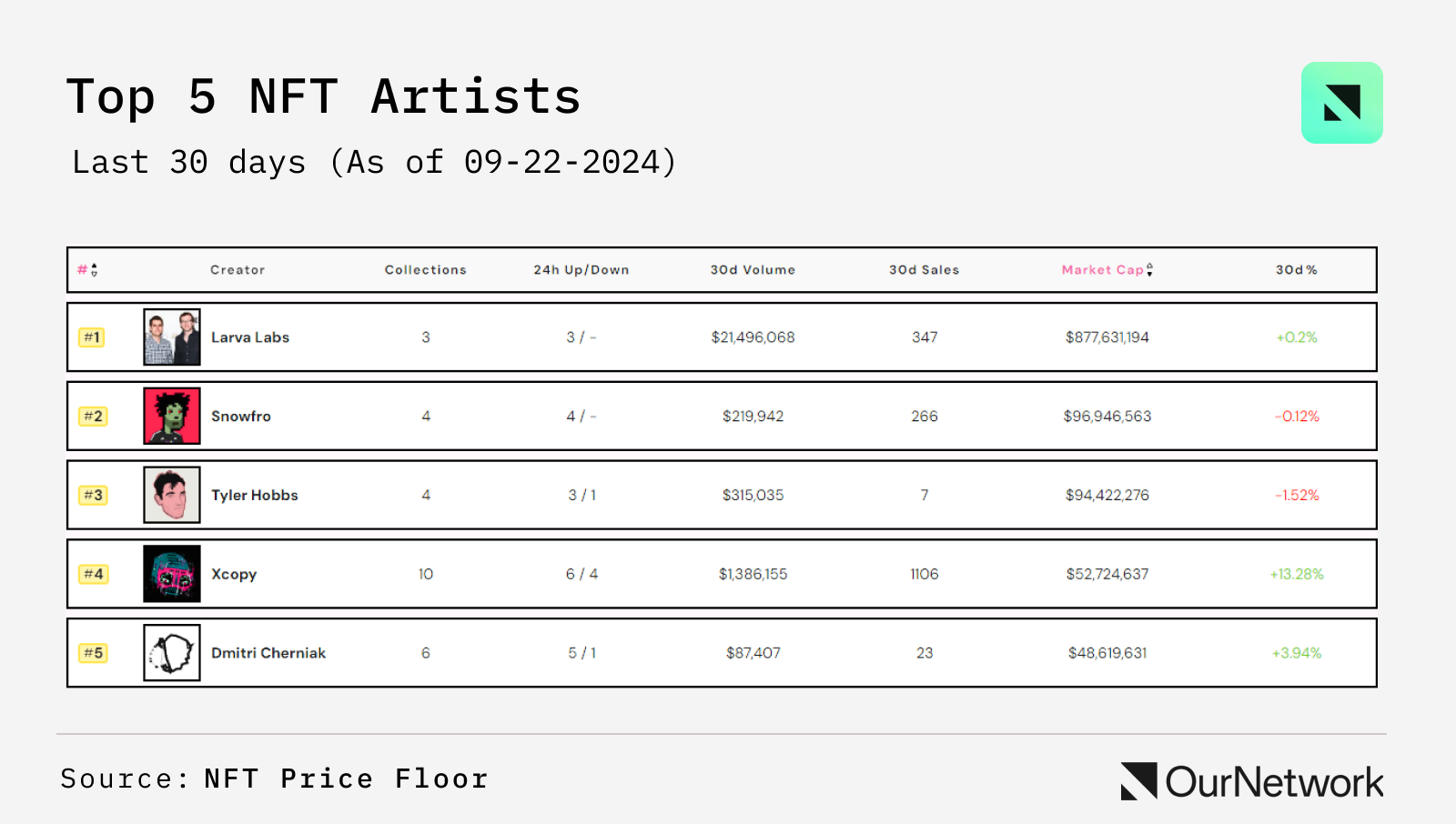
  • 在上个月的前30笔销售中——不包括 1-of-1 类型——有23个出自 Larva Labs,Dmitri Cherniak 和 Tyler Hobbs 各占1个。这两位艺术家在 1-of-1 收藏领域中经常是顶级卖家。根据 NFT Price Floor 的艺术家排名,该排名按艺术家收藏的市值进行排序,XCOPY 这位 NFT 艺术家以市值增长13%而脱颖而出,跻身前四名。

  • 交易亮点:XCOPY 在 NFT Price Floor 艺术家排名的上升,体现了收藏家和去中心化自治组织(DAO)对特定艺术家和风格的热情关注。一个典型的案例是 Artifaction² 最近以 55 ETH 购买了 The Doomed,这笔交易成为 Known Origin 版本中十大最昂贵的销售之一。这类交易促进了 XCOPY 的市场增长,进一步巩固了他在 NFT 领域中作为顶尖艺术家的地位。

Mad Lads

h4wk | Website | Dashboard

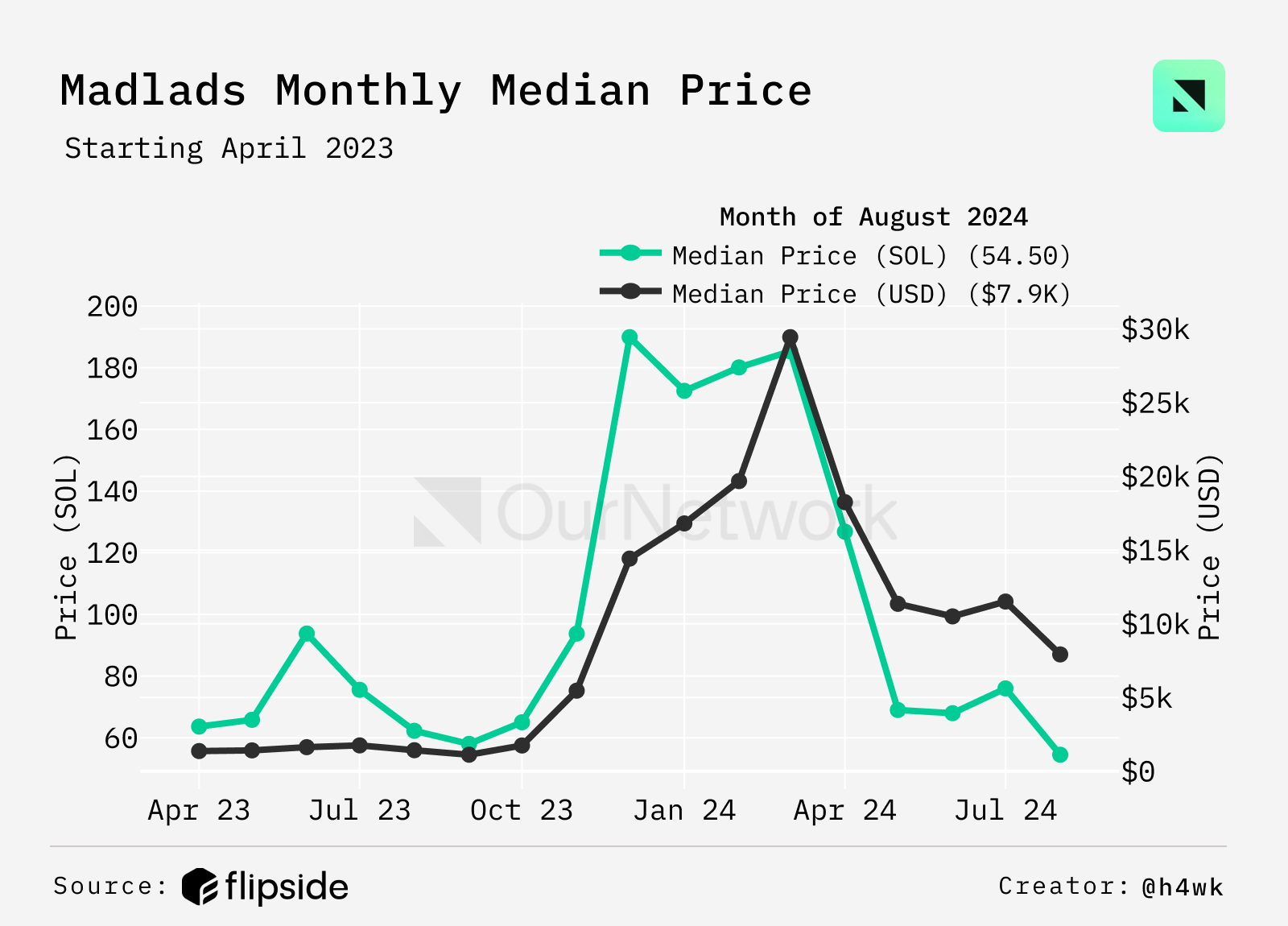
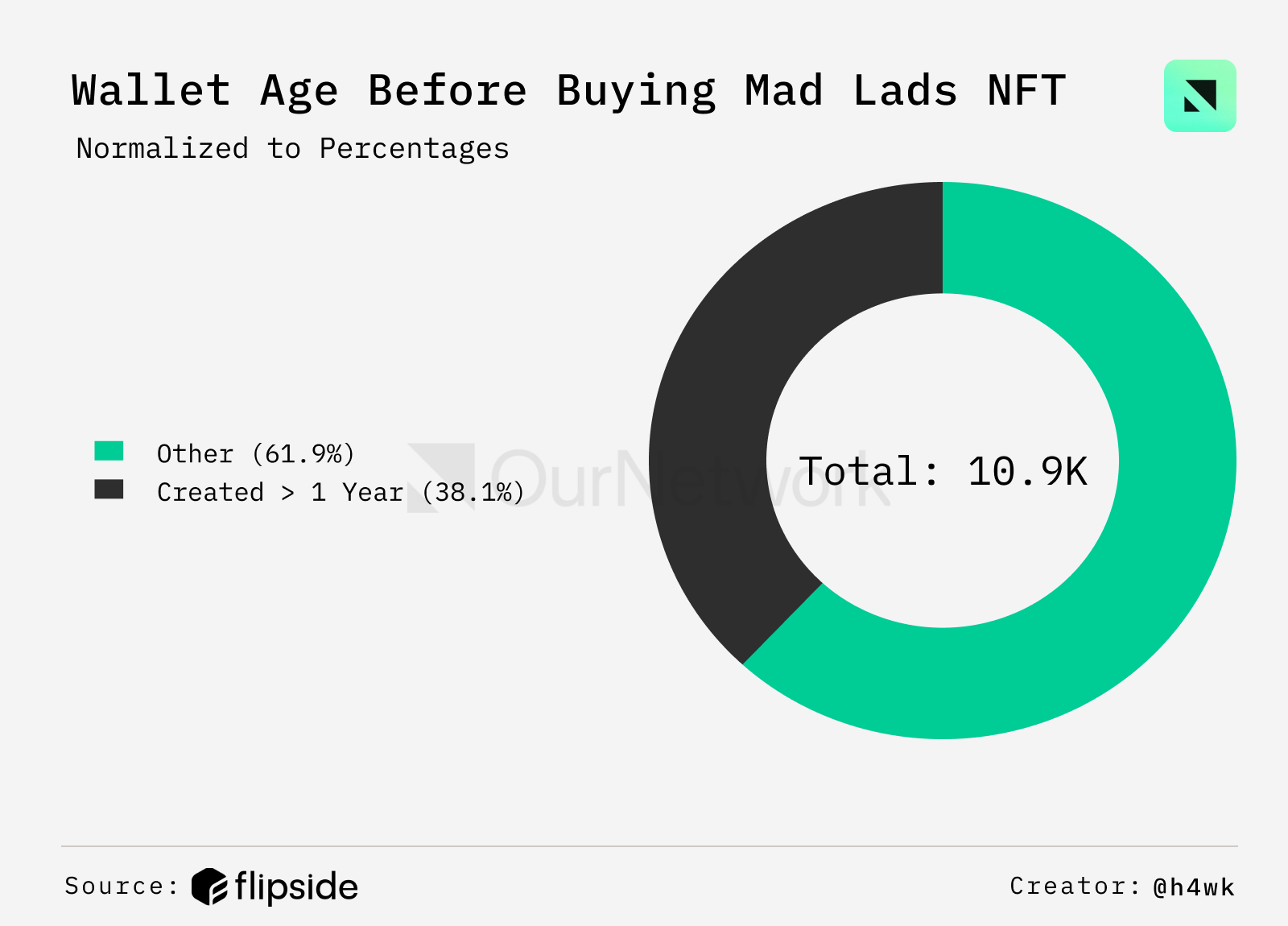
Mad Lads 的价格在 3 月达到了顶峰 29,400 美元,其中38% 的持有者也是持有 Claynosaurz 的 Solana 老用户。

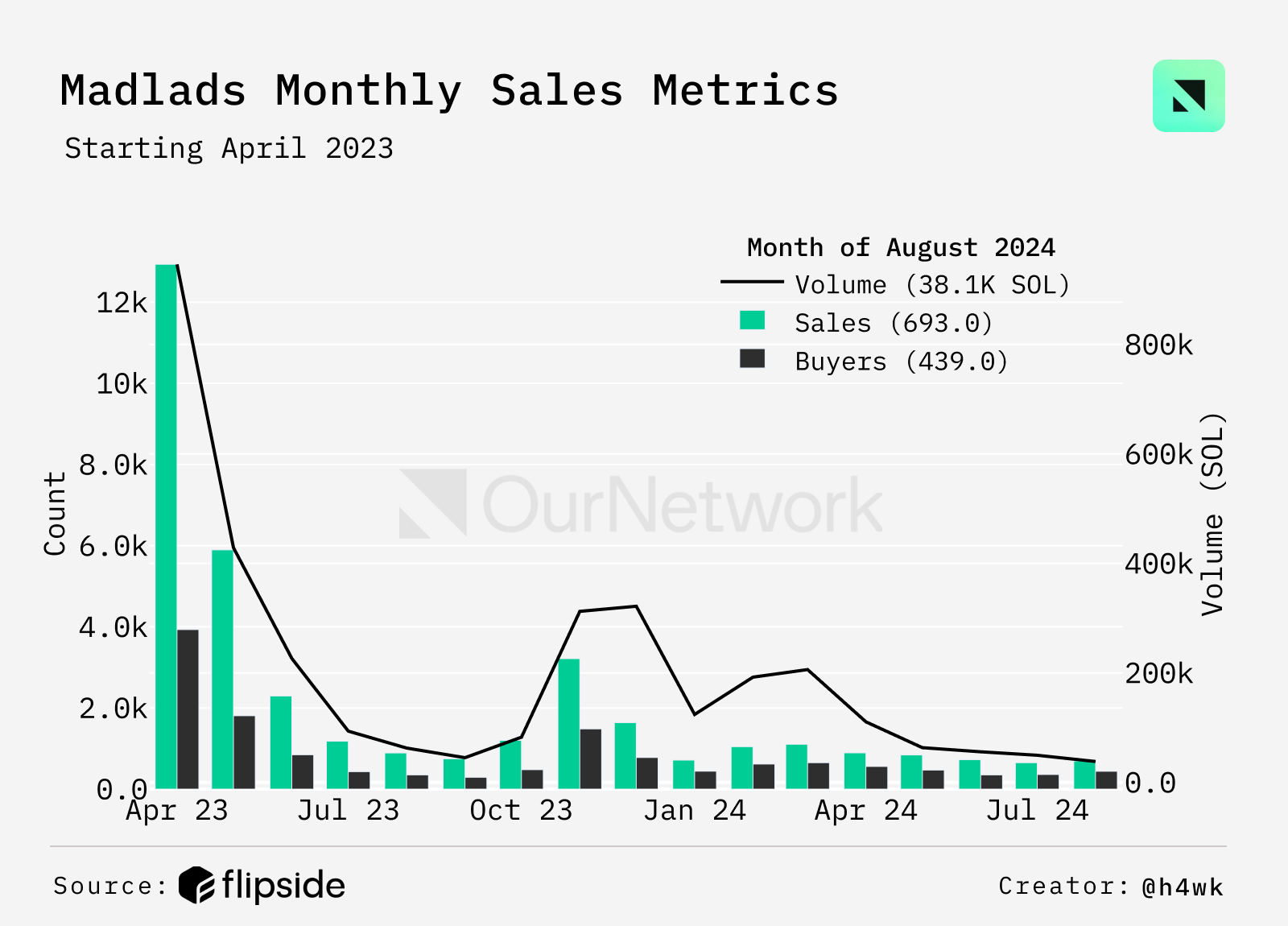
  • 在 Mad Lads 于 2023 年 4 月发布后的第一个月中,有 3,900 名买家推动了 946,000 SOL 的交易量,按当前价格计算约为 1.37 亿美元。从 2023 年中期开始,Mad Lads 的价格从接近 100 SOL 的高点下滑,但在 2024 年 3 月回升至中位价 185 SOL(当时约为 $29,440),随后在 2024 年 8 月降至并稳定在 61 SOL(约 $8,200)。目前,Mad Lads 的价格是其第一个月价格的 6.25 倍(以美元计)。

  • 38% 的 Mad Lads 持有者是在购买 NFT 之前就创建的钱包进行购买的——这表明,Mad Lads 的购买中有相当大的一部分来自长期的 Solana 用户,显示出他们对网络的忠诚和深度参与。

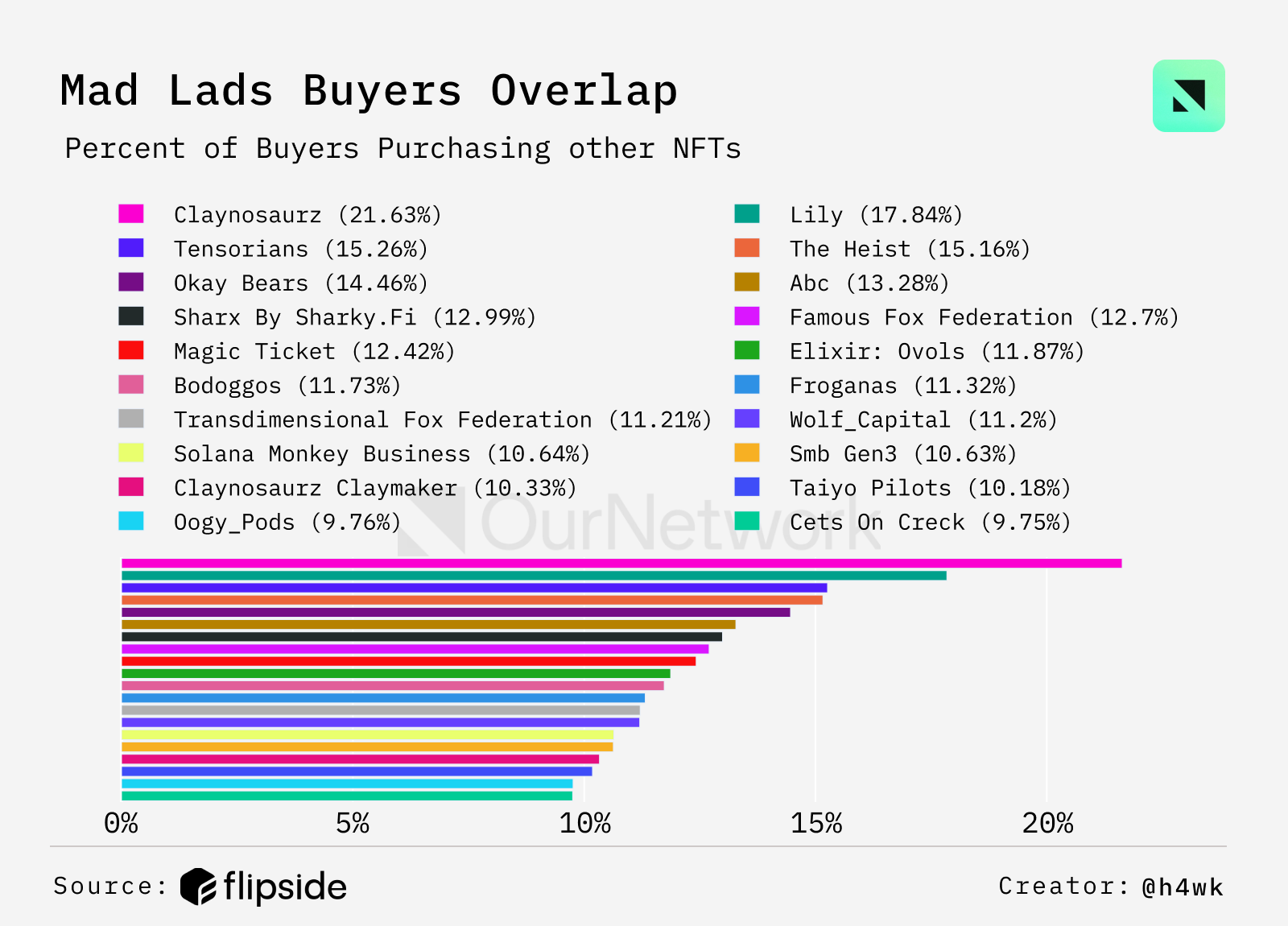
  • 分析 Mad Lads 持有者的其他 NFT 收藏时,可以发现 Claynosaurz 收藏的重叠率达到 21.67%。其他 notable 的交集包括 Lily、Tensorians、The Heist 和 Okay Bears,它们的重叠率在 14% 至 18% 之间。

Pudgy Penguins

Maus | Website | Dashboard

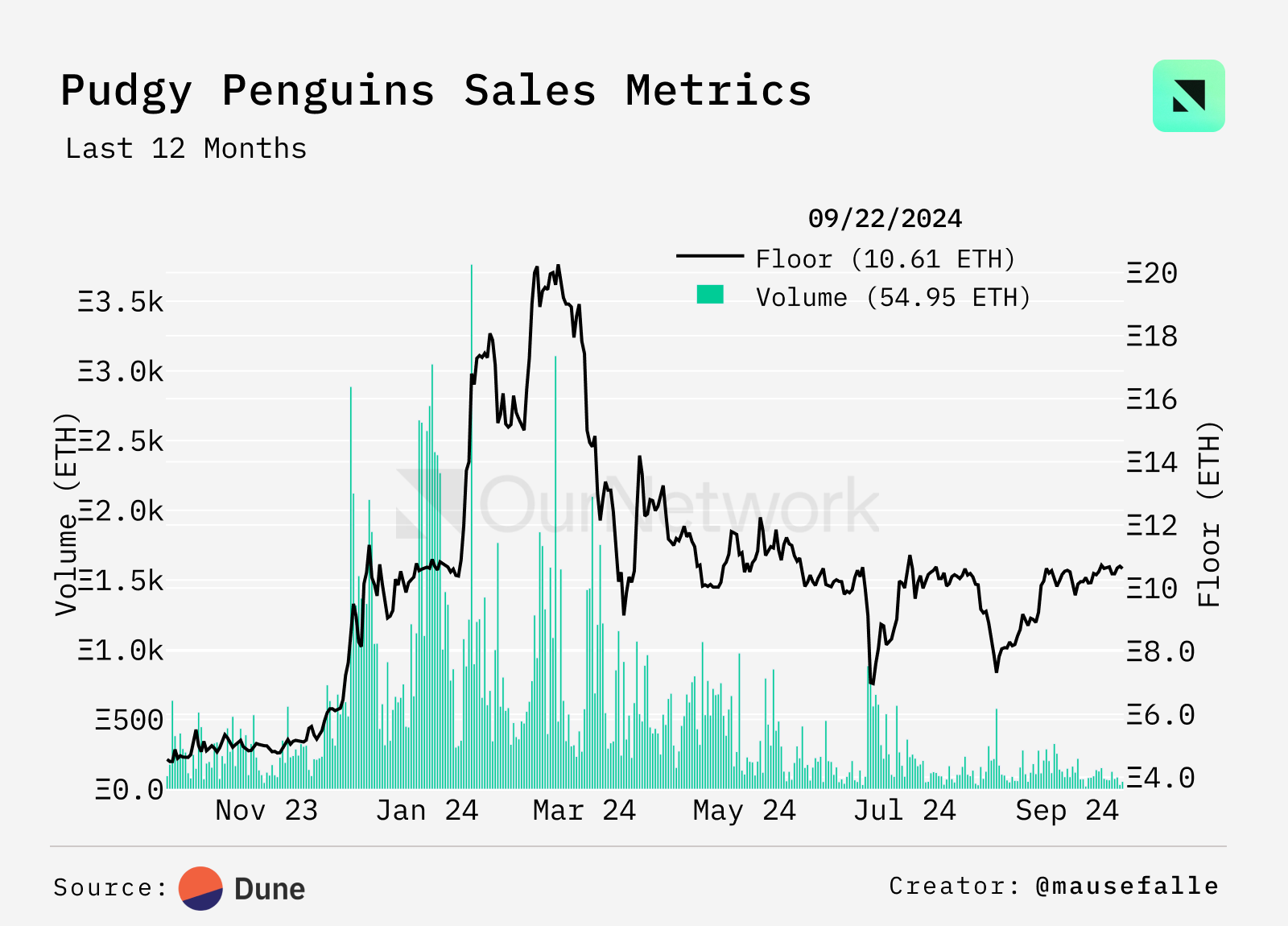
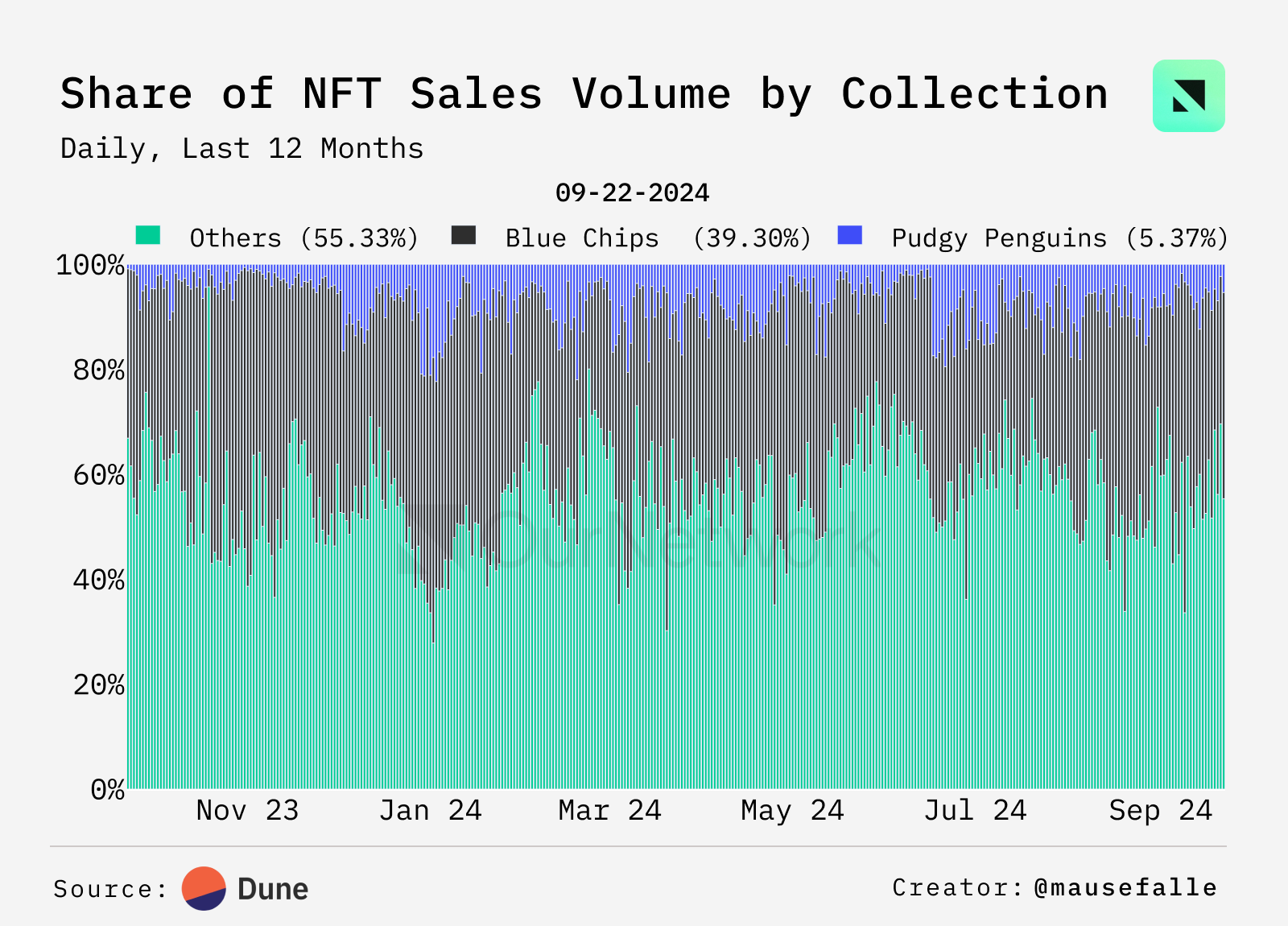
Pudgy Penguins 目前占所有 NFT 交易量的十分之一

  • Pudgy Penguins 目前是所有链上市值第三大 NFT 收藏。自 2021 年 7 月上线以来,Pudgys 持续扩大市场份额,自 2023 年 12 月以来,始终占据以 ETH 计价的 NFT 交易量的 5% 到 15%。这与 20 ETH 的价格峰值相对应,随后出现了下跌。自 2024 年 4 月以来,Pudgys 的最低价一直徘徊在 10 ETH 左右,这在距离历史最高价的百分比上显著更高于其他“蓝筹” NFT 收藏。

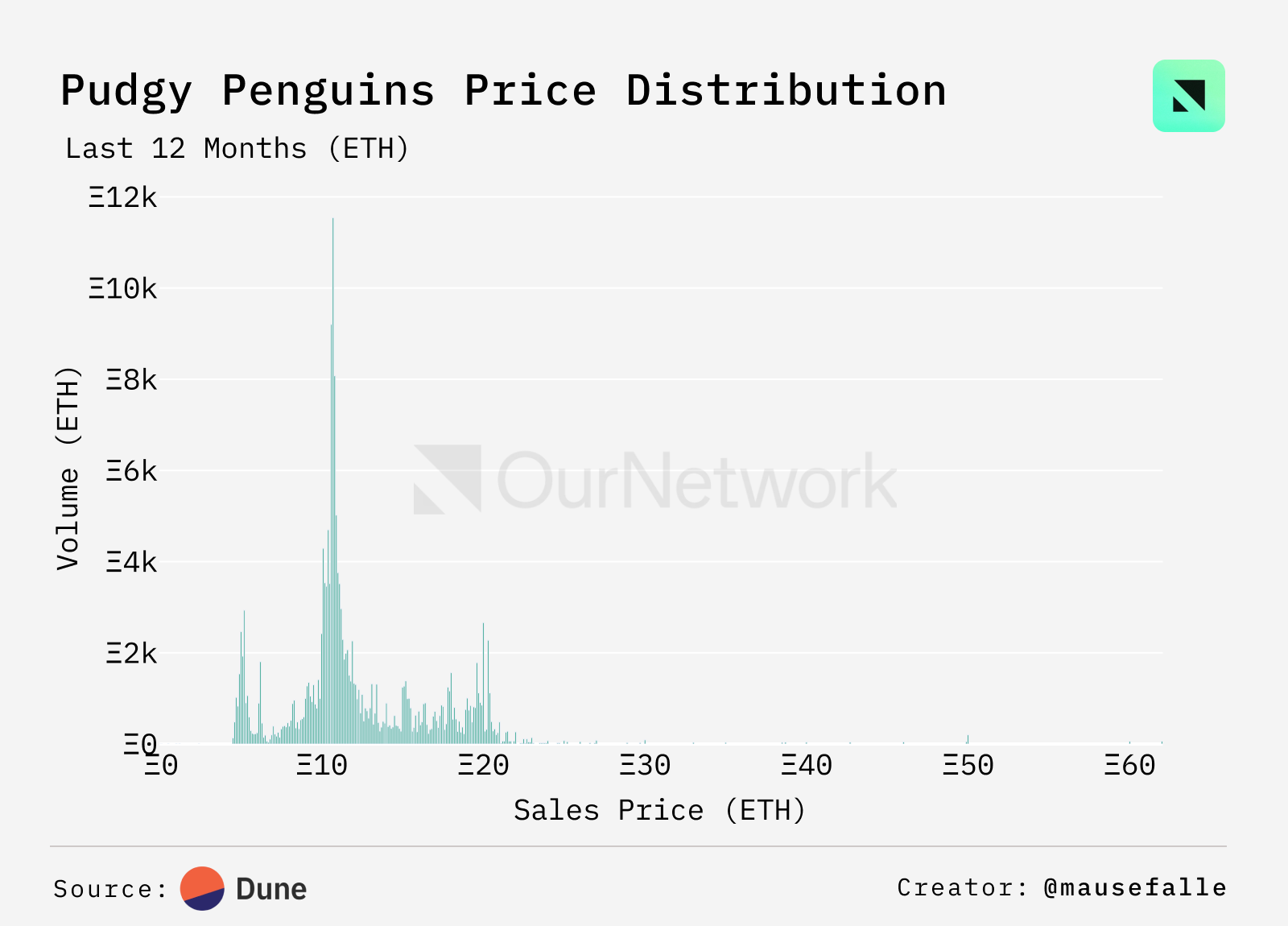
  • 在过去的 12 个月中,在 10 ETH 的价格点发生了大量销售,表明市场对 Pudgys 当前底价的强烈共识。此外,5.9 ETH 和 19.9 ETH 附近也出现了小幅波动,显示出次级价格集中。

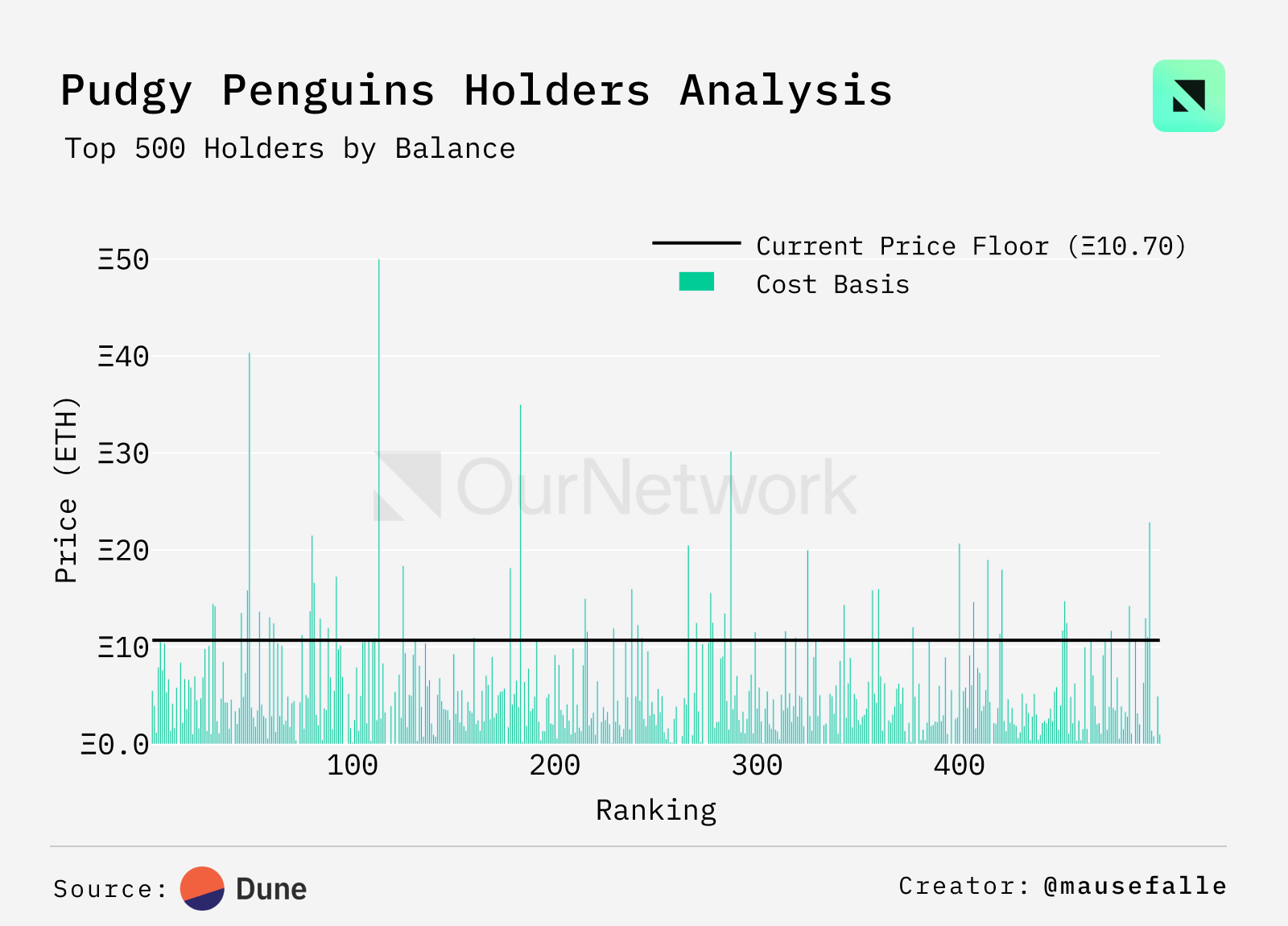
  • 许多持有者的成本基础远低于当前价格(黑线),这表明大多数持有者处于盈利状态。一些持有者的成本基础则远高于其他,最高可达 40 ETH,这意味着他们购买了“稀有”的 Pudgys。

  • 交易亮点:这笔价值 150 ETH 的 Pudgy 销售于 2024 年 3 月进行,是该 NFT 收藏历史上前 5 大销售之一,也是今年最大的销售。

NodeMonkes

TylerD | Website | Dashboard

NodeMonkes 反弹 80%,引领 Ordinals 回暖

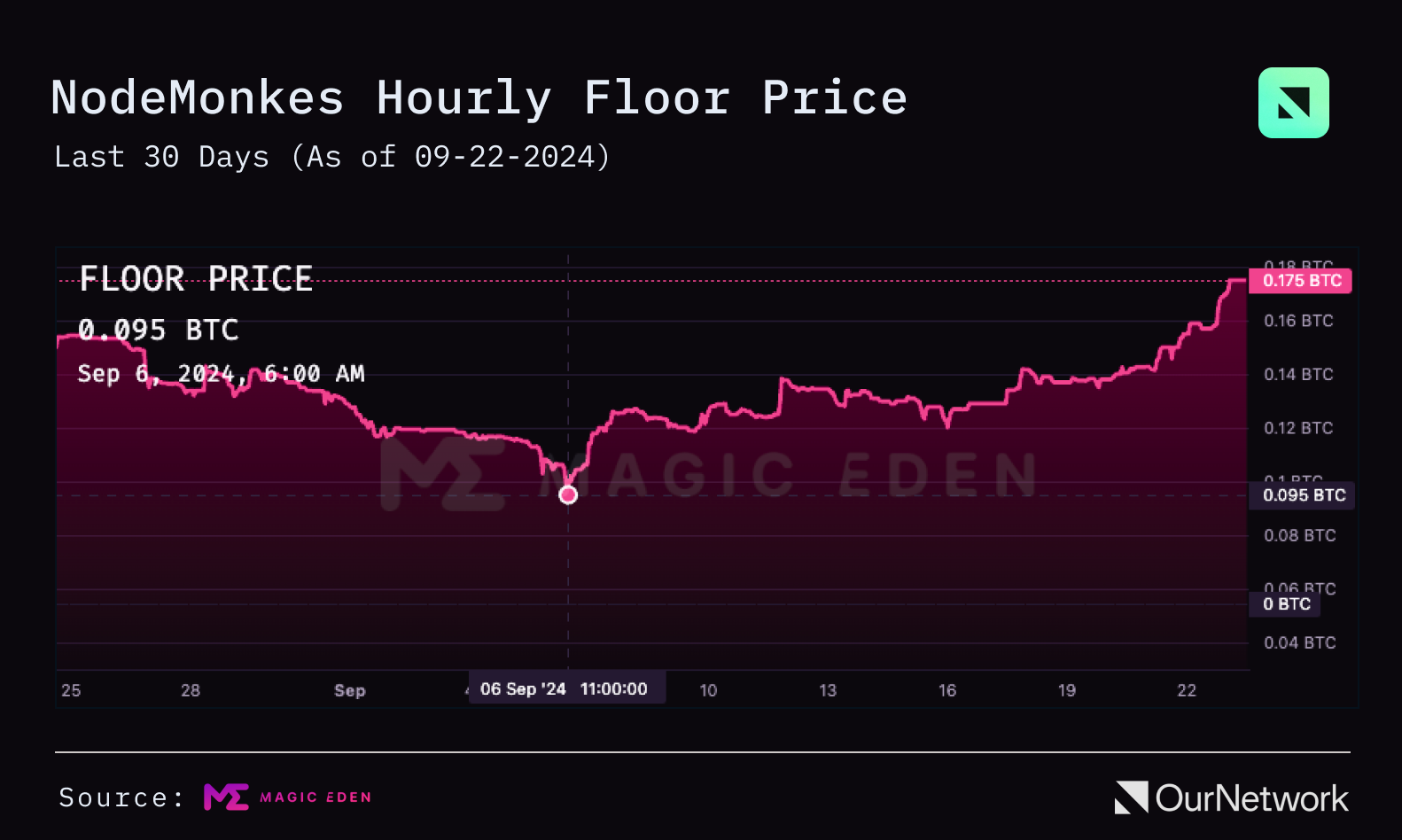
  • 夏季对 Ordinals 来说是不景气的,领先的收藏经历了 70% 甚至超过 80% 的下跌。然而,有迹象表明底部可能已经形成——NodeMonkes 在 Ordinals 中引领了一轮反弹,目前从 9 月 6 日的 0.095 BTC 的局部低点上涨了 94%。它们现在的价格为 0.18 BTC,这是自 6 月 20 日以来的最高水平——有效地弥补了整个夏季的下跌。

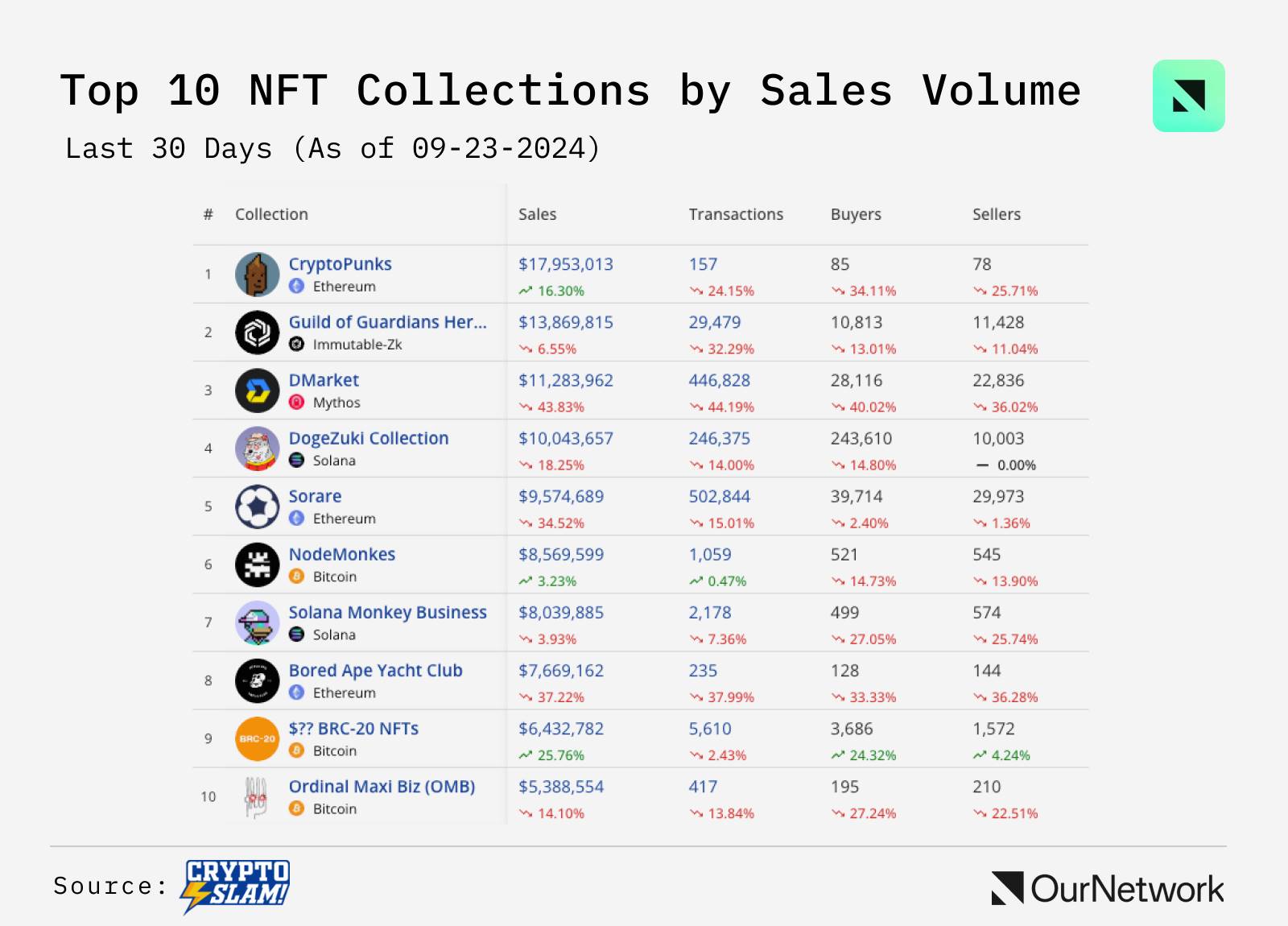
  • 跨区块链 NFT 交易量指标反映了对 NodeMonkes 的需求。根据 Cryptoslam 数据,NodeMonkes 在过去 30 天内的 NFT 交易量排名第 6,交易额为 860 万美元。它们是比特币上交易量最大的收藏,领先幅度为 58%,并且在所有以太坊 NFT 中仅次于 CryptoPunks。

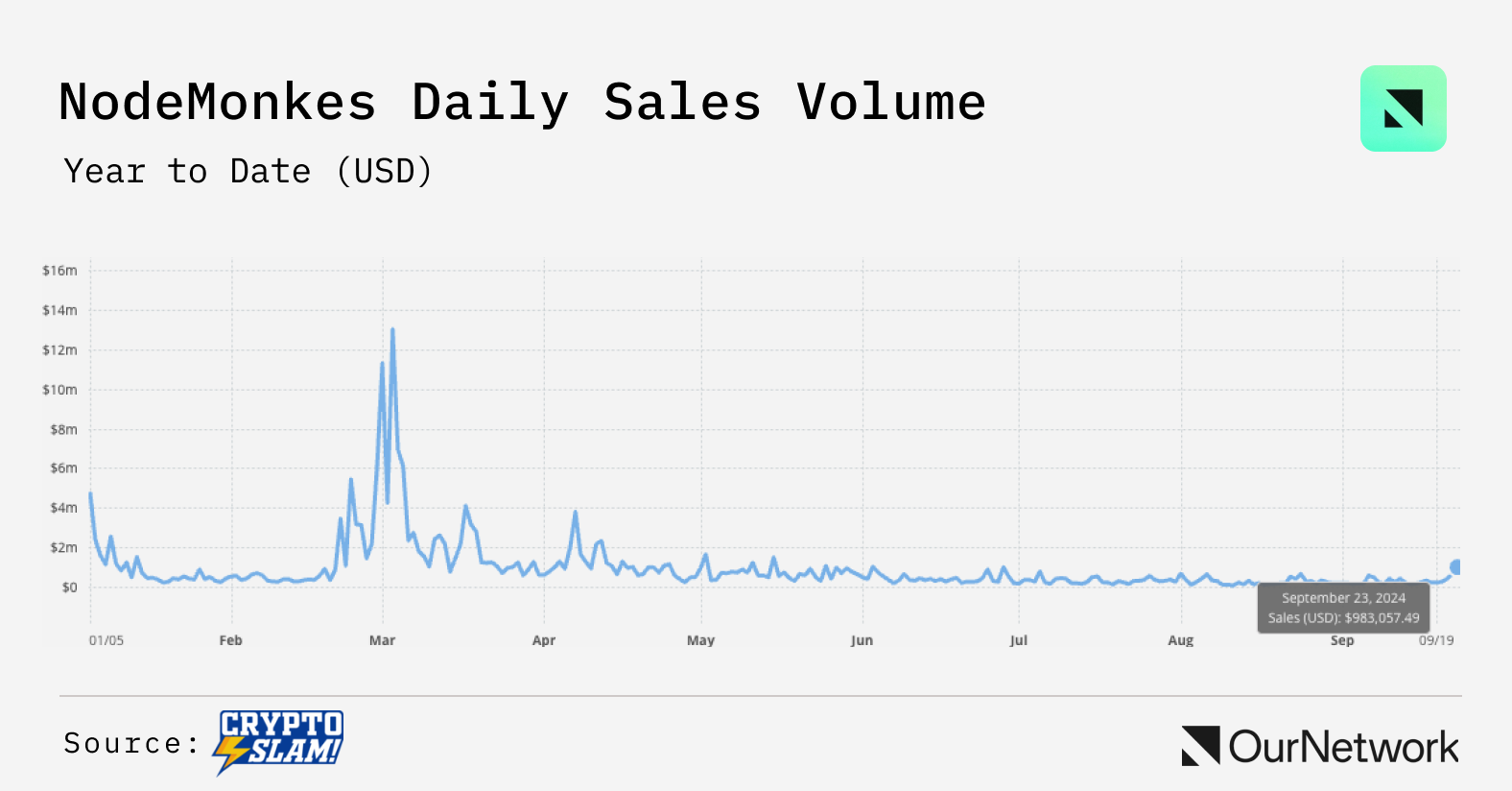
  • 不仅底价处于局部高点,交易量也是如此。NodeMonkes 在 9 月 23 日的单日交易量达到近 100 万美元,具体为 983,057 美元。这是自 6 月 28 日以来的单日最高,几乎是 3 个月来的最高记录。

  • 交易亮点:NodeMonkes 的价格持续高于底价。在 11 天前,一只单特征的 NodeMonke 以 1.02 BTC(57,600 美元)售出,是当时底价的 8 倍。在过去一个月中,还有四只 NodeMonkes 的售价达到 0.4 BTC(26,000 美元)或更高,价格范围从 0.4 BTC 到 0.714 BTC。其中三只 NodeMonkes 拥有备受追捧的“金色”皮肤特征,而售价 0.714 BTC 的 Node 被认为是该收藏中第 8 稀有。这些高于底价的销售显示了真正收藏家的需求,并且表明 NodeMonkes 的整体健康。

CryptoPunks

Geebz | Website | Dashboard

Punk 自 8 月初低点以来上涨超过 45%

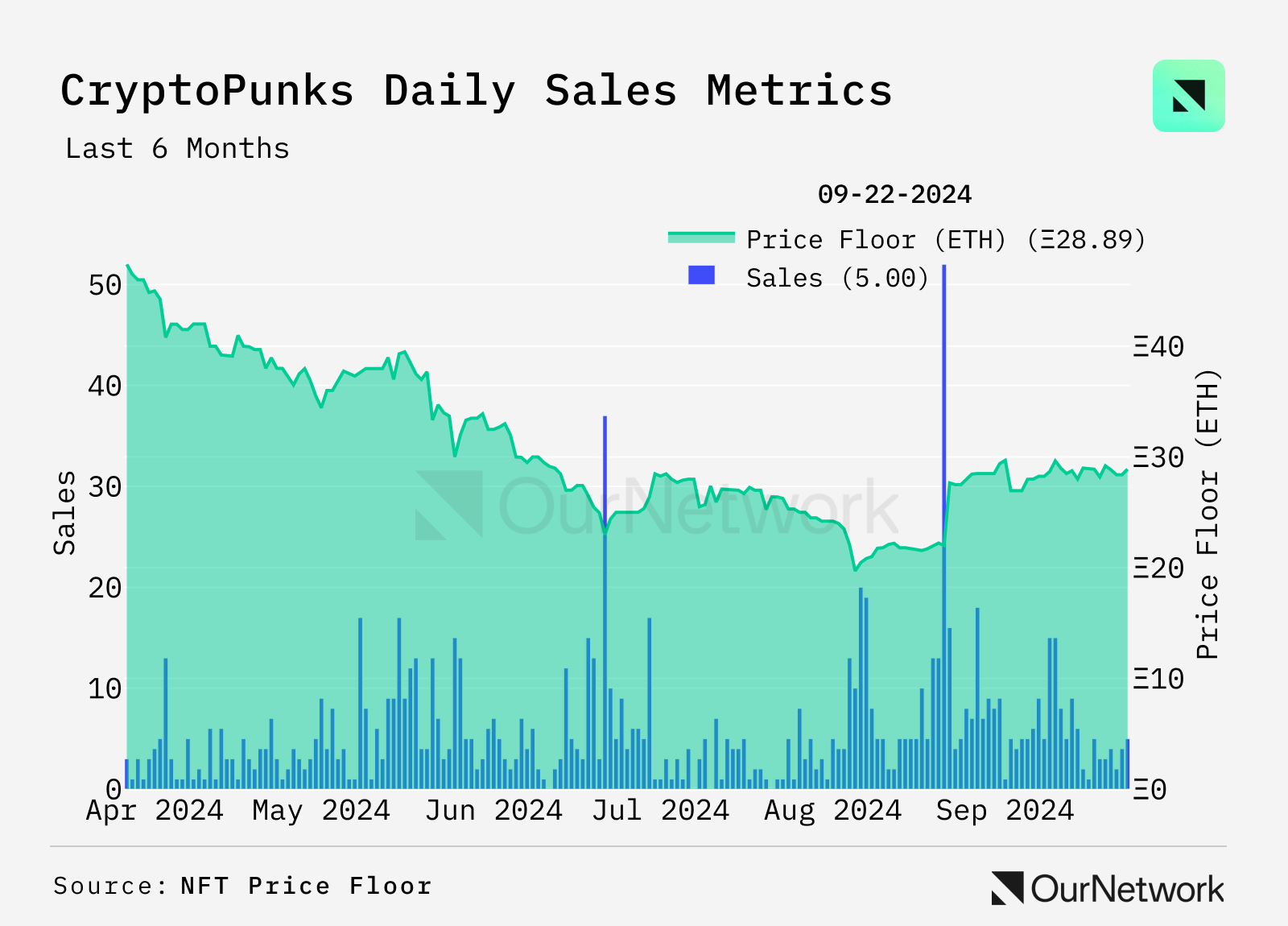
  • CryptoPunks 在 8 月 4 日创下了 19.7 ETH 的局部低点,此前 Punks 收藏和更广泛的 NFT 市场经历了一年艰难的市场。然而,截至 9 月 22 日,底价已反弹 46.6%,达到了 28.89 ETH。该收藏仍然下跌近 75%,与 2021 年 10 月创下的历史最高价 113.9 ETH 相比。

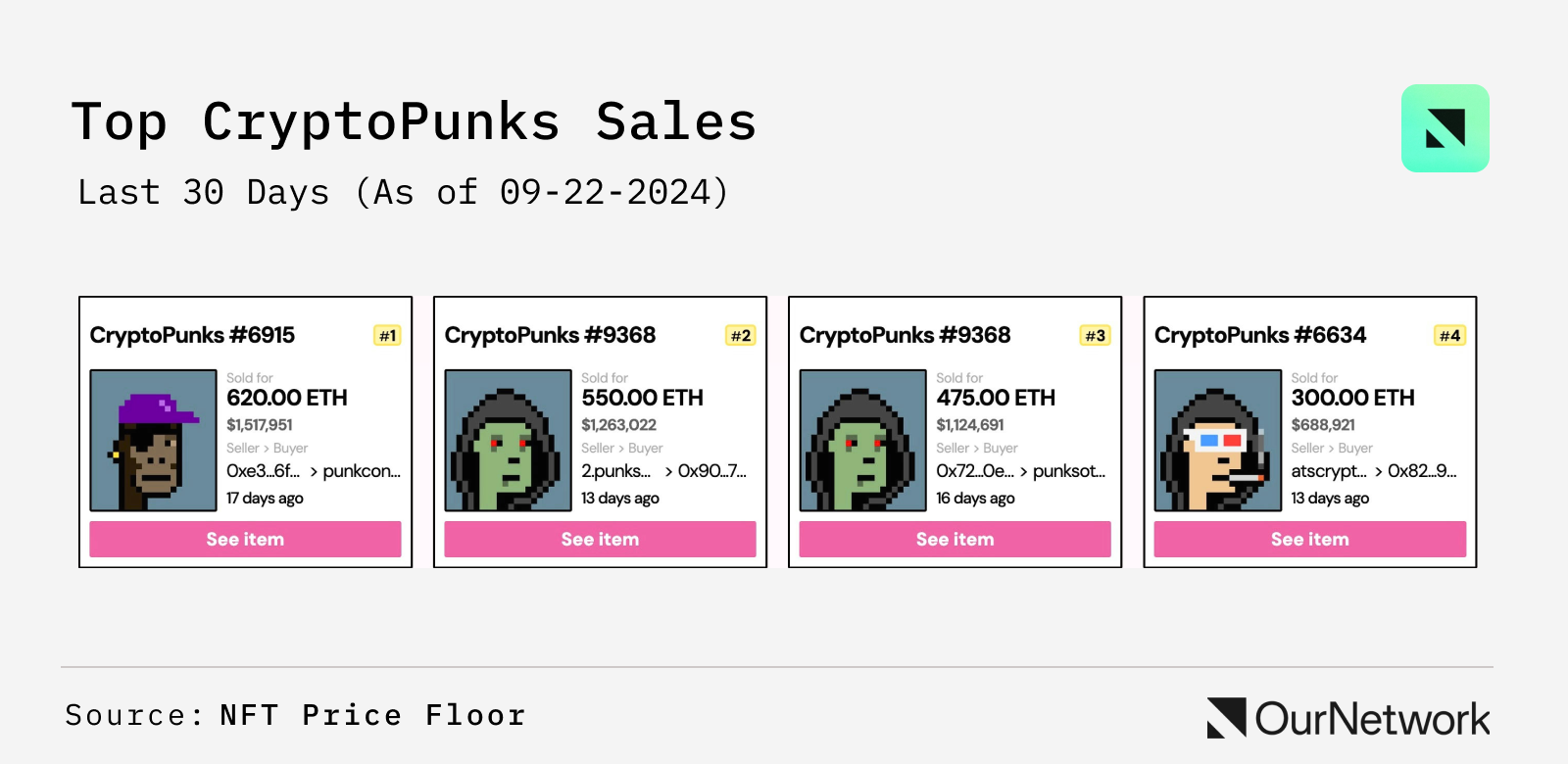
  • 在过去的 30 天里,发生了几笔引人注目的 Punk 销售,其中包括一只以 620 ETH(超过 160 万美元)成交的 Ape,这意味着自 2022 年 9 月以来的首次 Ape 销售。一只带有僵尸和连帽衫特征的 Punk 被购买后,在三天内转售获利 75 ETH。此外,名为 0x_b1 的加密市场“鲸鱼”以 300 ETH 购得了一只戴着 3D 眼镜的 Hoodie Punk。

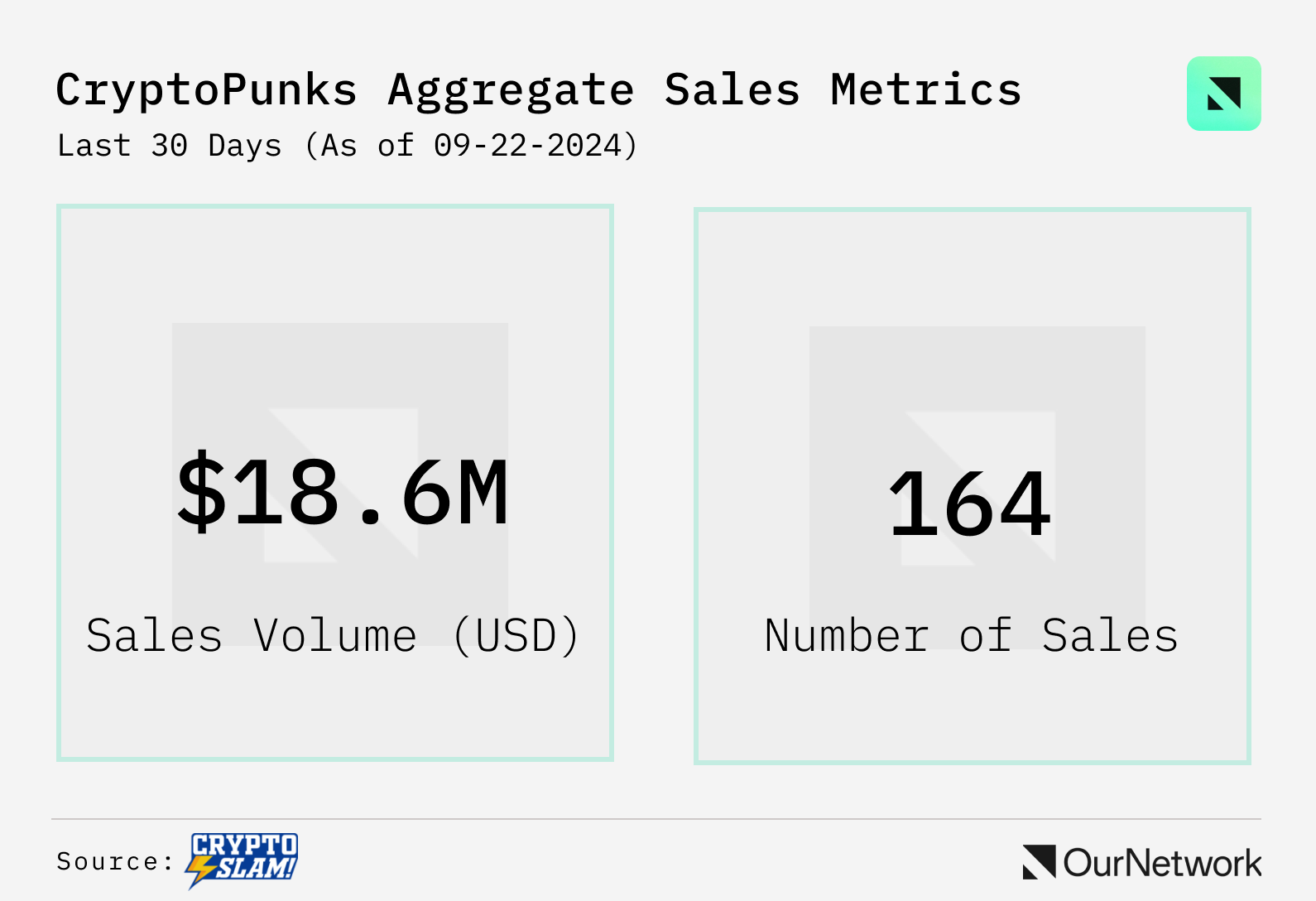
  • 在过去的 30 天里,总共进行了 164 笔 Punk 销售,总额超过 1850 万美元。最繁忙的一天是 8 月 20 日,销售超过 350 万美元。交易包括所有三个层级——珍品、中档和底价——尽管价格合理的中档产品受到了广泛关注。

  • 交易聚焦:一笔令人惊讶的 CryptoPunk 交易出现,Ape Punk #2386 仅以 10 ETH 成交。该资产最初在现已关闭的平台 Niftex 上进行了分拆,买家利用了每股 0.001 ETH 的买断协议。在为期 14 天的股东拒绝期后,该提议获得批准。这笔交易突显了在监控人数较少时,分割资产的风险,使其成为近期最备受瞩目的 Punk 交易之一。

Milady Makers

Honz | Website | Dashboard

自价格发现以来,从最低价下跌了约 45%

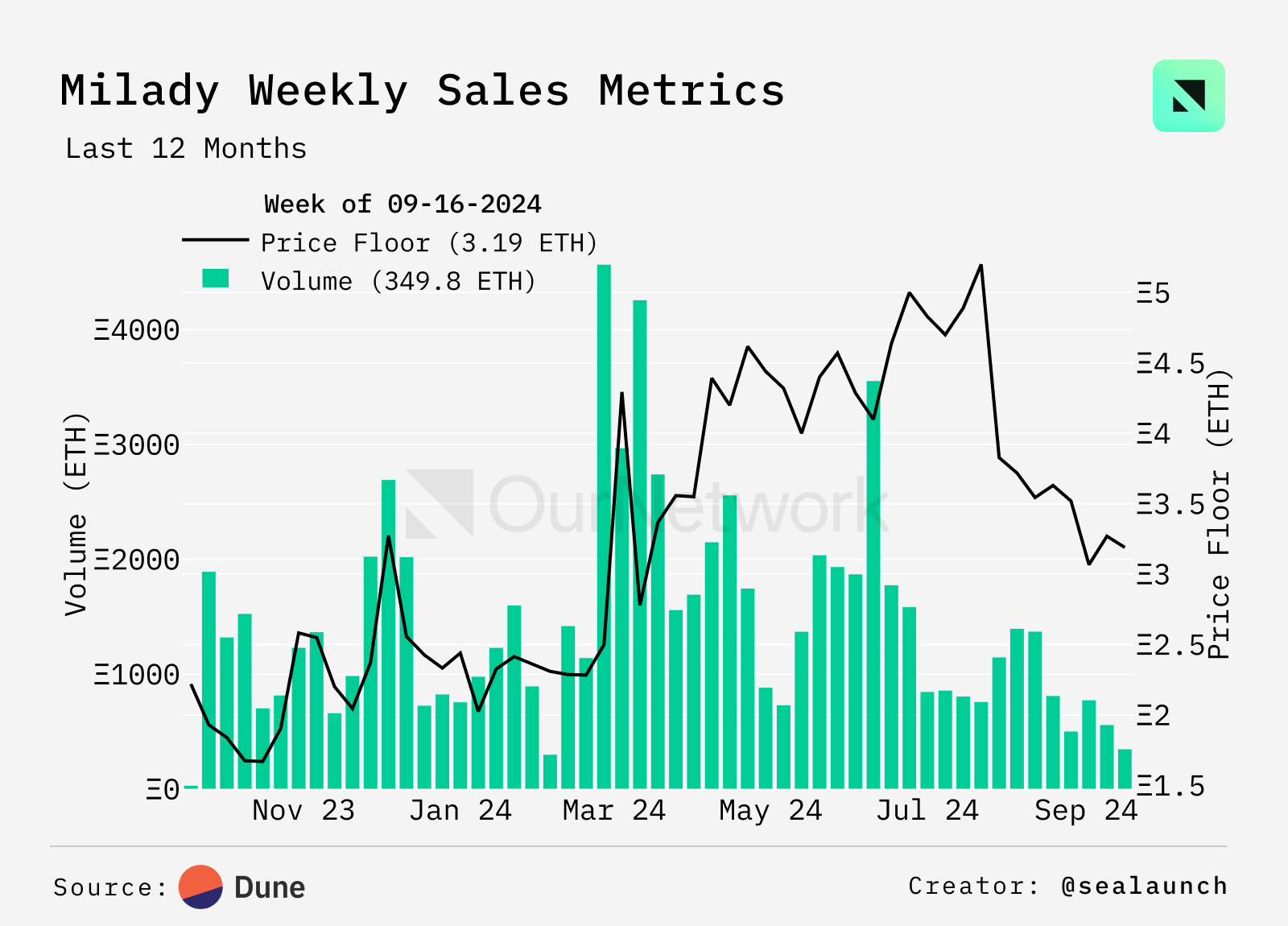
  • NFT 空投的趋势,即持有 NFT 能带来空投的概念,大大促进了 Milady NFT 系列的发展。在短短两个月内,Milady 就有资格获得来自 Ethena、Omni 和 zkSync(还有 Pudgy Penguins)的三次重要空投,这使得价格上涨,因为买家期待着进一步的“免费代币”。然而,距离 Milady 持有者上次获得免费代币空投已经将近三个月,这可能是导致该系列价格和交易量下滑的原因之一。

  • 尽管最低价大幅下降,排名前 100 的 Milady 持有者似乎毫不在意,因为他们在过去 30 天内没有减少自己的 Milady NFT 持有量。

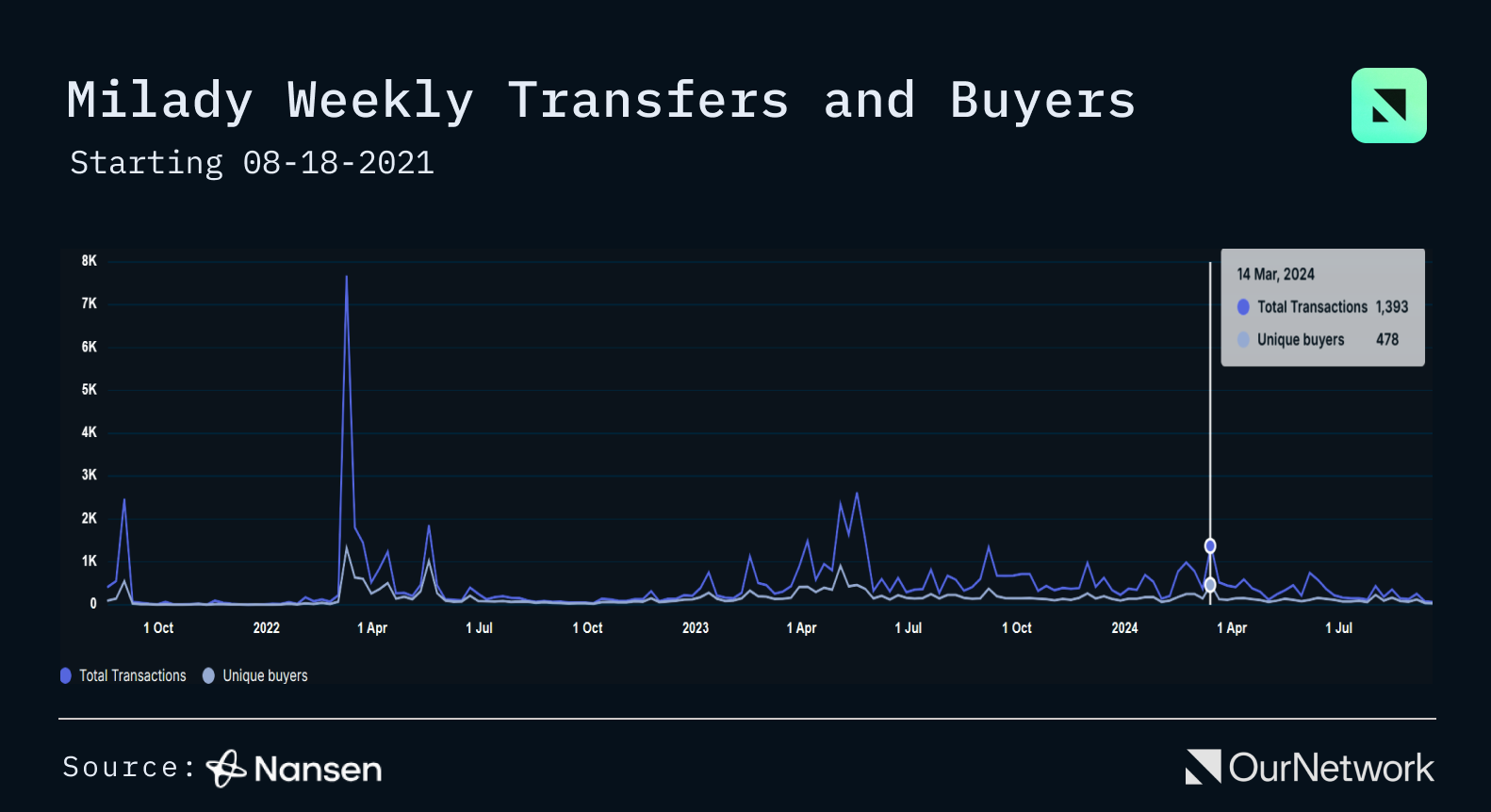
  • 自年初达到峰值以来,Milady 的交易量和独立买家数量持续下降。然而,Remilia 生态系统代币 $CULT 在预售期间筹集了 2000 万美元,这可能会激活交易活动和兴趣——每个 Milady 都有资格获得价值约为 2300 USDT 的空投。

Related Reads

New AMD Paper Overturns Conventional Wisdom: FP4 Training Instability's Cause Is Not Insufficient Randomness

AMD's new research challenges the conventional understanding of FP4 training instability. While reducing precision from FP8 to FP4 promises doubled computational throughput and is supported by new hardware like NVIDIA Blackwell and AMD MI350 series, training large language models natively with FP4 has been notoriously unstable, often attributed to insufficient stochasticity. The paper "Pretraining large language models with MXFP4 on Native FP4 Hardware" demonstrates successful end-to-end FP4 pre-training of Llama 3.1-8B on AMD MI355X GPUs using the MXFP4 format, achieving a 9-10% overall speedup over FP8. Crucially, it identifies the root cause of instability: not randomness, but the accumulation of *structural micro-scaling errors* along the sensitive weight gradient (Wgrad) path. Through controlled experiments, researchers found that quantizing the Wgrad operation to FP4 caused significant convergence degradation. Counterintuitively, common stochasticity-based mitigation techniques like stochastic rounding and randomized Hadamard transforms worsened performance. In contrast, applying a *deterministic* Hadamard transform successfully stabilized training by ensuring consistent error patterns, reducing the extra token cost from 26-27% to just 8-9%. This work has significant implications: 1) It provides a clear diagnostic for low-precision training instability, steering focus towards structural errors. 2) It pushes FP4 from a primarily inference-focused format into the realm of viable training. 3) It leverages the open OCP Microscaling (MX) standard, promoting cross-vendor compatibility. The research marks a critical step towards more economical large model training by further pushing the boundaries of low-precision computation.

marsbit8m ago

New AMD Paper Overturns Conventional Wisdom: FP4 Training Instability's Cause Is Not Insufficient Randomness

marsbit8m ago

Will ONDO's 'Tokenization Narrative' Change After Its CEO's Unexpected Passing?

Ondo Finance founder and CEO Nathan Allman has passed away unexpectedly. Allman, a Brown University graduate with a background in private credit and Goldman Sachs' digital asset team, was a key architect of Ondo's pivot from DeFi structured yield products to becoming a leading Real-World Asset (RWA) protocol. He drove the strategy to tokenize traditional financial assets like US Treasuries (OUSG), yield-generating dollar assets (USDY), and US stocks/ETFs (Ondo Global Markets) for on-chain accessibility. The company announced that President Ian De Bode, a former McKinsey partner with a strong institutional strategy and operations background, will succeed Allman as CEO. While Allman's sudden departure presents a near-term challenge, testing market confidence and Ondo's continuity, the project is seen as more than a founder-driven narrative. It has an established product suite and a management team with deep traditional finance experience. The long-term impact hinges on the new leadership's ability to execute. De Bode's expertise in compliance, distribution, and institutional partnerships aligns with RWA's next phase of scaling infrastructure. The core question is whether Ondo can maintain its product momentum and institutional relationships. Ondo's native ONDO token represents governance and RWA narrative value, not direct revenue from the underlying assets. Its future as a "top tokenization play" will depend on the team's continued delivery of product growth, asset scale, and real-world demand, moving beyond the initial emotional shock.

marsbit54m ago

Will ONDO's 'Tokenization Narrative' Change After Its CEO's Unexpected Passing?

marsbit54m ago

Bankless Co-founder's Confession on Selling Off ETH: Ethereum Did the Right Thing, but 'ETH as Money' Has No Future

Bankless co-founder David Hoffman recently sold his remaining ETH holdings, sparking debate within the Ethereum community. In a detailed explanation, Hoffman clarifies that his decision was not based on bearish sentiment towards Ethereum itself, which he remains highly optimistic about, but rather on the conclusion that the "ETH is Money" narrative has largely run its course. Hoffman argues that for ETH to achieve its envisioned status as global money, Ethereum needed to execute flawlessly across multiple layers—governance, technology, and market dominance—in a highly coordinated manner. He acknowledges Ethereum's significant successes and current justified valuation but suggests the window for a major revaluation based on this monetary narrative is closing. The post examines several challenges: the strong correlation between L1 chain activity/fees and native token value; the perceived failure of the "strong version" of crypto (user-owned, egalitarian systems) versus the rise of a "weak version" (efficient ledger technology for traditional finance); and the possibility that ETH's momentum as money was uniquely tied to the distorted conditions of the 2020-2021 period. Crucially, Hoffman highlights a structural tension: Ethereum is architected as a "giver, not a taker," providing critical infrastructure like secure block space and tokenization at cost. This ethos benefits the broader ecosystem (applications, L2s) but doesn't prioritize extracting maximum value for ETH itself. The "ETH is Money" thesis required Ethereum to win a war of overwhelming market dominance—a war its design philosophy refuses to explicitly fight. Therefore, while he sees continued immense success for the Ethereum network and its ecosystem (following a "fat application" theory where value accrues to apps and L2s), Hoffman finds it increasingly difficult to foresee a structural upward revaluation for the ETH asset based on the monetary narrative. His capital reallocation reflects a belief that this particular investment thesis has played out.

Odaily星球日报1h ago

Bankless Co-founder's Confession on Selling Off ETH: Ethereum Did the Right Thing, but 'ETH as Money' Has No Future

Odaily星球日报1h ago

Trading

Spot
Futures

Hot Articles

How to Buy NFT

Welcome to HTX.com! We've made purchasing AINFT (NFT) simple and convenient. Follow our step-by-step guide to embark on your crypto journey.Step 1: Create Your HTX AccountUse your email or phone number to sign up for a free account on HTX. Experience a hassle-free registration journey and unlock all features.Get My AccountStep 2: Go to Buy Crypto and Choose Your Payment MethodCredit/Debit Card: Use your Visa or Mastercard to buy AINFT (NFT) instantly.Balance: Use funds from your HTX account balance to trade seamlessly.Third Parties: We've added popular payment methods such as Google Pay and Apple Pay to enhance convenience.P2P: Trade directly with other users on HTX.Over-the-Counter (OTC): We offer tailor-made services and competitive exchange rates for traders.Step 3: Store Your AINFT (NFT)After purchasing your AINFT (NFT), store it in your HTX account. Alternatively, you can send it elsewhere via blockchain transfer or use it to trade other cryptocurrencies.Step 4: Trade AINFT (NFT)Easily trade AINFT (NFT) on HTX's spot market. Simply access your account, select your trading pair, execute your trades, and monitor in real-time. We offer a user-friendly experience for both beginners and seasoned traders.

6.7k Total ViewsPublished 2024.03.29Updated 2025.12.26

How to Buy NFT

What is Altura NFT?

Altura: Providing One-Stop NFT Solutions for Game Developers

55.9k Total ViewsPublished 2024.06.12Updated 2024.06.12

What is Altura NFT?

What is AINFT

EternaFi Agents and $AINFT: A Comprehensive Analysis of AI-Powered NFT Infrastructure in the Web3 Ecosystem The intersection of artificial intelligence (AI) and blockchain technology is rapidly evolving, establishing innovative platforms that redefine ownership models and economic participation. EternaFi Agents, along with its native token $AINFT, exemplifies a groundbreaking approach to the tokenization of AI infrastructures through the means of non-fungible tokens (NFTs). Launched in July 2025 by the development team at Nova Club, EternaFi merges the advancements of AI with the decentralized financial mechanisms of blockchain, presenting a unique investment opportunity for participants within the web3 ecosystem. This article aims to provide an in-depth assessment of EternaFi Agents, covering its core components, functionality, and significance within the crypto landscape. Introduction and Project Overview EternaFi Agents stands as a salient example of how blockchain technology can democratize access to advanced AI capabilities. The project endeavors to reshape the paradigm of AI ownership by diversifying economic participation, making sophisticated AI systems accessible to a larger pool of stakeholders. At its core, the project tokenizes a proprietary large language model (LLM) developed by Nova Club, allowing NFT holders to gain fractional exposure to the model's economic performance. By utilizing NFTs representing stakes in the LLM, EternaFi Agents fosters a model wherein stakeholders not only participate in AI service consumption but also enjoy sharing in the economic rewards generated by the platform. This transformative approach enables the development of sustainable revenue models for AI services, all the while promoting broad community engagement and facilitating transparent governance. What is EternaFi Agents? EternaFi Agents represents an AI-NFT infrastructure project that aims to blend the capabilities of AI with blockchain technology in a coherent ecosystem. The essential feature of this project is the creation of NFTs that serve as financial instruments, representing fractions of ownership in Nova Club's proprietary AI infrastructure. Each NFT symbolizes direct exposure to the economic performance of the underlying AI system, providing a lucrative opportunity for investors. The project operates on the Base blockchain, known for its scalability and efficiency, thus ensuring manageable transaction costs while facilitating a seamless operational experience. One of the notable features includes a revenue-sharing mechanism, wherein NFT holders can receive portions of subscription income generated by the AI services provided on the platform. This innovative approach establishes a connection between the success of the AI services and the economic dividends distributed among the holders, thus ensuring an alignment of interests across the community. Who is the Creator of EternaFi Agents? The creative force behind EternaFi Agents is Nova Club, a development team based in Singapore proficient in the amalgamation of AI and blockchain technology. Their prior experience in AI development and cryptocurrency analysis gives credence to the project, contributing a breadth of expertise to the creation of EternaFi Agents. Nova Club’s mission centers on democratizing access to cutting-edge AI technologies while building sustainable economic models that benefit users alongside developers. Their commitment to transparency, community governance, and innovation is reflected in the design and implementation of the EternaFi platform, aiming to establish a unique ecosystem that fosters positive engagement and long-term value creation. Who are the Investors of EternaFi Agents? The specific details concerning investors or investment organizations backing EternaFi Agents are not publicly available. However, EternaFi has adopted an inclusive approach to funding its development through the sale of NFTs to the public, allowing a wide array of participants to invest in the ecosystem. The project’s architecture ensures that core infrastructure is funded responsibly while allowing community members to partake in the ownership and economic returns generated from the AI services. This model emphasizes community engagement by aligning the interests of investors and project developers, creating a collaborative environment where long-term participation is incentivized. How Does EternaFi Agents Work? EternaFi Agents operates through a multifaceted ecosystem where NFTs serve as a primary means of ownership representation within the project. Each NFT holder is entitled to a share of the monthly subscription income produced by the underlying AI-powered platform, thereby positioning NFT ownership as a lucrative investment vehicle. Revenue Generation Mechanism The primary source of revenue generation for the EternaFi platform stems from subscription fees related to the AI services provided. Users can access various tiered services, ranging from basic market analysis tools to comprehensive AI-assisted trading solutions. These services are monetized and form the basis for the revenue-sharing framework, which distributes profits to NFT holders through automated smart contracts. An innovative feature of the EternaFi ecosystem is the revenue-sharing mechanism that operates transparently, ensuring that rewards are allocated based on verifiable metrics from the AI platform's operations. This creates a direct link between the performance of AI services and the returns available to community investors, establishing a sustainable economic model. Staking and Vesting Mechanisms Participants within EternaFi can engage in staking their NFTs to unlock additional economic benefits. The vesting schedule is designed to promote long-term commitment among participants, rewarding those who exhibit ongoing support for the project. This ensures a robust alignment of interests and fosters a sense of community engagement essential for achieving the project's long-term goals. Transparent Governance EternaFi Agents embraces decentralized governance, allowing NFT holders to play an active role in decision-making regarding the platform's development and future directions. The governing structure includes community voting mechanisms, providing NFT holders with the opportunity to influence significant decisions and contributing to a collaborative approach to project growth. Timeline of EternaFi Agents The development trajectory of EternaFi Agents showcases a systematic approach toward building a sustainable AI infrastructure while meeting the needs of community participants. Below is a timeline of important milestones in the project’s history: July 2025: Launch of EternaFi Agents, including the public sale of NFTs and deployment of the $AINFT token on the Base blockchain. Q4 2025: Establishment of market infrastructure including liquidity pools and launch of staking dashboards for NFT holders. 2026: Initiation of community engagement programs, expanding AI capabilities, and integration with cross-chain technologies. Q4 2026: Implementation of the dividend distribution system, allowing NFT holders to reap economic benefits from their investments. These milestones signify the focus on establishing a functional and participative ecosystem while ensuring continuous evolution to meet market demands. Technological Infrastructure and Blockchain Integration EternaFi Agents is anchored in an advanced technological framework combining AI systems with blockchain capabilities. Operating on the Base blockchain, the project leverages the advantages of scalability and low transaction costs. The underlying smart contract architecture governs the NFT ownership, revenue sharing, and community management features, ensuring efficiency and transparency. AI System Development The proprietary large language model underpinning EternaFi Agents has been independently developed and designed to cater to revenue-generating applications without reliance on proprietary external frameworks. This endeavor reflects a commitment to creating a versatile and adaptable AI infrastructure capable of delivering meaningful services to users, thus generating economic value for investors. Security Measures The robustness of EternaFi’s security infrastructure is paramount. Regular audits and stringent security measures ensure the integrity of the AI systems and blockchain mechanisms, safeguarding against potential vulnerabilities while fostering confidence among participants. Conclusion EternaFi Agents signifies a landmark innovation within the realm of artificial intelligence and blockchain technology, opening avenues for community ownership and economic participation in advanced AI capabilities. The project’s comprehensive strategy to tokenize AI infrastructure via NFTs establishes a precedent for future decentralized ecosystems. By harmonizing technical sophistication with user-centric economic models, EternaFi not only fosters engagement but also generates a sustainable revenue-sharing framework for community participants. The significance of EternaFi extends well beyond its operational success as it exemplifies how blockchain can democratize cutting-edge AI technologies, paving the way for future ventures in this intersectional space. The evolution of EternaFi Agents may herald a new era of AI development characterized by participant-driven governance, sustainable economic models, and transparent verification, ultimately contributing to the broader democratization of AI and technology accessibility across industries.

3.8k Total ViewsPublished 2025.08.14Updated 2025.08.14
What is AINFT

Discussions

Welcome to the HTX Community. Here, you can stay informed about the latest platform developments and gain access to professional market insights. Users' opinions on the price of NFT (NFT) are presented below.

活动图片