降息50基点像是应对危机?比特币前景恐怕不妙

jin10Published on 2024-09-19Last updated on 2024-09-19

9月19日,随着美联储降息50个基点,比特币试图将62000美元转换为支撑位。

这是美联储历史上第三次以50个基点启动降息周期,这一举措将比特币推至区间高点62,600美元,这一变化导致多个交易所中的比特币空头头寸被强制平仓。据监测资源CoinGlass的数据,截至撰稿时的24小时内,总清算量达到1.28亿美元。

CoinGlass随后在X社交平台上提醒其关注者:“现在我们需要减少杠杆或兑现利润,”他还警告他们不要“过于激进”。

此前,Cointelegraph曾报道,如果美联储降息50个基点,比特币价格可能会达到64,000美元。然而,尽管多头努力推动,但由于上方的强大阻力,这一预测未能实现。知名交易员Jelle在X上表示:

“比特币正在慢慢消化阻力位。突破62,500美元后,市场前景将更加乐观,65,000美元以上的止损位将不再安全。9月末将会非常有趣。”

与此同时,降息后美元指数(DXY)也经历了剧烈波动,先是上涨,随后回吐涨幅,回到先前的支撑位。知名交易员Aksel Kibar在X上最新的DXY分析中指出:“(美指)正处于支撑边缘。若跌破支撑位,可能会迅速跌至96。”

BitMEX前首席执行官Arthur Hayes则将注意力转向9月20日即将公布的日本央行利率决议。他暗示,日元的强弱将影响比特币的价格表现。

尽管如此,交易资源The Kobeissi Letter则对风险资产交易者发出了明确的警告。虽然降息似乎增加了流动性,但历史上以50个基点起步的降息周期最终导致了美国股市的下跌。

在X上的一则帖子中,Kobeissi回顾之前的降息周期:“2001年,市场在两年后下跌了31%;而在2007年,市场在两年后下跌了26%。这些都是重大危机。”Kobeissi还质疑了美联储乐观的信息与其政策放松力度之间的矛盾:

“如果美联储在过去的危机中都是以50个基点的降息幅度开始,为何这次也是50个基点起步?……美联储继续声称经济强劲,并预计实现‘软着陆’。但其政策决策却像是应对危机的措施。这其中有些东西不太对劲。”

根据CME Group的FedWatch工具数据显示,在11月7日的下一次美联储会议上,再次降息50个基点的可能性比降息25个基点的可能性要低。

Related Reads

China's AI Fronts: From Yan'an to Midway

This article analyzes the competitive landscape of China's AI industry through a dual-front war analogy: the "Eastern Front" of business model competition and the "Western Front" of global strategic positioning. **The Eastern Front: The Scramble for Supply Lines and Monetization** The "Eastern Front" examines the contrasting strategies of three Chinese tech giants—Tencent, Alibaba, and ByteDance—in the face of AI's high marginal costs. Tencent integrates AI as a catalyst within its existing ecosystems (advertising, gaming, cloud) for monetization, prioritizing high-value scenarios over user growth. Alibaba bets on a full-stack, self-developed approach from chips to applications, aiming to control costs and ecosystem, though this requires immense patience and resources. ByteDance, with Doubao as its flagship, pursues a traditional traffic-driven, "super app" strategy but faces severe monetization challenges as its massive user base incurs unsustainable operational costs. The central challenge for all is building a reliable "supply line" (sustainable funding/profit) and achieving efficient monetization, moving beyond being mere "token factories." **The Western Front: "Preserving Land" vs. "Preserving People"** The "Western Front" frames a global strategic divergence. The U.S. model ("preserving land") focuses on closed-source, high-premium models (e.g., Anthropic) targeting lucrative enterprise markets. China's strategy ("preserving people") leverages open-source models (e.g., Alibaba's Qwen, DeepSeek) and extremely low pricing to attract global developers and capture long-tail markets, akin to a "surround the cities from the countryside" approach. The goal is to make Chinese models the default infrastructure, locking in future ecosystem value. However, the critical test is whether this open-source ecosystem can achieve a commercial闭环, converting developer adoption into tangible revenue (e.g., via cloud services), and bridging the monetization gap with Western models that charge for value, not just tokens. **Conclusion: The Long March from Factory to Brand** The article concludes that China's AI industry possesses technology, users, and scenarios but must integrate them to create and capture value. Its ultimate success depends on navigating both fronts: companies must establish sustainable monetization on the Eastern Front, while the industry's Western strategy must evolve from simply "preserving people" (developer adoption) to truly "preserving both people and land" — transforming open-source ecosystem dominance into commercial success and premium brand value. This journey from being a "token factory" to a "value highland" will require strategic patience and the ability to outlast competitors in a prolonged contest.

marsbit1m ago

China's AI Fronts: From Yan'an to Midway

marsbit1m ago

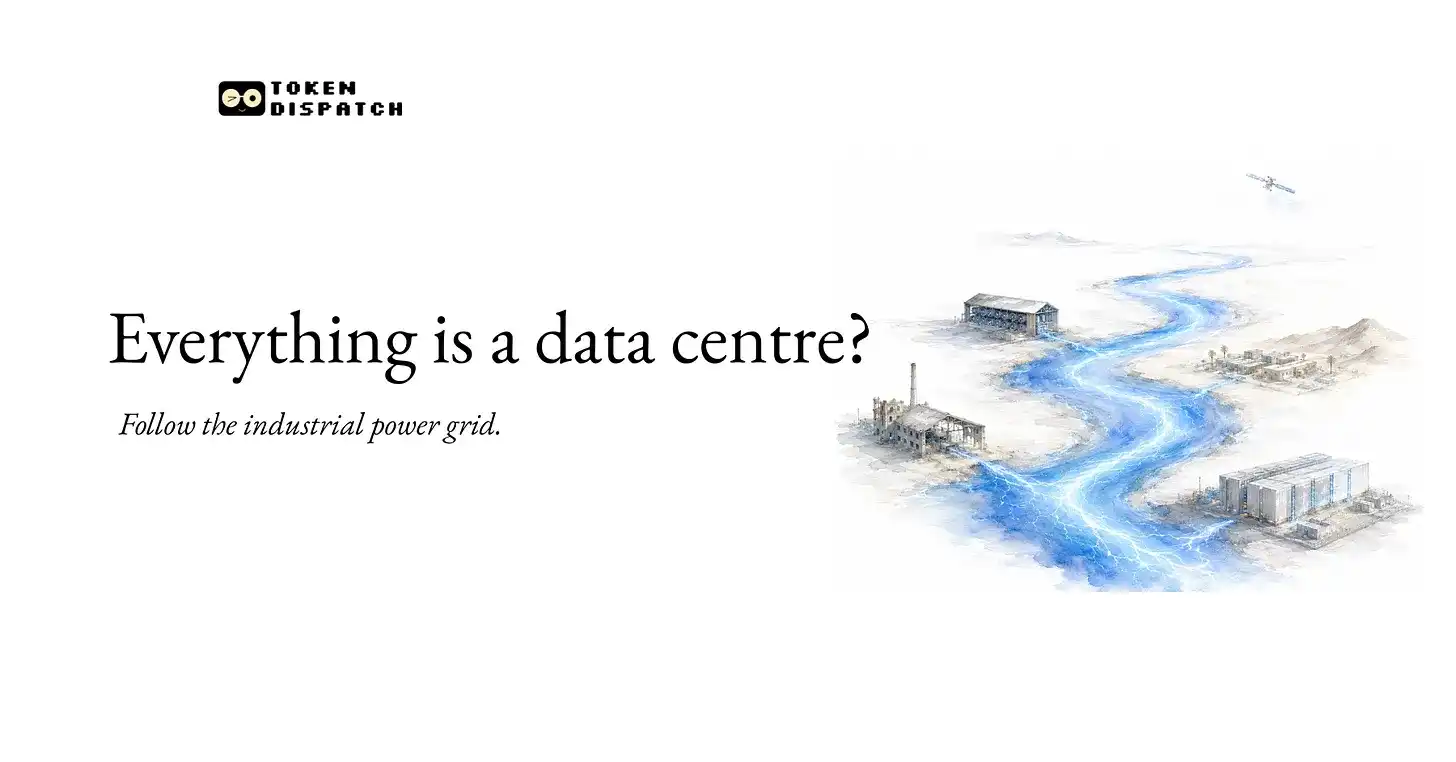
A History of Technological Evolution Powered by Electricity: Aluminum, Bitcoin, and AI

The journey from the Rockdale aluminum smelter in Texas to space-based data centers illustrates a core economic principle: whoever controls the cheapest electricity dictates the use of computing power. The evolution is clear. Old industrial sites with pre-existing, high-capacity power grids are being repurposed. In Rockdale, a former Alcoa plant now houses vast Bitcoin mining rigs, which are increasingly being replaced by AMD chips for AI training. The logic is purely financial: while smelting aluminum yields $0.17–0.27 per kWh and Bitcoin mining $0.05–0.11, AI inference on H100 GPUs generates $1.27–3.67 per kWh. Recent deals confirm the rush for power infrastructure. Riot Platforms leases space to AMD; TeraWulf bought an old Kentucky aluminum plant for its grid; NYDIG secured a New York site for its cheap hydropower to mine Bitcoin. As AI giants like Anthropic, Microsoft, Google, and Amazon aggressively expand, they now directly compete with crypto miners for the same industrial power resources, often outbidding them. This has led to a decline in Bitcoin's global hash rate and a wave of miner conversions to AI data centers. This "digital resource curse" extends globally. Gulf nations, long offering subsidized power to attract heavy industry like aluminum, are now pivoting to become AI and cloud computing hubs—exporting computational power instead of physical commodities. Similarly, Bhutan halted its sovereign Bitcoin mining to sell hydropower directly to India for a steadier return. The frontier is space. Projects like Starcloud plan orbital solar-powered data centers, leveraging constant sunlight and natural cooling, with Bitcoin mining as a secondary use for surplus power. Even consumer brands are transforming; Allbirds shifted from footwear to AI infrastructure, causing its stock to surge. Meanwhile, crypto projects like Bittensor, Render, and Akash propose a decentralized alternative, creating markets to aggregate distributed, idle computing resources from individual hardware. The underlying infrastructure—the power grid—remains constant. As profit margins shift, the facilities built upon it will continue to evolve, from aluminum to Bitcoin to AI and beyond, always chasing the highest yield per kilowatt-hour, whether in Texas, Abu Dhabi, or low Earth orbit.

marsbit11m ago

A History of Technological Evolution Powered by Electricity: Aluminum, Bitcoin, and AI

marsbit11m ago

Conquering is easy, governing is hard: Polymarket must bow to regulations to plant its flag globally

Polymarket, a decentralized prediction market platform, faces significant regulatory hurdles in its global expansion. Its "permissionless" model, which bypasses traditional identity and financial controls, has led to widespread crackdowns. India recently blocked the site, categorizing it as illegal online gambling under new 2025 laws. Brazil also banned it and similar platforms, though it simultaneously authorized a regulated, investor-only version on its national exchange. Across Europe, countries like France, Portugal, and the Netherlands are enforcing bans based on existing gambling and financial regulations. To enter key markets, Polymarket is adopting a pragmatic, compliant approach. In the U.S., it paid a $1.12 million fine, acquired a CFTC-licensed exchange, and now operates a regulated, KYC-mandatory platform for American users. It also secured a major investment from Intercontinental Exchange (ICE), which will distribute its prediction data to institutional investors. In Japan, where gambling laws are strict, Polymarket has begun a long-term lobbying effort, aiming for legalization by 2030 through building institutional partnerships and community presence. Despite these challenges, the prediction market industry is booming, with global volume projected to surge from $51 billion to potentially $1 trillion by 2030. Polymarket's core dilemma remains: adapting its decentralized, anonymous model to fit within sovereign regulatory frameworks focused on licensing, consumer protection, and anti-money laundering rules. Its survival in each market depends on navigating this complex political and legal landscape.

marsbit13m ago

Conquering is easy, governing is hard: Polymarket must bow to regulations to plant its flag globally

marsbit13m ago

It's Easier to Conquer than to Govern: Polymarket Must Bend to Every Rule to Plant Its Flag Globally

Polymarket, a decentralized prediction market platform, is facing significant regulatory hurdles as it expands globally, illustrating the tension between permissionless, crypto-native platforms and national legal frameworks. The platform, which allows users to bet on event outcomes, was recently blocked in India under new online gambling laws and faces similar outright bans in Brazil and Ukraine, the latter citing moral objections to wagering on active war events. In Europe, countries like France, the Netherlands, and the UK are restricting access by enforcing existing gambling and financial derivatives regulations, forcing Polymarket to geo-block users or operate in view-only modes. To navigate this complex landscape, Polymarket is adopting a market-by-market, compliant strategy. In the U.S., it paid a $1.4 million CFTC fine, acquired a licensed exchange (QCEX) for $112 million, and now operates a regulated U.S. entity with strict KYC, abandoning anonymity. It also secured a major investment from Intercontinental Exchange (ICE), which will distribute its prediction data to institutional investors. In Japan, a high-potential market, it has begun a long-term lobbying effort aiming for legalization by 2030, acknowledging the country's strict anti-gambling laws and slow regulatory processes. The article concludes that while the global prediction market is growing rapidly—projected to reach $2.4 trillion by 2030—Polymarket's core challenge is transforming its decentralized model to fit sovereign regulatory systems built on licensing, consumer protection, and anti-money laundering rules. Its survival depends on proving its legitimacy in each jurisdiction.

链捕手18m ago

It's Easier to Conquer than to Govern: Polymarket Must Bend to Every Rule to Plant Its Flag Globally

链捕手18m ago

Trading

Spot
Futures

Hot Articles

What is $BITCOIN

DIGITAL GOLD ($BITCOIN): A Comprehensive Analysis Introduction to DIGITAL GOLD ($BITCOIN) DIGITAL GOLD ($BITCOIN) is a blockchain-based project operating on the Solana network, which aims to combine the characteristics of traditional precious metals with the innovation of decentralized technologies. While it shares a name with Bitcoin, often referred to as “digital gold” due to its perception as a store of value, DIGITAL GOLD is a separate token designed to create a unique ecosystem within the Web3 landscape. Its goal is to position itself as a viable alternative digital asset, although specifics regarding its applications and functionalities are still developing. What is DIGITAL GOLD ($BITCOIN)? DIGITAL GOLD ($BITCOIN) is a cryptocurrency token explicitly designed for use on the Solana blockchain. In contrast to Bitcoin, which provides a widely recognized value storage role, this token appears to focus on broader applications and characteristics. Notable aspects include: Blockchain Infrastructure: The token is built on the Solana blockchain, known for its capacity to handle high-speed and low-cost transactions. Supply Dynamics: DIGITAL GOLD has a maximum supply capped at 100 quadrillion tokens (100P $BITCOIN), although details regarding its circulating supply are currently undisclosed. Utility: While precise functionalities are not explicitly outlined, there are indications that the token could be utilized for various applications, potentially involving decentralized applications (dApps) or asset tokenization strategies. Who is the Creator of DIGITAL GOLD ($BITCOIN)? At present, the identity of the creators and development team behind DIGITAL GOLD ($BITCOIN) remains unknown. This situation is typical among many innovative projects within the blockchain space, particularly those aligning with decentralized finance and meme coin phenomena. While such anonymity may foster a community-driven culture, it intensifies concerns about governance and accountability. Who are the Investors of DIGITAL GOLD ($BITCOIN)? The available information indicates that DIGITAL GOLD ($BITCOIN) does not have any known institutional backers or prominent venture capital investments. The project seems to operate on a peer-to-peer model focused on community support and adoption rather than traditional funding routes. Its activity and liquidity are primarily situated on decentralized exchanges (DEXs), such as PumpSwap, rather than established centralized trading platforms, further highlighting its grassroots approach. How DIGITAL GOLD ($BITCOIN) Works The operational mechanics of DIGITAL GOLD ($BITCOIN) can be elaborated on based on its blockchain design and network attributes: Consensus Mechanism: By leveraging Solana’s unique proof-of-history (PoH) combined with a proof-of-stake (PoS) model, the project ensures efficient transaction validation contributing to the network's high performance. Tokenomics: While specific deflationary mechanisms have not been extensively detailed, the vast maximum token supply implies that it may cater to microtransactions or niche use cases that are still to be defined. Interoperability: There exists the potential for integration with Solana’s broader ecosystem, including various decentralized finance (DeFi) platforms. However, the details regarding specific integrations remain unspecified. Timeline of Key Events Here is a timeline that highlights significant milestones concerning DIGITAL GOLD ($BITCOIN): 2023: The initial deployment of the token occurs on the Solana blockchain, marked by its contract address. 2024: DIGITAL GOLD gains visibility as it becomes available for trading on decentralized exchanges like PumpSwap, allowing users to trade it against SOL. 2025: The project witnesses sporadic trading activity and potential interest in community-led engagements, although no noteworthy partnerships or technical advancements have been documented as of yet. Critical Analysis Strengths Scalability: The underlying Solana infrastructure supports high transaction volumes, which could enhance the utility of $BITCOIN in various transaction scenarios. Accessibility: The potential low trading price per token could attract retail investors, facilitating wider participation due to fractional ownership opportunities. Risks Lack of Transparency: The absence of publicly known backers, developers, or an audit process may yield skepticism regarding the project's sustainability and trustworthiness. Market Volatility: The trading activity is heavily reliant on speculative behavior, which can result in significant price volatility and uncertainty for investors. Conclusion DIGITAL GOLD ($BITCOIN) emerges as an intriguing yet ambiguous project within the rapidly evolving Solana ecosystem. While it attempts to leverage the “digital gold” narrative, its departure from Bitcoin's established role as a store of value underscores the need for a clearer differentiation of its intended utility and governance structure. Future acceptance and adoption will likely depend on addressing the current opacity and defining its operational and economic strategies more explicitly. Note: This report encompasses synthesised information available as of October 2023, and developments may have transpired beyond the research period.

363 Total ViewsPublished 2025.05.13Updated 2025.05.13

What is $BITCOIN

Discussions

Welcome to the HTX Community. Here, you can stay informed about the latest platform developments and gain access to professional market insights. Users' opinions on the price of BTC (BTC) are presented below.

活动图片