Visa возвращается в Россию? Неожиданная заявка на регистрацию товарных знаков

cryptonews.ruPublished on 2022-12-14Last updated on 2024-09-14

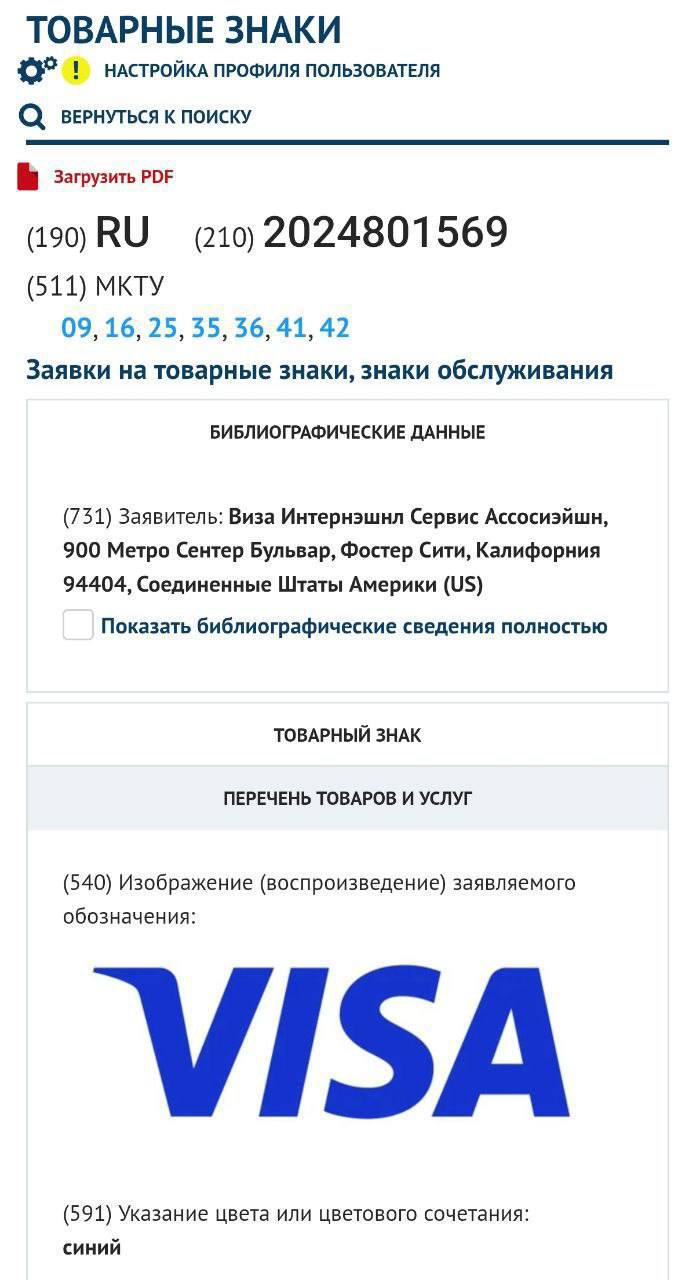
Компания Visa International Service Association сделала неожиданный шаг, подав заявку в Роспатент на регистрацию двух товарных знаков VISA в России. Это событие вызвало волну обсуждений о возможном возвращении платежного гиганта на российский рынок.

Согласно документации, полученной Агентством городских новостей «Москва», заявка охватывает широкий спектр финансовых услуг, включая банковские операции, управление финансами, обмен валют и даже операции с криптоактивами. Особый интерес вызывают пункты, связанные с технологией блокчейн и электронным переводом криптовалют.

Детали заявки

Visa подала заявку на регистрацию двух вариантов своего логотипа:

  • Классический синий логотип VISA
  • Надпись VISA, обрамленная желтой и синей полосами

Заявка охватывает множество классов международной классификации товаров и услуг (МКТУ), включая:

  • Банковские услуги
  • Финансовый менеджмент
  • Обмен денег и криптоактивов
  • Дистанционное банковское обслуживание
  • Обслуживание дебетовых и кредитных карт
  • Электронные денежные переводы, в том числе с использованием блокчейна
  • Администрирование программ лояльности
  • Предоставление кредитов и ипотечных ссуд
  • Страховые услуги

Возможные последствия

Этот шаг Visa вызывает множество вопросов о будущем компании на российском рынке. После начала украинского кризиса в феврале 2022 года Visa, как и многие другие западные компании, приостановила свою деятельность в России. Текущая заявка может сигнализировать о намерении компании вернуться на российский рынок, хотя официальных заявлений по этому поводу пока не было.

Интересно, что заявка Visa включает услуги, связанные с криптовалютами и блокчейном. Это может указывать на стратегическое направление развития компании, которое совпадает с глобальными трендами в финансовом секторе.

Ситуация остается неопределенной, и многое будет зависеть от геополитической обстановки и решений регулирующих органов. Рынок и потребители с интересом следят за развитием событий, ожидая официальных комментариев от Visa и российских финансовых регуляторов.
Related Reads

Bitcoin at 59,000 Is Not the Bottom, One Last Drop Needed! Chain Data and Liquidity Analysis: Where is BTC's True Bottom?

Based on analysis by trader Mr. Beggar, Bitcoin's (BTC) recent low of $59k is likely not the final cycle bottom. He argues that while a bottom is near, a final downward movement is still probable to target liquidity below that level, making a deeper low healthier for a sustainable reversal. Mr. Beggar's framework combines on-chain data for long-term cycles and liquidity-based technical analysis for shorter-term trades. His "four deep bear buying models" include Cointime Price (market cost weighted by coin holding time) and AVIV (an enhanced MVRV indicator), which currently suggest prices are nearing cyclical bottom zones. While a PSIP (Percent Supply in Profit) signal has flashed below 50%, it alone is not considered definitive; typically, the first signal is not the final bottom. He presents three potential scenarios for the current market: 1) a direct drop from here, 2) an upward liquidity sweep (stop hunt) of the recent high near $67.3k before declining, and 3) a direct reversal without new lows. He heavily discounts the third scenario due to significant un-swept liquidity in the $59k-$62.3k range, suggesting the market must revisit these levels. Mr. Beggar shares that he used on-chain signals to identify potential cycle tops in late 2024/early 2025 and later established low-leverage BTC-denominated short positions. He emphasizes the importance of risk management and staying within one's expertise ("strike zone"), warning against investing in assets like AI/semiconductor stocks simply because they are rising.

marsbit6m ago

Bitcoin at 59,000 Is Not the Bottom, One Last Drop Needed! Chain Data and Liquidity Analysis: Where is BTC's True Bottom?

marsbit6m ago

From Signal Monitoring to Strategy Copy Trading: How PPP Lowers the Barrier to Trading on Polymarket?

From Signal Monitoring to Strategy Copy Trading: How PPP Lowers the Barrier to Polymarket Trading The surge in trading demand on prediction markets like Polymarket, especially during events like the World Cup, exposes a common challenge for novice users: emotional and impulsive trading due to a lack of stable strategies and reliable signals. Prediction Position Platform (PPP) addresses this by serving as a Telegram-based tool for strategy discovery and automated copy-trading on Polymarket. PPP offers a suite of features through a subscription model. Key functionalities include 24/7 market signal monitoring (tracking smart money movements and rapid probability shifts), an "AI Address Analysis" tool to evaluate trader performance metrics, and specialized sections like a "World Cup Zone" for quick access to related markets. Its core value lies in two curated lists: the "Strategy Square," which identifies addresses suitable for long-term tracking based on comprehensive metrics like returns, win rate, and drawdowns, and the "Trading Leaderboard," highlighting recently outperforming addresses for short-term opportunities. Users can manually analyze any address or set up automated copy-trading with customizable parameters like investment amount and stop-loss. After initiating copy-trades, users can manage all positions from a unified dashboard, adjusting parameters or stopping follows as needed, and review historical performance data. Crucially, PPP employs a non-custodial wallet model, meaning user funds remain in their own self-custodied wallets, enhancing security and trust. In summary, PPP aims to reduce the learning curve and trial-and-error cost for Polymarket users by aggregating signals, curating and analyzing profitable traders, and facilitating automated, yet manageable, copy-trading execution.

Odaily星球日报6m ago

From Signal Monitoring to Strategy Copy Trading: How PPP Lowers the Barrier to Trading on Polymarket?

Odaily星球日报6m ago

From the White-Haired Stock God to the Billion-Dollar Fund Titan: The Smart People Shorting NVIDIA Are Getting Rich Using the Same Framework

From "white-haired stock god" to billionaire fund manager, those profiting from shorting NVIDIA share a common framework. The article analyzes the critical bottlenecks in the AI hardware supply chain, which have become key investment focal points. The core argument is that the real constraint on the AI boom isn't software or algorithms, but fundamental physical infrastructure. The piece dissects nine major bottlenecks, organized around the lifecycle of an AI accelerator circuit board. *Before the Board*: The pre-manufacturing stage faces constraints in EDA tools, new materials (like GaN, SiC, InP) replacing silicon, and the critical, non-renewable supply of helium for semiconductor fabrication. *On the Board*: The primary bottlenecks are High-Bandwidth Memory (HBM), essential for unleashing GPU power, and advanced packaging (e.g., CoWoS), required to integrate components. Both are in severe shortage. *Between Boards*: Chip-to-chip communication is hitting limits with copper, pushing photonics and optical interconnects (CPO) as the next-gen solution, with NVIDIA heavily investing in this area. *Around the Board*: Power delivery requires new materials (GaN/SiC) for efficient voltage conversion from 48V to sub-1V. High-density AI racks (120kW+) are forcing a shift from air to liquid cooling as the standard. *Beyond the Board*: The ultimate bottleneck is electricity. AI data centers consume power equivalent to mid-sized cities, and grid expansion lags far behind demand, causing project delays and a scramble for power contracts. Prominent investors like Leopold and "white-haired stock god" are heavily betting on these infrastructure bottlenecks. Leopold's fund, for instance, holds no NVIDIA stock but uses massive put options to short the semiconductor sector while going long on power and physical infrastructure. His thesis is that while chip competition may eventually erode margins, the scarcity of foundational elements like electricity is more persistent. The framework's validity is tied to the supply-demand gap. Major new capacity in HBM and photonics is scheduled for 2027-2028, but demand continues to outpace it. Experts like Intel's CEO suggest no relief before 2028. However, the article warns of a potential reversal around 2028-2029 if AI capex slows and new capacity floods the market, turning scarcity into oversupply. Until then, the imbalance persists.

链捕手38m ago

From the White-Haired Stock God to the Billion-Dollar Fund Titan: The Smart People Shorting NVIDIA Are Getting Rich Using the Same Framework

链捕手38m ago

Trading

Spot
Futures
活动图片