比特币周期的终结?当前周期与历史表现大不同

marsbitPublished on 2024-09-13Last updated on 2024-09-14

本文将复盘2011-2024年比特币4个周期,深入探讨当前周期的市场变化。

比特币周期理论,尤其是与比特币减半事件的关联,一直以来被视为预测比特币价格走势的重要工具。历史上比特币减半通常会导致价格上涨,但当前市场表现及其背后的因素表明,这一理论的有效性可能正在减弱。

本文将复盘2011-2024年比特币4个周期,深入探讨当前周期的市场变化。
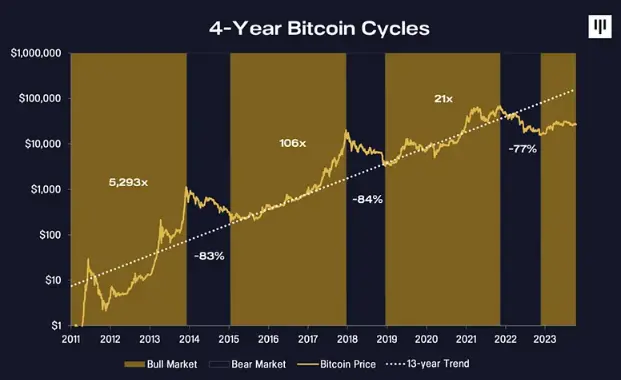
周期

01.比特币周期理论的基础

比特币每210,000个区块的挖矿奖励会减半,约每四年发生一次。这一机制旨在控制比特币的供应量,从而增加其稀缺性。历史上,减半事件通常伴随着比特币价格的显著上涨,形成周期。例如:

2012年减半:比特币价格从大约12美元飙升至2013年底的超过1000美元。

2016年减半:比特币价格在减半后不久上涨至近3000美元,并在2017年底达到近20000美元的历史高点。

2020年减半:比特币价格在2020年5月的减半后,迅速上涨至2021年的历史新高。

2012年、2016年和2020年的减半事件后,比特币价格均经历了显著上涨,形成了明显的牛市周期。这些历史数据使得比特币周期理论获得了广泛的认可和信任。

本轮周期在2024年4月20日完成第四次比特币减半,然后减半后的表现却不如预期。

02.减半后价格数据

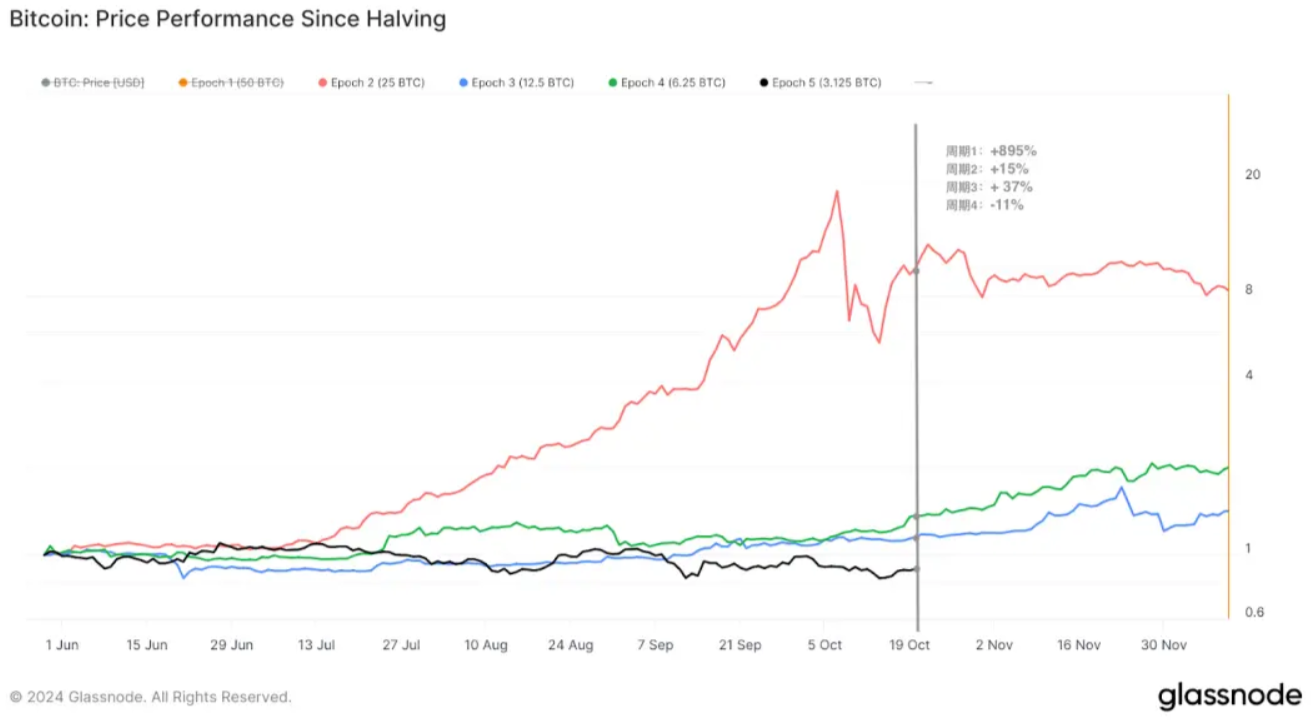
如果我们把历史上比特币减半的日期拉到坐标轴同一起点,并把之后的价格与减半当天币价进行对比,可以发现当前周期的表现是最差的。

尽管在4月减半事件之前,市场首次突破了新的周期性历史高点,但这并未改变当前周期相对低迷的表现。
周期

来源:Glassnode

以下是每轮周期减半后144天左右价格涨跌情况(与减半当天价格对比):

  • 周期1:+895%
  • 周期2:+15%
  • 周期3:+ 37%
  • 周期4:-11%

当前周期减半后比以往呈现更弱的价格反应,比特币的价格表现不佳。这究竟是为什么?本轮周期与此前有何不同?

03.趋于稳定的比特币

2023-2024年的比特币周期在某些方面与以往周期相似,但也存在明显的不同。

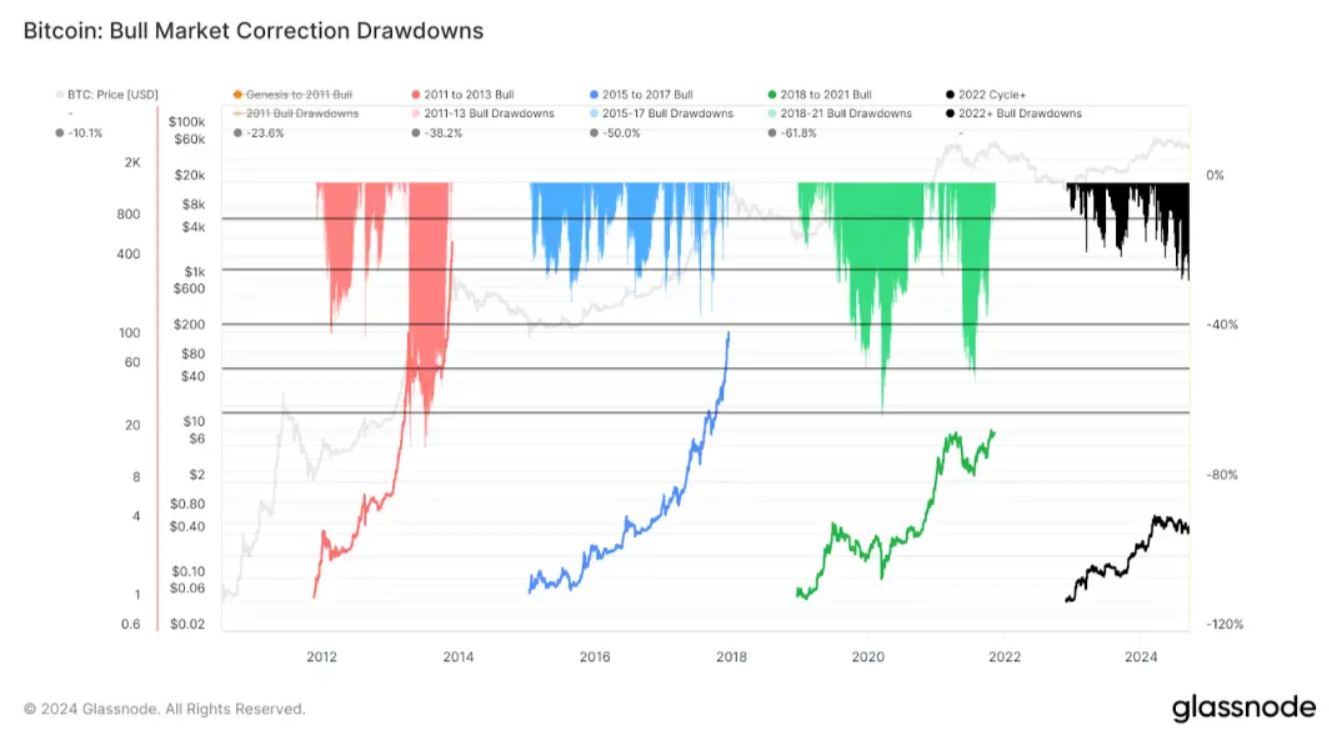
在2022年底FTX崩溃后,市场经历了约18个月的价格稳定上涨。伴随比特币ETF通过,新资金不断涌入,在达到73,000美元的高点后,市场进入了为期三个月的区间震荡。

在这期间,从5月到7月,比特币价格经历了最深的周期性修正,回调幅度超过了26%。尽管这一下跌幅度显著,但与以往周期相比,这次的下跌明显较浅,波动性也有所减弱,反映出比特币市场结构相对稳定,作为金融资产比之前更成熟。
周期

来源:Glassnode

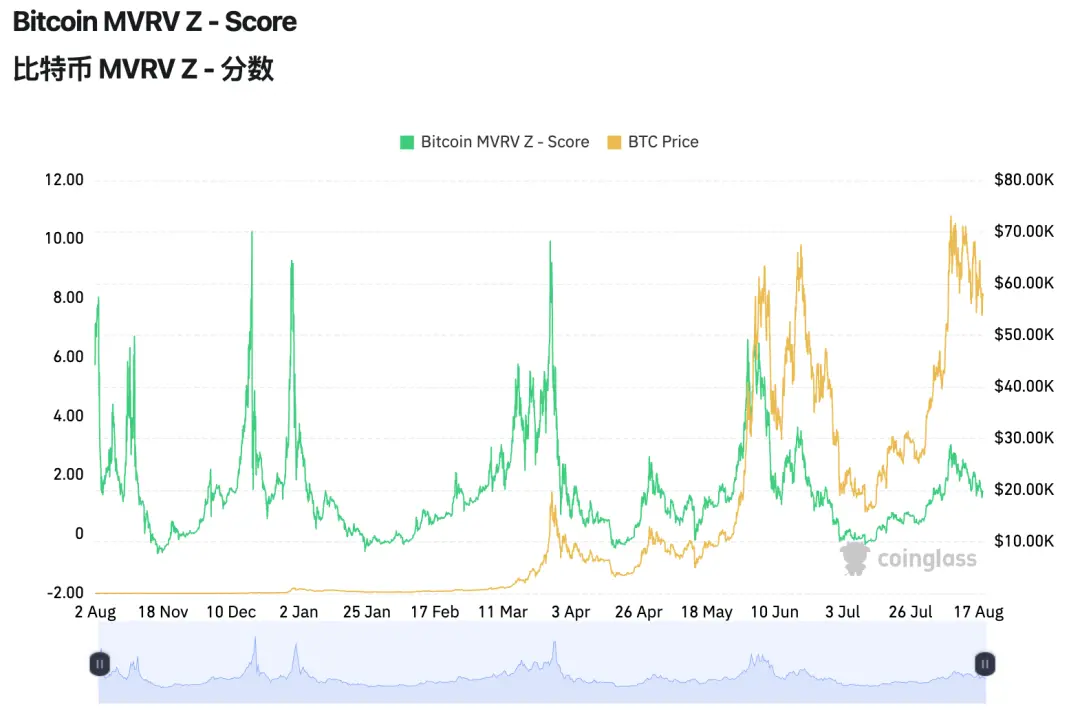
我们来看一下另一个技术指标 MVRV Z-score,同样也可以看出不同周期比特币市场表现的差异。

首先,MVRV-Z分数是一个相对指标,计算公式为:(流通市值-已实现市值)/标准差(流通市值)。当该指标过高时,表示比特币的市场价值相对于其真实价值被高估,这对价格可能不利。反之,如果该指标较低,则意味着比特币的市场价值被低估。
周期

来源:Coinglass

从上图2010年-2024年数据中我们可以看出,相比之前周期,MVRV-Z分数(绿色线)波动、峰值和回报相对温和,并不像早期那般幅度大。

比特币开始趋于一种稳定的、逐步上升的走势,而不是以往那种剧烈的价格飙升,这种渐进式的增长模式在长期来看更具吸引力。

04.波动性减弱的原因

我们可以用一个数据指标直观解释,为什么比特币波动性减弱,趋于稳定。

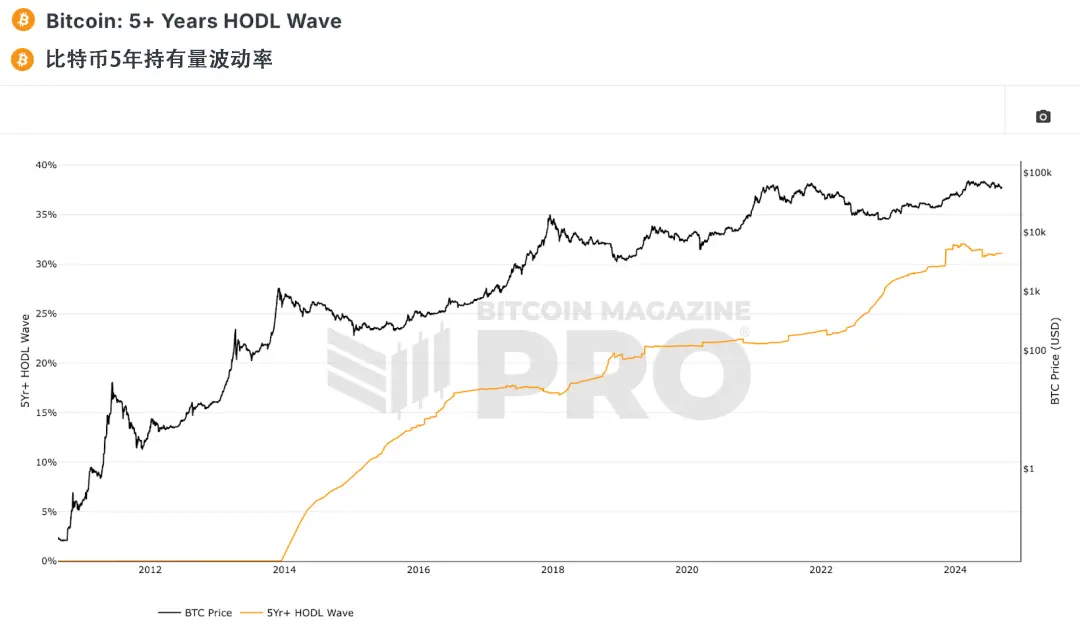
比特币 5+ Years HODL Wave 指标,显示了至少 5 年没有在链上移动的比特币百分比,有时也称为 5 年前最后活跃的比特币供应量。某种程度上,反映了市场中长期参与者的行为。

当然,也有可能这些比特币的一部分已经丢失,即用户不再能够访问包含比特币的钱包的私钥,不过这种比例较小。
周期

从图中可以看出,目前超过30%的比特币在过去五年内没有被转手,这一比例可能还会继续上升。

该现象导致市场上流通的比特币数量减少,其影响已超过减半事件带来的供应增量的减少。

这意味着,长期持有比特币的趋势正在显著上升,使得市场能够更好地抵御短期波动,同时也可能会削弱比特币的周期性波动,这是促成比特币波动性减弱的原因之一。

其他因素还可以归结于:比如,随着市场的成熟,越来越多的投资者选择长期持有比特币,减少了流通供应,降低了价格的剧烈波动。

此外,比特币的供需关系也在发生变化,资金的持续流入为价格提供了支撑。

再者,全球经济的不确定性、政策变化以及市场情绪等因素都会对比特币的价格产生影响。

在这种情况下,比特币的价格可能会与传统金融市场的走势更加相关,从而降低其独立波动性。

这些原因共同作用,使得比特币价格的波动性在当前周期中呈现出相对温和的特点。

05.总结

与历史周期相比,目前周期的价格回调幅度较小,市场结构相对稳健,比特币价格波动性减弱。

因此,在进行比特币交易时,单靠市场周期的分析是不够的。一方面,历史数据无法预测未来的走势。另一方面,加密市场也会逐渐走向市场规范化,迎来流动性增强和更大规模应用,这是金融发展的自然结果。

Related Reads

Huawei's "Tao Law": A Comprehensive Overview of Core Companies

Huawei's "Tau Law": Core Companies Overview On May 25, 2026, Huawei's Director and President of the Semiconductor Business Division, He Tingbo, formally introduced the "Tau (τ) Law" at ISCAS 2026, marking a significant principle guiding industry development in the global semiconductor field from China. The Tau Law shifts focus from traditional Moore's Law, which pursues geometric transistor scaling, to "time scaling"—continuously compressing signal propagation delay (time constant τ) without solely relying on extreme feature size reduction. The core implementation path is "logic folding." This technique transforms circuit layouts from two-dimensional planes to multi-layer 3D stacks, using short vertical interconnects to replace long horizontal wiring, thereby drastically reducing τ. Huawei has already designed and mass-produced 381 chips following this principle over the past six years, with plans to launch a Kirin chip utilizing logic folding in Fall 2026. By 2031, high-end chips based on the Tau Law are expected to achieve performance levels equivalent to a 1.4nm process node. This development impacts several key industry segments, with related Chinese companies poised to benefit: 1. **EDA Design Software**: Essential for circuit-level optimization. Key players include: * **Empyrean Technology** (Huada Jiutian): China's largest full-flow EDA provider. * **Primarius Technologies** (Gailun Dianzi): Specializes in device modeling and verification. * **Semitronix** (Guangliwei): Focuses on yield enhancement and test chip EDA. 2. **Chiplet & Advanced Packaging**: Logic folding's 3D stacking necessitates advanced packaging (e.g., TSV, hybrid bonding). Core participants are: * **Tongfu Microelectronics**: A leader in advanced packaging and a key partner for AMD's Chiplet products. * **JCET Group** (Changdian Keji) & **Tianshui Huatian Technology**: Major OSATs with advanced packaging capabilities. * **VeriSilicon** (Xinyuan Gufen): Provides Chiplet-based design platforms and IP. 3. **Foundry Manufacturing**: Optimization must be implemented in transistor structures and process parameters. Potential foundries for Huawei's future chips include: * **SMIC**: China's leading foundry with advanced FinFET capabilities, the most likely candidate for next-gen Kirin chips. * **Hua Hong Semiconductor** (Huahong Gongsi): A leader in specialty processes (power, embedded memory). * **Nexchip Semiconductor** (Jinghe Jicheng): Major foundry for display driver ICs and MCUs. The Tau Law represents a strategic move towards architectural innovation and design-process co-optimization, driving demand across the domestic semiconductor supply chain.

marsbit37m ago

Huawei's "Tao Law": A Comprehensive Overview of Core Companies

marsbit37m ago

TechFlow Intelligence Report: Huawei Unveils "Tao" Law, Semiconductor Sector Surges; Meta Cuts 10% of Workforce

"TechFlow Intelligence Brief": Huawei's new "Tau Law" in semiconductors and Meta's 10% layoffs headline today's tech landscape. In AI, breakthroughs include an AI solving 9 high-difficulty pure math problems for just a few hundred dollars each, and DeepSeek's new Reasonix programming agent challenging commercial models. However, research highlights a "constraint decay" issue in LLM-generated backend code. Open-source model Qwen 3.6 27B achieves high speeds on older GPUs, sparking debate on NVIDIA's future dominance. In Crypto/Web3, Ethereum Foundation plans to downsize, possibly reducing ETH selling pressure. Fake news about CZ ignited a meme coin frenzy, showing the market's sensitivity to celebrity narratives. DeFi sees a new trend in HELOC-backed Real World Asset (RWA) pools. The chip sector is stirred by Huawei's proposed "Tau (τ) Law," aiming for 1.4nm-equivalent performance by 2031 through architectural innovation, causing related stocks to surge. A report notes memory now constitutes nearly two-thirds of AI chip cost. Meanwhile, executives at 7 Chinese semiconductor firms sold shares after price peaks. Meta announces 10% layoffs as it pivots to AI. Google's CEO faced student protests over AI ethics during a speech, and the company controversially published a Chromium exploit before patching was complete. Xiaomi permanently banned installers for AC installation fraud. In US stocks, AMD is seen as a potential challenger to NVIDIA, while a survey reveals 99% of CEOs expect AI-driven layoffs within two years. Palantir secured a government contract for employee monitoring, raising privacy concerns. Macro developments include a 6% drop in WTI crude oil on hopes for reopened Hormuz Strait, and silver prices rising over 4%. Global oil inventories are nearing critical lows. New trends highlight a "audio prompt injection" attack targeting AI voice assistants via hidden commands, and CBS pausing takedowns of pirated Stephen Colbert episodes after public pushback. The underlying narrative connects AI's cost-effective problem-solving, widespread planned job displacement, and Huawei's challenge to Western tech hegemony, framing the AI and chip race as a broader contest over employment, geopolitics, and the very definition of intelligence.

marsbit1h ago

TechFlow Intelligence Report: Huawei Unveils "Tao" Law, Semiconductor Sector Surges; Meta Cuts 10% of Workforce

marsbit1h ago

Trading

Spot
Futures

Hot Articles

What is $BITCOIN

DIGITAL GOLD ($BITCOIN): A Comprehensive Analysis Introduction to DIGITAL GOLD ($BITCOIN) DIGITAL GOLD ($BITCOIN) is a blockchain-based project operating on the Solana network, which aims to combine the characteristics of traditional precious metals with the innovation of decentralized technologies. While it shares a name with Bitcoin, often referred to as “digital gold” due to its perception as a store of value, DIGITAL GOLD is a separate token designed to create a unique ecosystem within the Web3 landscape. Its goal is to position itself as a viable alternative digital asset, although specifics regarding its applications and functionalities are still developing. What is DIGITAL GOLD ($BITCOIN)? DIGITAL GOLD ($BITCOIN) is a cryptocurrency token explicitly designed for use on the Solana blockchain. In contrast to Bitcoin, which provides a widely recognized value storage role, this token appears to focus on broader applications and characteristics. Notable aspects include: Blockchain Infrastructure: The token is built on the Solana blockchain, known for its capacity to handle high-speed and low-cost transactions. Supply Dynamics: DIGITAL GOLD has a maximum supply capped at 100 quadrillion tokens (100P $BITCOIN), although details regarding its circulating supply are currently undisclosed. Utility: While precise functionalities are not explicitly outlined, there are indications that the token could be utilized for various applications, potentially involving decentralized applications (dApps) or asset tokenization strategies. Who is the Creator of DIGITAL GOLD ($BITCOIN)? At present, the identity of the creators and development team behind DIGITAL GOLD ($BITCOIN) remains unknown. This situation is typical among many innovative projects within the blockchain space, particularly those aligning with decentralized finance and meme coin phenomena. While such anonymity may foster a community-driven culture, it intensifies concerns about governance and accountability. Who are the Investors of DIGITAL GOLD ($BITCOIN)? The available information indicates that DIGITAL GOLD ($BITCOIN) does not have any known institutional backers or prominent venture capital investments. The project seems to operate on a peer-to-peer model focused on community support and adoption rather than traditional funding routes. Its activity and liquidity are primarily situated on decentralized exchanges (DEXs), such as PumpSwap, rather than established centralized trading platforms, further highlighting its grassroots approach. How DIGITAL GOLD ($BITCOIN) Works The operational mechanics of DIGITAL GOLD ($BITCOIN) can be elaborated on based on its blockchain design and network attributes: Consensus Mechanism: By leveraging Solana’s unique proof-of-history (PoH) combined with a proof-of-stake (PoS) model, the project ensures efficient transaction validation contributing to the network's high performance. Tokenomics: While specific deflationary mechanisms have not been extensively detailed, the vast maximum token supply implies that it may cater to microtransactions or niche use cases that are still to be defined. Interoperability: There exists the potential for integration with Solana’s broader ecosystem, including various decentralized finance (DeFi) platforms. However, the details regarding specific integrations remain unspecified. Timeline of Key Events Here is a timeline that highlights significant milestones concerning DIGITAL GOLD ($BITCOIN): 2023: The initial deployment of the token occurs on the Solana blockchain, marked by its contract address. 2024: DIGITAL GOLD gains visibility as it becomes available for trading on decentralized exchanges like PumpSwap, allowing users to trade it against SOL. 2025: The project witnesses sporadic trading activity and potential interest in community-led engagements, although no noteworthy partnerships or technical advancements have been documented as of yet. Critical Analysis Strengths Scalability: The underlying Solana infrastructure supports high transaction volumes, which could enhance the utility of $BITCOIN in various transaction scenarios. Accessibility: The potential low trading price per token could attract retail investors, facilitating wider participation due to fractional ownership opportunities. Risks Lack of Transparency: The absence of publicly known backers, developers, or an audit process may yield skepticism regarding the project's sustainability and trustworthiness. Market Volatility: The trading activity is heavily reliant on speculative behavior, which can result in significant price volatility and uncertainty for investors. Conclusion DIGITAL GOLD ($BITCOIN) emerges as an intriguing yet ambiguous project within the rapidly evolving Solana ecosystem. While it attempts to leverage the “digital gold” narrative, its departure from Bitcoin's established role as a store of value underscores the need for a clearer differentiation of its intended utility and governance structure. Future acceptance and adoption will likely depend on addressing the current opacity and defining its operational and economic strategies more explicitly. Note: This report encompasses synthesised information available as of October 2023, and developments may have transpired beyond the research period.

363 Total ViewsPublished 2025.05.13Updated 2025.05.13

What is $BITCOIN

Discussions

Welcome to the HTX Community. Here, you can stay informed about the latest platform developments and gain access to professional market insights. Users' opinions on the price of BTC (BTC) are presented below.

活动图片